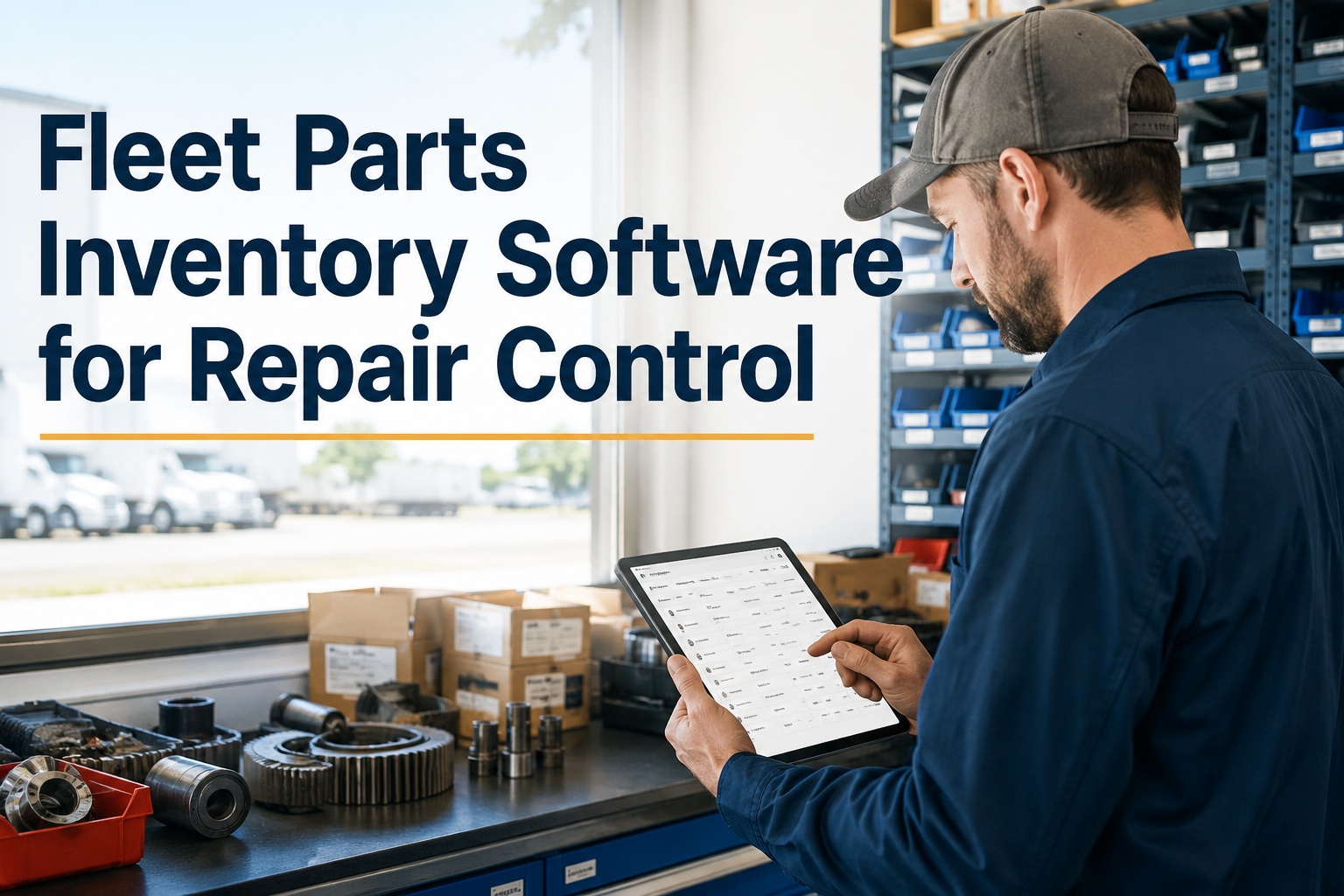
Fleet parts inventory failure is the silent profit killer most fleet managers don't fully account for. The average commercial fleet wastes 19-24% of its annual parts budget on rush orders, duplicate stock, and obsolete inventory sitting in storerooms for 36+ months (per ATA data). A single $40 hydraulic fitting stockout idles a $300K machine at $2,000+ per day until the part arrives — and adds 3-5x emergency shipping premiums, overtime labor for rushed repairs, and cascading schedule disruptions. The total impact of one critical stockout commonly hits $10,000-$20,000. Meanwhile, technicians waste 15-20 minutes per job searching for parts that are theoretically "in stock" but practically lost. Fleets running dedicated parts inventory platforms paired with their inspection and maintenance system report 31% lower carrying costs, 47% fewer stockouts, and parts requisition cycles compressed from days to minutes. This guide covers exactly how fleet parts inventory software for repair control works in 2026, the 8 essential capabilities, how HVI connects inspection-detected defects directly to parts reservation and work order completion, and the typical ROI fleets see in the first year. Start your free HVI trial or book a 30-minute demo to see the integrated workflow live.
Stop losing uptime to parts that should have been on the shelf
HVI connects inspection-detected defects directly to parts reservation, work order generation, and inventory deduction — closing the gap between "we found the problem" and "the truck is back on the road."
What is fleet parts inventory software for repair control?
HVI's fleet parts inventory module is designed as the natural extension of the inspection and maintenance workflow — when a driver flags a defect during pre-trip, the system can auto-reserve the required parts, generate the work order, and ensure the mechanic has everything needed before the truck rolls into the bay. The integration eliminates the "we found the problem yesterday but the parts won't arrive for three days" pattern that defines paper-tracked operations.
Why fleet parts inventory failures cost more than fleets realize
The real cost of parts inventory failure goes far beyond the price of the part itself. Every stockout cascades into emergency shipping premiums, idle equipment costs, overtime labor, and schedule disruption that compounds across the fleet.
Of fleet parts budget wasted on rush orders, duplicate stock, and obsolete inventory each year (ATA data). The largest hidden cost in fleet operations.
Total impact of a single critical stockout including emergency shipping, idle equipment, overtime labor, rental costs, and schedule disruption.
Typical emergency parts order when stock runs out — and it arrives in days, not hours, while the vehicle sits idle.
Cost of a $300K machine idled waiting for a $40 hydraulic fitting that should have been on the shelf. The ratio is the point.
Time technicians waste per job searching for parts that are theoretically in stock but practically lost. Bin-level tracking eliminates this.
Typical age of obsolete inventory sitting in fleet storerooms. Capital tied up in parts the fleet will never use.
The 8 essential capabilities of modern parts inventory software
The 2026 fleet parts inventory platform pairs eight specific capabilities into a single workflow. Missing any one creates the failure modes that produce $10-20K stockouts and 19-24% budget waste.
Real-time bin-level stock tracking
Every part tracked to a specific location: warehouse, aisle, row, bin. Technicians stop wasting 15-20 minutes per job searching. Mobile scan reveals exact bin location instantly. "We have it but I can't find it" disappears as a failure mode.
Min/max thresholds with auto-reorder
Set minimum and maximum stock levels per part. When inventory hits minimum, HVI automatically generates a reorder alert or purchase request. Dynamic reorder points adjust based on actual consumption velocity — not static estimates. Reorder Point formula: (Avg Daily Usage × Lead Time Days) + Safety Stock.
Work order integration with auto-deduction
Parts flow seamlessly into work orders — assign a part to a repair, and inventory updates automatically when the WO completes. Total repair cost calculated instantly. No double-entry, no spreadsheet reconciliation. Every part consumed is traceable to the vehicle and job that used it.
Multi-location stock pooling
Fleet-wide inventory visibility across yards, shops, and job sites. Before ordering new, check whether the part already exists at another location. Transfer parts between sites with digital documentation. Eliminate duplicate stock — the second-largest source of carrying cost.
Barcode/QR scanning & mobile updates
Scan parts in and out via mobile app. Receiving, issuing, and counting all happen at the parts cage — not back at a desk. Technicians update stock counts instantly with minimal human error. Cycle counts complete in a fraction of paper-based time.
PM schedule integration & pre-staging
HVI analyzes the PM schedule and pre-flags parts needed for upcoming services. Oil change coming next week? Filters already flagged for reorder. Brake inspection scheduled? Chambers already pre-staged. Parts ready before the technician is.
Warranty tracking & claim automation
Track warranty expiration dates per part. Get alerts when replaced parts are still under warranty. Generate warranty claim reports with one click instead of digging through file cabinets. Recover thousands annually that fleets typically write off.
Cost-per-vehicle & vendor analytics
Track cost-per-vehicle, cost-per-mile, and spending by part category. Identify which vehicles are eating your parts budget and which vendors deliver the best value. Data-driven decisions on fleet age-out, vendor consolidation, and replacement timing.
How HVI connects inspections, parts, and repair control end-to-end
The unique value of HVI's parts inventory module is the integration with the inspection workflow. The defect-to-repair-to-inventory cycle becomes a single closed loop instead of three disconnected systems.
Driver flags defect during pre-trip inspection
Driver completes pre-trip in HVI app, photographs a worn brake chamber, tags severity. The defect is now structured data — not a paper note that might never reach the shop.
HVI auto-creates work order with required parts
System recognizes the defect type, looks up required parts for this vehicle's make/model/year, and generates the work order with parts list attached. Mechanic sees the job before the truck arrives.
Parts auto-reserved or flagged for order
If parts are in stock, they're reserved against the work order — preventing another job from grabbing them. If stock is low, HVI flags a reorder before the truck arrives. No surprises in the bay.
Mechanic scans parts & completes repair
Mechanic scans each part as it's installed. Inventory deducts in real time. Repair documented with photos for the 3-signature chain. Cost auto-calculated against the vehicle.
Inventory updates & auto-PO if below threshold
Stock count updates instantly. If usage just pushed inventory below the minimum threshold, an auto-PO generates to the preferred supplier. Restock happens before the next driver finds the next defect.
Vehicle returns to service & data feeds analytics
Driver acknowledges repair in next pre-trip (signature 3). Vehicle dispatches. Parts usage feeds the next round of reorder forecasting, cost-per-vehicle analysis, and vendor performance reporting.
What ROI does fleet parts inventory software deliver?
The financial case for fleet parts inventory software is well-documented because the savings come from distinct, measurable categories. Below is the typical annual breakdown for a representative 50-vehicle fleet running HVI's integrated parts + inspection workflow.
Frequently asked questions
QHow do I calculate reorder points for fleet parts?
The standard formula is: Reorder Point = (Average Daily Usage × Lead Time in Days) + Safety Stock. For example, if you use 4 brake chambers per day on average, your supplier's lead time is 5 days, and you want 10 units as safety stock, your reorder point is (4 × 5) + 10 = 30 units. HVI's auto-reorder feature calculates this dynamically per part based on actual fleet consumption patterns — adjusting safety stock recommendations as your usage velocity changes.
QWhat's the real cost of a parts stockout?
Far more than the part itself. A stockout on a $40 hydraulic fitting idles a $300K machine at $2,000+ per day until the part arrives. Add emergency shipping (3-5x standard), overtime labor for rushed repair, rental equipment to cover the gap, and cascading schedule disruptions. A single critical stockout commonly costs $10,000-$20,000 in total impact. Prevention through min/max automation costs a fraction of one stockout event.
QHow does HVI's parts inventory integrate with the inspection workflow?
HVI is built so the inspection workflow and parts inventory are one system. When a driver flags a defect during pre-trip, HVI identifies the required parts for that defect type on that vehicle, auto-creates the work order, and either reserves parts from stock or flags a reorder. The mechanic sees the job, parts, and instructions before the truck arrives. After repair, the mechanic scans each part as installed, inventory updates automatically, and cost is attributed to the vehicle for cost-per-mile analytics.
QCan I track parts across multiple locations?
Yes. HVI supports multi-location stock pooling across yards, shops, and job sites. Before ordering new, the system checks whether the part already exists at another location. Transfers between sites are documented digitally. This eliminates duplicate stock — the second-largest source of carrying cost after obsolete inventory — and gives fleet managers a single inventory view across all facilities.
QHow quickly can I deploy HVI's parts inventory module?
Most fleets are running their first integrated inspection-to-parts workflow within 1-2 weeks of HVI signup. Full deployment — parts catalog imported, suppliers configured, min/max thresholds set, vehicle records linked, and shop team trained — typically completes within 2-4 weeks. First measurable carrying cost reduction appears within 60 days. The 80/20 rule (top 20 failure parts cover 80% of unplanned demand) means quick early wins.
Make every defect, work order, and parts movement one connected workflow.
HVI integrates fleet parts inventory directly with the inspection and maintenance platform — inspection-detected defects auto-reserve parts, work orders generate with parts attached, mechanics scan parts as installed, inventory deducts in real time, and reorder triggers automatically. Most fleets see 31% carrying cost reduction and 47% fewer stockouts within the first quarter.
No credit card required · Live in 2-4 weeks · Integrates with leading parts suppliers