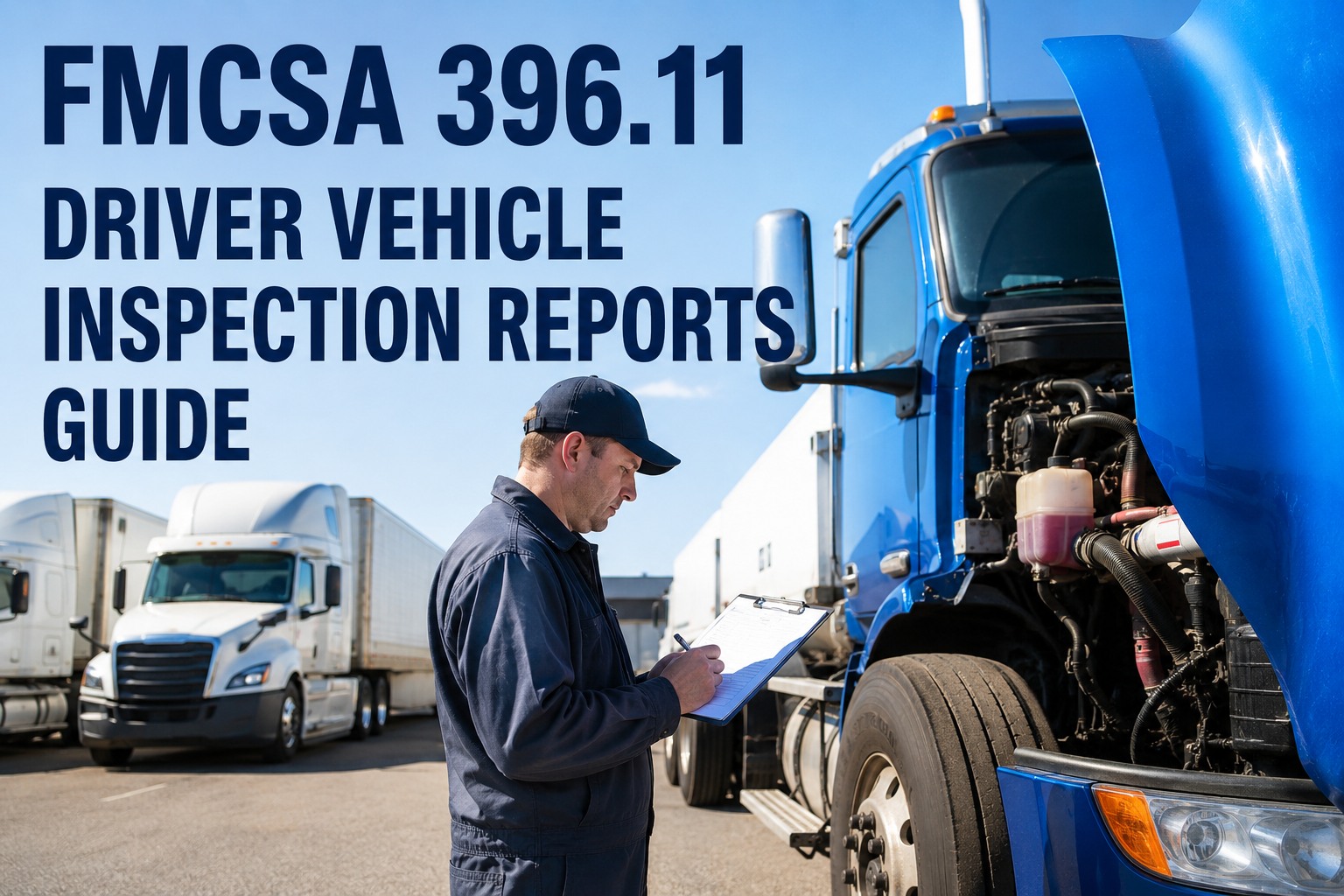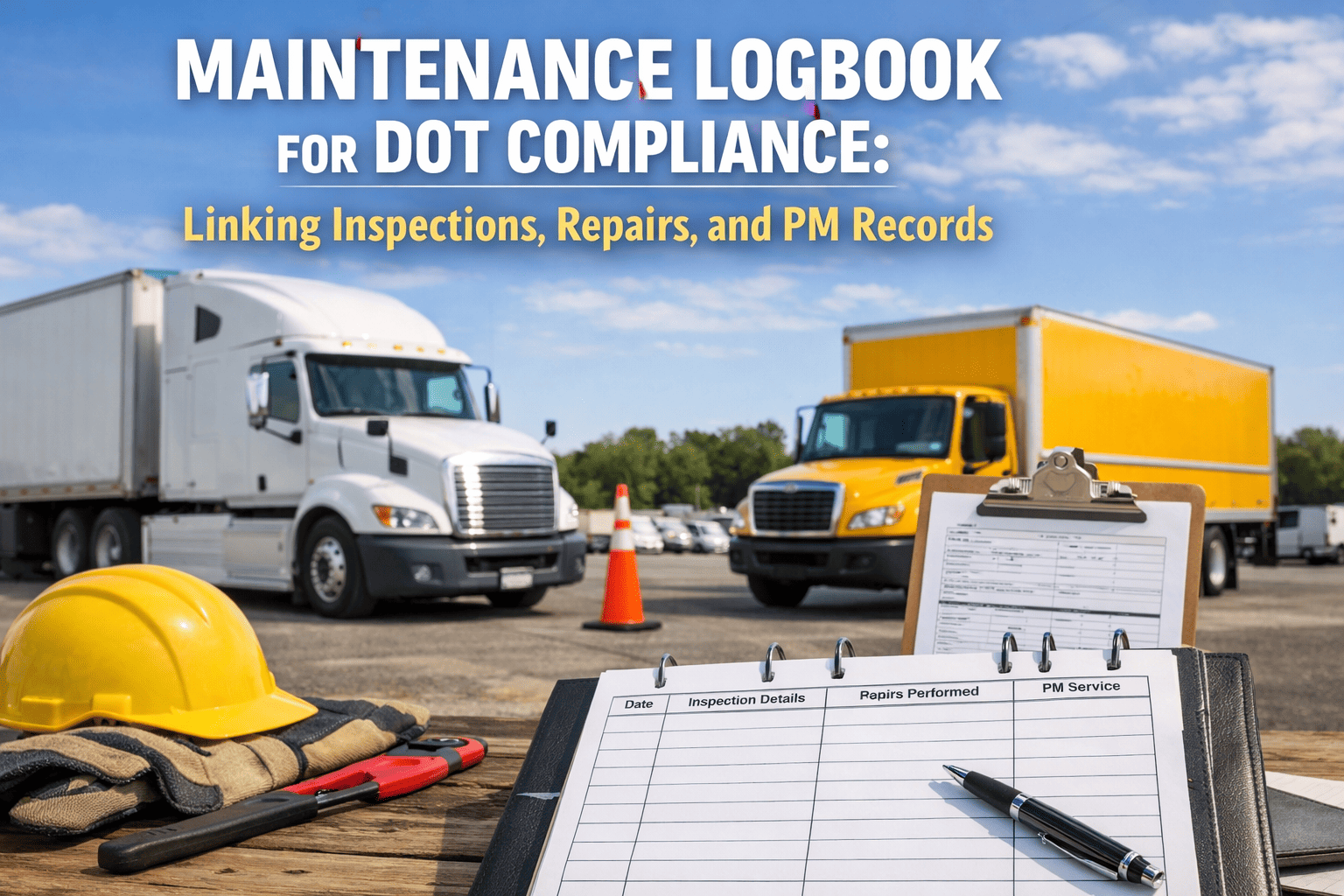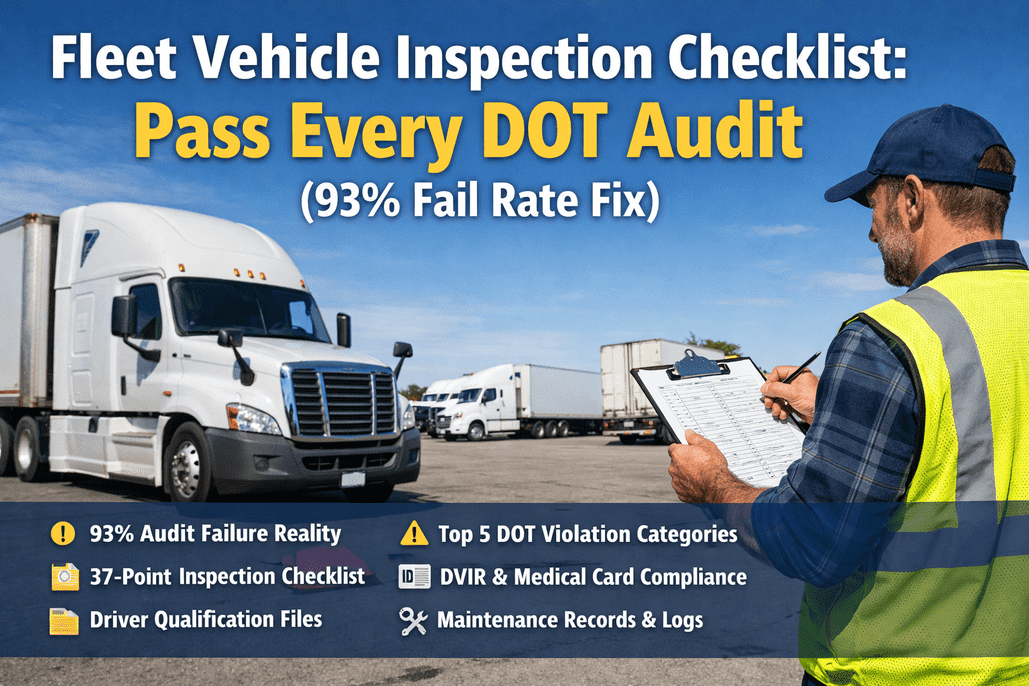
FMCSA compliance isn't won in the shop — it's won in the filing system. A fleet can service every truck flawlessly and still fail an audit because the records weren't kept, weren't complete, or weren't retrievable when the investigator asked. And the rules have teeth: different documents carry different retention clocks, and mixing them up is one of the most common compliance failures there is. A DVIR must be kept three months, an annual inspection report fourteen months, and general maintenance records a year plus six months after the vehicle leaves your control — get the clock wrong on any of them and a clean repair becomes a citation. The pressure has only grown: FMCSA offsite audits now routinely arrive with 48-hour notice to produce records digitally, and an auditor who asks for a week of DVIRs and finds none treats the absence as a violation — there's no presumption the truck simply wasn't run. This guide lays out every retention period, the three-signature DVIR chain auditors actually check, the 2026 electronic-DVIR rule, and how to keep an audit-ready trail from defect to repair. book a 30-minute walkthrough to see it set up for your fleet.
You can maintain every truck perfectly and still fail the audit. The record is the compliance.
HVI captures DVIRs, annual inspections, and maintenance records digitally with the full signature chain, applies the correct retention clock to each, turns defects into certified repairs, and produces any record in seconds — so a 48-hour audit notice is a non-event.
Why recordkeeping is where fleets fail
The maintenance can be perfect and the audit can still go wrong. These are the realities that make documentation — not wrenching — the real compliance battleground.
The single most-cited recordkeeping failure isn't a missing repair — it's an incomplete record. Retaining only the driver's original DVIR without the mechanic's repair certification and the next driver's acknowledgment creates an incomplete chain that auditors cite, even when the truck was actually fixed. The trail has to be whole, not just present.
The four retention clocks
This is the heart of FMCSA recordkeeping. Each document type has its own retention period under Part 396 — and the most common audit failure is applying the wrong one. Keep these straight and most exposure disappears.
The 396.3 maintenance clock is the one fleets miss most: records must be kept one year while the vehicle is under your control, plus six months after it leaves through sale, trade, or end of lease. When in doubt, retain the DVIR alongside its repair record for the longer period. HVI applies the right clock to each document type automatically — nothing ages out early or gets purged too soon.
The three-signature DVIR chain
A DVIR isn't one signature — it's a three-party loop that FMCSA treats as the backbone of vehicle-condition monitoring. Auditors look for a clear trail across all three. Miss a link and the record is incomplete.
Driver reports (396.11)
At the end of the day's work, the driver prepares and signs a written report on each vehicle operated, listing any defect that could affect safe operation or cause a breakdown.
Mechanic certifies
If defects are noted, a qualified person reviews them and certifies that repairs were made — or that the condition doesn't require repair — before the vehicle is dispatched.
Next driver reviews (396.13)
The next driver to operate the vehicle reviews the most recent DVIR and signs it, confirming awareness of any reported conditions before starting the trip.
A no-defect DVIR isn't federally required for property-carrying CMVs — the obligation kicks in when a defect is found — but the moment one is, all three signatures must exist and be retained. sign up free and capture the full signature chain digitally on every DVIR, or book a demo to see the driver-mechanic-driver loop in action.
Electronic DVIRs are now explicitly compliant
Any lingering doubt about going paperless is gone. The rules changed in 2026 to remove all ambiguity — and they did it specifically to encourage fleets to adopt digital, cost-saving methods.
The 2026 final rule
FMCSA published a final rule effective March 23, 2026 that explicitly added electronic-DVIR authorization language to 49 CFR 396.11 and 396.13 — building on electronic permissibility that existed under 390.32 since 2018.
What's now fully compliant
Digital signatures, mobile submission, and cloud storage all satisfy the rules. All three required signatures can be captured digitally with timestamps, and digital records fully meet the retention requirements.
Why it matters for audits
With offsite audits arriving on 48-hour notice to produce records digitally, paper is now the liability. Electronic records are instantly retrievable with the full signature chain intact — exactly what an auditor expects.
FMCSA stated the rule's explicit purpose was to encourage motor carriers to adopt electronic, cost-saving methods. In other words, the regulator is now actively pointing fleets toward digital recordkeeping. HVI's electronic DVIRs capture all three timestamped signatures and satisfy every retention rule.
From defect to audit-ready record
FMCSA investigators expect a clear trail from defect identification to repair certification — and gaps in that trail create exposure. The record has to flow automatically, not depend on someone filing paper.
Driver logs defect
The post-trip DVIR captures the defect digitally with a timestamp and the driver's signature, on a phone or tablet.
Work order opens
The defect auto-creates a work order routed to a mechanic, linking the repair to the originating DVIR.
Repair certified
The mechanic certifies the repair, the next driver acknowledges — the full chain closes with every signature.
Retained & retrievable
The complete record is stored under the correct retention clock and exported in seconds when an audit asks.
A defect identified but missing its repair certification is exactly the gap investigators look for. sign up free and build an unbroken defect-to-repair trail on every truck.
Paper filing vs. HVI
Both technically hold records. Only one keeps the full signature chain intact, applies the right retention clock automatically, and produces any document the instant an auditor asks.
Paper / spreadsheet filing
- Retention clocks mixed up — records purged too early
- DVIRs kept without mechanic or next-driver signatures
- Defects logged but repair certification never filed
- 48-hour audit notice triggers a filing-cabinet scramble
- Missing records treated as outright violations
- No live view of what's complete and what's missing
With HVI software
- Correct retention clock applied to each document type
- Full three-signature DVIR chain captured digitally
- Every defect links to a certified repair, loop closed
- Any record exported in seconds for an audit
- 2026-compliant electronic DVIRs with timestamps
- Fleet-wide view of record completeness at a glance
to produce any record. When DVIRs, annual inspections, and maintenance history are digital, complete, and clock-correct, a 48-hour audit notice stops being a fire drill — every document is retrievable instantly with the full signature chain intact. The result is defensible compliance, no early-purged records, and an unbroken defect-to-repair trail. HVI runs the whole recordkeeping system alongside your fleet maintenance.
Frequently asked questions
How long must FMCSA inspection and maintenance records be kept?
Each document type has its own retention clock under 49 CFR Part 396, and mixing them up is one of the most common compliance failures. DVIRs and their repair certifications (396.11) must be kept three months from the date the report was prepared. Annual periodic inspection reports (396.21) must be kept fourteen months from the inspection date. General maintenance records (396.3) must be kept one year while the vehicle is under the carrier's control, plus an additional six months after it leaves through sale, trade, or end of lease. Copies of roadside inspections (396.9) are kept twelve months. The 396.3 "plus six months after" rule is the one fleets miss most often. HVI's inspection and maintenance software applies the correct retention period to each document type automatically, so nothing is purged early or kept past its required window. sign up free and put every retention clock on autopilot.
What makes a DVIR record complete for an audit?
A complete DVIR record is not just the driver's report — it's a three-signature chain. First, the driver completes and signs the condition report at the end of the day's work, listing any defect that affects safe operation. Second, if defects are noted, a qualified mechanic reviews them and certifies that repairs were made or that the condition doesn't require repair before the vehicle is dispatched. Third, the next driver to operate the vehicle reviews that DVIR and signs it under 396.13, confirming awareness. Retaining only the driver's original report without the mechanic's certification and the next driver's acknowledgment creates an incomplete record that auditors cite — even if the truck was genuinely repaired. The trail must be whole. HVI's inspection and maintenance software captures all three signatures digitally with timestamps so the chain is always complete.
Are electronic DVIRs legally compliant in 2026?
Yes, fully. Electronic DVIRs were already permissible under 49 CFR 390.32 since 2018, and FMCSA published a final rule effective March 23, 2026 that explicitly added electronic-DVIR authorization language to 396.11 and 396.13, removing all remaining ambiguity. Digital signatures, mobile submission, and cloud storage are all fully compliant; all three required signatures can be captured digitally with timestamps, and digital records fully satisfy the retention requirements. FMCSA explicitly stated the rule's purpose was to encourage motor carriers to adopt electronic, cost-saving methods — so the regulator is now actively pointing fleets toward digital recordkeeping. Given that offsite audits arrive on 48-hour notice to produce records digitally, paper has effectively become the liability. HVI's inspection and maintenance software provides fully compliant electronic DVIRs with the complete timestamped signature chain. book a demo to see 2026-compliant electronic DVIRs.
What happens if a DVIR is missing during an audit?
An auditor who asks for DVIRs from a given week and finds none will treat the absence as a violation — there is no presumption that the vehicle simply wasn't operated. The regulation is unambiguous: once a DVIR is generated it must be retained for the full ninety-day period and be retrievable on demand. This is especially consequential now that FMCSA offsite audits routinely arrive with just 48 hours' notice to produce records digitally, which means every DVIR for every truck across the past 90 days needs to be instantly available with all signatures documented. Paper filing makes that a scramble and incomplete chains make it worse. The safest position is a digital system where every record is captured, complete, and exportable in seconds — which is exactly what HVI's inspection and maintenance software provides. sign up free and make missing records a thing of the past.
How does HVI help with FMCSA inspection recordkeeping?
HVI is an inspection and maintenance software platform built to keep fleets audit-ready. Drivers complete post-trip DVIRs from a phone or tablet with digital, timestamped signatures, and the platform captures the full three-party chain — driver report, mechanic repair certification, and next-driver acknowledgment — so no record is incomplete. Every defect auto-creates a work order linked back to its originating DVIR, building the unbroken defect-to-repair trail investigators look for. It applies the correct retention clock to each document type automatically — three months for DVIRs, fourteen for annual inspections, a year-plus-six for maintenance records — so nothing ages out early or lingers past its window. All records are stored digitally as fully 2026-compliant electronic DVIRs and export in seconds, turning a 48-hour audit notice into a non-event. Because it's the same platform running your fleet maintenance, the inspection, the defect, the repair, and the record all connect. book a demo and we'll map the software onto your fleet's recordkeeping on the call.
Make a 48-hour audit notice a non-event.
HVI captures DVIRs, annual inspections, and maintenance records as fully 2026-compliant electronic documents with the complete signature chain, applies the right retention clock to each, links every defect to a certified repair, and produces any record in seconds. Stop failing audits on paperwork when the trucks were maintained right — keep the record airtight.
No credit card required · Live in under two weeks · Electronic DVIRs + signature chain + retention clocks + audit-ready export in one platform