Half of what fleets "know" about DOT sleep apnea rules is out of date. The BMI-40 cutoff, the 17-inch neck, mandatory CPAP for every at-risk driver — those come from guidance that was never a binding rule, and the piece people still quote was rescinded in 2024. So what does FMCSA sleep apnea screening in 2026 actually require? Less than most managers think, and more judgment than any checklist. This playbook clears up the myth and shows how fleets manage the documentation that matters. Book a demo to see driver compliance records handled in HVI.
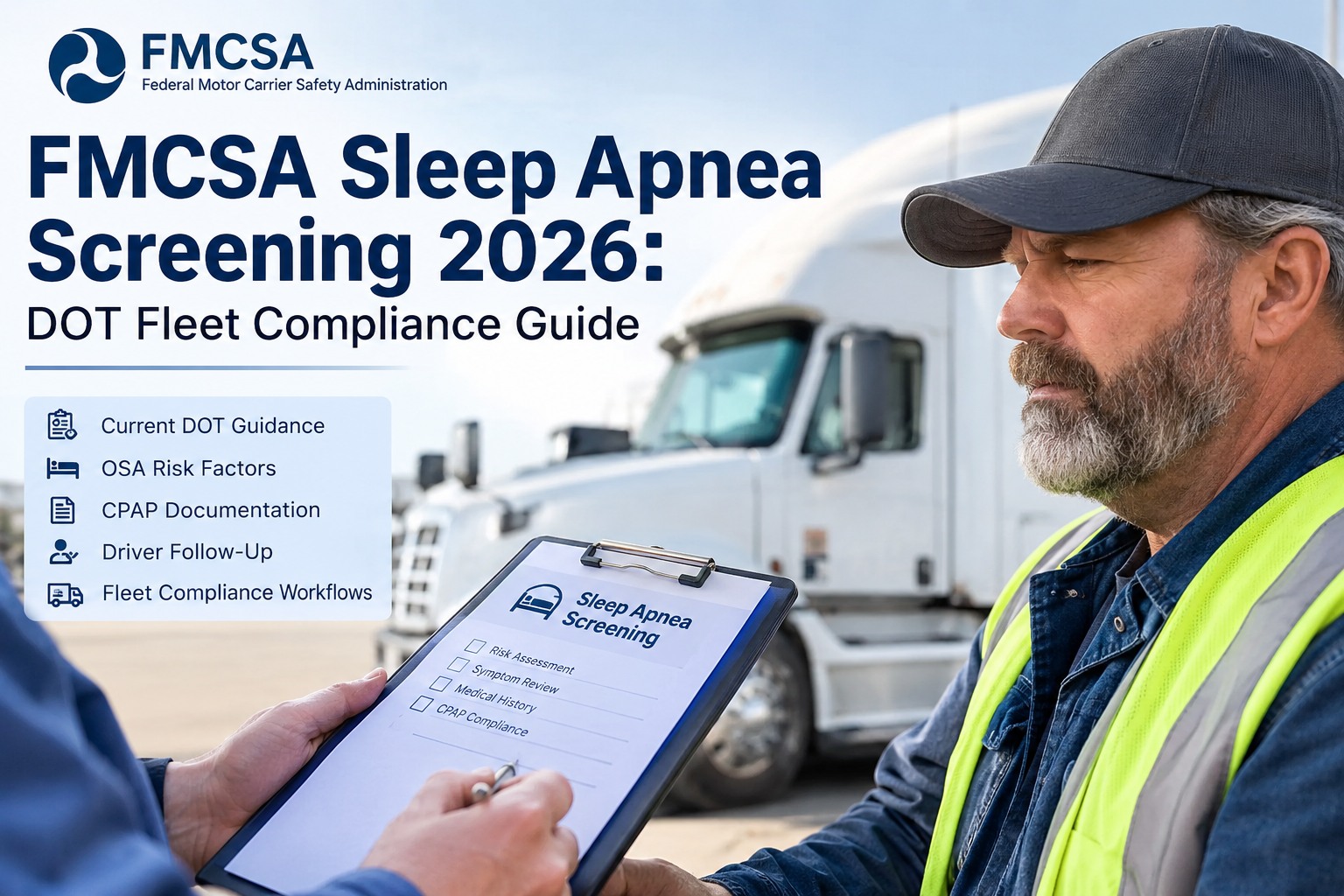
FMCSA Sleep Apnea Screening in 2026
There is no universal OSA test, no federal BMI cutoff, no mandated CPAP rule. Here's what's actually true — and what your fleet is responsible for documenting.
This guide is administrative and educational — not medical or legal advice. Medical examiners make qualification decisions.
Obstructive sleep apnea (OSA) is a genuine safety concern for commercial drivers — untreated, it causes daytime fatigue that raises crash risk. But there's a wide gap between "OSA matters" and "FMCSA mandates a specific screening and treatment protocol." Understanding exactly where that line sits is what keeps a fleet from either over-promising compliance it can't define or missing the documentation it genuinely needs to keep. Let's start by killing the myths.
Myth vs. current reality
These recycled "requirements" show up in blog posts and even some vendor materials. Every one of them misstates federal law. Here's the correction, grounded in the current guidance.
Where do these numbers come from? Mostly from advisory recommendations and a 2015 examiner bulletin that were never binding regulation — and the 2015 OSA bulletin was formally rescinded and replaced in January 2024. Quoting them today as "FMCSA requirements" isn't just outdated; it's inaccurate. Book a demo to keep your program built on current guidance, not myths
What FMCSA actually says in 2026
The governing document is the 2024 Medical Examiner's Handbook, published January 22, 2024, which replaced all prior editions. On sleep apnea, its position is strikingly restrained — and that restraint is the whole point.
FMCSA has never adopted a sleep apnea rule. By law, it could only do so through formal rulemaking — which hasn't happened. OSA is handled through existing medical standards.
The Handbook states the regulations do not require examiners to screen for OSA, do not mandate preferred diagnostic tests, and set no fixed treatment or certification periods specific to OSA.
Drivers must have no established medical history or clinical diagnosis of a respiratory dysfunction likely to interfere with safe driving. OSA is evaluated under this general standard.
The Handbook leaves it to the certified medical examiner to determine whether an individual driver should be screened, based on that driver's specific circumstances.
In plain terms: there is no national sleep-apnea test every driver must pass. Instead, a certified medical examiner looks at the whole picture during the DOT physical and uses professional judgment. That's not a loophole — it's the deliberate federal position, and building your fleet program around it (rather than around invented cutoffs) is what keeps you accurate. Start free on HVI to organize each driver's medical-certification records in one place.
The risk factors an examiner weighs
Because there's no single trigger, examiners look for a combination of risk factors that together suggest moderate-to-severe OSA. These are considerations that may lead an examiner to recommend further evaluation — not automatic disqualifiers, and not fleet decisions to make.
A diagnosis of OSA does not automatically disqualify a driver. Many drivers with well-managed, effectively treated OSA are certified and drive safely for years. The examiner's focus is whether any condition is adequately treated, effective, safe, and stable — a clinical judgment, informed by documentation the fleet often helps assemble. Book a demo to keep treatment and follow-up documentation audit-ready
Building a defensible fleet program
Since FMCSA doesn't hand you a protocol, a strong fleet program is about consistency and documentation, not medical rules. These four pillars turn an ambiguous area into a repeatable, auditable workflow — all on the administrative side of the line.
Define how your fleet handles driver medical certification, referrals to examiners, and follow-up — applied uniformly to every driver, so decisions are consistent and defensible rather than ad hoc.
Keep medical examiner's certificates, expiration dates, and any clinician-provided treatment documentation in one place — not scattered across HR files, email, and paper.
Automate reminders for med-card renewals, examiner-requested follow-ups, and any recurring documentation dates so nothing lapses silently and drivers stay current.
Maintain a searchable trail of status, documentation, and follow-up actions, with fleet-level visibility into who's current, who's due, and what's outstanding.
Notice what's not on this list: diagnosing, testing, or judging treatment. Every pillar is administrative — the work of keeping records straight and follow-ups on time. That's the fleet's actual responsibility, and it's exactly the part that spreadsheets and inboxes handle badly. Book a demo to see all four pillars run as one workflow
Where fleets actually lose control
The compliance risk in OSA management is rarely a medical mistake — it's an administrative one. A driver's card expires unnoticed, a requested follow-up is never logged, treatment paperwork can't be found during an audit. Here's how a centralized system closes those gaps.
Certificate dates tracked per driver with reminders well before they lapse — no silent expirations.
Examiner-requested follow-ups logged and tracked to completion, not left in someone's memory.
Clinician-provided records stored securely per driver, retrievable instantly when needed — when applicable.
Fleet-wide view of who's current, who's due, and what's outstanding — turning scattered records into oversight.
This is the entire HVI value here, and it's deliberately bounded: HVI is the administrative and record-keeping layer, giving safety and compliance teams a centralized, auditable view of driver documentation and follow-ups. It does not make medical determinations — certified medical examiners and treating clinicians do. That separation is the point. Start free and give your compliance team one dashboard instead of ten spreadsheets.
From a safety manager who stopped chasing paper
We used to think we needed to "enforce the sleep apnea rule," and we tied ourselves in knots trying to define cutoffs that don't actually exist in federal regulation. Once we understood the examiner makes the medical call, our job got clearer: keep the documentation impeccable and never let a follow-up or a med-card date slip.
That's purely an organization problem, and it's the one we'd been losing. Moving driver certs, expirations, and follow-up reminders into one system meant we stopped discovering lapses during audits. We're not practicing medicine — we're just finally keeping our records like a professional operation should.
Get the facts right, then get organized
The honest answer to what FMCSA sleep apnea screening requires in 2026 is: there is no OSA-specific regulation, no mandatory screening test, no federal BMI or neck-size cutoff, and no universal CPAP-compliance threshold. Obstructive sleep apnea is evaluated under the general respiratory standard in 49 CFR 391.41(b)(5), and the 2024 Medical Examiner's Handbook deliberately leaves screening decisions to the certified medical examiner's judgment based on each driver's risk factors. The widely repeated numbers come from advisory recommendations and a 2015 bulletin that was rescinded and replaced in 2024 — quoting them as current requirements is simply wrong.
What a fleet is responsible for is administrative and very real: keeping driver medical certifications, expiration dates, examiner-requested follow-ups, and any clinician-provided treatment documentation consistent, current, and auditable across every driver. That's where compliance is actually won or lost — and where HVI helps. HVI centralizes driver compliance records, automates follow-up and expiration reminders, and gives safety teams fleet-wide visibility and audit-ready documentation, all while leaving every medical decision to the qualified professionals who are supposed to make it. Always confirm current requirements against FMCSA guidance and the Medical Examiner's Handbook, as federal guidance can change. Book a demo to see HVI's driver compliance and documentation workflow.
Frequently asked questions
Does FMCSA require sleep apnea screening in 2026?
No. FMCSA has not adopted any regulation specifically requiring obstructive sleep apnea (OSA) screening, and that remains the case in 2026. The 2024 Medical Examiner's Handbook — the current governing guidance, published January 22, 2024 — explicitly states that the federal regulations do not require medical examiners to screen individuals for OSA, do not mandate preferred diagnostic testing methods, and do not establish fixed treatment methods, waiting periods, or maximum certification periods specific to OSA. By federal law, FMCSA could only impose specific screening, testing, or treatment requirements through a formal rulemaking process, which has not occurred. Instead, OSA is evaluated under the general respiratory qualification standard in 49 CFR 391.41(b)(5), which requires that a driver have no established medical history or clinical diagnosis of a respiratory dysfunction likely to interfere with safe driving. Whether any individual driver should be referred for a sleep study is left to the certified medical examiner's professional judgment, based on that driver's specific risk factors and the overall clinical picture — not to a national checklist or a fleet's own determination.
Is there a BMI or neck-size cutoff that forces a sleep study?
No federal rule sets a BMI number or neck circumference that automatically requires OSA testing. The widely repeated figures — such as a BMI of 40 or a 17-inch neck — come from earlier advisory recommendations and expert-panel materials that were never adopted as binding regulation, not from current federal law. Body mass index, neck size, and upper-airway anatomy can be among the risk factors a medical examiner considers, but they are inputs to professional judgment, not automatic legal triggers. The 2024 Medical Examiner's Handbook emphasizes evaluating multiple risk factors together — such as loud snoring, witnessed breathing pauses, daytime sleepiness, obesity, high blood pressure, cardiovascular disease, and a history of stroke or diabetes — as a reasonable way to identify drivers who may have moderate-to-severe OSA, rather than relying on any single measurement. So while a high BMI or large neck size may contribute to an examiner's decision to recommend further evaluation, neither one is, by itself, a federal requirement to test. Always rely on the examiner's assessment rather than a fixed cutoff.
Does a sleep apnea diagnosis disqualify a commercial driver?
Not automatically. A diagnosis of obstructive sleep apnea does not by itself disqualify a commercial driver. Many drivers diagnosed with OSA are medically certified and continue to drive safely, provided their condition is being effectively managed. What a medical examiner focuses on is whether any respiratory condition that could interfere with safe driving is adequately treated — and whether that treatment is effective, safe, and stable. For a driver using a treatment such as CPAP, the examiner and treating clinician consider whether the treatment is working and being used appropriately, but there is no single federal compliance percentage written into regulation that applies universally to every driver. These are clinical determinations made by qualified professionals on a case-by-case basis. From a fleet's perspective, the important thing is not to attempt to make these medical judgments internally, but to support the process: ensure drivers complete their examinations, keep any clinician-provided documentation organized and current, and track follow-up dates so that certification stays valid. The medical decision belongs to the examiner; the documentation belongs to the fleet.
What happened to the old 2015 FMCSA sleep apnea guidance?
It was rescinded. The January 2015 FMCSA Bulletin to Medical Examiners and Training Organizations Regarding Obstructive Sleep Apnea was formally rescinded and replaced when the 2024 Medical Examiner's Handbook took effect on January 22, 2024 — specifically, the Handbook's OSA section replaced that earlier bulletin. The 2024 Handbook also replaced all previous editions of the Handbook itself, and FMCSA has stated that medical examiners should not rely on any earlier editions or drafts as a source of agency guidance. This matters because a great deal of outdated online content still cites the older bulletin and various draft recommendations as if they were current, binding requirements. They are not. When researching DOT sleep apnea obligations today, the correct primary sources are the current federal regulations, particularly 49 CFR 391.41(b)(5), and the 2024 Medical Examiner's Handbook. Because federal guidance can be updated, it's wise to confirm the latest position directly from FMCSA before finalizing any fleet policy, rather than relying on secondary summaries that may lag behind changes.
How can software help manage driver OSA compliance without practicing medicine?
The distinction is important, and it's exactly where a platform like HVI is designed to operate. Software should not — and HVI does not — make medical determinations: it doesn't diagnose OSA, decide who needs a sleep study, or judge whether treatment is adequate. Those are decisions for certified medical examiners and treating clinicians. What software does well is the administrative side that fleets are genuinely responsible for and frequently mishandle. HVI centralizes driver medical certifications, expiration dates, examiner-requested follow-ups, and any clinician-provided treatment documentation in one place instead of scattered spreadsheets, HR folders, and email. It automates reminders so med-card renewals and follow-up dates don't lapse unnoticed, maintains a searchable and auditable record trail, and gives safety and compliance teams fleet-wide visibility into who is current, who is due, and what documentation is outstanding. In other words, it removes the administrative failure points — missed expirations, lost paperwork, forgotten follow-ups — that create real compliance exposure, while leaving every medical judgment with the qualified professionals who are supposed to make it. That separation of roles is a feature, not a limitation.
Centralize driver compliance — leave medicine to the examiners
HVI gives safety and compliance teams one place for driver medical certifications, expiration dates, follow-up reminders, treatment documentation when applicable, and fleet-wide status — with an audit-ready trail. No more chasing paper or discovering lapses during an audit, and no medical decisions ever made by software. Mobile-first, live in under two weeks.
No credit card · Centralized driver compliance records · Follow-up reminders on day one