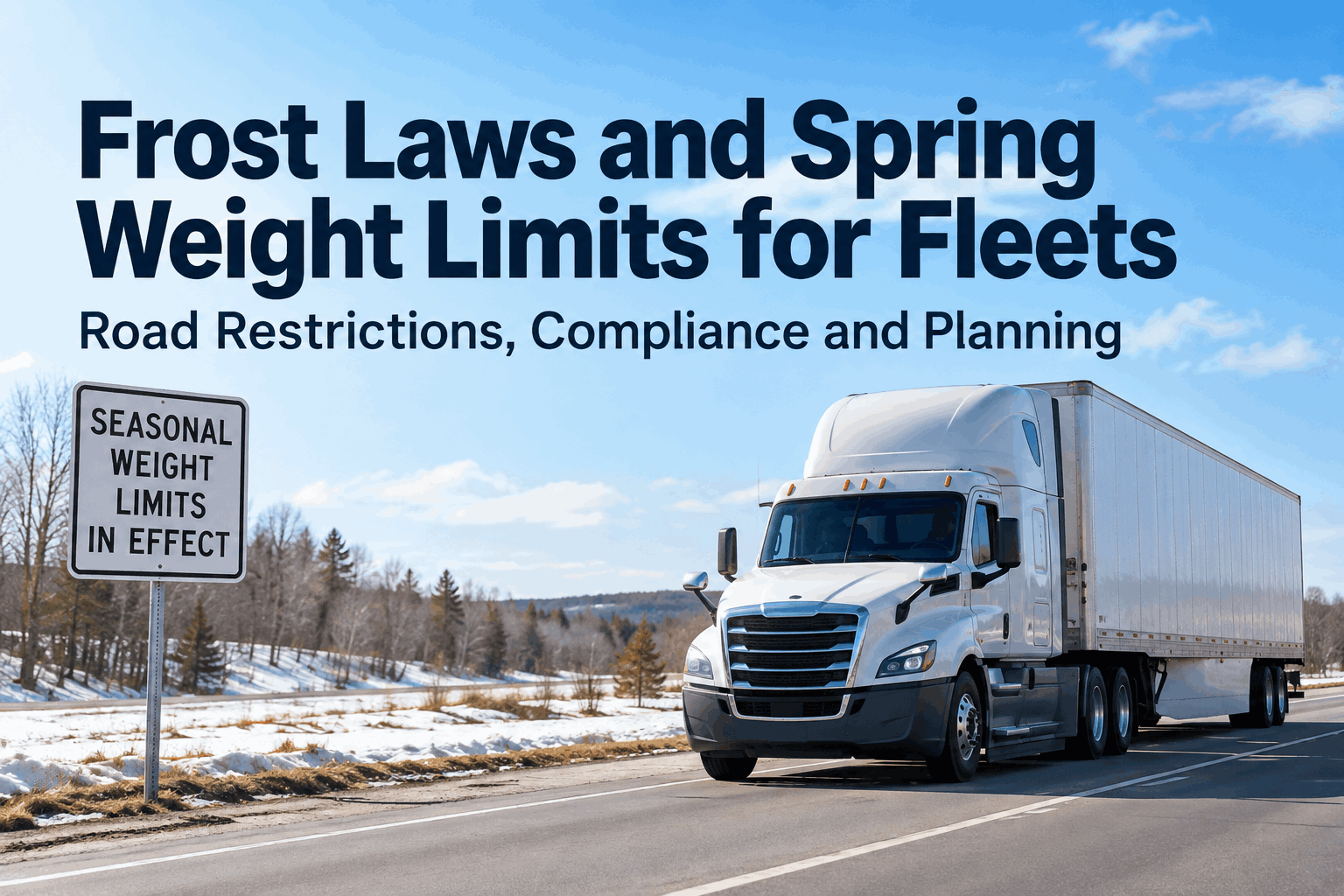
Frost laws — the spring weight limits that drop the legal load on thawing roads — catch out-of-region fleets every year: a truck that's perfectly legal in January is overweight and ticketed on the same county road in April. They are not arbitrary; a thawing roadbed simply can't carry what a frozen one can. Here's how frost laws and spring weight limits work, which fleets they hit, and how to stay compliant — or book a demo.
The load was legal all winter. Then the ground thawed.
Every spring, posted roads across the northern states drop their weight limits while the roadbed is soft — and an overweight ticket, or a bill for road damage, is waiting for the fleets that didn't plan for it. Frost laws are predictable. Getting caught by them isn't necessary.
One honest point up front: HVI isn't a routing or permit tool. It doesn't publish state frost-law postings, calculate legal axle weights by road, or route your trucks around restricted roads — those come from the state and county agencies and your dispatch or routing system. What HVI does is the vehicle side of compliance: it keeps each truck's configuration, axle setup and weight ratings on record under vehicle management, holds the compliance documentation, and keeps a clean audit record — so when restrictions hit, you know exactly which units and configurations are affected and can prove how you handled it. Book a demo to see it on your fleet.
Why spring thaw weakens the roadthe reason frost laws and weight limits exist at all
Frozen ground is strong — which is why some regions even allow heavier winter loads. The danger comes in the thaw, and a cross-section shows exactly why.
- 1
Thawed surface — the top layer softens first as temperatures rise.
- 2
Saturated base — meltwater soaks the base course and has nowhere to go.
- 3
Still-frozen subgrade — the frozen layer below traps the water above it.
- 4
Heavy axle load — pressing on a soft, waterlogged base ruts and cracks the road.
That trapped water is the whole story — a saturated base behaves like a sponge, and heavy axles pump it until the road fails. Book a demo to track which rigs are affected.
What frost laws actually restrictthe spring weight limits a fleet has to plan around
Frost laws vary by state and even county, but the shape is consistent. These are the four facts every fleet manager needs (US examples; Canadian provinces run equivalent spring restrictions).
Interstates generally stay open at normal limits — it's the secondary and local roads, the ones fleets use for the last mile, that get posted. Start a free trial to keep your vehicle weight data on hand.
How fleets stay frost-law compliantfour steps to plan around spring weight restrictions
Compliance isn't complicated — it's four habits run every spring. The agencies handle the postings; you handle the fleet.
- 1
Know your rigs
Have every vehicle's axle configuration, GVW and axle ratings on record, so you know in seconds which units a posted limit affects.
- 2
Watch the postings
Monitor the state and county frost-law notices each spring — most agencies publish start dates, affected roads and the reduced limits.
- 3
Plan loads & routes
Lighten loads, split shipments, or reroute off posted roads for the few weeks the restriction is active — and check for exemptions.
- 4
Keep the proof
Hold the weight and compliance records for each trip, so a stop or dispute is answered with documentation, not a scramble.
Steps one and four are where a vehicle-management system earns its place — the data's already there when you need it. Book a demo of the vehicle record.
Where HVI fits frost-law compliancethe vehicle management features behind seasonal weight compliance
HVI covers the vehicle and record side of frost-law season — the part that makes planning and proving compliance quick. Five features carry it.
Vehicle management
Every truck's axle configuration, GVW and ratings on one record — so you know instantly which rigs a posted limit affects.
Compliance documentation
Weight ratings, permits and seasonal records kept together and signed — ready for a roadside stop or an audit.
Vehicle maintenance records
Full history per unit alongside its specs — the whole picture of a vehicle in one lookup, not scattered files.
Analytics & reporting
Filter the fleet by configuration and weight to see at a glance which units are affected when a restriction drops.
Integrations
Connect with telematics and your other systems so vehicle and load data lines up with your routing and dispatch.
It runs on the same inspection and reporting backbone as the rest of HVI, built for transportation fleets. Book a demo of the fleet record.
From a fleet manager in the Upper Midwest
Frost laws used to cost us a couple of tickets every spring — a driver would run a road that got posted overnight, and we'd eat the fine plus the argument with the customer about a late load. The problem was never knowing the rule; it was knowing, fast, which of our trucks and trailers the reduced limits actually hit on a given config. Having every rig's axle setup and weights in one place changed that — when the postings go up, I can tell dispatch in minutes which loads need to lighten and which routes to avoid. We haven't taken a frost-law ticket since.
Frost laws & spring weight limits — FAQs
What are frost laws?
Frost laws — also called spring weight restrictions, seasonal load restrictions or spring thaw restrictions — are temporary reductions to the legal weight a vehicle can carry on affected roads during the spring thaw. When the roadbed thaws from the top down while a frozen layer still sits below, meltwater is trapped in the base and the road loses strength. Reducing axle and gross weight limits for a few weeks prevents heavy trucks from rutting and cracking roads that can't yet support full loads.
Which states have frost laws?
Frost laws are used mainly in colder northern states and Canadian provinces where the ground freezes deeply each winter — including Michigan, Minnesota, Wisconsin, North Dakota, Montana, Maine, New Hampshire, Vermont, New York, Washington and others. Each sets its own rules, affected roads, reduced limits, timing and exemptions, often down to the county or township level. Southern states that don't experience deep ground freeze generally don't have them. Always check the specific state and local agency for the roads you run.
How much do frost laws reduce weight limits?
It varies by jurisdiction. Many agencies post a set reduction to axle and gross weight limits on affected roads — commonly a significant percentage below the normal legal limit — while some specify reduced per-axle or per-tire-width limits. Interstates and designated all-season highways usually stay at normal limits; it's the secondary, county and local roads that get posted. Because the exact reduction and the affected roads differ everywhere, the posted notice for your specific route is the only reliable source.
When do frost laws start and end?
There's no fixed calendar date — frost laws are triggered by conditions, not the calendar. They typically begin in late winter or early spring as the thaw sets in, and run for a few weeks until the roadbed drains and regains strength, often somewhere between late February and May depending on latitude and that year's weather. Agencies announce the start and end dates as conditions dictate, so fleets have to watch the postings each spring rather than rely on last year's dates.
Does HVI track frost-law postings or route around them?
No. HVI isn't a routing or permit tool and doesn't publish state frost-law postings or set legal weights — those come from the state and county agencies and your routing or dispatch system. HVI handles the vehicle side: it keeps each truck's axle configuration, weight ratings and compliance documentation on record, so when restrictions are posted you can immediately see which units and loads are affected, plan accordingly, and prove how you handled it if a load is ever questioned.
Make frost-law season a plan, not a gamble
Leave the postings and routing to the agencies and your dispatch — and keep every rig's configuration, weight ratings and compliance records on one system. When the spring weight limits drop, you'll know exactly which trucks are affected and can prove you handled it right.
Vehicle specs on record · compliance docs in one place · audit-ready