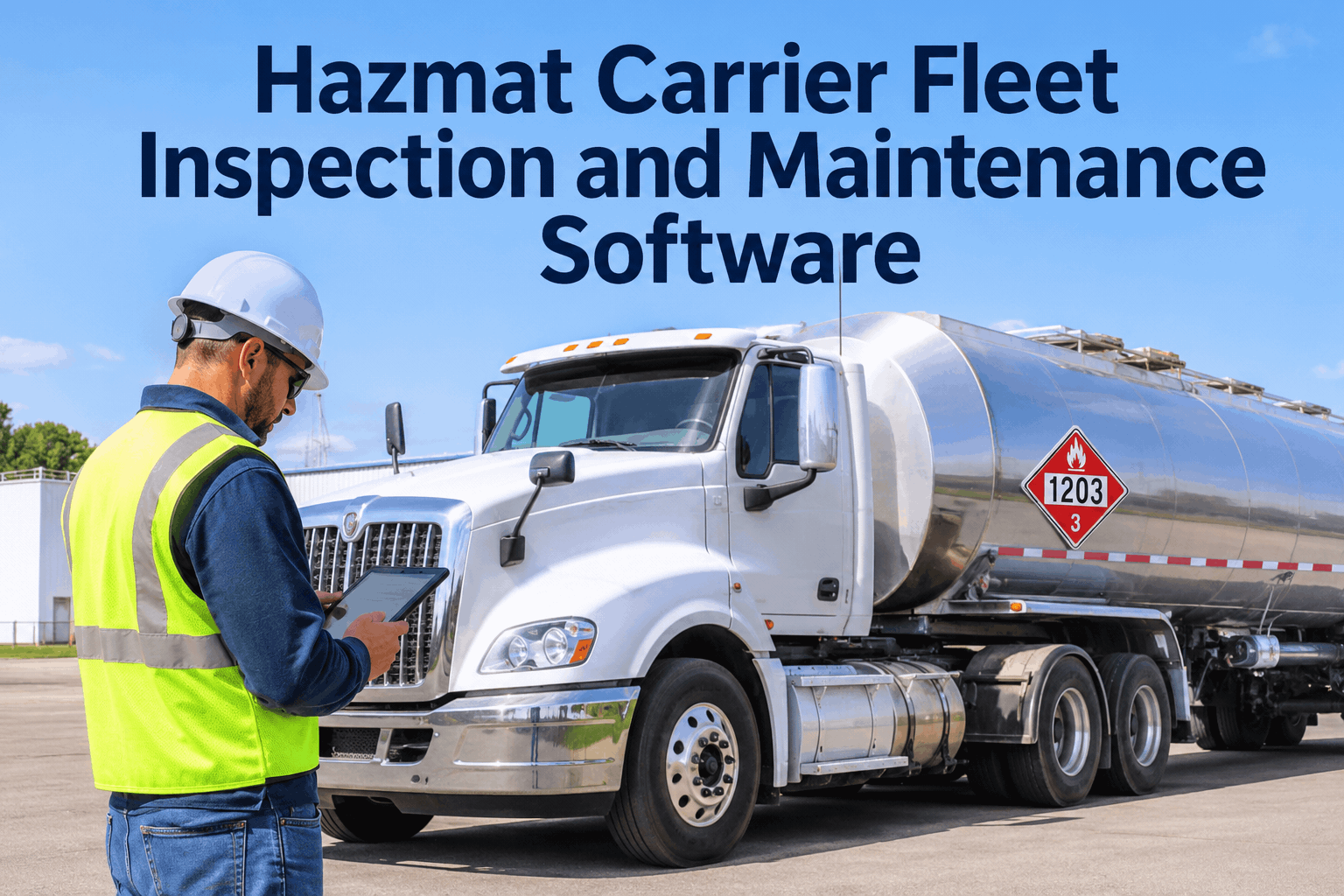
A hazmat roadside inspection doesn't stop at brakes and tires. The officer wants the shipping papers, the emergency response guide, the placards matching what's actually in the trailer, and the grounding cable in one piece. Miss any one of those and it's not a minor note — it's a hazmat violation, and those start in the tens of thousands of dollars per day. Hazmat fleet inspection software exists to make sure every one of those items is checked, every time, on every truck, not just the parts a standard DVIR happens to cover. See a hazmat-specific checklist built for your fleet
Hazmat Compliance Doesn't Stop at the Cargo Tank
Placards, shipping papers, grounding, emergency equipment — a hazmat carrier's inspection has items a generic truck checklist was never built to cover. HVI tracks all of it, tankers and placarded box trucks alike.
Cargo tank testing under 49 CFR 180.407 gets most of the attention in hazmat compliance conversations, and rightly so — HVI has a dedicated guide to the 180.407 test and inspection matrix if that's what brought you here. But a hazmat carrier's exposure doesn't end at the tank. A placarded box truck hauling drums, a tractor pulling a tanker, and a bulk pneumatic trailer all carry their own set of items that a generic fleet inspection checklist simply doesn't ask about.
What a missed hazmat item actually costswhy "mostly compliant" isn't a safe place to sit
These aren't the fender-bender numbers a standard trucking violation carries — hazmat enforcement is built to be felt. A single roadside stop that finds a missing placard, an expired cargo tank certification, or shipping papers that don't match the load can turn into a penalty that dwarfs the cost of the software that would have caught it. Book a demo to see what a missed item actually looks like flagged in HVI.
What a hazmat inspection checklist actually coversthe items a generic DVIR template leaves out
Placards match the load
Correct class, correct UN number, visible on all required sides — not left over from the last run.Shipping papers & emergency response info on hand
Accessible to the driver, matching what's actually loaded, not just present somewhere in the cab.Grounding & bonding cable intact
Frayed or missing bonding equipment is a real ignition-source risk on loading, not a paperwork detail.Emergency shutoffs & relief valves function
Tested, not just visually present — a stuck valve is exactly the kind of thing a quick glance misses.Spill kit & required PPE present
Checked for completeness, not assumed present because the bin is still bolted to the frame.Fire extinguisher charged & accessible
Date-checked, not just mounted — an expired extinguisher is its own citation.Driver's hazmat endorsement current
Verified against the load being hauled, not assumed because the driver's been on the route before.Cargo tank test decal current (if applicable)
For tankers, the 180.407 markings are checked on every pre-trip, not rediscovered at a PHMSA audit.This checklist ships ready to load into HVI, alongside the full tanker-specific 180.407 checklist for carriers running cargo tanks. Start free and load your hazmat checklist this week.
From a flagged placard to a closed work orderhow a hazmat defect moves through HVI
-
1
Driver runs the hazmat pre-trip
Placards, papers, grounding, and emergency equipment checked on the inspection app before the load leaves the yard.
-
2
A missing or damaged item gets flagged with a photo
A torn placard or a frayed grounding cable is logged with severity, before the truck's dispatched.
-
3
It becomes a work order instantly
Routed to the shop with the photo and work order history attached, so nothing waits on a verbal handoff.
-
4
It closes and writes to the truck's record
Signed, timestamped, and searchable — ready the next time a safety manager, auditor, or roadside officer asks for it.
Keeping regulatory dates on a calendar, not in someone's headPM scheduling for a mixed hazmat fleet
A hazmat fleet runs more than one maintenance clock, and they don't line up with each other. A daily hazmat-item check happens every pre-trip, on every truck. Cargo tank test cycles under 180.407 run on their own interval per tank spec, often five different test types with five different due dates on the same tank. Driver hazmat endorsement and training renewals run on a separate clock entirely, tied to the person rather than the vehicle. Tracking all three by memory, or across three different spreadsheets, is exactly how a date slips. HVI's PM scheduling tracks all three per vehicle, firing an alert weeks before a certification lapses — not the week after a tank's already out of service. Book a demo to see your own fleet's cycles mapped out.
What PHMSA actually asks to seeorganized records are the difference between an audit and an escalation
A PHMSA compliance review doesn't usually start with an accusation — it starts with a request for records: inspection history, driver training files, cargo tank test documentation, incident reports if any exist. How fast and how completely a carrier can produce those often shapes how the rest of the review goes. A fleet that hands over a complete, organized record set looks like a carrier that takes the regulation seriously. One that's still digging through a filing cabinet looks like exactly the kind of carrier an inspector digs deeper into.
Every inspection, defect, and work order in HVI writes to the vehicle's permanent record automatically, searchable by truck, date, or driver, with reporting that can be pulled together before a reviewer finishes asking for it. Start free and see how fast your own records come together.
From a safety manager who used to track three clocks by hand
Before, I had a spreadsheet for cargo tank test dates, a different one for driver endorsement renewals, and the daily hazmat checklist was still on paper in the truck door. Three different places to miss something, and I missed things — nothing catastrophic, but enough roadside notes to make me nervous every time a truck got pulled over.
Now it's all one calendar. A tank's test date, a driver's endorsement, and this morning's placard check all live in the same system, and if anything's about to lapse I get a flag weeks out, not a surprise at the scale. I stopped dreading PHMSA showing up, because I actually know what our fleet looks like on paper now.
Want your own compliance calendar mapped out? Book a 20-minute demo and walk through your fleet.
Frequently asked questions
What is hazmat fleet inspection software?
It's digital inspection and maintenance software built to cover hazmat-specific items — placards, shipping papers, grounding equipment, emergency gear, and cargo tank certification status — alongside standard DVIR checks.
Does this cover cargo tank testing under 49 CFR 180.407?
Yes, cargo tank test dates are tracked in PM scheduling. For the full 180.407 interval matrix by tank specification, HVI has a dedicated tanker inspection guide with that detail.
Does this work for placarded box trucks, not just tankers?
Yes. Hazmat checklist items like placards, shipping papers, and emergency equipment apply to any placarded vehicle, and checklists can be built separately for tankers, box trucks, and bulk trailers.
How much can a hazmat violation actually cost?
Under the current federal penalty schedule, most hazmat violations carry a maximum civil penalty of $102,348 per violation per day, rising to $238,809 if the violation results in death or serious injury.
Can it track driver hazmat endorsement renewals too?
Yes. Driver credential renewals can be scheduled alongside vehicle PM and cargo tank test dates, so all three compliance clocks are visible in one place.
Don't let a $102,348-a-day violation start with a missing placard
HVI builds hazmat-specific checks into every inspection, tracks cargo tank and credential renewal dates on one calendar, and keeps a signed, searchable record for every truck in your fleet. Live on your fleet this week.