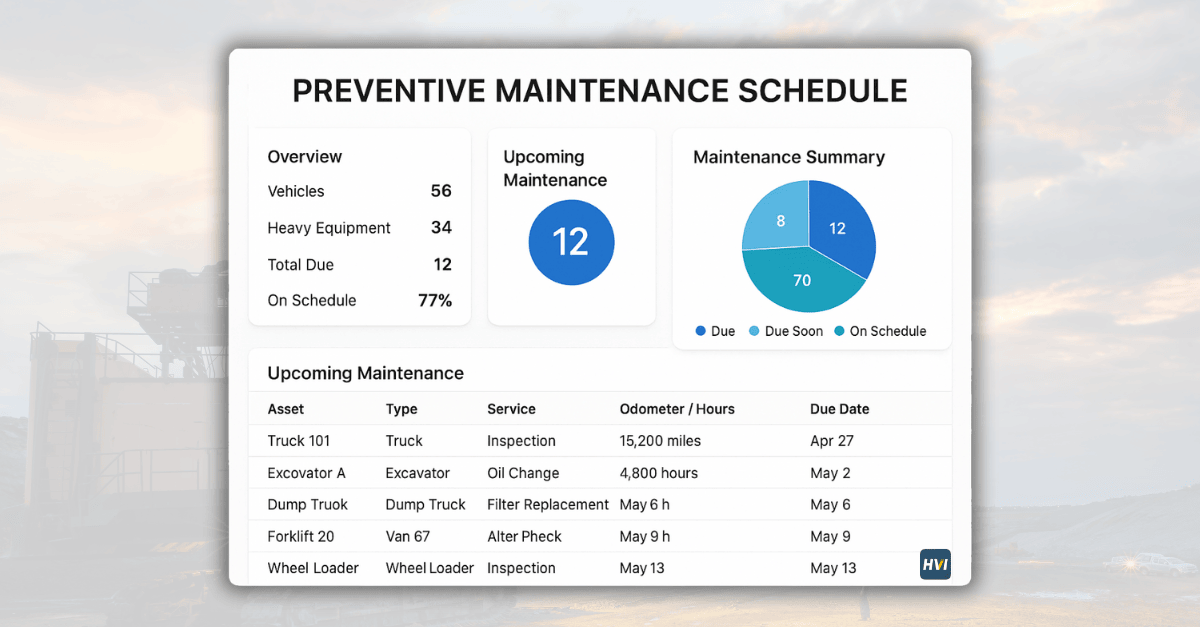
Your workshop board says twelve services were scheduled this week. By Friday, nine are finished, one is waiting for parts and two trucks have been sent back out. That is not just a busy week—it is a maintenance schedule compliance problem. The metric shows whether planned work happens when promised, before missed service windows turn into overdue repairs and avoidable downtime.
Maintenance Schedule Compliance: Formula, Targets & Weekly Control
See which planned jobs finished on time, which slipped, and what to change before next Monday's dispatch.
Maintenance Schedule Compliance Formula: What Counts?
Use the number of scheduled jobs completed within the agreed service window—not every job closed this week.
Illustrative weekly result. Three of twelve jobs missed the defined window. A late completion still belongs in the denominator and should not be counted as on time.
Decide the measurement rule before reporting: does “on time” mean by the scheduled date, before a meter-hour threshold, or within a documented tolerance? Record that rule consistently. For meter-based PM, check the hour or mileage reading alongside the calendar date. If you need to connect scheduled work with inspection findings, Book a Demo for Fleet PM Scheduling to review HVI's preventive maintenance workflow.
Why a Completed Work Order Can Still Be Late
Three different counts can make the same workshop look successful—or seriously behind.
Jobs due this week and completed inside their planned window.
Best for: keeping the weekly promiseJobs finished eventually, including two finished after their deadline.
Best for: tracking throughputJobs still overdue at the reporting cutoff, even if other late jobs are now closed.
Best for: recovery planningA fleet can show a high work-order completion rate while still missing service windows. Keep these metrics separate in your weekly review. Use Sign Up Free to Track Preventive Maintenance to start organizing preventive maintenance and maintenance records.
Maintenance Schedule Compliance Targets: Set Them by Risk
There is no single defensible percentage for every fleet. A practical target must reflect equipment criticality, PM requirements, resources and your definition of an acceptable window.
Don't average away critical misses
A missed safety-critical inspection or manufacturer-required service may deserve immediate escalation even when the overall percentage looks healthy. Separate critical jobs from routine work, and follow applicable safety, manufacturer and regulatory requirements.
Set a starting target from several weeks of clean data, then investigate whether staffing, parts availability, asset access or unrealistic planning is driving misses.
Make next week's maintenance plan easier to keep
HVI helps teams schedule preventive maintenance, record inspections and follow repair work across fleet assets.
Prevent Overdue Maintenance Before Friday
One missed service window can turn into next week's backlog. Use a three-checkpoint maintenance rhythm to protect scheduled work while there is still time to act.
Reserve the service windows
Confirm equipment release with dispatch, assigned technicians, service intervals and required parts before the week fills up.
Rescue jobs at risk
Identify vehicles still on route, parts not received and work orders unlikely to finish within the original window. Assign a recovery owner.
Close the week without hiding misses
Record actual completion times, calculate on-time compliance using the original due windows and carry open overdue jobs into a visible recovery queue.
Asset ID and service type · Original due date or meter threshold · Actual completion time and reading · On-time/late/open status · Delay reason and recovery owner.
Reviewing the week this way helps you spot the operational reason behind the percentage. HVI connects preventive maintenance scheduling with work orders and asset service history so teams can follow planned maintenance more consistently.
Read the Maintenance KPI Like a Shop Supervisor
The percentage is a signal. Pair it with the reason for each miss before choosing an action.
Review PM task quality, inspection defects and whether the service interval fits actual duty cycles.
Check parts planning and lead times before simply adding more technicians.
Coordinate service windows with dispatch and document which assets cannot be released.
Escalate critical tasks individually. Do not use a fleet-wide average to justify continued operation.
Review the trend by site, vehicle class and maintenance type rather than only as one fleet-wide number. HVI's asset records and maintenance reporting can help organize that review. Book a Demo for Fleet PM Scheduling to discuss the reporting available for your fleet.
From Maintenance Schedule Compliance to Better Fleet Decisions
For the next four weeks, start with a clean due-job list. Record every scheduled PM, its original deadline and its outcome. Review the misses each Friday, then fix the largest recurring blocker the following week. A consistent measure will show whether the change actually helped.
Where HVI fits
HVI supports preventive maintenance scheduling, digital inspections, work orders and maintenance records. These are the operational inputs a team needs before it can produce reliable schedule-compliance reporting. Confirm the precise KPI calculation and dashboard configuration during a product demo rather than assuming an out-of-the-box metric.
For maintenance schedule compliance, the real win is knowing which job was due, whether it happened on time, and what held it back. Sign Up Free to Track Preventive Maintenance to begin bringing your PM records together.
Maintenance Schedule Compliance FAQs
What is maintenance schedule compliance?
It is the percentage of scheduled maintenance jobs completed within their defined service window during a reporting period. Use the original due-job population and a consistent on-time rule.
How do you calculate maintenance schedule compliance?
Divide scheduled jobs completed on time by all scheduled jobs due in the period, then multiply by 100. For example, nine on-time completions out of twelve due jobs equals 75%.
What is a good maintenance schedule compliance target?
There is no universal target suitable for every fleet. Establish a baseline, separate safety-critical tasks, consider manufacturer and regulatory requirements, and set improvement targets appropriate to your operation.
Does a late completed PM count as compliant?
Not under an on-time schedule compliance definition. A late job may count toward overall work completion, but it should remain a missed schedule commitment for the original period.
Can HVI help track preventive maintenance compliance?
HVI supports preventive maintenance scheduling, inspections, work orders and maintenance records. Ask for a demonstration of the specific compliance KPI or reporting setup you need.
Turn the weekly PM plan into work your team can follow
Give technicians and fleet managers a clearer maintenance schedule, inspection history and repair follow-up in HVI.