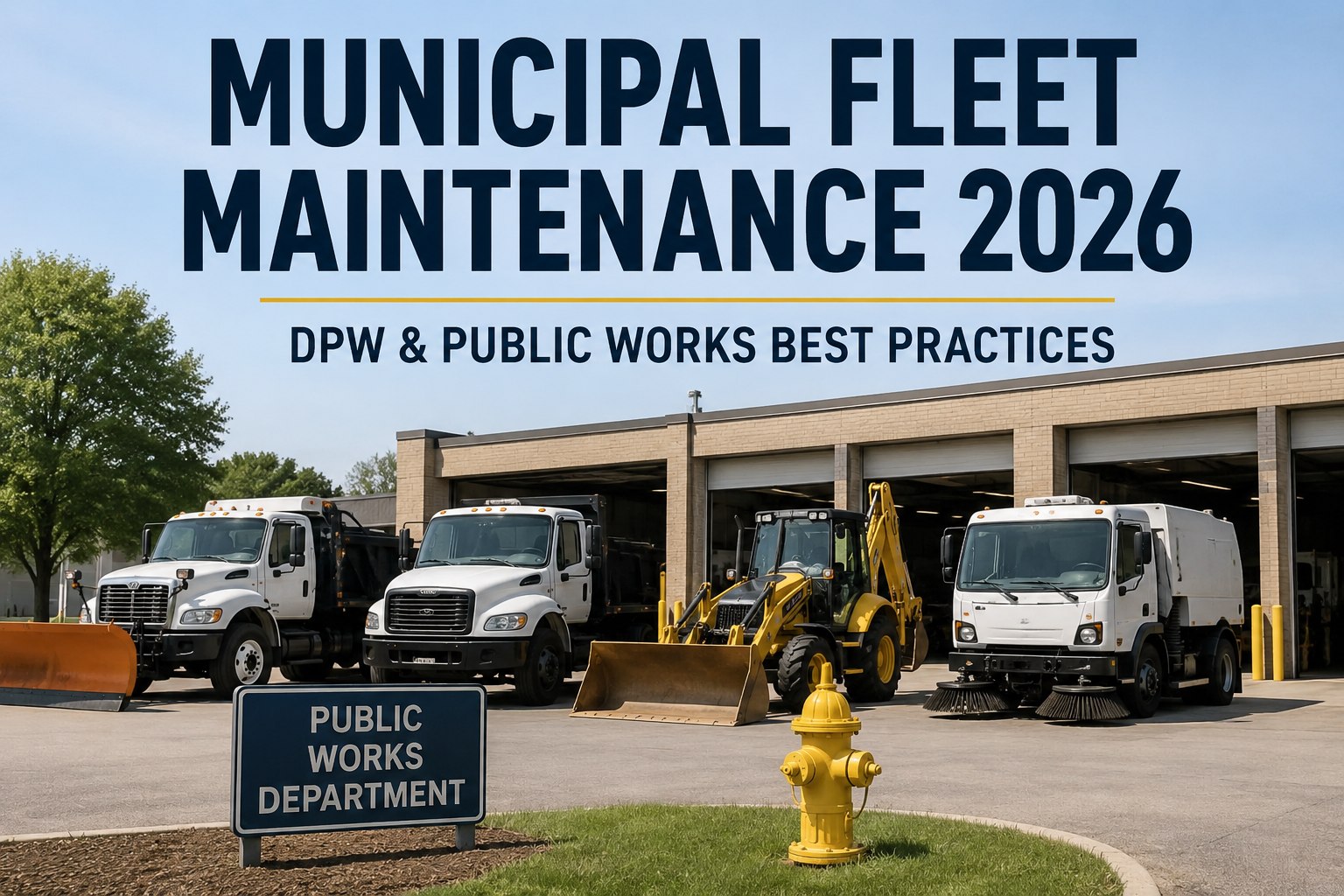
A municipal fleet manager's job is not one job. It's six jobs, each with its own inspection standard, compliance framework, and replacement cycle. Police cruisers, fire apparatus, refuse trucks, snowplows, parks equipment, and administrative vehicles share the same garage but almost nothing else. The universal challenge of municipal fleet maintenance is running a coherent PM program across six asset classes at once — while producing GASB 34 records, satisfying NFPA 1900 compliance, and defending the annual budget at council. This playbook covers the decisions. Book a demo
Six asset classes. Six compliance regimes. One director.
A universal PM checklist misses the compliance-critical details on every specialized class. Dashboard-per-class is what turns a mixed municipal fleet into a defensible operation.
Cruiser chassis, light bars, radar, radio, MDT, prisoner partition, weapon rack. High-mileage rapid-turnover.
Pumper, tanker, aerial ladder, quint, rescue, hazmat. Pump certification, aerial + ground ladder testing, hose testing.
Front-loader, side-loader, rear-loader, roll-off. Packer, hopper, tailgate, hydraulic cylinders, PTO.
Plow blade, cutting edge, hydraulic lift, spreader, pre-wet system. Engine-hours tracking, not mileage.
Mowers, tractors, chippers, aerators, sprayers, utility vehicles. Blade sharpening, deck condition, PTO safety.
Sedans, pickups, SUVs, vans for inspectors, supervisors, code enforcement, meter readers. Lower stress, longer cycles.
The average government vehicle is 7.4 years old, versus 3-5 for commercial fleets. That gap is the arithmetic of 18-36 month procurement cycles, competitive bid requirements, and constrained capital budgets. Which means predictive maintenance isn't optional for municipal fleets — it's how you keep aging assets running while procurement grinds toward replacement, and how you defend the replacement request when the transmission finally goes.
The regulatory framework matrix — six systems, one calendar
Municipal fleet managers run under simultaneous jurisdiction from federal, state, and local frameworks. Understanding which framework applies to which asset class is the foundation of a defensible program.
Requires state and local governments to report capital assets on government-wide financial statements with accumulated depreciation. Modified approach available for preservation-based infrastructure reporting.
Uniform Guidance for grant-funded assets. Records must include federal award ID, acquisition date, cost, % federal participation, location, condition, disposition. Retention: useful life + 3 years.
Consolidated standard replacing NFPA 1901 (automotive fire apparatus), 1906 (wildland), 1917 (ambulances), 414 (aircraft rescue). NFPA 1911 covers inspection, maintenance, testing, and retirement.
Federal Motor Carrier Safety Regulations for CDL vehicles over 26,000 lb. Refuse trucks, dump trucks, plow trucks, and large service trucks typically fall under DOT depending on jurisdiction.
Federal emissions standards for diesel and gasoline vehicles. Underground storage tank (UST) requirements for municipal fueling. Spill prevention, aboveground tank compliance, clean-fleet transitions.
Federal Transit Administration standards for municipal transit. Bus PM cycles, drug & alcohol testing, ADA compliance, procurement rules for federally-funded transit. State DOTs enforce.
The alphabet-soup complexity is why municipal fleet managers need a compliance calendar that tracks every regulatory deadline across all applicable frameworks simultaneously. A missed NFPA 1911 aerial certification, a lapsed CDL medical card on a plow driver, and a GASB reporting error at year-end each become a career event if they land during an audit or incident. Book a demo to see multi-framework compliance calendars configured per municipal fleet
Asset lifecycle timeline — from CIP planning to disposal record retention
Municipal fleet lifecycle management (LCAM) is the framework recognized by APWA and referenced in federal-funding compliance guidance. Four sequential stages form a continuous loop that keeps aging fleets defensible year over year.
Needs assessment
Fleet composition analysis. Service demand forecast. Right-sizing. Multi-year replacement roadmap tied to capital budget projection.
Procurement & commissioning
RFP development or cooperative-purchasing contract (Sourcewell, NASPO, HGACBuy). Vendor evaluation. Delivery inspection. Upfit specification. Federal grant compliance if applicable.
The middle life · 80% of cost
Daily inspections, PM per OEM and municipal standard, unscheduled repair, cost tracking, downtime tracking, safety incident tracking. This is where 80% of an asset's total cost occurs.
Retirement & residual
Replacement decision. Salvage or auction. Federal grant asset disposition per 2 CFR 200. Title transfer. Removal from GASB register. Records retained useful life + 3 years.
Fleets that make LCAM work treat all four stages as one continuous data record per asset. Planning references disposal data from prior cohorts. Acquisition captures the baseline that operation trends against. Disposal decisions draw from operation-and-maintenance cost history. Broken records at any stage break the cycle — which is why paper systems and disconnected databases fail municipal fleets over time. Book a demo to see continuous asset records across all four LCAM stages
The 5-criterion replacement scorecard — how to defend the request at council
The single hardest budget conversation for a municipal fleet director is the annual replacement request. Below is the scorecard: five criteria, each with a defined trigger threshold and evidence type. Councils push back on capital requests; the fleet director's answer needs to be data, not anecdote.
Compare vehicle age against class-specific replacement benchmarks. Government fleet average sits at ~7.4 years, well above commercial norms — benchmark against comparable municipal peers, not commercial fleets.
Lifetime maintenance and repair cost divided by original acquisition cost. When ratio crosses 60-70%, replacement becomes economically defensible on straight math — the single most powerful line item in a council presentation because it converts subjective condition into objective cost math.
Track days-out-of-service per year as percentage of scheduled operational time. When an asset is in the shop more than 10-15% of scheduled time, service continuity is compromised and operational risk exceeds capital risk of replacement. Downtime data is especially compelling for public-safety asset classes.
In-service breakdowns or safety-related incidents per year. A snowplow that fails during a snow event has direct citizen-service consequences. A refuse truck that breaks down on route creates public health exposure. A fire apparatus that fails en route is a life-safety event. Reliability data connects fleet condition to public service delivery in a way councils understand.
Vehicles that no longer meet current emissions standards, or require compliance retrofits exceeding a defined cost threshold, become replacement candidates. State clean-fleet mandates, EV transition roadmaps, and federal emissions requirements shift the compliance floor over time; assets that can't meet the new floor at reasonable cost become replacement targets by default.
Presenting a replacement request that scores each candidate vehicle against all five criteria — with underlying data attached — turns a budget conversation from adversarial into evidence-based. Fleet managers who present this way win budget battles; those without data lose them. Start free and get lifetime cost and reliability tracking per vehicle for council-ready reports
The municipal software RFP checklist — 10 items commercial platforms fail on
Selecting fleet management software for a municipal environment carries requirements commercial fleets don't face. The checklist below separates a municipality-ready platform from a commercial platform with a public sector marketing page.
Any RFP scoring respondents against these 10 items — and requiring narrative evidence for each — will surface the meaningful differences between a truly municipality-ready platform and a commercial platform with a government marketing page. Skipping the checklist typically produces buyer's regret at year one when the first CAFR audit exposes the gap. Book a demo to walk HVI through this 10-item RFP checklist item by item
From a DPW Fleet Manager who runs 340 mixed assets across a mid-sized city
We run 340 vehicles across 11 departments — 42 police, 18 fire, 34 refuse, 24 snow, 96 parks and grounds, 126 administrative. Before we consolidated on a single platform in 2023, we had NFPA 1911 records in one spreadsheet, GASB 34 in the finance ERP, daily inspections in paper binders, and lifetime cost data reconstructed manually every October. It was 4-6 weeks of my year just producing the annual report.
Two years in, the annual report takes me two days. But that's not the actual value. The actual value is that when the finance director came to me last November asking why my replacement request went from $780K to $1.1M, I pulled up every candidate vehicle's five-criteria scorecard in the meeting. Age, cost ratio, downtime, reliability incidents, compliance status — per vehicle, per decision. Two candidates dropped off the list once we looked at the data. Three moved up because reliability data showed they were bigger risks than I'd realized. My final request was $940K, and council approved it without a single line item challenged. That doesn't happen without the data.
Frequently asked questions
What makes municipal fleet maintenance different from commercial fleet maintenance?
Municipal fleet maintenance operates under conditions commercial fleet management rarely encounters. Mixed asset classes: a single municipal fleet typically spans police vehicles, fire apparatus, refuse trucks, snowplows, parks equipment, and administrative vehicles — each with distinct PM templates and compliance frameworks. Parallel compliance regimes: municipal fleets are simultaneously accountable to GASB 34 (financial reporting), NFPA 1900/1911 (fire apparatus), DOT/FMCSA (CDL vehicles), EPA (emissions), FTA (transit), and state-specific requirements. Commercial fleets typically face DOT and EPA only. Extended asset lifecycles: government vehicles average 7.4 years old due to 18-36 month procurement cycles and capital budget constraints, versus 3-5 years for commercial fleets — predictive maintenance is essential, not optional. Public accountability: operations are subject to public records requests, council presentations, budget hearings, and CAFR capital asset reporting. Cross-department cost allocation: costs must be allocated back to originating departments (police, fire, DPW, parks) for internal chargeback and fund accounting. Federal grant compliance: assets purchased with federal funds carry additional tracking requirements under 2 CFR 200. A commercial fleet platform stretched to serve municipal needs typically fails at the compliance boundary.
What is GASB 34 and how does it affect fleet management?
GASB 34 is Governmental Accounting Standards Board Statement No. 34, issued in 1999. It requires state and local governments to report capital assets — including vehicles, equipment, buildings, and infrastructure — on government-wide financial statements with accumulated depreciation. For fleet management, GASB 34 creates specific operational requirements. Asset register accuracy: every capitalized fleet asset must be tracked with acquisition date, original cost, expected useful life, current condition, and accumulated depreciation. Physical verification: the register must reconcile to physical inventory. Depreciation calculation: standard approach depreciates assets over expected useful life; modified approach available for infrastructure preserved rather than replaced. Disposal tracking: retirements recorded with disposition method and salvage value. Grant-funded asset overlay: assets purchased with federal funds carry additional requirements under 2 CFR 200 including federal award ID, % federal participation, and disposition data, retained for useful life plus three years. Practical implication: the fleet management platform must produce GASB 34-compliant asset register exports that reconcile to physical inventory and support annual CAFR preparation. Spreadsheet-based tracking typically fails GASB 34 audit scrutiny by year 3-5 as data drift accumulates.
How should a municipal fleet handle mixed-asset PM scheduling?
Mixed-asset PM scheduling requires asset-class-specific templates rather than a universal checklist stretched across every vehicle type. Police vehicles: high-mileage rapid-cycle requiring annual emergency equipment certification, radio and MDT verification, prisoner partition and weapon rack inspection, plus standard chassis PM (3-5 year cycle). Fire apparatus: NFPA 1900 (design) and NFPA 1911 (in-service inspection, maintenance, testing, retirement) apply. Annual pump certification, aerial and ground ladder testing per NFPA 1911, hose testing, specialized PTO and hydraulic maintenance (15-20 year cycle plus reserve). Refuse trucks: hydraulic and compaction system inspection separate from chassis PM. Front-loader, side-loader, rear-loader, and roll-off each have distinct hydraulic layouts (8-10 year cycle). Snowplows: engine-hours tracking rather than mileage. Seasonal winterization schedule and post-season reactivation. Cutting-edge wear tracking, hydraulic lift, spreader maintenance. Parks and grounds: seasonal PM schedules with equipment-type-specific templates for mowers, tractors, chippers, aerators, sprayers, utility vehicles. Administrative: standard commercial PM intervals per manufacturer specification. Platform requirement: distinct configurable templates per class, not a stretched universal template.
How do municipal fleet managers justify vehicle replacement requests to city council?
Defending replacement requests at council requires data-driven rationale rather than anecdotal justification. A five-criterion framework based on documented lifecycle cost analysis produces council-ready evidence per candidate vehicle. Criterion 1 — age versus asset class benchmark: compare vehicle age against class-specific replacement benchmark (police 3-5 years, admin sedans 8-10 years, refuse trucks 8-10 years, fire apparatus 15-20 years front-line plus reserve). Criterion 2 — lifetime maintenance to acquisition cost ratio: total lifetime maintenance and repair cost divided by original acquisition cost. When ratio crosses 60-70%, replacement becomes economically defensible. A 2014 F-250 with $32,000 lifetime repairs on a $28,000 original acquisition, facing an $8,500 transmission replacement, is a data-driven case. Criterion 3 — downtime frequency and duration: track days-out-of-service per year. When an asset is in the shop more than 10-15% of scheduled operational time, service continuity is compromised. Criterion 4 — reliability incident count: in-service breakdowns per year, connected to public service delivery consequences. A snowplow that fails during a snow event or a refuse truck that breaks down on route creates specific citizen-facing exposure. Criterion 5 — compliance and emissions status: vehicles that no longer meet current standards or require retrofits exceeding cost thresholds. Presenting candidate vehicles scored against all five criteria with underlying data attached is what transforms a budget conversation from adversarial to evidence-based.
How does HVI support municipal fleet maintenance programs?
HVI runs municipal fleet maintenance with the six-asset-class model this playbook describes — distinct configurable PM templates for police, fire apparatus, refuse, snow, parks, and administrative vehicles. Fire apparatus templates configured to NFPA 1900 design and NFPA 1911 inspection, maintenance, testing, and retirement including pump certification, aerial and ground ladder testing, and hose testing. Multi-framework compliance calendar tracks DOT medical currency, NFPA 1911 apparatus certifications, EPA emissions, FTA transit compliance, state inspection cycles, and CDL requirements simultaneously. GASB 34 asset register with acquisition cost, useful life, condition, and depreciation tracked per vehicle, exportable for CAFR preparation. Federal grant fields per 2 CFR 200 with useful life plus three year retention. Cost allocation by department, cost center, division, or fund for chargeback and fund accounting. Council-ready analytics: cost-per-vehicle, cost-per-department, TCO trends, and the five-criterion replacement decision framework pre-formatted for budget hearings. Fleet data exports directly to municipal ERP systems (Tyler Munis, Workday, Oracle, SAP Public Sector). For DPW Fleet Managers like Carla T. running 340 mixed assets across 11 departments, consolidating from spreadsheets and paper into a single platform reduces the annual report cycle from 4-6 weeks to 2 days. Published data shows fleets on HVI report approximately 25% lower annual maintenance cost with typical payback around 3 months.
Six asset classes, six compliance regimes, one budget hearing. Run them as one system or spend six weeks a year reconciling them.
HVI runs municipal fleet maintenance with per-class templates, per-framework compliance, and council-ready analytics. Live in under two weeks; annual report cycle drops from weeks to days.

.png)