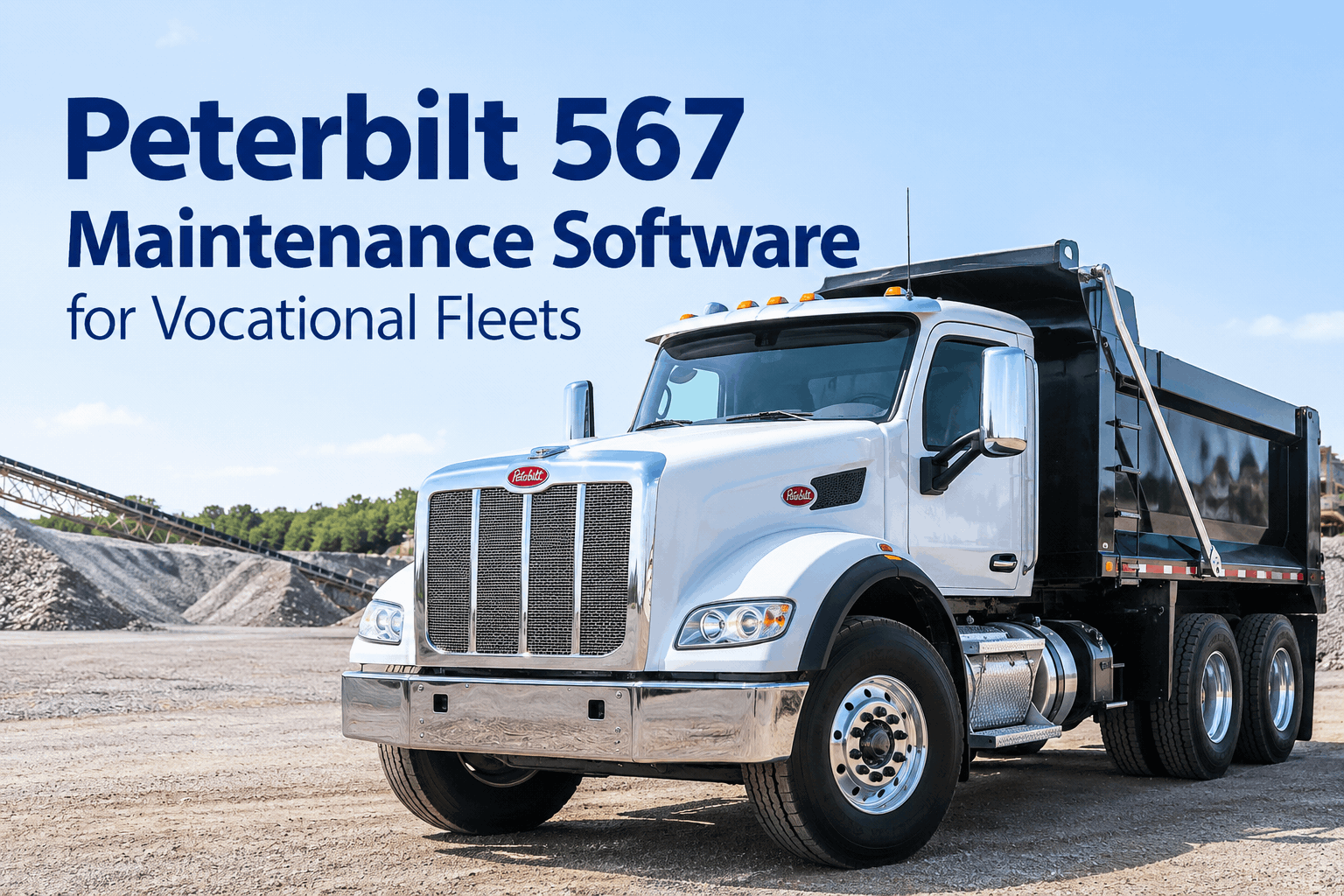
A Peterbilt 567 isn't just a truck — it's a chassis built to carry someone else's equipment, whether that's a dump bed, a mixer drum, a crane, or a refuse body. That means Peterbilt 567 maintenance software has to track two things at once: the chassis itself and whatever's bolted onto it, under a duty cycle that's nothing like a highway tractor's. Sign up free and set up your first 567's maintenance profile.
Peterbilt 567 Maintenance Software for Vocational Fleets
Dump, mixer, crane, or refuse — every 567 upfit changes what "maintenance" actually means. HVI tracks the chassis and the body on severe-duty schedules, with digital inspections and work orders built for job-site trucks, not highway tractors.
Why Vocational Trucks Break Generic Fleet Software
Most fleet maintenance software is built around highway duty cycles — steady mileage, predictable routes. A 567 running a dump bed or a mixer drum doesn't work that way, and the software that tracks it shouldn't pretend it does.
Mileage Alone Lies
A 567 doing short, stop-start job-site runs can rack up engine and brake wear far faster than its odometer suggests — a mileage-only PM reminder misses it.
The Body Has No Maintenance Plan
Hydraulic fluid, PTO hours, cylinder wear, and body controls rarely make it into fleet software at all — they get tracked separately, if tracked at all.
Inspections Skip the Equipment
A generic DVIR checks lights, brakes, and tires. It doesn't ask whether the dump bed's hydraulics are leaking or the crane's safety latch is intact.
One Truck, Two Service Files
Chassis service goes through one shop record, body service through another — nobody sees the full maintenance picture for the unit in one place.
Give Your 567s a Maintenance Plan Built for the Job Site
Track severe-duty PM, chassis service, and upfit equipment maintenance for every vocational truck in your fleet — all in one record, built for how these trucks actually work.
What Peterbilt 567 Maintenance Software Should Actually Cover
A vocational truck needs more than a mileage counter. Here's what should be tracked for every 567 in your fleet — sign up free to set this up for your own trucks.
Severe-Duty PM Scheduling
PM intervals set for stop-start, off-road, and job-site duty cycles — shorter and different from a highway tractor's mileage-based schedule.
PTO & Hydraulic Hour Tracking
PTO hours and hydraulic system use tracked alongside engine hours, since a dump bed or mixer drum wears on its own clock entirely.
Upfit-Specific Inspection Checklists
Digital inspections that check the dump bed, mixer drum, crane, or refuse body — not just the chassis items a generic DVIR covers.
Chassis & Air Disc Brake Service
Engine, EGR, and front air disc brake service tracked on the chassis side, visible alongside the body's maintenance record.
One Service File per Unit
Chassis repairs and upfit repairs logged against the same truck record, so nobody's reconstructing history from two different shops.
Generic Fleet Tracking vs a Vocational-Built Maintenance Record
- One mileage-based PM reminder, regardless of duty cycle
- Upfit equipment left out of the inspection entirely
- PTO and hydraulic hours tracked nowhere, if at all
- Chassis and body service live in separate records
- Brake service treated the same as a highway tractor's
- Severe-duty PM schedules built for stop-start job-site work
- Digital inspections covering dump, mixer, crane, or refuse body
- PTO and hydraulic hours tracked alongside engine hours
- One service file per unit — chassis and body together
- Front air disc brake service tracked on its own interval
Self-Check: Does Your Fleet Software Actually Fit Your 567s?
Run through this before your next PM comes due. Every unticked box is a gap generic fleet software leaves open on a vocational truck.
Left more than one box unticked? Your 567s are running on a maintenance plan built for a different kind of truck. Book a vocational fleet demo and we'll map your fleet onto one built for the job site.
Expert View — From a Vocational Fleet Maintenance Supervisor
We run a mixed fleet of dump and mixer trucks on 567 chassis, and for years our maintenance software only knew about the chassis — the mixer drum and the hydraulics were tracked on a separate sheet the body shop kept. The first time we pulled everything into one system, we found two trucks with hydraulic service that was months overdue and nobody chasing it, because it simply wasn't in the software anyone was looking at. Vocational trucks aren't just trucks with extra weight on them — the body is half the maintenance job, and it needs to be half the software too.
Conclusion — Maintain the Whole Truck, Not Just the Chassis
Peterbilt 567 maintenance software has to do a job generic fleet tools were never built for — tracking a chassis and a vocational upfit as one truck, on duty cycles that don't fit a highway mileage model. Severe-duty PM, PTO and hydraulic hour tracking, upfit-specific inspections, and one unified service file are what keep a dump, mixer, crane, or refuse 567 doing its job instead of sitting in the shop. If your fleet's maintenance plan still only sees the chassis, it's time to fix that. Sign up free and set up your 567 fleet today.
Track the Chassis and the Body, Together
HVI gives vocational fleets severe-duty PM scheduling, PTO and hydraulic hour tracking, upfit-specific inspections, and one unified service file per 567. No credit card required to start.
- Chassis & upfit maintenance, together
- Severe-duty PM schedules
- PTO & hydraulic hour tracking
- Upfit-specific inspection checklists