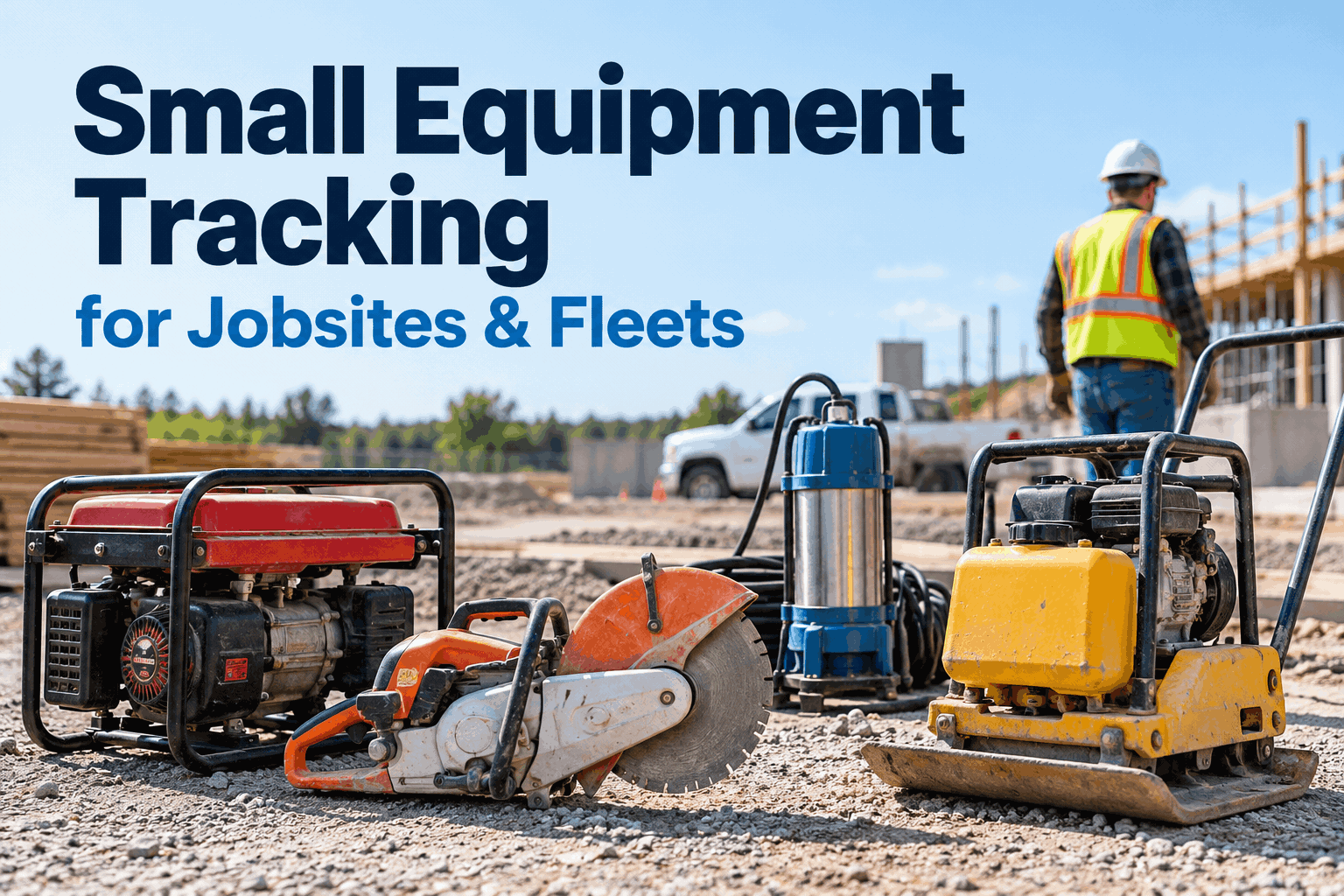
Small equipment tracking is the blind spot hiding inside every well-run fleet. The excavator is watched to the hour; the trash pump, the cut-off saw, the plate compactor just... drift. They ride home in a truck bed, get lent to a buddy's crew, end up behind a connex at a site that closed last month. Too cheap to chase, too valuable to keep losing. Book a demo of small-asset tracking and see every pump, saw and compactor hang on one board.
Small Equipment Tracking for Pumps, Saws & Compactors
The gear that walks isn't your big iron — it's the portable stuff nobody signed for. Hang it all on one board, tag it to a name, and the losses stop.
Most fleets track heavy equipment well and small equipment not at all — which is exactly backwards from where the losses happen. A compactor is cheap enough to fall off the radar, expensive enough that losing a few a year is real money, and portable enough to vanish without a trace. Below is where the small stuff actually hides, the sign-out habit that keeps it honest, the re-buy bill it quietly runs up, and how one tagged register closes all of it.
Where Small Equipment Actually Hidesone pump, five places it drifts — and off the books
A machine this portable doesn't get stolen so much as it wanders. Here's the real path a single untagged pump takes between the last time anyone saw it and the day you write it off.
Every hop is a place the record could have caught it — and didn't, because there was no record. The point of small equipment tracking isn't a GPS dot on each saw; it's a tag that says who had it last. You can book a demo of checkout accountability to see that single change close every one of these gaps.
The Check-Out Log That Keeps Gear Honesta sign-out habit turns "the crew's pump" into "Dave's pump"
Small equipment walks because it belongs to everyone, which means no one. The fix is old-school and it works: nothing leaves without a name against it. Digital or on paper, the sign-out log is the whole discipline.
That's the entire mechanism: a dated name against every unit. Do it consistently and "it walked off" becomes "Dave's had it at Eastgate since the 9th." Sign up free and start a sign-out log your crews run from a phone, so it actually gets filled in.
The Hidden Re-Buy Bill of Untracked Gearthe cost isn't theft — it's duplicates you never needed
The real money lost to poor small equipment tracking rarely shows up as "stolen." It shows up as a re-purchase line that climbs every year because it's faster to buy another compactor than to find the two you already own.
Same jobs, same demand — the untracked fleet buys duplicates to cover gear it can't locate. Half the re-buys were sitting idle somewhere the whole time.
Put every unit on a register and the re-buy line shrinks on its own, because a misplaced pump surfaces before a new one gets ordered. Book a demo of the loss-prevention view to see that spend against your own numbers.
Small Equipment Tracking Software in Actioncheck a unit out from the jobsite, in seconds
No clipboard, no office trip. A crew member scans or taps a unit on their phone, their name goes on it, and the board updates — accountability that's quick enough to actually happen at the gate.
Condition on the way out, a name on the unit, the board current the moment it leaves — and sign up free and check out your first unit in minutes.
Small Equipment Accountability Checklistset these up once and the gear stops walking
You don't need a GPS tag on every saw. You need these basics behind your small equipment tracking. Run down the three tags — every unchecked line is a unit waiting to wander.
- Every pump, saw, compactor and generator has an asset ID
- Make, model and serial number on file
- A photo attached to each unit's record
- Each unit checked out to a named person and site
- Check-in and check-out logged with dates
- Unassigned units flagged, not ignored
- Each unit has a PM schedule, not just the big iron
- Faults and damage logged against the unit
- Idle units surface so you redeploy before re-buying
Three tags, nine lines — that's the whole system. Book a demo and build this into your register so accountability is the default, not an afterthought.
A Contractor on Tracking the Small Stuffthe re-buy line that finally got noticed
We budget our machines down to the hour, but small equipment was a black hole — I think we bought six plate compactors in two years and never retired one. They just vanished. Once every pump and saw went on a register and crews had to sign them out, the re-purchase line basically disappeared. Turned out we didn't have a theft problem, we had a nobody-owns-it problem. Two of the "missing" compactors were sitting at a yard forty minutes away.
Put small equipment tracking on every pump, saw and compactor
HVI registers your portable gear, signs each unit out to a person and site, schedules PM, and flags anything unaccounted for — so nothing walks unnoticed and you stop re-buying what you already own. Live in under two weeks, no hardware.
No credit card · No hardware · Small-asset register ready on day one
Small equipment tracking — common questions
What is small equipment tracking?
It's keeping portable gear — pumps, saws, compactors, generators — on an asset register with each unit checked out to a person and site, plus condition and PM records. Unlike heavy-equipment tracking, the goal is accountability and loss prevention for assets small enough to walk off unnoticed.
Why does small equipment go missing more than heavy equipment?
Because it's portable, lower-value per unit, often untagged, and usually nobody's specifically responsible for it. A compactor fits in a pickup and "belongs to the crew" — meaning no one. Heavy equipment is hard to move and always noticed when gone; small gear slips through the gaps.
Do I need GPS tags to track small equipment?
Usually not. Most small-equipment losses are accountability failures, not theft — the fix is a register with checkout to a named person, not a GPS chip on every saw. A sign-out record tells you who has each unit and since when, which stops most of the loss at a fraction of the cost.
How does tracking small equipment save money?
Mostly by cutting re-purchases. Fleets quietly re-buy gear they already own but can't locate. A register surfaces idle and misplaced units so you redeploy instead of re-buy, keeps small assets on a PM schedule, and holds people accountable — so fewer units walk in the first place.
How does HVI handle small equipment tracking?
HVI puts every small asset on one register with checkout to a person and site, logs condition and PM per unit, and flags anything unaccounted for or idle. It's the same asset-management system that runs your heavy fleet — so the small stuff finally gets tracked the way the big iron already is.