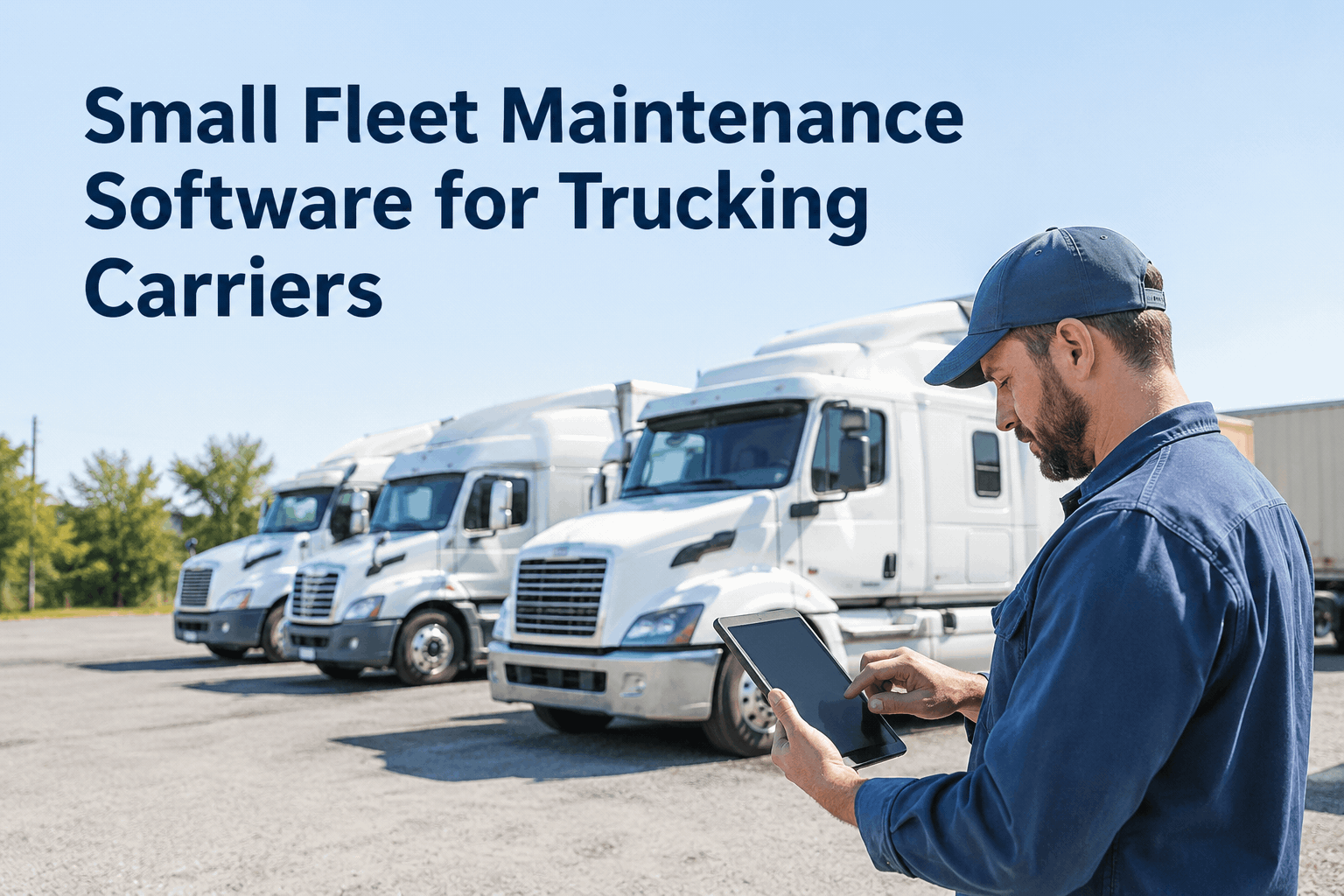
Run eight trucks and you've lived this: a tire gauge mark on a sticky note, a driver's text at 6am saying "truck 4 is making a noise," and a renewal reminder you find out about because an officer mentions it at the scale. Most fleet maintenance software is built and priced for someone running 300 trucks with a shop and a compliance department. Small fleet maintenance software has to do the same job — DVIRs, PM, work orders, records — without the enterprise price tag or the six-week rollout. See it sized for a fleet your size
Maintenance Software That Doesn't Assume You Have a Fleet Office
One app for DVIRs, preventive maintenance, work orders, and records — set up by you, this week, without a sales call for every seat.
That last stat is the one that stings. According to ATRI's 2026 operational cost analysis, truckload carriers with fewer than five trucks carry the highest repair and maintenance cost per mile in the sector — not because small carriers are careless, but because they run older equipment longer and catch problems later, after a spreadsheet or a sticky note failed to flag them in time. Small fleet maintenance software exists to close exactly that gap: catch the $40 problem on a phone screen before it becomes the $4,000 one on the shoulder of a highway.
Why "enterprise" fleet software fails a small carrierthe mismatch that sends small fleets back to spreadsheets within a year
Most CMMS platforms were designed around a 500-truck shop with a dedicated maintenance manager, a parts clerk, and an IT person to run the rollout. A 10-truck carrier doesn't have any of those people — the owner is the maintenance manager, dispatcher, and safety officer. Here's where that mismatch actually bites.
- Per-module pricing that assumes a 50+ truck minimum
- Multi-week onboarding with a dedicated implementation team
- Admin console built for a fleet office, not a phone in a truck cab
- Rigid templates that don't flex for mixed tractor/trailer/reefer fleets
- Annual contract locked in before you know if it fits
- Scales from a handful of trucks to dozens without a pricing cliff
- Self-serve setup — load trucks and drivers and go the same day
- Mobile-first driver DVIR app a new driver learns in one shift
- Checklist templates you edit yourself per truck, trailer, or reefer unit
- Start free, scale up as the fleet grows — no long lock-in to size you don't have yet
The point isn't that small carriers need less software — it's that they need the same core loop (inspect, flag, fix, PM, record) without the overhead that comes with it at enterprise scale. Book a demo and see the setup live on your truck count
What a missed inspection actually costs a small carrierthe numbers behind "we'll catch it next week"
One truck stacking violations from a bald tire or a missed brake adjustment doesn't just cost a repair bill — under the current CSA scoring, it drags the whole carrier's safety score for a year, which insurers and brokers both see. A small fleet feels that faster than a large one, because one bad truck is a bigger share of the whole operation. Reporting that shows which truck is quietly draining the fleet is the difference between fixing it this month and finding out at renewal. If that sounds like your fleet right now, start free and see your own numbers this week rather than wait for the next renewal to find out.
What small fleet maintenance software actually needs to coversix things HVI runs for carriers who don't have a maintenance department
Digital DVIR
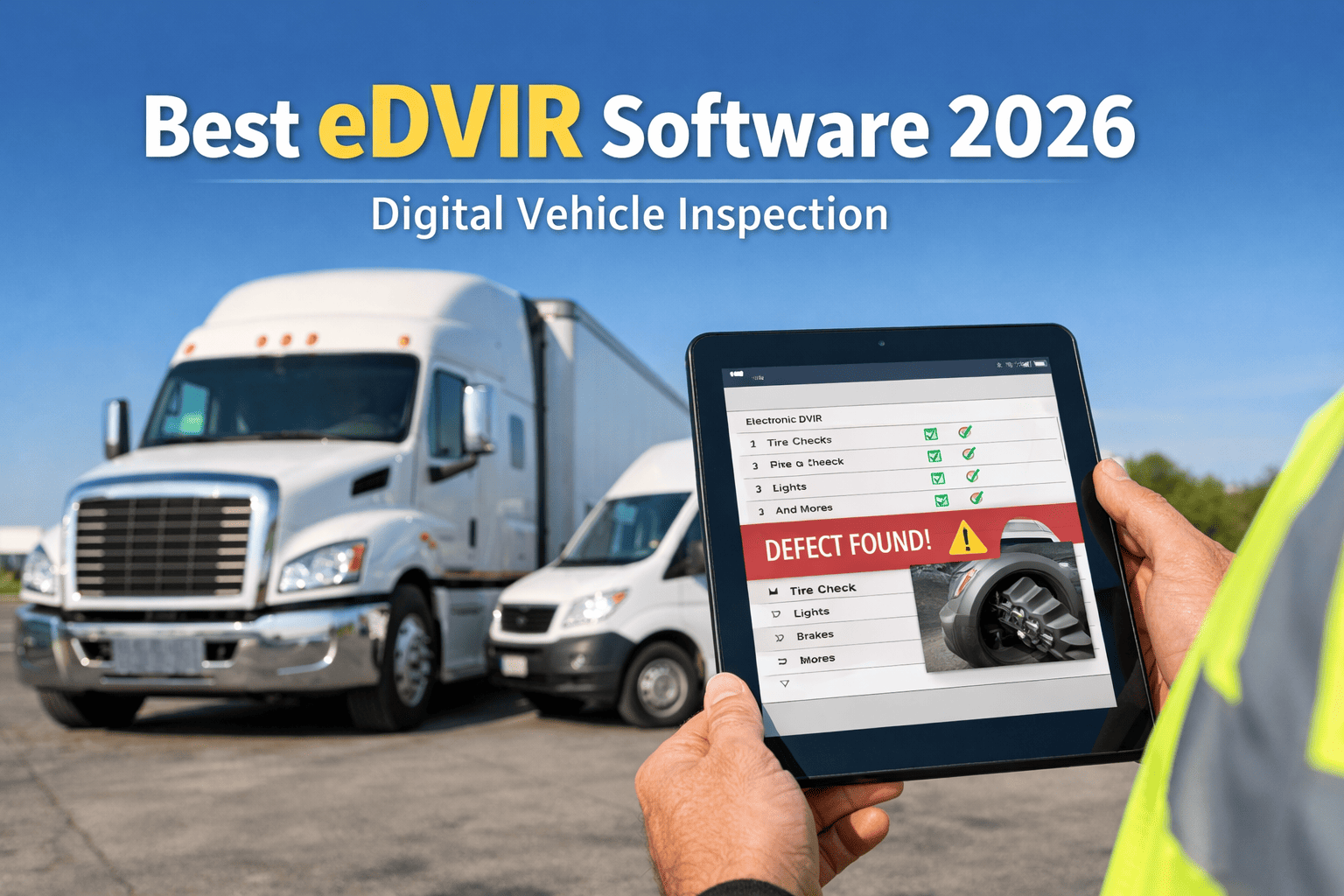
Pre- and post-trip inspections on a driver's phone, signed and timestamped — no paper forms left in a truck door pocket. See the DVIR app.
Preventive maintenance
PM fires on mileage, hours, or calendar date — whichever hits first — per truck and trailer, instead of living in one person's memory.
One-tap work orders
A flagged defect becomes a work order with the photo attached, assigned to a shop or mobile tech — no re-typing the problem from memory.
Parts & inventory
Know what's in the cage before a tech drives 40 minutes to find out it isn't. Parts tie straight to the job and the cost. Parts tracking.
Trailer & reefer tracking
Trailers don't log hours the way a tractor does, so they get skipped — until brakes or a reefer unit fails mid-load. Trailers get their own inspection and PM schedule.
Owner-level reporting
Cost per truck, open defects, and upcoming PM in one screen — readable on a phone between loads, not a report someone has to build. Analytics & reporting.
Every one of those six runs from the same login — no separate app for inspections and a separate spreadsheet for parts. Book a demo to see all six running together on your fleet.
How a small carrier actually runs this day to dayfrom a driver's pre-trip to a closed work order, in four steps
-
1
Driver runs the pre-trip
A guided checklist on their phone — brakes, lights, tires, coupling — signed before the truck leaves the yard.
-
2
A defect gets flagged with a photo
A chafed air line or a worn tread gets logged with severity — not described over a phone call from the road.
-
3
It becomes a work order instantly
The work order is assigned to your shop or a mobile tech, with the photo and truck history attached.
-
4
It closes and writes to the truck's record
Parts, labor, and sign-off land in the truck's history — one search away the next time anyone, including an auditor, asks.
The small fleet maintenance software buyer's checklistrun this before you sign up for anything — including HVI
A lot of small carriers buy software once, get burned by the wrong fit, and go back to paper for two years before trying again. Check a tool against this list first.
No minimum fleet size or seat-count penalty
Pricing shouldn't punish you for running 6 trucks instead of 60.You can set it up yourself, same day
If it needs a paid onboarding team, it wasn't built for your size.Drivers learn the app in one shift
If it takes training, your drivers quietly go back to paper within a week.A defect flows into a work order automatically
Not a separate tool you have to re-type the same problem into.PM covers trailers, not just tractors
A tool that only schedules the power unit misses half the fleet.Records are produced in seconds, not emailed
At roadside or audit, "let me find that" is already a problem.You can try it free before committing
No fleet should sign an annual contract to find out if the app fits.It grows with you without a re-platform
The tool you pick at 8 trucks should still work at 40, not force a switch.HVI checks every box on that list, and you can verify it yourself rather than take our word for it — start free and load your own trucks today.
From a small carrier who ran paper for nine years
I've got 11 trucks and for years our whole maintenance program was a clipboard in the office and whatever a driver remembered to tell me. I looked at a couple of the big fleet platforms and walked away from both — one wanted a 50-truck minimum, the other quoted a six-week setup with a project manager I'd never met.
What actually got us off paper was something my drivers could figure out without me standing over their shoulder. Now a defect becomes a work order before the truck's even back in the yard, and when my insurance broker asked for maintenance records last renewal, I had them pulled up before he finished the sentence.
Want to see the same setup Ray runs, on your own trucks? Book a 20-minute walkthrough with your fleet size in mind.
What going live actually looks likeno six-week rollout — here's the real timeline
Trucks, trailers & drivers loaded
Add your fleet and pick a DVIR template — tractor, trailer, reefer — or start from HVI's checklist library and edit it to match your equipment.
First inspections & work orders flow
Drivers run pre-trips on their phones; the first flagged defects turn into work orders without you touching a spreadsheet.
PM schedules & reporting live
PM intervals are set per truck and trailer, and you've got a real picture of cost per unit — not a guess from memory.
Frequently asked questions
Is small fleet maintenance software different from enterprise fleet software?
Same core job — DVIRs, PM, work orders, records — but without the per-module pricing, multi-week rollout, and seat minimums built for a 300-truck operation. It should be self-serve and usable the same day you sign up.
How many trucks do I need before fleet maintenance software makes sense?
There's no real floor — even 3 to 5 trucks benefit, since that's the exact bracket ATRI found carries the highest repair and maintenance cost per mile in trucking. The earlier you catch a pattern, the cheaper the fix.
Can drivers use it without training?
Yes — the DVIR is a guided checklist on a phone, similar to any consumer app. Most drivers complete their first inspection without any walkthrough beyond a quick demo from the owner.
Does it cover trailers and reefers, or just tractors?
Trailers and reefer units get their own inspection and PM schedule in HVI, since they don't log engine hours the way a tractor does and are the equipment most often skipped on generic tools.
How fast can a small carrier actually get this running?
Most small fleets load their trucks and drivers and run their first digital inspection the same day. PM schedules and reporting are typically fully set within the first two weeks.
Your fleet doesn't need a 300-truck maintenance program — it needs this one
HVI runs the full loop — digital DVIRs, preventive maintenance, one-tap work orders, trailer tracking, and owner-level reporting — sized and priced for a carrier running 3 to 75 trucks, not 300. Load your fleet today and see your first inspection flow into a work order before lunch.