Missed preventive maintenance is the largest single root cause of unplanned fleet downtime — and the most avoidable. Not because fleets don't schedule PMs, but because they schedule them on the wrong things: calendar dates that ignore how hard the truck actually worked, odometer readings someone hand-copied wrong three months ago, spreadsheet reminders that never fire because the person who owned them left last quarter. Telematics integration replaces guesswork with live vehicle data — real odometer, real engine hours, real fault codes streaming continuously into the maintenance system. PMs schedule themselves against actual usage. Overdue services stop existing. This guide walks through why calendar-based PM programs fail, the six telematics data points that actually drive maintenance decisions, how to design a meter-based PM program that runs itself, and the common integration pitfalls that trip up fleets making the transition. Book a demo to see the PM program that schedules itself on your fleet.
One truck. One PM program. Zero manual meter entry.
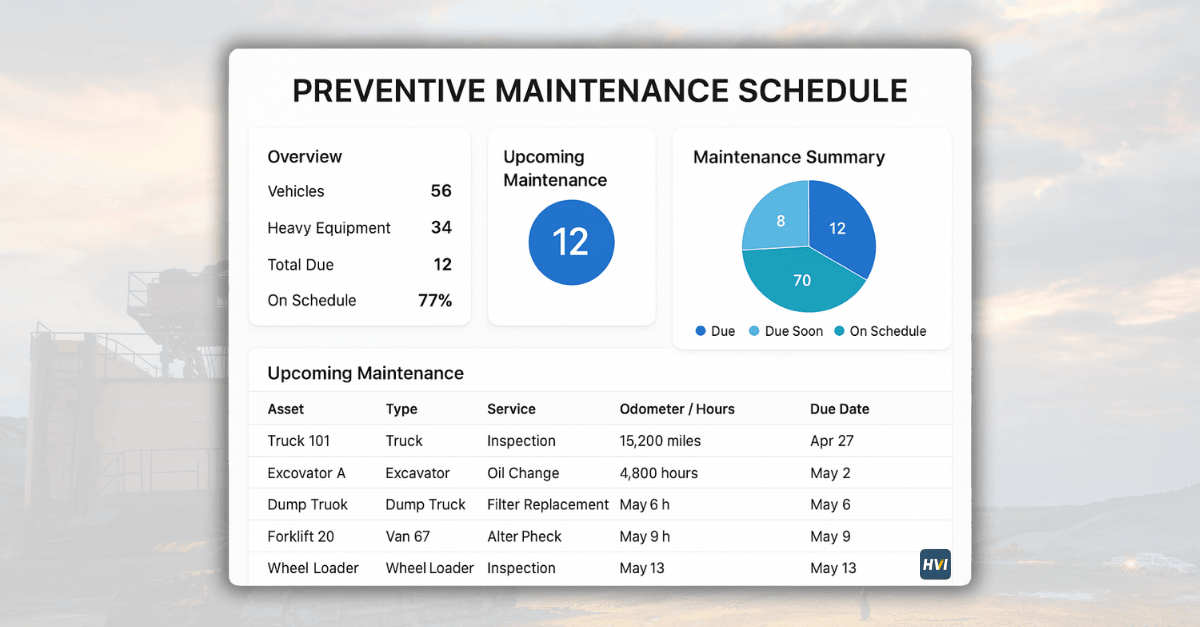
See how a PM schedule looks when telematics data drives it — every meter reading live, every threshold auto-tracked, every service triggered by actual vehicle usage
Why calendar-based PM programs fail
Most fleets still schedule PMs on the calendar — "oil change every 90 days" — or on a spreadsheet where someone types in odometer readings weekly. Both approaches sound reasonable in theory. Both fail in practice for the same reason: the calendar doesn't know how hard the truck worked, and hand-entered mileage drifts from reality within weeks.
- Long-haul truck at 130,000 mi/year hits oil-change interval every 60 days — but the calendar says 90
- Local delivery truck at 40,000 mi/year still gets oil changes every 90 days — wasting $180 per change
- Odometer entered wrong by 5,000 mi in March; discovered in July after a bearing failure
- Reminders miss when the responsible person is on vacation, at another site, or leaves the company
- Brake inspections timed on months when the truck actually needs them timed on engine hours
- PM compliance rate typically 60-75% because of the above accumulated errors
- Every truck's PM triggers off its own actual mileage — hard-working trucks serviced more often, light-duty less
- Odometer sync is automatic and continuous — drift is mathematically impossible
- Reminders fire against real thresholds regardless of who's in the office
- Engine-hour based triggers (brakes, transmission) run off CAN bus data, not paper logs
- Fault-code arrivals trigger their own event-driven work orders alongside PM cycles
- PM compliance rate typically 95%+ within the first quarter of migration
Every failure mode on the calendar side traces to the same root cause: the human hand entering the wrong number at the wrong time. Removing that hand from the workflow is what makes meter-based PM programs run at 95%+ compliance. Book a demo to see meter-based PM configured on your existing telematics data
The 6 telematics data points that drive maintenance decisions
Not every data stream from telematics matters for maintenance. Six specific data points do the heavy lifting — and integrating each one into the PM system unlocks a different maintenance capability.
Live Odometer
The foundation of all mileage-based PM. Streams continuously from the ELD or telematics device via J1939. Eliminates hand-entry drift, no-longer-current spreadsheet entries, and the "we thought it had 220K miles but it has 240K" surprise.
Drives: oil changes, filter replacements, transmission service, drivetrain PMsEngine Hours
Runtime-based metric more accurate than mileage for many components. A truck idling in a yard accumulates engine wear without adding miles — hour-based PMs catch this exposure that mileage-based schedules miss entirely.
Drives: brake inspections, hydraulic service, generator maintenance, PTO service intervalsFault Codes (DTCs)
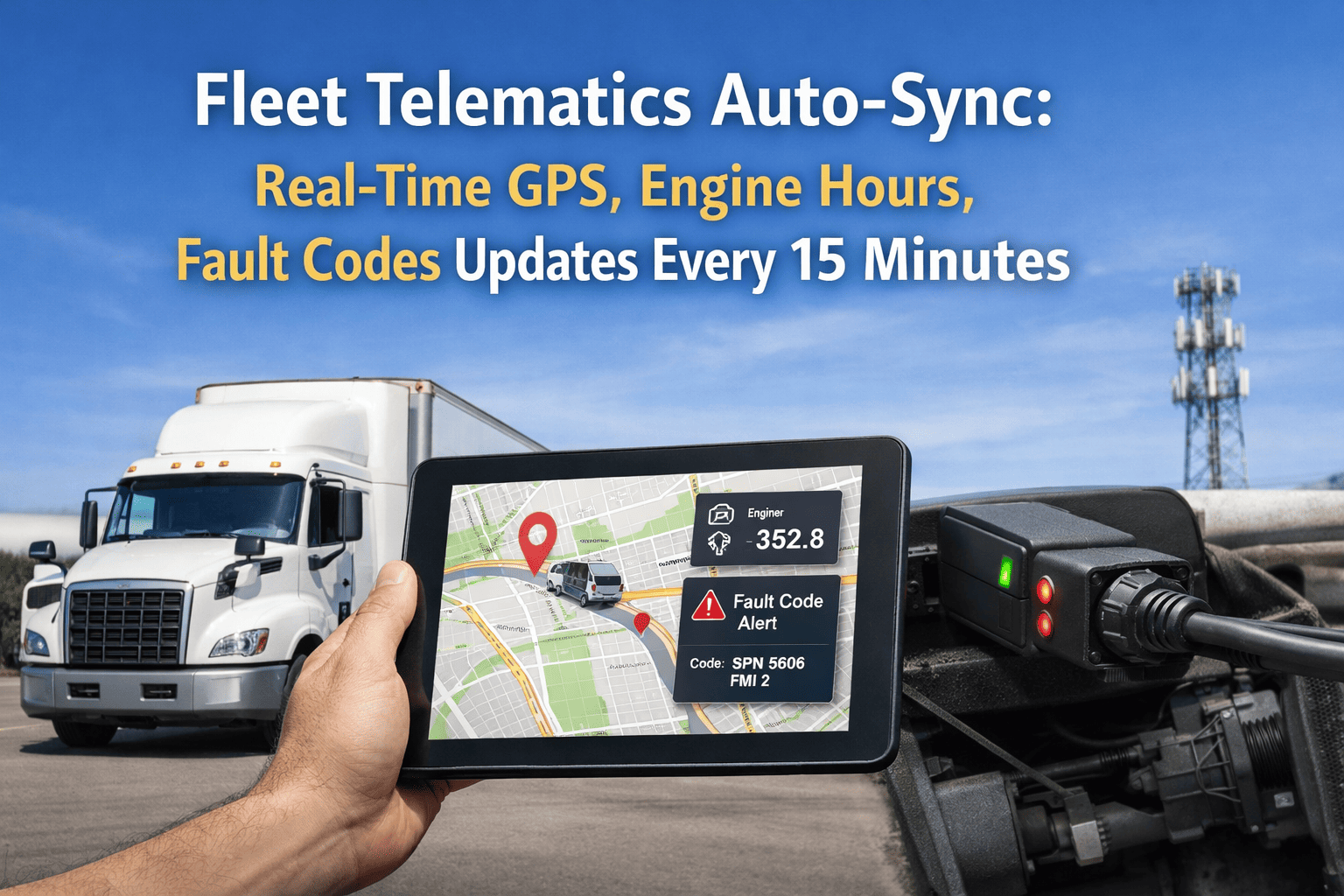
Diagnostic trouble codes read directly from the CAN bus. Severity-tagged and translated to human-readable failure descriptions. Auto-generates work orders for critical codes, alerts for advisory codes.
Drives: unplanned repairs, event-driven work orders, warranty tracking, root-cause analysisFuel Consumption & MPG
Fuel-per-mile trend is one of the earliest indicators of mechanical drift — degrading injectors, dragging brakes, tire pressure loss, aerodynamic damage. A truck's MPG dropping 5% typically precedes a maintenance event by 3-6 weeks.
Drives: fuel-efficiency PMs, driver coaching, tire management, aerodynamic-fairing checksIdle Time
Idle hours accumulate engine wear equivalent to about 25 miles of driving per hour of idle. Fleets with high idle patterns need shorter PM intervals on aftertreatment components (DPF, DEF, EGR) — something calendar-based PM can't account for.
Drives: DPF regen tracking, DEF consumption, aftertreatment PM intervals, idle-reduction coachingHard Events
Hard braking, hard acceleration, and hard cornering events indicate component stress. A truck with 3x fleet-average hard-brake events needs brake inspection intervals compressed. Component-level wear signals live inside telematics data most fleets ignore.
Drives: adaptive brake service, tire wear predictions, suspension inspection intervals, driver coachingPrograms that integrate all six data points typically produce the tightest PM compliance and lowest unplanned failure rates. Programs that integrate only 1-2 (usually odometer) capture roughly 40% of the total maintenance benefit available. Book a demo to see all six data points configured against your existing PM program
Designing a meter-based PM program — the 5-step build
Migrating a PM program from calendar to meter-based isn't a one-click switch — it's a five-step build that most fleets complete in 30-45 days. Done right, it produces a program that maintains itself for years afterward without manual scheduling overhead.
Break the PM program into service tiers. Classic A/B/C-Service model: A-Service (oil, filters, fluids — every 25K), B-Service (chassis, brakes, drivetrain — every 50K), C-Service (major inspection — annually or every 100K). Larger fleets add D-Service for major overhauls. Each tier gets its own trigger definition.
For each service tier, choose the driving metric: miles, engine hours, or hybrid. Most fleets use miles for A-Service, engine hours for B-Service brake work, and mixed miles/months for C-Service (whichever comes first). Set the meter thresholds based on OEM guidance, historical wear data, and duty cycle.
PM scheduling isn't binary. Configure a "warning" threshold (typically 90% of interval remaining) that alerts the shop to plan the service, and an "overdue" threshold (100%+) that triggers escalation. Buffers give the shop the runway to plan against dispatch schedules instead of forcing emergency swaps.
Who receives the alert when a PM approaches? Who assigns the technician? Who signs off on completion? Configure the workflow so alerts route to the right role automatically — shop foreman for routine PMs, maintenance manager for major services, safety manager for compliance-related inspections.
PM cycles handle routine wear. Fault codes handle events. Configure event-driven work order creation for critical DTCs (check-engine, brake system warnings, DPF regen failures) so component-specific issues create their own tickets in parallel with the routine PM schedule.
The 5-step build takes 30-45 days for most mid-size fleets. Larger fleets with multiple vehicle classes may add 2-3 weeks to configure per-class trigger sets. Start a free trial to walk through the 5-step build with pre-loaded templates for Class 6-8 duty cycles.
What changes when PM runs on telematics
The operational metrics that shift most on telematics-driven PM programs. All numbers reflect typical mid-sized fleet performance in the first 12 months post-migration.
Up from typical 60-75% on calendar-based programs. The gap is the difference between "we scheduled it" and "it actually happened."
Component failures caught during scheduled service instead of on the highway. Roadside events drop measurably within 6 months.
No more Monday morning spreadsheet reconciliation, no more calling driver phones to ask "what's the odometer on 4472?"
Right-sized PM intervals + fewer emergency repairs + better warranty capture combine into a meaningful cost-per-mile improvement.
The four impact categories compound — better compliance drives fewer failures, which drives lower cost per mile, which recovers admin time to focus on higher-value work. Book a demo to see the specific impact model calculated on your fleet's telematics data
6 common telematics-PM integration pitfalls
Not every telematics-PM integration lands cleanly. Six specific pitfalls trip up fleets making the transition — each avoidable if you know to watch for it.
"Oil every 90 days" isn't the same interval on a long-haul as on a local delivery truck. Reset the intervals based on OEM guidance and actual duty cycle when you switch to meter-based — don't just translate the calendar version.
Trucks with high idle patterns burn engine hours faster than mileage suggests. If a truck idles 30% of engine-on time, its brake and aftertreatment PMs need to run on engine hours — not miles — or the intervals are effectively lengthened by 30%.
PM schedules handle wear. Fault codes handle events. Fleets that only run scheduled PMs miss the between-cycle DTCs that predict imminent failure. Configure both flows or you get half the benefit.
PM alerts to a maintenance manager's inbox at 2 AM don't route the work. Configure the alert workflow so approaching-due PMs hit the shop foreman during business hours, and overdue PMs escalate to the maintenance manager immediately.
Rolling telematics-driven PM to the full fleet in one shot invites edge-case failures nobody anticipated. Run the new program on 10-15 vehicles for 4-6 weeks first, tune the trigger definitions and workflows, then roll to the full fleet.
Every completed PM is a compliance artifact — auditors want to see documented service history. Ensure PM completion in the maintenance system also updates the compliance record automatically. If they're separate systems, gaps appear.
Each pitfall above is an operational lesson learned by fleets that shipped fast without piloting. Skipping them saves 2-4 weeks of firefighting during the first 90 days of the new program. Start a free trial to walk the pilot phase with pre-built templates that avoid every pitfall on this list.
From a maintenance director who cut unplanned failures by 41%
Our PM compliance rate hovered around 68% for years. Not because we didn't schedule the work — we scheduled everything. The gap was between the schedule and reality. Drivers hand-entered odometer readings once a week, and by the time the number got into our spreadsheet it was already 500-1,500 miles off. Some trucks got serviced early. Most got serviced late. A few got completely missed for months.
Telematics integration killed all of that in about 30 days. Odometers and engine hours stream live into the PM system. Alerts fire against real thresholds. Compliance rate hit 96% in the first quarter and hasn't dropped below 94% since. Unplanned failures on the road dropped 41% in the first year — not from new equipment, just from finally servicing the equipment we had when it actually needed it.
Frequently asked questions
What is telematics integration for fleet maintenance?
Telematics integration for fleet maintenance is the connection between the telematics or ELD platform in each vehicle and the fleet's maintenance management system, so that live vehicle data (odometer, engine hours, fault codes, fuel consumption, idle time, hard events) drives the preventive maintenance program automatically. Without integration, maintenance managers manually enter meter readings weekly, schedule PMs on calendar dates that don't reflect actual truck usage, and miss fault codes that could have predicted failures. With integration, meter readings sync continuously, PM schedules trigger against real vehicle usage thresholds, fault codes auto-create work orders in real time, and the entire program runs without manual data entry. Integration typically happens via native API connection between the telematics provider (Samsara, Motive, Geotab, Verizon Connect, Omnitracs, and others) and the maintenance platform. The business impact is significant: PM compliance rates typically rise from 60-75% to 95%+, unplanned failures drop 30-50%, and maintenance managers recover 4-8 hours per week of admin time previously spent on manual meter tracking and reconciliation.
Which telematics providers integrate with fleet maintenance software?
Most major FMCSA-registered ELD and telematics providers offer API integration with fleet maintenance platforms. HVI integrates natively with Samsara, Motive (formerly KeepTruckin), Geotab, Verizon Connect, Omnitracs (now Solera), Trimble/PeopleNet, EROAD, ISAAC Instruments, and Fleet Complete. For providers not on the native-integration list, HVI supports generic API and webhook connections with any FMCSA-registered telematics platform that exposes an API — which is now the vast majority of providers in the US market. Native integrations typically go live in 2-5 business days from the fleet providing API credentials. Generic API integrations add 1-2 weeks for custom data mapping. Fleets running multiple telematics providers across acquired subsidiaries or regional operations can maintain simultaneous connections to different platforms, with the data normalized into a unified schema before it reaches the maintenance module. This preserves existing hardware investments and avoids the cost and disruption of standardizing on a single telematics vendor before maintenance modernization can happen.
How does meter-based PM differ from calendar-based PM?
Calendar-based PM schedules service based on time elapsed since the last service — "every 90 days" or "every 6 months." Meter-based PM schedules service based on actual vehicle usage — "every 25,000 miles" or "every 500 engine hours." The critical difference: calendars don't know how hard the truck worked. A long-haul truck running 130,000 miles per year hits maintenance thresholds much faster than a local delivery truck running 40,000 miles per year, but calendar-based programs treat both identically. The result is that long-haul trucks are chronically under-maintained (calendar interval is longer than the truck needs) while local trucks are over-maintained (paying for services the truck didn't need yet). Meter-based PM, driven by live telematics data, sizes each PM cycle to the actual work the vehicle has done. Hard-working trucks get serviced more often; light-duty trucks get serviced less often. The overall PM budget stays roughly the same, but the timing of services aligns with actual wear — which is what produces the compliance and downtime improvements. Meter-based programs also eliminate the manual meter-entry drift that plagues calendar programs, where odometer readings entered by hand from paper logs are consistently wrong by hundreds or thousands of miles.
How long does it take to migrate from calendar-based to telematics-driven PM?
Most mid-sized fleets (20-100 tractors) complete the migration in 30-45 days end-to-end, following a 5-step build path: (1) define PM service tiers (A/B/C service, or custom levels for your fleet); (2) set meter-based triggers per tier based on OEM guidance and duty cycle; (3) configure warning and overdue buffers for planning runway; (4) set up approval and assignment workflows so alerts route to the right roles; (5) enable event-driven fault-code triggers alongside routine PM cycles. Larger fleets (250+ vehicles) may add 2-3 weeks to configure per-class trigger sets, since Class 6, Class 7, Class 8, and specialty vehicles typically need distinct PM programs. The migration doesn't disrupt operations — existing scheduled PMs continue on their calendar until the meter-based replacement is validated in the pilot phase (typically weeks 3-4), at which point the new program takes over. Fleets that pilot on 10-15% of the fleet before full rollout typically see the smoothest transitions. Fleets that skip piloting occasionally hit edge cases that require workflow adjustments during full-fleet operations.
What ROI can I expect from telematics-driven PM?
Return on investment comes from four categories, all measurable within the first 12 months post-migration. First, unplanned downtime reduction: fleets typically see 30-50% fewer roadside failures and emergency repairs as PM compliance rises and component wear is caught during scheduled service. On a typical Class 8 tractor, one avoided roadside breakdown pays for a year of platform subscription for that vehicle. Second, PM compliance improvement: from a typical 60-75% baseline on calendar programs to 95%+ on meter-driven programs, directly reducing warranty forfeitures, insurance premium increases from CSA violations, and the compounding wear from missed intervals. Third, admin labor recovery: maintenance managers typically recover 4-8 hours per week previously spent on manual meter tracking, spreadsheet reconciliation, and phone calls chasing odometer readings from drivers. Fourth, maintenance cost per mile drops 15-25% as right-sized PM intervals reduce over-servicing on light-duty vehicles while catching wear on hard-working vehicles before it becomes catastrophic. Combined, most fleets see the platform pay for itself within the first quarter, with compounding benefits accruing across subsequent quarters as data quality improves and predictive patterns emerge from the accumulated maintenance history.
The PM program that maintains itself — because the trucks tell it what to do
HVI reads odometer, engine hours, fault codes, fuel data, and hard events directly from your telematics provider — and runs your entire PM program off live vehicle data. No calendar drift. No missed intervals. Live in under two weeks. 95%+ PM compliance inside the first quarter.
No credit card · Works with Samsara, Motive, Geotab, Verizon Connect · 30-45 day migration

.png)