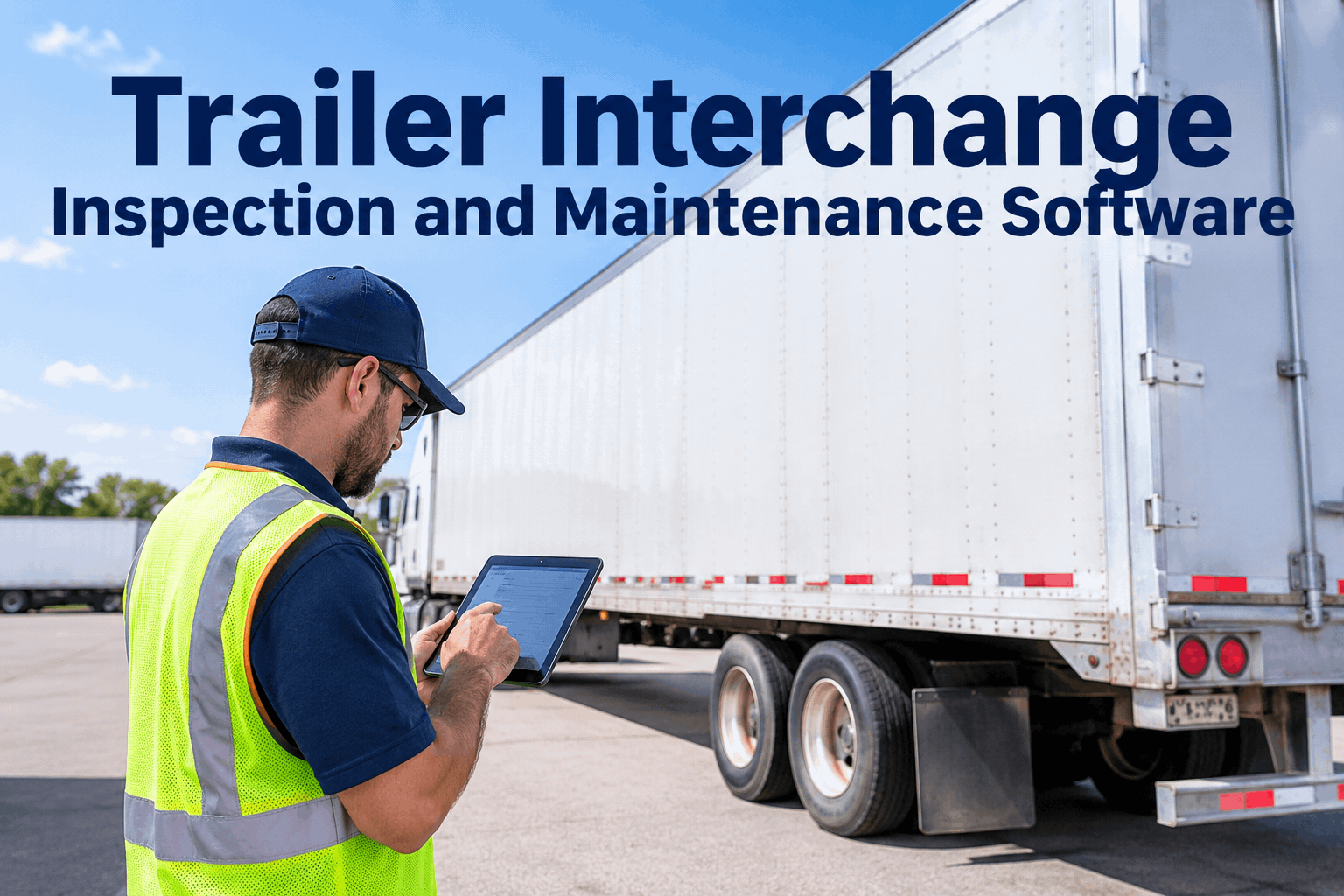
Three weeks after you dropped a dry van at the interchange yard, a damage bill for $2,400 lands on your desk — a bent ICC bar nobody photographed, on a trailer you held for eleven days. Was that dent there when you picked it up? Nobody can prove it either way, so you pay. Trailer interchange inspection and maintenance software exists to end that argument before it starts, with a timestamped, photo-backed condition record at every handoff. Book a demo to see it on your interchange fleet
Prove the Dent Wasn't Yours Before the Bill Shows Up
A photo-backed digital inspection at every pickup and return, defects routed straight to a work order, and one searchable condition history per trailer — so a disputed charge gets settled in a minute, not a month.
The handoff is where the liability startswhy trailer interchange inspection software matters the moment custody changes
Under a UIIA or a carrier-to-carrier interchange agreement, whoever has the trailer when the damage is found usually pays for it — unless they can prove it was already there. A paper Equipment Interchange Receipt with a rushed checkbox and a scrawled signature almost never holds up against a photo. Three handoffs decide whether you win that argument.
-
1
Pickup
Condition documented with photos the moment the trailer comes into your custody — before it ever moves.
-
2
In your custody
Any new defect found during the run is logged immediately, tied to a date and driver — not discovered weeks later.
-
3
Return
A second photo-backed inspection, compared against the pickup record, closes the loop before the trailer leaves your yard.
Paper EIR vs. a digital interchange inspectionwhat actually holds up when a damage claim gets disputed
A paper form proves someone looked at the trailer. It rarely proves what they saw. Here's the difference when a claim actually gets contested.
| What matters in a dispute | Paper EIR | Digital interchange inspection |
|---|---|---|
| Photo evidence of condition | Rarely attached, easy to lose | Timestamped photos on every item |
| Signature & timestamp | Handwritten, easy to dispute | Captured automatically, GPS-tagged |
| Finding the record later | Filing cabinet or a driver's cab | Searchable by trailer, date, or carrier |
| Pickup vs. return comparison | Manual, often skipped | Side-by-side condition history per trailer |
| Time to resolve a claim | Days to weeks, chasing paperwork | Minutes — the record already exists |
HVI's digital inspection turns every pickup and return into that right-hand column automatically. Book a demo to see a side-by-side condition comparison
The six damage points every interchange inspection has to catchwhat a trailer interchange checklist needs beyond a generic DOT form
A standard pre-trip form checks for safety. An interchange inspection has to document ownership of damage too — these are the points that end up in a claim.
Tires & wheels
Tread depth, sidewall cuts, missing lug nuts, rim damage — the first thing a receiving carrier checks and disputes.
Doors, seals & locks
Hinge damage, broken seals, locking bar condition — disputed constantly since cargo claims often ride on it.
Lights & electrical
Marker and brake lights, ABS harness, 7-way connector — the easiest items to miss on a rushed walkaround.
Floor & structure
Floor boards, crossmembers, roof bows — forklift damage and load impact that's expensive and easy to argue over.
ICC bar & bumper
The most commonly disputed item on a return — a bent ICC bar is near-impossible to blame on a prior holder without a photo.
Brakes & landing gear
Pad wear, air-line condition, landing gear crank function — safety items that also carry liability weight in a claim.
HVI lets you build the interchange template to your UIIA or carrier agreement's exact condition categories. Book a demo to see your interchange checklist built
From flagged defect to a resolved disputehow trailer interchange inspection software works in practice
-
1
Driver inspects the trailer at pickup
A guided interchange checklist on a phone — tires, doors, lights, floor, ICC bar — with a photo on every flagged item, in minutes.
-
2
Condition is signed and timestamped
The record attaches to that exact trailer number, GPS-tagged to the yard, replacing the handwritten EIR entirely.
-
3
A defect becomes a work order in one tap
Anything flagged routes straight to a work order if it's yours to fix, or stays on the record as pre-existing if it isn't.
-
4
Return inspection compares against pickup
Side by side, photo against photo — new damage is obvious, and so is what was already there.
-
5
It lands in that trailer's history
Every handoff writes to the trailer's record and feeds cost-per-trailer reporting, so repeat disputed charges stand out fast.
Maintenance doesn't stop because the trailer's sharedpreventive maintenance for interchange and pool trailers
A trailer that moves between carriers still wears on a clock — tires, brakes, and lights don't pause because it's out of your yard. Meter and date-based PM scheduling keeps every trailer in the pool serviced on schedule, whoever's holding it.
Full photo inspection logged before the trailer leaves the yard — your proof of condition on day one.
Brake adjustment, tire rotation and tread check, lighting test — the interval most pool trailers hit regardless of holder.
Full federal annual inspection and certification, documented and attached to the trailer's permanent record.
Matching photo inspection compared to pickup, closing the custody record before it changes hands again.
The trailer interchange pickup checklistwhat every trailer interchange inspection should cover at the handoff
This is the walkaround that protects you the next time a damage claim shows up. In HVI it's a guided digital template — tick, flag, photo — built around interchange liability, not just a safety pass.
Most intermodal and drayage interchange runs under the UIIA (Uniform Intermodal Interchange and Facilities Access Agreement), which puts documented condition at the center of who pays for damage. This checklist, run digitally at every handoff, is the single highest-leverage thing you can put between your fleet and the next disputed invoice. For the daily DOT side of trailer inspections, see our full trailer inspection checklist. Book a demo and see it live on one screen
From an asset manager who handles interchange disputes weekly
We run a pool of chassis and dry vans that move between three carriers, and for years our only defense in a damage dispute was whatever the driver remembered to write on the EIR. Half the time it was a checkbox with no detail, and we ate the charge because we couldn't prove the dent wasn't ours.
Switching to photo inspections at every pickup and return changed that completely. Now when a claim comes in, I pull up the trailer's record, compare the two photo sets, and the conversation's over in five minutes instead of two weeks of back-and-forth with the other carrier's claims desk.
What a photo-backed handoff is actually worththe payback case for trailer interchange inspection software
Frequently asked questions
What is trailer interchange inspection software?
It's a mobile-first digital inspection system that documents trailer condition with photos at every pickup and return, replacing the paper EIR so damage liability can be proven instead of argued. Book a demo to see it on your trailer pool.
What is an EIR in trailer interchange?
An Equipment Interchange Receipt is the condition record signed at pickup and return under a carrier interchange or UIIA agreement. A digital version adds photos and timestamps a paper form rarely has.
Who pays for trailer damage found during interchange?
Generally whoever had custody when the damage occurred, which is why a documented condition at both pickup and return matters — without it, the carrier holding the trailer at discovery often pays by default.
Does interchange software replace the daily DOT inspection?
No, it runs alongside it. See our full trailer inspection checklist for the daily DOT-focused walkaround.
Can this work for intermodal chassis as well as dry vans?
Yes, the same photo-backed handoff model applies to chassis interchange too. Start a free trial to build a template for your equipment mix.
Stop losing disputes you should be winning
HVI gives every driver a photo-backed interchange inspection at pickup and return, routes flagged defects straight to a work order, and keeps one searchable condition record per trailer — so the next disputed charge gets settled with evidence, not a guess. Live on your fleet in under two weeks.
- Photo-backed pickup & return inspections
- Defect → work order in one tap
- Side-by-side condition comparison
- One searchable record per trailer