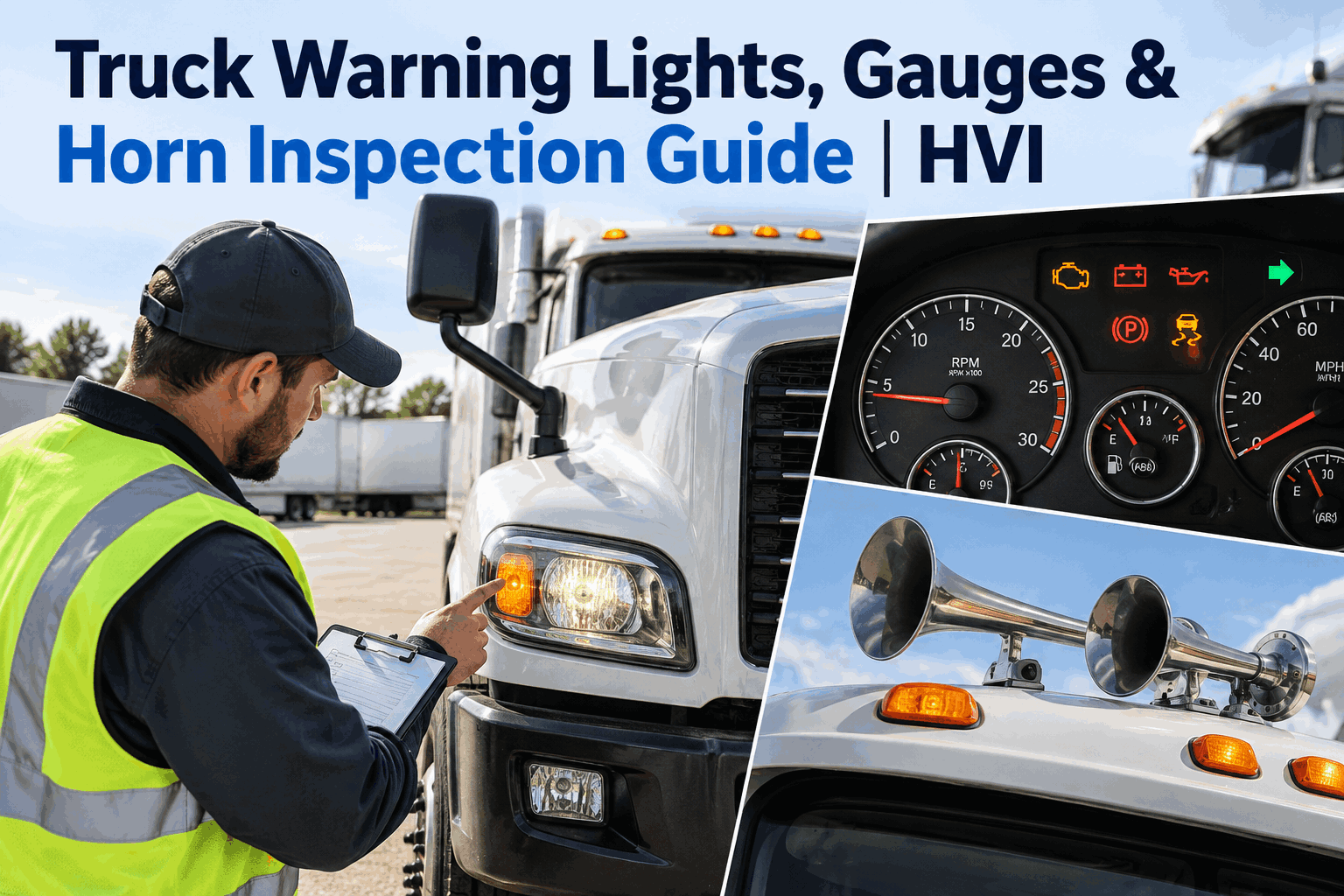
A proper truck warning lights inspection is the fastest safety check you'll ever do — and the easiest one to fake. Turn the key, watch a light flicker and go out, and it's tempting to call it good. But a burned-out warning bulb, a gauge frozen on "normal," or a low-air buzzer that never sounds all look exactly like a truck that's fine. That's the trap this guide is about. Book a demo to see it caught digitally.
The Dash Is the Truck Telling You What's Wrong
Warning lights, gauges and the low-air buzzer are the truck's own report on itself. Inspecting them means proving each one still works — not just glancing at a dark dashboard and moving on.
Here's the full walk — how to read the key-on self-test, what each warning color actually demands of you, how to catch a gauge that's lying, how to prove the low-air buzzer and horn still work, and how to turn every one of those checks into a defect that gets fixed instead of forgotten.
Start with the key-on bulb checkthe self-test that proves the warnings can warn
Turn the ignition to the run position without cranking, and the instrument cluster runs a self-test: nearly every warning lamp lights for a second or two, then goes out as each system reports in. This is the single most useful part of a warning lights inspection, because it's the only time you can confirm a lamp actually works.
The danger is the light that never comes on at all. A dashboard with no lights looks like a healthy truck, but a burned-out oil-pressure or ABS lamp means the one warning you'd rely on in a real failure simply won't appear. So the check isn't "are the lights off?" — it's "did they all light first, then clear?"
A trailer ABS lamp is a common one drivers miss — on many rigs it should light at key-on and then go out once the trailer is connected and moving. If you don't know your truck's normal self-test pattern, note it once and check against it every day. Book a demo to see the bulb check built into a daily inspection
Decode the warning lights by colorred means stop, amber means service, and neither means "later"
Warning lamps follow a color language that's consistent across almost every heavy truck. Red is a stop-now condition that can wreck the engine or the brakes. Amber is a service-soon fault the truck can usually limp with, but not ignore. Knowing the difference is what turns a lit dash from panic into a decision.
- Low oil pressure — keep driving and the engine can seize
- High coolant temp — overheating on the way to a cracked head
- Low air pressure — brakes are minutes from locking up
- Brake system / park brake — a braking fault, not a nuisance
- Check engine (MIL) — an emissions or engine fault stored in the ECU
- ABS — anti-lock is offline; normal braking still works
- Low DEF / aftertreatment — ignore it and the truck derates
- Low fuel, water-in-fuel — act before it becomes a roadside stop
The mistake that costs the most is treating an amber light as optional. A check-engine lamp for a minor sensor and one for a de-rate countdown look identical on the dash — only a scan tool tells them apart, which is why an amber light belongs on the defect list, not in the "I'll watch it" pile. Start free and log every lit lamp with a photo so nothing gets waved off.
Cross-check the gauges — don't trust the needlea gauge reading "normal" can be a gauge that's dead
Gauges are quieter liars than warning lights. A needle sitting mid-scale looks reassuring, but a gauge that's stuck, a sender that's failed, or a reading that never moves gives you the exact same picture as a healthy system. The fix is to make each gauge prove itself against what the engine is actually doing.
| Gauge | What it should show | How to prove it's real |
|---|---|---|
| Air pressure (primary & secondary) | Builds to ~120–135 psi, both needles tracking together | Watch it build from zero at start-up; a needle that won't climb or lags the other is a fault |
| Oil pressure | Rises right after start, steady at idle and cruise | Should jump within seconds of start; a slow or flat needle means low pressure or a dead sender |
| Coolant temperature | Climbs to operating range and holds | Must move off cold as the engine warms; a needle stuck on cold is a failed gauge or thermostat |
| Voltmeter / charge | ~13.5–14.5 V with the engine running | Reads battery voltage at key-on, then rises once running; no rise means the alternator isn't charging |
| Fuel & DEF level | Moves as tanks fill and drain | A level that never changes over a shift is a stuck sender, not a full tank |
The tell across all of them is movement. A gauge that reacts to what the truck is doing is working; a gauge that sits perfectly still through start-up, warm-up and a shift is the one to distrust. Note the reading, not just "gauges OK," so a slow drift shows up over days. Book a demo to capture gauge readings on every inspection
Test the warning devices — the buzzer and the hornthe low-air alarm and horn only count if you hear them work
Lights and gauges are things you look at. The warning devices are things you have to hear — and the only way to inspect a sound is to make it happen. Two matter most every day: the low-air warning that tells you the brakes are about to fail, and the horn that keeps a spotter or pedestrian alive.
With the engine off and key on, fan the service brake to bleed air down slowly. The warning light and buzzer must activate at or before 60 psi — the threshold set by U.S. federal rule 49 CFR 393.51. If the alarm never sounds before 60, the one warning standing between a driver and no brakes is dead.
Sound the electric city horn and, where fitted, the air horn. Both should be loud and immediate. A weak or dead horn isn't a comfort issue — on a jobsite or backing into a dock it's the difference between a warning and a collision, and it's a standard equipment defect on any inspection.
Both of these are pass/fail, and both are easy to skip because they take a deliberate action rather than a glance. Building them into a set daily routine is how they actually get done. For the full brake-side procedure, see HVI's 7-step DOT air brake test, which walks the low-air alarm in context. Book a demo to make buzzer and horn checks required, not optional
Turn every dash finding into a routed defectthe check only matters if the fault reaches the shop
Here's where most warning-light checks quietly fail: the driver sees a lit lamp, means to mention it, and by end of shift it's gone from memory. A finding that lives in someone's head isn't an inspection — it's a near miss waiting to repeat. The point of checking the dash is to move a fault from the cab to the shop, with proof.
- Light noted in a margin, if at all
- No photo, no timestamp, easy to dispute
- Slip gets lost between cab and office
- Same fault reappears with no history
- Failed item becomes a defect instantly
- Photo of the cluster attached as proof
- Work order routes to the shop automatically
- Repeat faults surface per unit in analytics
That last point is the quiet win. When the same ABS lamp or the same dead gauge shows up on one truck month after month, analytics makes the pattern obvious instead of letting each report look like a one-off. This is the same defect-routing backbone behind HVI's daily operator reporting and DVIR workflow. Start free and route your first dash defect today.
From a fleet safety manager
The one that made me a believer was a low-air buzzer that never sounded — the driver had gotten used to it being quiet and just watched the gauge instead. Once we made the key-on bulb check and the 60-psi buzzer test tap-to-confirm items, dead warnings stopped slipping through. Now if a lamp or buzzer fails, it's a photo and a work order before the truck leaves the yard, not a story I hear about after something happens.
How HVI keeps the cab check honestdigital inspection, instant defects, per-unit trends
A warning lights inspection is only as good as the record it leaves. HVI's fleet inspection, defect routing and analytics turn the daily dash check from a glance into proof — captured, routed and trended without a paper slip in sight.
Check the dash on a phone
Bulb check, gauges, buzzer and horn as tap-to-confirm items — nothing gets skipped by habit.
Route the failure as a defect
A failed item plus a cluster photo becomes a work order to the shop, timestamped to the unit.
Trend repeat faults per unit
Analytics surfaces the truck that keeps throwing the same lamp, so it gets fixed for good.
See how the dash check, defect routing and per-unit history sit on one screen inside HVI's fleet inspection. Line it up in a quick demo
Truck warning lights inspection: quick answers
What should happen to the warning lights when I turn the key on?
With the key in the run position and the engine off, the cluster runs a self-test: nearly every warning lamp should light for a second or two, then go out as each system reports in. A lamp that never lights at all is a burned-out bulb, which means that warning won't appear when a real fault happens. A lamp that stays on after the self-test is a live fault to investigate.
What's the difference between a red and an amber warning light?
Red means stop safely now — conditions like low oil pressure, high coolant temperature, low air pressure or a brake fault can cause serious damage or a loss of braking if you keep driving. Amber means service soon — faults like check-engine, ABS, or low DEF that the truck can usually operate with briefly but shouldn't ignore. Both belong on the defect list; the color tells you how urgently to act.
At what air pressure should the low-air warning activate?
On U.S. commercial vehicles the low-air warning light and buzzer must activate at or before 60 psi, per federal rule 49 CFR 393.51. To test it, turn the engine off with the key on, then fan the service brake to bleed pressure down slowly and confirm the alarm sounds before the gauge drops to 60 psi. If it doesn't, the warning device has failed and the truck should be flagged.
How do I know if a gauge is broken if it reads normal?
The tell is movement. A working gauge reacts to what the engine is doing — oil pressure jumps within seconds of start, coolant temperature climbs off cold as the engine warms, and air pressure builds from zero. A needle that sits perfectly still through start-up, warm-up and a whole shift is likely stuck or has a failed sender, even if the reading looks fine. Record the actual reading, not just "gauges OK," so slow drift shows up over time.
How does HVI help with warning light and gauge inspections?
HVI turns the cab check into tap-to-confirm inspection items — the key-on bulb check, gauge readings, low-air buzzer test and horn test. Any failed item becomes a defect with a photo attached, routed automatically to the shop as a work order on that unit. Its analytics then surface trucks that repeatedly throw the same lamp or gauge fault, so recurring problems get fixed instead of re-reported.
Stop letting a dead warning light slip through
HVI makes the bulb check, gauge readings, low-air buzzer and horn tap-to-confirm items, turns any failure into a photo-backed work order, and trends repeat faults per unit. The dash stops being a glance and becomes proof the warnings still work.
No credit card · Cab & dash inspection ready on day one
- Key-on bulb check pass/fail
- Gauge readings, not just "OK"
- Low-air buzzer test at 60 psi
- Horn test — city & air
- Photo-backed defect per fault