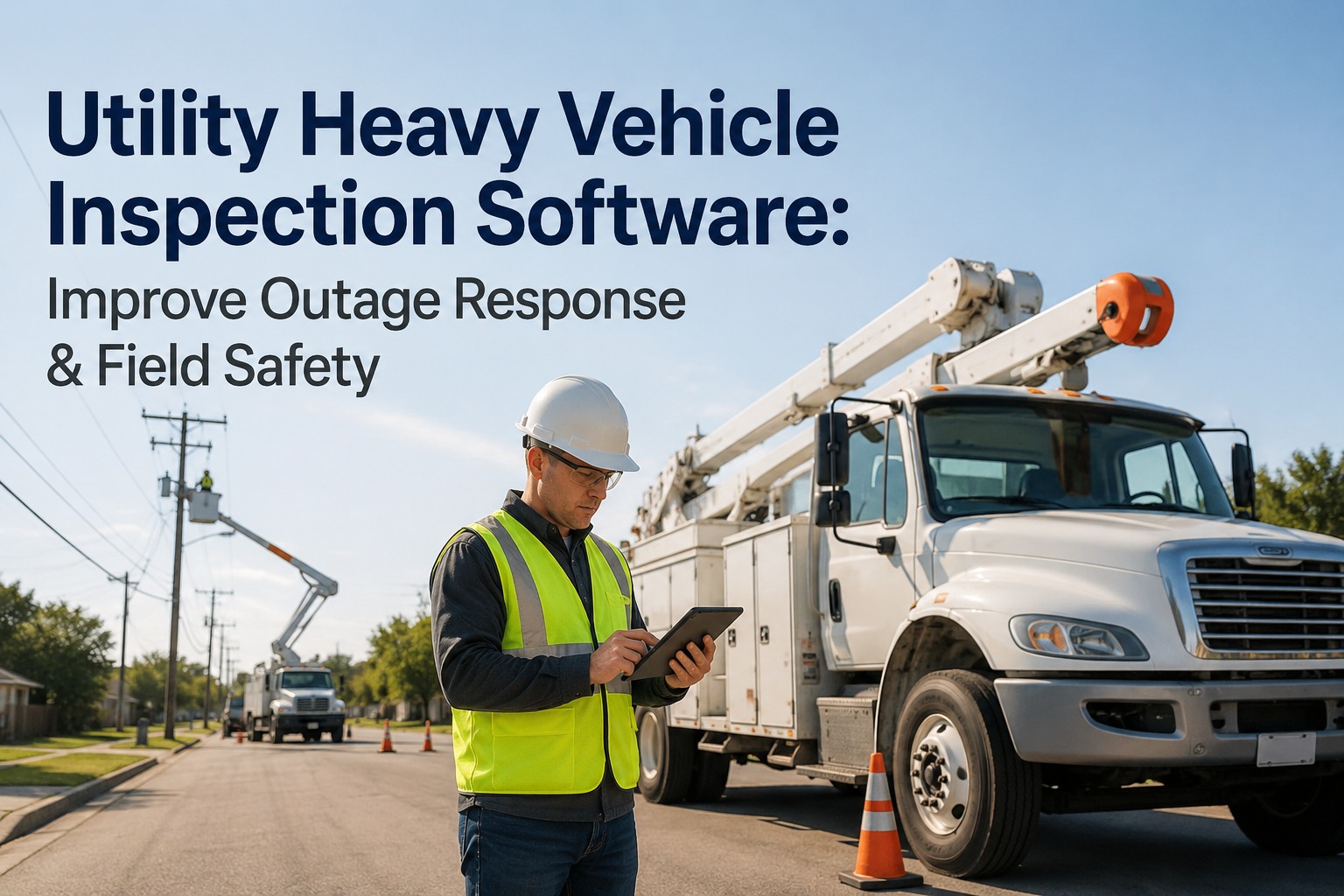
A utility heavy vehicle is held to a higher standard than almost anything else on the road, because it does two jobs at once: it's a DOT-regulated truck, and it's a piece of life-safety equipment that puts a lineworker next to energized conductors at a hundred feet. A bucket truck, digger derrick, or line truck that fails inspection isn't just a downtime problem — its insulation, hydraulics, and outriggers are the systems standing between a crew and a fatal arc flash or a tip-over. That's why these vehicles carry a stack of obligations a normal fleet never sees: daily pre-use control tests under OSHA 1910.67, the ANSI A92.2 frequent/periodic/annual inspection tiers, and annual dielectric testing of the insulating booms. And there's a second clock running: when a storm knocks out power, the utility's restoration speed depends on every truck being ready to roll the moment the call comes — a unit grounded by a missed inspection or an undocumented defect is a slower outage response. Digital inspection software is how utilities meet both demands at once. This guide covers why utility vehicles are different, the ANSI inspection tiers, the daily pre-use checklist, the outage-readiness payoff, and the safety-critical systems that can't be missed. book a 30-minute walkthrough to see it set up for your fleet.
A utility truck is a DOT vehicle and a life-safety device. The inspection has to protect both the road and the crew.
HVI runs the utility heavy vehicle inspection from a phone — daily pre-use control tests, insulation, hydraulics, and outriggers, plus the ANSI A92.2 frequent, periodic, and annual tiers and dielectric due-dates — flags any defect, tags an unsafe unit out of service, and keeps every rig outage-ready and audit-ready.
Why utility vehicles are different
A line truck answers to more rulebooks than any standard commercial vehicle, because its failure modes are catastrophic. The obligations stack up fast.
Two regimes on one truck: DOT and OSHA/ANSI
Most commercial trucks need only DOT certification. A utility heavy vehicle goes a step further — the specialized aerial equipment is governed by OSHA standards (1910.67 for aerial lifts, 1910.269 for electrical line work) that incorporate ANSI A92.2 for vehicle-mounted aerial devices and A10.31 for digger derricks. ANSI standards are technically "voluntary recommended practices," but OSHA references them by reference, which gives them the force of law. The practical result: a bucket truck must pass a daily pre-use check, a frequent inspection at 3 months or 150 hours, an annual inspection within 13 months, and an annual dielectric test — none of which appear on a standard fleet's checklist.
The ANSI A92.2 inspection tiers
Aerial devices follow a layered inspection schedule, each tier deeper than the last and triggered differently. Knowing which is due keeps the fleet legal.
Frequent (pre-use) inspection
A daily or before-first-use check by the operator, and each shift using the lift performs its own. OSHA 1910.67 also requires the lift controls be tested each day prior to use to confirm safe working condition.
Periodic inspection
A deeper look at structural and internal boom components by a qualified technician, due at 3 months or 150 work hours, whichever comes first — so tracking each truck's hours is essential.
Annual inspection & dielectric
A full annual inspection no later than 13 months from the prior one, by a certified technician, including the annual dielectric test of insulating components on insulated units.
Major structural inspection
Added to ANSI A92.2 in 2021 under 8.2.5, this in-depth structural inspection is required once an aerial device has been in service for fifteen years.
Four of the five inspections are the owner's responsibility, each on a different clock — miss one and the truck is out of compliance the moment it rolls. sign up free and track every ANSI tier and dielectric due-date automatically, or book a demo to see utility inspection scheduling.
The daily pre-use checklist
This is the before-first-use inspection the operator runs every day, covering the chassis and the aerial device. Each item is a pass-or-pull decision.
The items that set a utility truck apart from a generic pre-trip are the insulation, hydraulics, and outrigger systems — the safety-critical three where a failure leads to a catastrophic accident, not just a breakdown. A standard vehicle form checks none of them. HVI builds the chassis and aerial-device items into one utility template with photo capture.
Outage response: the second clock
Beyond compliance, a utility fleet is judged on restoration speed. When the storm hits, inspection readiness is what determines whether trucks roll or sit.
Ready to roll on the call
A truck with a current pre-use record and no open critical defect is dispatch-ready the moment an outage hits. One grounded by a missed inspection or unverified repair is a slower response and a frustrated crew.
Catch the defect before the storm
Daily digital checks surface the worn hose or weak outrigger weeks early, so it's fixed in the yard during normal hours — not discovered when every truck is needed and the shop is slammed.
See fleet status at a glance
A live view of which units are inspected, compliant, and defect-free lets dispatch send the right trucks first instead of discovering an out-of-service rig at the staging area.
Restoration speed is a reliability metric utilities are measured on — and it starts with knowing every truck's readiness before the lights go out. sign up free and keep your storm fleet inspection-ready and dispatch-ready.
The safety-critical three
If an inspection misses anything, it can't be these. Insulation, hydraulics, and outriggers are the systems where failure is catastrophic — and each gets special scrutiny.
Insulation
The FRP boom is the barrier between an energized line and ground. It must be clean, dry, and undamaged, with dielectric testing current — only the booms are tested, not the bucket, so conductive items in the basket must be isolated. A tracking path here is a fatal arc flash.
Hydraulics
The lift, boom, and tool circuits raise the worker and power the equipment. A failed hose or cylinder at height is a falling-boom hazard, so leaks, wear, and pressure are checked before every use and serviced on schedule.
Outriggers
Outriggers keep the truck stable while the boom is extended and loaded. A pad that slips or an interlock that fails is a tip-over with a worker in the air — so deployment, hold, and interlocks are confirmed every time.
margin for a missed defect. On a utility heavy vehicle, the insulation, hydraulic, and outrigger systems don't fail into a breakdown — they fail into an arc flash, a falling boom, or a tip-over with a lineworker a hundred feet up. That's why the daily pre-use check and the ANSI tiers exist, and why documenting them isn't paperwork but proof the crew was protected. HVI makes the safety-critical checks required, photo-verified, and impossible to skip.
Paper checklists vs. HVI
Both technically record an inspection. Only one tracks the ANSI tiers and dielectric dates, covers the safety-critical aerial systems, tags an unsafe unit out of service, and keeps the fleet outage- and audit-ready.
Paper / reactive
- Generic check skips insulation & outriggers
- ANSI frequent/periodic/annual dates tracked by memory
- Dielectric test slips past its due date
- Defects on paper, repairs unverified
- No fleet-wide view when the storm hits
- Audit records scattered across the yard
With HVI software
- Utility template covers insulation, hydraulics & outriggers
- ANSI tiers & dielectric due-dates tracked automatically
- Hour-based triggers for the 150-hour frequent inspection
- Every defect auto-creates a tracked work order
- Live dispatch-ready status across the fleet
- One-click OSHA/ANSI audit export
and ready, every truck. A utility heavy vehicle program has to satisfy DOT, OSHA, and ANSI at once while keeping every rig storm-ready — a burden paper simply can't carry across a fleet. Digital inspection ties the daily pre-use check, the ANSI tier schedule, the dielectric due-dates, the defect-to-repair loop, and the dispatch-ready view into one system. HVI makes utility fleet compliance and outage readiness the same routine.
Frequently asked questions
What inspections does a utility bucket truck require?
A utility aerial device follows a layered schedule under ANSI A92.2 and OSHA. A frequent, or pre-use, inspection is performed daily or before first use by the operator, and each shift using the lift performs its own — OSHA 1910.67 also requires the lift controls be tested each day prior to use. A periodic inspection by a qualified technician is due at 3 months or 150 work hours, whichever comes first, examining structural and internal boom components. An annual inspection by a certified technician must occur no later than 13 months from the prior one, and includes the annual dielectric test on insulated units. A major structural inspection, added to ANSI A92.2 in 2021, is required once the device has been in service for fifteen years. Four of these five are the owner's responsibility. On top of all this, the truck still needs its DOT annual inspection as a commercial motor vehicle. HVI's inspection and maintenance software tracks every tier and due-date automatically. sign up free and stay ahead of every inspection.
What is dielectric testing and when is it required?
Dielectric testing verifies the electrical insulating strength of the fiberglass-reinforced plastic (FRP) components on an insulated aerial device — the upper and lower booms, bucket liners, FRP extensions on digger derricks, tool circuits, and upper control systems. It confirms those insulating parts are properly dissipating electrical current so the boom can serve as the barrier between an energized line and ground. Under ANSI A92.2 and OSHA 1910.269, insulated booms must be dielectrically tested at least once every 12 months, and it's performed by qualified technicians, often as part of the annual inspection. An important nuance: only the booms are tested for insulation, not the bucket itself — so any potentially conductive items in or on the bucket must be isolated from energized parts to avoid an arc flash. The rule applies to any vehicle that carries an insulation rating, even if it isn't currently used on electrical lines. HVI's inspection and maintenance software tracks each unit's dielectric due-date and flags it before it lapses. book a demo to see compliance tracking.
How does inspection software improve outage response?
Outage restoration speed depends on every truck being ready the moment the call comes, and inspection software protects that readiness in three ways. First, it keeps each unit's daily pre-use record current and its critical-defect status visible, so a truck that's compliant and defect-free is immediately dispatch-ready when a storm hits. Second, daily digital checks surface developing problems — a worn hydraulic hose, a weak outrigger, an out-of-date dielectric — weeks early, so they're repaired in the yard during normal hours rather than discovered when every truck is needed at once and the shop is overwhelmed. Third, it gives dispatch a live, fleet-wide view of which units are inspected, compliant, and ready, so the right trucks roll first instead of an out-of-service rig being found at the staging area. Because restoration time is a reliability metric utilities are measured on, that readiness has real value beyond compliance. HVI's inspection and maintenance software delivers the dispatch-ready fleet view and the early-warning defect capture. sign up free and keep your storm fleet ready.
Which utility truck systems are most safety-critical?
Three systems carry catastrophic consequences if they fail, so they get special scrutiny on every inspection. Insulation is first: the FRP boom is the barrier between an energized conductor and ground, and it must be kept clean, dry, and undamaged with dielectric testing current — a tracking path or contamination can cause a fatal arc flash, and because only the booms are insulation-tested, conductive items in the bucket must be isolated. Hydraulics are second: the lift, boom, and tool circuits raise the worker and power the equipment, so a failed hose or cylinder at height is a falling-boom hazard, making leak, wear, and pressure checks essential before every use. Outriggers are third: they keep the truck stable while the boom is extended and loaded, so a pad that slips or an interlock that fails is a tip-over with a worker in the air. A generic vehicle checklist covers none of these specialized systems, which is exactly why utility fleets need purpose-built inspections. HVI's inspection and maintenance software makes these safety-critical checks required and photo-verified. book a demo to see the safety-critical workflow.
How does HVI help utility fleets stay compliant and ready?
HVI is an inspection and maintenance software platform built for electric and gas utility fleets — bucket trucks, digger derricks, and line trucks. Operators run the daily pre-use inspection from a phone or tablet using a utility-specific template that covers the chassis and the aerial device, with special attention to the safety-critical insulation, hydraulic, and outrigger systems and mandatory photo capture on defects, satisfying the OSHA 1910.67 daily control-test requirement. The platform tracks every ANSI A92.2 tier — frequent at 3 months or 150 hours, annual within 13 months, and the 15-year major structural — by both calendar and real engine hours, and flags each unit's annual dielectric test before it lapses. A flagged defect auto-creates an assigned work order, a critical defect tags the unit out of service, and a live fleet view shows dispatch which trucks are compliant and ready when an outage hits. Every record is retained and exports a one-click OSHA/ANSI audit package. book a demo and we'll map the software onto your fleet on the call.
Keep every utility truck compliant, safe, and ready to roll when the lights go out.
HVI runs the utility heavy vehicle inspection from a phone — daily pre-use control tests, insulation, hydraulics, and outriggers — tracks every ANSI A92.2 tier and dielectric due-date, tags an unsafe unit out of service, auto-creates a work order from every defect, and shows dispatch which trucks are storm-ready. Protect the crew, satisfy OSHA and ANSI, and restore power faster.
No credit card required · Live in under two weeks · Daily pre-use checks + ANSI tier & dielectric tracking + dispatch-ready fleet view + audit export in one platform