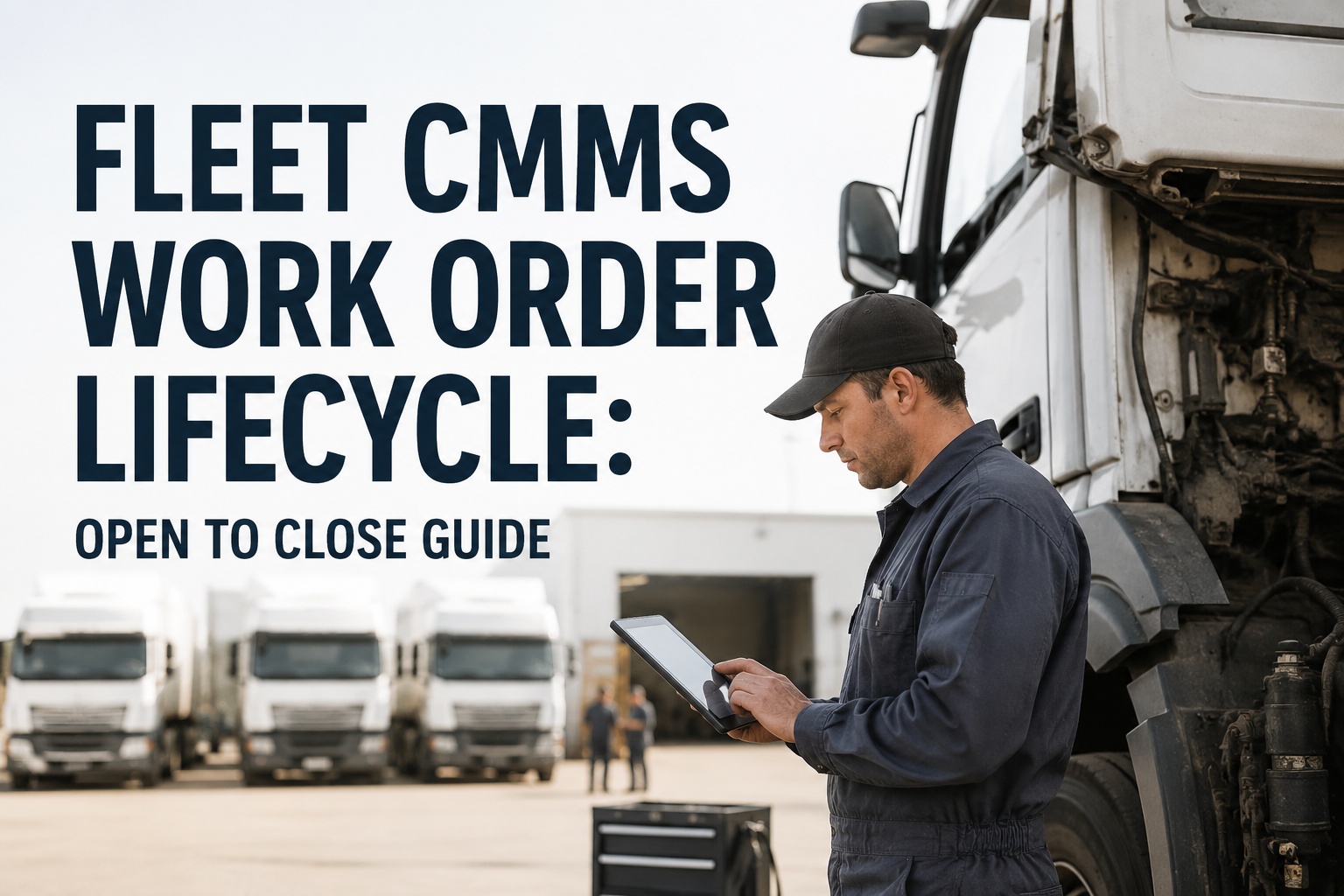
Every fleet CMMS work order lifecycle should read like a clean pipeline: request comes in, gets triaged, gets assigned, work happens, defect verifies, work order closes with a complete record. In practice, most fleets leak at every stage — 60% of reliability insights lost to bad closeout data, backlogs stretching past 2 weeks. This guide walks the full 6-stage lifecycle end-to-end, what data belongs at each stage, and where delays hide. Book a demo to see the WO pipeline live.
The 6-Stage Work Order Pipeline
Here's every stage a work order passes through — and roughly how many WOs sit in each stage on an actively managed 100-truck fleet at any given time.
The stage labels above are close to universal across CMMS platforms — the specific names may vary, but the concept of a 6-stage flow with an "On Hold" branch and a distinct "Closed" gate is standard. What separates a well-run pipeline from a stalled one isn't the stage names. It's what happens between them: who moves the work order, what data gets captured, how fast the transitions occur, and how disciplined the closeout is.
Stage 01 · OpenWhere every work order starts — and where 60% of them are already broken
An "Open" work order is submitted but unassigned. Origin can be a DVIR defect, a PM trigger, an inspection failure, an operator complaint, or a shop-initiated request. All flow into the same queue. This stage should last hours, not days — if WOs sit in Open longer than 24 hours on average, something is broken in the triage step. Book a demo to see the intake queue and triage flow
Data captured at Open
- Requestor identity + role
- Asset (VIN, unit number)
- Description of issue (voice or text)
- Severity flag (P1 / P2 / P3)
- Photos (mandatory for P1)
- Location / terminal / bay availability
- Auto-timestamp of submission
Where delays hide
- Requests submitted with no severity tag — foreman guesses
- Missing photos on P1 defects — tech dispatches blind
- Duplicate requests for the same defect (no dedupe)
- "Everything is urgent" — priority inflation kills triage
Stage 02 · AssignedTriage to a technician — the make-or-break for MTTR
Assignment is where the shop foreman routes the WO to a specific tech (or a tech pool by specialization). This stage should last minutes for P1, hours for P2, same-day for P3. Assignment quality — the right tech, not just any tech — drives 30% of total mean time to repair.
Data captured at Assigned
- Assigned technician + shift
- Estimated labor hours
- Bay / shop location
- Parts pre-pull list (if PM)
- Any special tools or lift equipment needed
- Auto-timestamp of assignment
Where delays hide
- Assigning to a generalist when a specialist is available (adds 30% to MTTR)
- No load-balancing across techs — one tech buried, another idle
- Assignments not visible to techs until they walk to the office
- Silent reassignments — no notification, no accountability
Stage 03 · In ProgressWrench on the truck — the only stage that generates real value
In Progress is the only stage where actual repair work happens. Best-in-class shops maintain 70%+ "wrench time" — the ratio of technician hours actually spent on repair vs. walking, waiting, or searching. Average shops sit at 35%. That gap is the entire optimization opportunity. Book a demo to see wrench-time tracking per tech
Data captured at In Progress
- Start timestamp (tech taps "Start")
- Diagnosis notes as tech works
- Parts consumed (scanned or picked from list)
- Labor hours (auto-tracked)
- Photos of failed component & repair steps
- Failure mode code (dropdown)
Where delays hide
- Tech starts work but forgets to change status — wrench time invisible
- Parts not on the shelf — walk to storeroom, walk back
- Special tool needed but not requested during Assigned stage
- Notes deferred to end of shift — details lost by then
Stage 04 · On HoldThe stage every shop foreman should watch obsessively
On Hold is the branch stage: work started but can't continue. Standard reasons: waiting on parts, waiting on bay access, waiting on authorization for a scope expansion, waiting on the customer, waiting on a specialist tech. Hold duration by reason is the single most useful diagnostic in the entire pipeline — it tells you where your shop is structurally constrained.
Every hour a work order spends On Hold is downtime the fleet is paying for. Tagging every Hold with a mandatory reason turns the pipeline into a diagnostic tool — not just a status board.
Stage 05 · CompletedWork is done — but the record isn't finalized yet
Completed is the pre-close review stage. Work is physically finished, tech has released the vehicle, but the record hasn't been reviewed. This is where a foreman or maintenance manager verifies that the closeout data is complete before the WO can move to Closed.
Data captured at Completed
- Completion timestamp (tech taps "Done")
- Vehicle return-to-service confirmation
- All parts consumed logged
- Total labor hours finalized
- Digital tech signature
- Follow-up flag (if additional work needed later)
Where delays hide
- Reviewer bottleneck — one manager reviewing 40 WOs/day
- "Complete" but no failure code entered — can't trend
- Vehicle back in service before defect is verified as repaired
- Follow-up flag ignored — secondary work orphaned
Stage 06 · ClosedThe 6 fields that make a closed WO actually useful
Closed is not just "work order archived." It's the moment the WO becomes historical data that feeds MTBF, cost per asset, first-time fix rate, and warranty tracking. Every closed WO with missing fields is future analytics you can't run. Best-in-class shops enforce a strict 6-field closeout that structurally prevents low-quality data from ever hitting the archive. Start a free trial and enforce these fields on your closeout.
Enforcing all six as mandatory at closeout improves downstream data quality by roughly 85% — the difference between a CMMS that generates KPIs vs. one that generates a filing cabinet.
The 6 KPIs the pipeline should produceIf your CMMS doesn't surface these weekly, it's a form — not a system
A properly instrumented WO pipeline surfaces six operational KPIs continuously. These are the numbers that answer "is our shop actually improving" — not just "are we doing work." Book a demo to see all six on a real fleet dashboard
From a shop foreman who fixed a chronic backlog
Our backlog was 4–6 weeks running average. Every Monday I'd open the WO list and try to guess which ones to push. When I finally pulled the hold-reason data, 60% of On-Hold WOs were waiting on parts — parts we should have had on the shelf but didn't because nobody was looking 14 days ahead.
We fixed the parts forecast first, backlog dropped to 8 days in 6 weeks. Then we enforced the 6-field closeout — every WO required failure code, root cause, corrective action, parts, hours, RTS. Data quality went from garbage to good, and now I actually trust my MTBF numbers. Same shop, same crew, same tools — different pipeline discipline.
Frequently asked questions
What's the difference between "Completed" and "Closed" in a CMMS work order lifecycle?
Completed means the physical repair work is done and the vehicle has been released back to service. Closed means the work order record has been reviewed, all required closeout fields are populated (failure mode, root cause, corrective action, parts, labor time, return-to-service confirmation), and the record has been formally archived. The gap between the two exists on purpose — it's the reviewer's opportunity to catch missing data before it hits the historical archive. Skipping the review step and auto-closing on completion is one of the most common causes of low-quality CMMS data downstream. Most well-run shops keep a WO in Completed status for 24–72 hours to allow reviewer sign-off; some CMMS platforms auto-close after a defined review period if no manager action is taken, but this should be a safety net, not the default workflow.
How many work order stages does a fleet CMMS actually need?
Six is the industry-standard baseline: Open, Assigned, In Progress, On Hold, Completed, Closed. Some CMMS platforms add a "Draft" stage before Open for work orders being composed, or a "Cancelled" stage for WOs submitted but determined unnecessary (duplicates, self-resolved issues, deferred work). Cancelled is distinct from Closed — Closed means work was done, Cancelled means it wasn't, intentionally. Both are valid endpoints of the WO lifecycle and produce different analytics. Fewer than 6 stages typically means "On Hold" is missing, which is the biggest visibility gap you can have — without a dedicated Hold state, delayed WOs stay in "In Progress" and skew MTTR data upward. More than 8 stages usually means the platform is over-engineered for shop-floor use and technicians start ignoring status changes. Six with an optional Draft and Cancelled is the sweet spot for most fleet operations.
What's a healthy work order completion rate for a fleet shop?
Best-in-class fleets run 90%+ WO completion rates measured as closed WOs divided by total WOs opened in the reporting period. Anything below 80% signals a systemic problem — typically some combination of chronic parts shortages, tech assignment mismatch, or unrealistic priority tagging where "everything is urgent" so nothing gets prioritized. The metric to pair completion rate with is backlog age distribution: if 90% of your WOs close but your remaining 10% are aging past 30 days, you're chronically deferring the same category of work. Track completion rate by WO type (PM vs. corrective vs. emergency) separately — PM completion should be 95%+, emergency should be 100% same-day, corrective sits between them. A single fleet-wide completion number hides the specific stage where the pipeline is leaking.
Why does closeout data quality matter so much?
Because every downstream analytic in your CMMS — MTBF, MTTR, cost per asset, first-time fix rate, warranty tracking, PM interval tuning — runs on closed work order data. Missing or generic fields at closeout render that data useless. Industry research shows fleets lose approximately 60% of potential reliability insights due to poor closeout discipline: work orders closed with "brake issue" instead of a standardized failure code, missing part numbers on parts consumed, blank labor hours, no root cause. The 6-field closeout requirement (failure mode, root cause, corrective action, parts, actual time, RTS confirmation) is the discipline that transforms your WO history from a filing cabinet into a data source. Fleets that enforce the 6 fields as mandatory at closeout typically see an 85% improvement in downstream data quality and can start running meaningful MTBF trend analysis within 60 days.
Can technicians update work order status from mobile, or do they need a desktop?
Mobile status updates are the standard for any modern fleet CMMS — if techs need to walk to a desktop to change WO status, wrench time drops significantly (industry data shows the walk-to-desktop model reduces effective repair hours by 15–25% per shift). HVI's mobile app lets techs tap through status changes directly from the WO screen: Start (moves Assigned → In Progress), Hold with mandatory reason dropdown (moves In Progress → On Hold), Resume (back to In Progress), Complete with signature (moves to Completed for review). Every status change auto-timestamps and captures the tech identity, so wrench time, hold duration, and total cycle time are calculated automatically without a separate time-tracking step. The status-change UX on mobile is arguably more important than the desktop dashboard — if the tech workflow is friction-heavy, data quality collapses regardless of how good the reports look.
See HVI's work order lifecycle end to end
HVI runs every stage of the 6-stage WO lifecycle on mobile and desktop: intake queue with severity flags, one-tap assignment with tech load balancing, mobile in-progress with photo capture, mandatory hold reasons, reviewer gate before close, and the 6-field enforced closeout that gives you honest MTBF and MTTR downstream. Backlog surfaces before it compounds. Wrench time tracked per tech.
No credit card · No hardware · Full WO pipeline live on day one