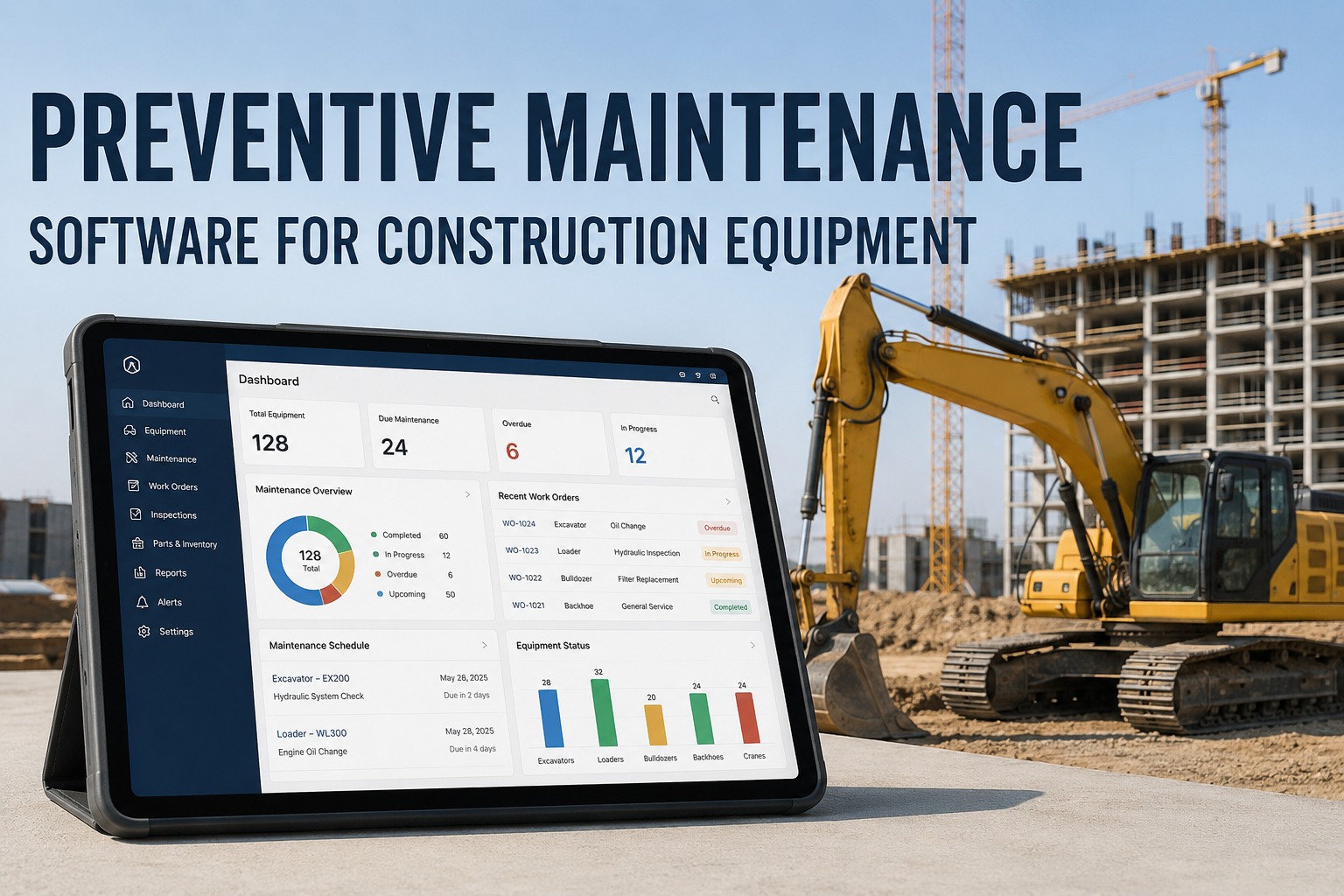
A concrete pour is the one job where a breakdown can't wait. Once water hits cement, a clock starts — and every mixer truck, boom pump and finishing machine has to hold up until the last yard is placed. Concrete contractor equipment management is the work of keeping that whole chain pour-ready at once. Book a demo of a live pour-line view and watch the whole fleet on one board.
Concrete Contractor Equipment Management, From Plant to Slab
The batch plant, the trucks in rotation, the boom pump and the finishing crew are one production line — and it's racing a 90-minute clock. Keep every machine on that line inspected, scheduled and flagged in one place, and a surprise failure stops deciding how your day ends.
The Truck Rotationwhy one slow or down mixer stalls the whole concrete fleet
On a pour, mixer trucks don't work alone — they cycle. Load at the plant, run to site, discharge, return, repeat. The pour only stays continuous if the next truck arrives before the last one empties, which is why concrete contractor fleet management is really about rotation, not individual trucks.
Pull one truck out with an unplanned repair and a gap opens in the lane — the pump runs dry, a cold joint can form, and the crew waits on the clock. Catching that drum leak the night before is the difference between a four-truck rotation and a three-truck scramble. Book a demo of rotation-ready scheduling, or see how HVI handles preventive maintenance by meter and calendar.
The Boom Pump Wears Fastestconcrete pump truck maintenance runs on wear limits, not calendar dates
Nothing on the line eats itself quicker than the pump. Abrasive slurry grinds the same parts every pour, so concrete pump truck maintenance is measured against wear limits — replace at the threshold, before a thinned part blocks the line mid-pour with trucks queued behind it.
S-tube / S-valve
Swaps side to side thousands of times a pour — the first part to thin. At 96% of limit, it's due now, not next month.
Wear plate & cutting ring
The sealing pair behind the S-tube. Worn, they leak grout and cut output — the classic "runs, just badly" trap.
Delivery lines & hoses
Walls thin from the inside. A burst line under pressure is a safety event — thickness checks belong on the schedule.
The mixer drum has its own version: fins and blades wear smooth and hardened buildup robs capacity, so washouts and blade checks ride the same wear-based rhythm. Put both on limits and you replace parts on your schedule, not the job's. See how a failed check becomes a tracked work order with parts attached, and sign up free to track pump wear limits.
Two Worlds, One Listconcrete equipment management software has to cover the small gear too
Most fleet tools track the trucks and forget the slab. But a seized trowel or a saw with no blade guard stops a finish just as surely as a dead mixer — so real concrete equipment management software has to carry both worlds on the same list, each tracked the way it actually wears.
- AssetsMixer & pump trucks
- Tracked byCalendar + DOT + hours
- Key checksDVIR, brakes, drum, boom, S-tube
- Fails asRoadside OOS or dead pour
- AssetsSaws, screeds, trowels, vibrators
- Tracked byHour meter
- Key checksGuards, blades, belts, kill switch
- Fails asStalled finish or safety event
Put both columns on one system and nothing lives on a whiteboard that gets wiped by Friday. For how the small gear gets its own signed checks, see HVI digital fleet inspections, or book a demo of tracking trucks and small gear together.
The Price of a Dead Loadwhat a single missed check actually costs on a concrete job
A breakdown on a pour isn't one cost — it stacks. Under ASTM C94, ready-mix should discharge within 90 minutes or 300 drum revolutions of batching; blow past that and the math adds up fast.
That's why for concrete work, maintenance is pour insurance. One flagged defect the night before is always cheaper than a boom pump dying with six trucks queued. Book a demo of defect-to-work-order and see a flag caught before the concrete is in the drum.
The Dispatch Boardconcrete contractor equipment tracking the morning of a pour
This is the view that replaces three spreadsheets and a group chat — every asset on the line flagged against its own wear or calendar clock, so the dispatcher knows what's pour-ready before the plant batches a single yard.
Everything that fails a check becomes a work order, not a note someone forgets — and because the records are stored and exportable, the same data that keeps the pour on track answers an insurer or a DOT auditor later. Explore HVI analytics and reporting for the trend side.
From the Yarda concrete fleet manager on what actually breaks the schedule
People think it's the big trucks that sink a pour day, but it's the little stuff — a saw with a seized bearing, a trowel nobody serviced since spring. I run the finishing gear on hour meters and the trucks on the calendar, all on one board. The day I stopped tracking the small equipment on a whiteboard is the day our mornings stopped being a scramble.
Bringing It Togetherthe point of concrete contractor equipment management
Concrete contractor equipment management works when the whole pour line — trucks in rotation, the boom pump, and the on-slab gear — lives on one board, each asset tracked by its own clock, with a failed check turning straight into a work order. That's the difference between a pour that runs clean and a load that hardens while you hunt for a backup. Put the line on one screen and the morning scramble becomes a thirty-second status check.
Put your whole concrete pour line on one board
Mixer trucks, boom pumps, saws, screeds and trowels — inspected, scheduled by wear limit or calendar, and flagged before the plant batches. HVI runs across road-registered trucks and off-road gear in one place, so a breakdown stops being the thing that decides your day.
No credit card · Works across trucks and on-slab gear · Set up in days
Concrete contractor equipment management: FAQs
What is concrete contractor equipment management?
It's managing a concrete crew's full pour line — road-registered mixer and pump trucks plus on-slab gear like saws, screeds and trowels — as one tracked asset base. The hard part is that each asset wears differently (calendar and DOT, wear limits, or run-hours), so they need schedules that run in parallel on one system, not one shared one.
Why does one down mixer truck stall the whole pour?
Because a continuous pour depends on trucks rotating — the next arriving before the last empties. Pull one out with an unplanned repair and a gap opens: the pump runs dry, a cold joint can form, and the crew waits on the clock. That's why catching a defect the night before protects the rotation, not just the truck.
What is the 90-minute rule and why does it matter for maintenance?
Under ASTM C94, ready-mix should generally discharge within 90 minutes or 300 drum revolutions of batching. A breakdown anywhere in the chain can push a load past that window, where it may have to be rejected. It makes maintenance effectively pour insurance — a caught defect is far cheaper than a scrapped load.
How often should concrete pump wear parts be replaced?
Pump wear parts — the S-tube, wear plate, cutting ring and delivery lines — wear by run-hours, not calendar, because abrasive slurry grinds them constantly. The reliable approach is tracking each part against its wear limit and replacing on a cycle before failure. Exact life varies by pump, mix and output, so track each unit's own hours.
Can one software handle both DOT trucks and off-road concrete equipment?
Yes — that's the main reason to use a CMMS like HVI instead of separate tools. It schedules road-registered trucks on calendar and DOT requirements while scheduling off-road gear on hour meters, keeps inspections and work orders for both, and shows the whole pour line on one board. One system, every asset.