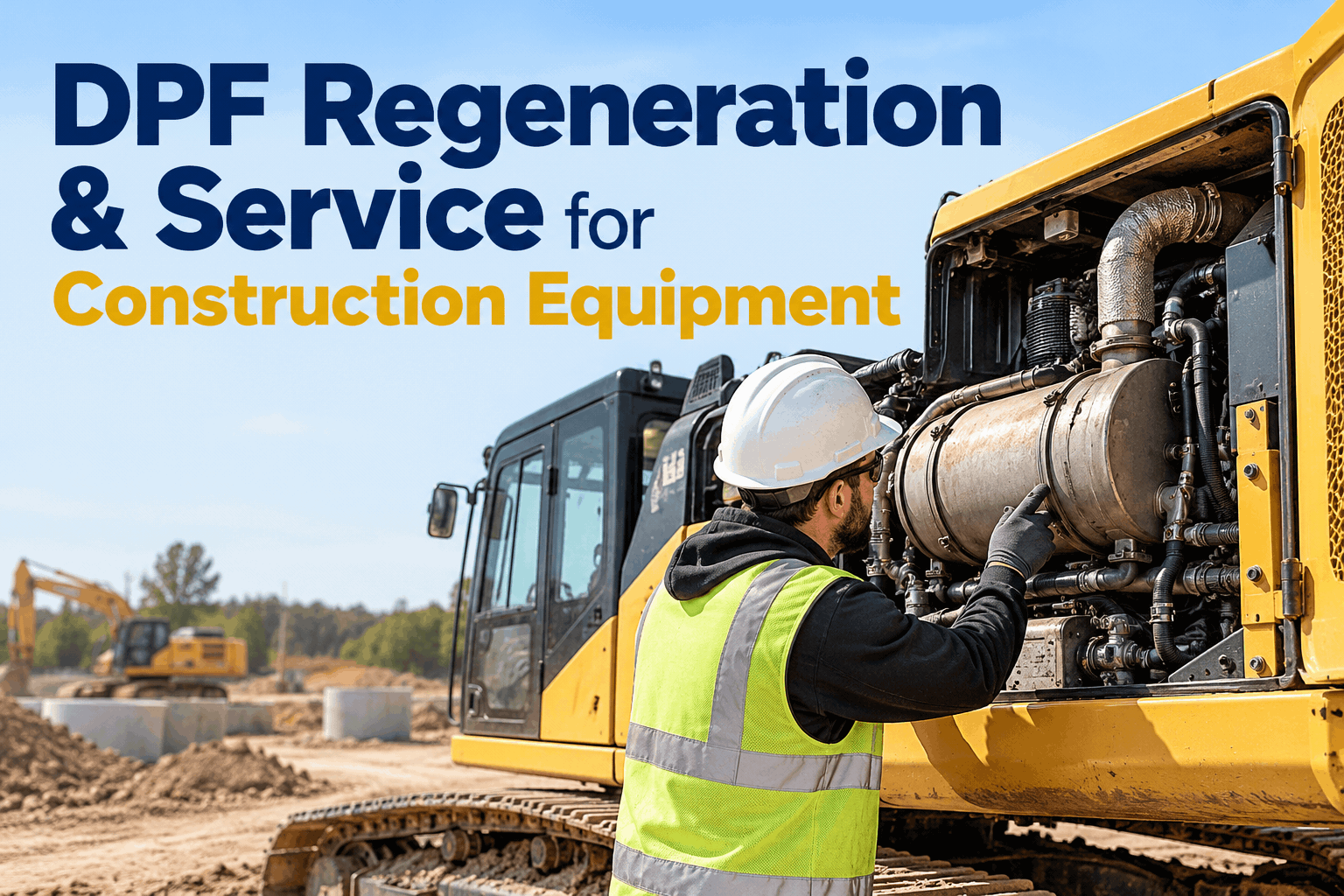
DPF regeneration on construction equipment is where a lot of off-road machines quietly go wrong — not because the filter fails, but because the way these machines work never lets it clean itself properly. A diesel particulate filter traps soot and burns it off in a process called regeneration, which needs heat. The trouble is that excavators, loaders and dozers spend their lives idling and working at low load, exactly the conditions where the exhaust never gets hot enough to regen. The result is a clogged filter, a warning light, a derate, and a machine off the job. Book a demo of DPF service tracking.
DPF Regeneration Fails on Construction Equipment for One Main Reason
Excavators and loaders idle and work light — and a filter that never gets hot never cleans itself. Understand why off-road regens fail, and you can stop the clogs before they derate a machine.
Every modern off-road diesel — Tier 4 Final, Stage V — carries a diesel particulate filter to trap soot before it leaves the exhaust. The filter has to be emptied periodically by burning that soot off at high temperature, and on a highway truck that happens naturally at cruising speed. Construction machines don't cruise. They idle between tasks, dig in short bursts, and run at part load for hours — and that low-heat duty cycle is the single biggest reason DPFs clog on off-road equipment. The filter isn't defective; the machine just never gives it the conditions to clean itself. Once you see the problem that way, the fix is about managing heat and regens, not replacing filters.
How regeneration worksthe three levels of DPF regeneration, and when each kicks in
DPF regeneration happens at escalating levels — the machine tries the easy one first and only climbs to the disruptive ones when soot keeps building. The deeper into this ladder a machine goes, the more production it costs. The goal is to stay at the top.
- 1Passive — the free oneWhen the machine works hard and hot, exhaust heat burns soot off continuously with zero disruption. This is where you want to live.
- 2Active — automaticIf soot builds, the engine adds heat on its own while the machine keeps working. Mostly invisible — unless it keeps getting interrupted.
- 3Parked — you stopSoot high enough that the machine must sit, engine running, for a regen cycle — real lost production, often 30 to 60 minutes.
- 4Forced — the shopThe filter's too clogged to self-clean; a technician commands a regen with a scan tool, or it needs cleaning. Downtime and cost.
Passive regen needs genuinely hot exhaust — roughly 575°F and up — while active, parked and forced push toward 1,100°F; exact thresholds vary by OEM and engine. A machine working hard lives at level 1 or 2 and barely notices. A machine idling all day never gets the heat, so it slides down to levels 3 and 4 — which is the whole off-road problem in one sentence. See the on-road truck regen guide for the general mechanism, and book a demo of regen tracking.
Why off-road failsthe reasons construction machines clog DPFs more than trucks
A highway truck regenerates almost for free because it runs hot and steady for hours. Construction machines do the opposite, and these are the specific duty-cycle traps that drive off-road DPF failures.
The thread through all of these: the machine, the operator or an upstream fault stops the filter getting what it needs to clean itself. Most are preventable with duty-cycle awareness and acting on warnings early — which means making the DPF a thing you watch, not a light you notice too late. Explore DPF and aftertreatment on the PM schedule.
Soot vs ashwhy regeneration eventually isn't enough
A crucial distinction most operators miss: regeneration deals with soot, not ash. Understanding the difference explains why even a well-regenerated filter eventually needs cleaning — and why that's normal, not failure.
- Carbon from incomplete combustion
- Burns away at regen temperature
- Managed by regular regeneration
- The day-to-day cycle you control
- Mineral residue, mostly from oil
- Does not burn off — it accumulates
- Eventually needs professional cleaning
- Scheduled service, not a failure
So two things keep a DPF healthy: frequent, completed regens to clear soot, and periodic professional cleaning to remove the ash regen leaves behind. For off-road machines that interval is best tracked by engine hours and duty cycle, not mileage — which is exactly the kind of hour-based service HVI schedules. Start free and schedule DPF cleaning by hours.
Keep them regeneratingthe off-road DPF health checklist
Most DPF trouble is preventable with habits, not parts. Run your operation against this list — any "no" is a way a filter clogs and a machine derates.
- Excessive idling is minimized where possible
- Machines get worked hard enough to run hot
- High-idle machines are watched for regen issues
- Operators let parked regens finish, not cancel them
- DPF warnings are reported, not ignored
- Crews know what the regen light means
- Correct low-ash engine oil is used
- Upstream faults (injectors, EGR, DEF) are fixed
- Ash cleaning is scheduled by engine hours
- DPF status is on the daily inspection
- Failed or cancelled regens are logged
- Repeat-offender machines are identified
Twelve confident "yes" answers mean your DPFs stay clear and your machines keep working — no mystery derates mid-shift. Book a demo to see DPF tracking.
The cost of ignoring ithow a cheap warning becomes an expensive derate
A DPF problem gets more expensive at every stage you ignore it. The warning is nearly free to act on; the end of the chain is a tow and a repair bill. Here's how it escalates.
Soot is building; the machine asks for a regen. Act now — work it hard or run a parked regen — and it costs you almost nothing.
Ignored, soot climbs until the machine must stop for a regen cycle — 30 to 60 minutes of lost production, but still self-serviceable.
Keep ignoring it and the engine cuts power to force the issue. A derated machine can't do its job — now it's real downtime on the critical path.
The filter's too clogged to recover in the field — a shop forced regen, a professional clean, or a filter replacement. The expensive end of a cheap problem.
Every stage of that chain is avoidable by acting at stage one — which only happens if someone sees the warning and it becomes a tracked task rather than a note in an operator's head. That early catch is the whole value of putting the DPF on the inspection. The DEF side of the same aftertreatment system works the same way — see DEF handling and storage on construction sites. Book a demo of defect-to-work-order tracking.
DPF on recordregen history and service tracked per machine
When DPF status, regen events and cleaning run against each machine, a clogging filter gets caught at inspection — and the repeat offenders become obvious. Here's the record that keeps DPFs from stranding machines.
That record turns "which machine keeps clogging?" into an answer you can see — and a scheduled fix instead of a surprise derate. It's built from the inspections, defects and service history HVI already tracks for every machine. Explore per-machine service and defect records.
From a construction equipment maintenance manager who tamed his DPF problems
Our DPF derates used to feel random — a machine would just lose power mid-shift and we'd scramble. When I actually started tracking it, the pattern was obvious: it was always the same two or three machines, and they were always the ones parked on light duty, idling half the day, with operators cancelling the regens to keep moving dirt. It wasn't a filter problem at all, it was a duty-cycle and habit problem. We started logging DPF status on the walkaround, made it clear that a parked regen gets to finish, and scheduled ash cleaning by hours. The derates basically stopped. The filters were never the issue — not watching them was.
DPF regeneration on construction equipment — FAQs
Why do construction equipment DPFs clog more than trucks?
Because construction machines idle and work at low load, keeping exhaust too cool for passive regeneration. A highway truck runs hot and steady and regenerates almost for free; an idling excavator never gets the heat, so soot builds and the filter clogs.
What are the types of DPF regeneration?
Passive (soot burns off while the machine works hot), active (the engine adds heat automatically while working), parked (the machine sits, engine running, for a regen cycle), and forced (a technician commands one at the shop). The goal is to stay at passive and active.
What causes a failed DPF regeneration?
Mostly low-load or idling duty cycles that never reach regen temperature, plus cancelled or interrupted regens, short work cycles, upstream faults like injectors or EGR, and the wrong engine oil. The filter is usually the symptom, not the root cause.
What's the difference between soot and ash in a DPF?
Soot is carbon that regeneration burns off; ash is mineral residue, mostly from engine oil, that regen can't remove. Ash accumulates over time and eventually needs professional cleaning — that's normal scheduled service, not a failure.
How does HVI help with DPF maintenance?
HVI doesn't run regens or clean filters — it keeps the DPF on the maintenance radar. It puts DPF status on the inspection, logs warnings and cancelled regens as defects, tracks regen history per machine, and schedules ash cleaning by engine hours, so problems are caught before a derate.
Stop losing machines to DPF derates
Off-road DPFs clog because of how construction machines run — and almost every derate is preventable by catching the warning early. HVI puts DPF status and regen history on the inspection, flags cancelled regens as defects, and schedules ash cleaning by hours, so a clogging filter is a work order, not a breakdown. Book a demo and see it on your fleet.
No credit card · No hardware · Put DPF and regen checks on every inspection from day one