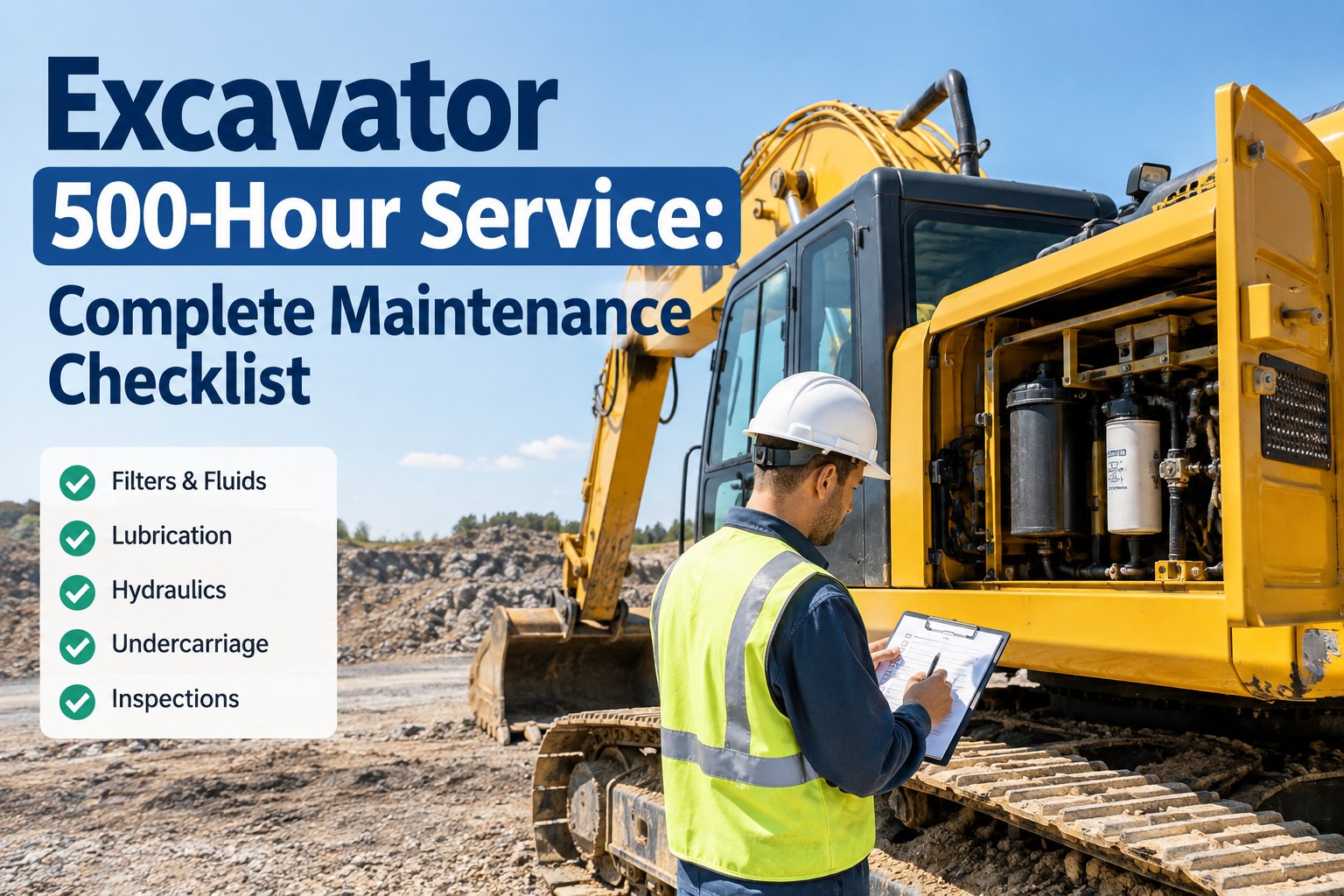
The excavator 500 hour service is where preventive maintenance stops being a fluid-and-filter routine and starts being detective work. This is the intermediate service — every 250-hour task carries forward, but now you're pulling hydraulic filters, drawing an oil sample for the lab, and putting a tape on the undercarriage to measure wear you can't see. Book a demo to see how those readings get captured against each machine. This guide walks the full 500-hour checklist — and where the OEM manual always overrides it.
At 500 Hours You Stop Changing Fluids and Start Measuring Wear
The 250 keeps the machine running. The 500 tells you where it's heading — through hydraulic filtration, a lab oil sample, and undercarriage measurements that predict component life months ahead. It's the most important checkpoint for hydraulic-system health in the whole ladder.
Same ground rule as always: this list is a framework, not your machine's manual. Whether your model even runs a 500-hour hydraulic-filter interval, the exact filter part numbers, the coolant spec, the undercarriage wear limits and the valve-clearance values all come from the OEM service manual for your specific serial number, engine and emissions tier. Use what follows to understand what the 500 usually involves — then confirm every figure against the book, especially while the machine is under warranty.
What makes it the "500"the six things it adds that the 250 never touches
The excavator 500 hour service is the second tier of scheduled PM, run roughly every eight to twelve weeks at full-time use. It's additive: every 250-hour task still gets done — engine oil and filter, full greasing, level checks, basic inspections — and then the 500 layers on six deeper actions that catch wear and contamination the 250 can't reach. This is the difference between a service and an inspection.
- Engine oil & filter change
- Grease all pins & swing bearing
- Fluid level checks
- Track tension & basic inspections
- Fuel filter replacement — the 250 only drains water; the 500 replaces the element
- Outer air filter replacement — the 250 inspects; the 500 replaces it
- Coolant concentration test — refractometer check of inhibitor & freeze protection
- Hydraulic return & pilot filter replacement — core to system cleanliness
- Hydraulic oil sample — drawn and sent to an accredited lab
- Undercarriage wear measurement — per the OEM wear-limit procedure
Those six are why the 500 takes three to four hours and usually a qualified fitter, not the hour-and-a-half a 250 runs. Two of them — the oil sample and the undercarriage measurement — don't fix anything on the day. They produce data, and that data is only worth collecting if you keep it. Book a demo to see the 500 tasks pre-loaded per model
The 500-hour checklistby system — confirm every spec against your OEM manual
Here's the full intermediate service grouped by system, including the carried-over 250 work so nothing gets missed on the day. A mid-size tracked hydraulic excavator is the reference machine; scale capacities to your model.
- Drain & replace engine oil + oil filter (grade per OEM emissions tier)
- Replace the fuel filter element — not just drain the separator
- Replace the outer air filter element regardless of appearance
- Check the restriction indicator; replace secondary element if triggered
- Replace hydraulic return & pilot filters (vent tank pressure first)
- Draw a hydraulic oil sample from the correct port for lab analysis
- Inspect the pump for seepage, cavitation noise or unusual vibration
- Pressure-check accessible hoses; log any weeping fittings as defects
- Measure track pad/shoe height against OEM wear limits
- Measure link pitch, roller and idler wear; check sprocket tooth profile
- Recheck & adjust track tension to spec
- Log every reading — the number matters more than pass/fail
- Test coolant concentration with a refractometer
- Clean the radiator & cooler pack — critical in dusty work
- Adjust fan/alternator belt tension; inspect belts and hoses
- Top up DEF and check the SCR system on Tier 4 machines
- Grease every pin, bushing and the swing bearing per shot count
- Check swing-gear grease/oil condition and top off the race
- Inspect final drives for noise, seepage or leaks
- Wipe fittings before greasing so you don't pump in grit
- Load-test the battery; clean terminals and earth straps
- Scan & record fault codes before clearing
- Check valve clearance if the interval calls for it
- Inspect boom, arm, bucket teeth, cutting edge & welds for cracks
The tasks that produce a number — oil sample, undercarriage measurements, fault codes, belt readings — are the ones that pay off later, and only if they land somewhere you can trend them. A photo of a worn sprocket next to a logged measurement is worth ten "looked fine" checkmarks. Book a demo to attach measurements and photos to each service
The undercarriage numberwhy the 500 is where you start measuring, not eyeballing
The undercarriage is often the single largest lifetime maintenance expense on a tracked excavator, and it wears slowly enough that your eye can't catch it — which is exactly why the 500-hour service introduces measurement. A track pad, a link, a roller, an idler and a sprocket each wear against a published OEM limit. Measure them at every 500 and log the numbers, and you get something a visual inspection never gives you: a wear rate.
Four readings turn "the tracks look worn" into "these pads hit the wear limit around 4,200 hours — order them now, plan the swing for the winter shutdown."
That's the whole argument for measurement discipline: you plan track and idler replacements six to eight months ahead of the wear limit instead of scrambling when a component fails on a Friday. OEM systems like Cat's Undercarriage Management System produce the measurement data — but the data only matters when it's tracked over time against the specific machine. Start free and log undercarriage wear as a trend
The oil samplecondition monitoring, not a box to tick
Hydraulic oil sampling at the 500 is the industry-standard baseline for excavators — but be clear about what it is: a condition-monitoring practice, not something every OEM universally mandates at exactly 500 hours. The value is the same as the undercarriage measurement: a single result is a snapshot, a series is a diagnosis.
Sent to an accredited lab, a sample reads out ISO cleanliness code (particle count), water content, and metal spectroscopy — iron from bearings, copper from bushings, aluminum from pumps, silicon from dirt ingress — plus viscosity and oxidation. Four to six samples logged over a couple thousand hours flag a pump trending on iron content months before it shows up as a performance symptom, so you can schedule a controlled rebuild during a planned shutdown instead of eating unplanned downtime. Draw it from the correct sampling port on the operating hydraulic tank — never the drain plug or a filter housing, which give misleading results — and log every result against the machine. OEM programs like Cat S·O·S, Komatsu KOWA and equivalent lab services all feed the same idea. Book a demo to trend sample results alongside PM history
When the 500 comes earlysevere-duty conditions that pull the interval in
The OEM's 500-hour interval assumes normal operating conditions — and quarry, demolition and high-dust production are anything but normal. Under severe duty the fluids and filters the 500 addresses degrade faster, so industry practice is to shorten the interval, commonly by 20 to 30% for a single severe factor and more when several stack up.
Limestone, coal and sand accelerate hydraulic contamination through rod seals and drive undercarriage wear faster — a case for pulling the oil sample and measurement in sooner.
High ambient temperature and sustained high-pressure cycles oxidize hydraulic fluid faster, shortening the real filter-and-fluid interval below the published figure.
Breaker attachments create pressure spikes and shock loading that stress the hydraulic system — a classic reason to sample at 250 rather than wait for the 500.
Demolition and long-shift mining duty push fluids and undercarriage past normal-duty assumptions — measurement discipline gets more important, not less.
Set the baseline from the manual, adjust for the duty the machine actually sees, and let the oil analysis confirm you got it right. Stay on OEM specs during any active warranty period — extending intervals beyond the manual can void coverage no matter how clean the oil looks. Start free and set a per-machine severe-duty multiplier
Plan the parts before the daythe 500 fails when the filters aren't on the shelf
Here's the practical trap the 500 sets that the 250 doesn't: it needs more parts, and specific ones. Hydraulic return and pilot filters, a fuel element, an air element, coolant, and possibly undercarriage components you'll only know about after you measure. Discover mid-service that the pilot filter isn't in stock and the machine either sits or goes back to work un-serviced — both bad. The fix is to let the scheduled service tell you what it needs before the tech walks up to the machine.
None of this is glamorous, but it's the difference between a 500 that closes in an afternoon and one that drags across two days because a $40 filter wasn't on hand. Book a demo to see parts planned from the PM trigger
From a maintenance supervisor in a quarry
For years the 500 was "change the hydraulic filters and eyeball the tracks." We took the oil samples the service called for but they went in a drawer — nobody trended them, so they were just paper.
Once we started logging the ISO codes and the undercarriage measurements per machine over time, the whole thing changed. First real trend flagged two pumps climbing on iron, and we rebuilt them on a planned shutdown instead of blowing one up mid-shift. The undercarriage numbers now let me order track groups six to eight months out. Same service we were always doing — we just finally kept the numbers, and the maintenance line moved.
Common 500-hour service mistakes
The 500 has more moving parts than the 250, so it has more ways to go wrong. These are the ones that cost the most.
Every one traces back to the same two things the 500 lives on: discipline in taking the measurements, and a place to keep them. Get those right and the intermediate service starts earning its keep as a prediction tool, not just a cost.
Excavator 500-hour service FAQs
What is included in a 500-hour excavator service?
A 500-hour excavator service is the intermediate scheduled service, and it's additive — it includes every 250-hour task (engine oil and filter change, full greasing, fluid level checks, track tension and basic inspections) plus roughly six deeper actions. Those additions typically are: replacing the fuel filter element rather than just draining the separator, replacing the outer air filter element, testing coolant concentration with a refractometer, replacing the hydraulic return and pilot filters, drawing a hydraulic oil sample for laboratory analysis, and measuring undercarriage wear against the OEM limits. Many schedules also fold in a battery load test, belt-tension adjustment and a valve-clearance check. It usually takes about three to four hours and is performed by a qualified fitter. Exact filter part numbers, fluid specs, wear limits and clearances come from your machine's OEM service manual for its specific model, engine and emissions tier — a generic checklist is a framework, not a substitute for the manual.
What filters should be changed at 500 hours?
On most excavators the 500-hour service replaces more filters than the 250 does, though the exact set is model-specific. Commonly it includes the engine oil filter (carried over from the 250), the fuel filter element (the 250 typically only drains the fuel/water separator, while the 500 replaces the element), the outer air filter element (the 250 usually just inspects it), and the hydraulic return and pilot filters, which are central to keeping the hydraulic system clean. The secondary air filter is generally replaced only if the restriction indicator has triggered. Always match filter part numbers to your OEM specification — off-spec filters on a Tier 4 engine can compromise the aftertreatment and affect warranty. Check your manual for whether your specific model changes the hydraulic filters at 500 hours or on a different interval, since this varies between manufacturers and machine sizes.
Should excavator hydraulic oil be sampled at 500 hours?
Sampling hydraulic oil at the 500-hour service is the common industry baseline for excavators, but it's best understood as a condition-monitoring practice rather than a task every OEM universally mandates at exactly 500 hours. The reason to do it is that a lab sample reveals what you can't see: ISO cleanliness code, water content, and wear-metal spectroscopy (iron from bearings, copper from bushings, aluminum from pumps, silicon from dirt ingress), plus viscosity and oxidation. A single result is only a snapshot; the real value comes from trending four to six samples over a couple thousand hours, which can flag a pump or valve problem months before any performance symptom appears — letting you plan a controlled repair instead of absorbing unplanned downtime. If you sample, draw it from the correct port on the operating hydraulic tank rather than the drain plug or a filter housing, and log every result against the specific machine so the trend accumulates. Under severe duty, sampling as early as 250 hours can be justified.
How do you inspect and measure excavator undercarriage wear?
The undercarriage is often the largest lifetime maintenance cost on a tracked excavator, and the 500-hour service is where inspection becomes measurement rather than a glance. Using the OEM procedure and wear-limit charts, you measure track pad or shoe height, track link pitch, and roller, idler and sprocket wear, and you recheck track tension against spec. The key discipline is logging the actual numbers, not just marking pass or fail — because a single measurement tells you the current state, but a series of measurements logged at each 500-hour service tells you the wear rate. That wear rate is what lets you predict when a component will reach its limit and order track groups or idlers six to eight months ahead of failure instead of scrambling. OEM tools such as Caterpillar's Undercarriage Management System and equivalents from other manufacturers produce the measurement data; it only becomes useful when tracked over time against the specific machine.
How do you track excavator service hours across a fleet?
Reading the hour meter by hand works on one or two machines, but across a fleet it breaks down fast — excavators move between operators and jobsites, meters go unread for weeks, and the gaps that accumulate between manual readings are exactly how a 500-hour service slips past due. The reliable method is to feed engine hours automatically from the machine's telematics — systems like Caterpillar VisionLink, Komatsu KOMTRAX, John Deere JDLink and Volvo CareTrack all report operating hours — directly into your maintenance system so PM triggers fire on the actual reading. In HVI you set each model's intervals once, hours flow in from the hour meter or telematics, and the platform raises a work order with the correct 500-hour tasks and parts list when the service comes due. For mixed fleets running several OEMs, that means one PM schedule, one place to capture measurements and photos, and one service history across every brand instead of separate dealer portals.
Turn the 500-hour service into a prediction, not just a cost
HVI triggers every excavator PM from actual machine hours — read manually or pulled from Cat, Komatsu, Deere and Volvo telematics — builds the work order with the right tasks and parts, captures undercarriage measurements and oil-sample results as a trend, stores photo evidence, and keeps the full service history attached to each machine for life. Set your intervals once per model and stop scrambling at the wear limit.
No credit card · Measurement & photo capture · Service history that travels with the machine