Your roller measures three inches. New, it was four — so it's 25% worn and good for ages, right? Wrong, and it's the most expensive error in tracked equipment maintenance: it either scraps parts with life left or runs them until they destroy everything they touch. Undercarriage wear measurement isn't a fraction of the part's size; it's a reading against a wear chart, trended over time. Book a demo to capture and trend wear.
Undercarriage Wear Measurement: a Roller Worn From 4″ to 3″ Is Not 25% Worn
Wear percentage isn't how much smaller the part got — it's how far it's travelled between its new spec and its end-of-life limit. Read it the wrong way and you either bin good parts or run ruined ones.
The undercarriage is the single most expensive system on a tracked machine — per Caterpillar it runs 20 to 50% of lifetime maintenance cost — and also the most controllable, because its wear is measurable and predictable. Two things trip operators up: reading wear as a simple fraction of a part's dimension, and treating a track wear inspection as a one-time check instead of a trend. Fix both and you get 30 to 50% more life out of every chain, sprocket and roller. This guide covers how to measure each component correctly, how to trend the wear rate, and why skipping it turns cheap planned parts into ruinous emergency rebuilds.
The track wear measurement mathwhy undercarriage wear isn't a fraction of the part's size
This is the misunderstanding that quietly wastes the most money. A component isn't "25% worn" because it's 25% smaller — it's worn by how far it has travelled along its usable range, which is the span between the manufacturer's new dimension and its end-of-life limit. That range is often far smaller than the part itself, which is why intuition gets it so wrong.
"The roller went from 4″ to 3″, so it's lost a quarter — 25% worn, plenty left."
Treats the whole part as the usable range. But rollers, bushings and idlers only have a thin band of allowable wear before the OEM limit — the rest is structural.Wear % = (new spec − measured) ÷ (new spec − wear limit) × 100.
If new is 4″ and the wear limit is 3.2″, the usable range is 0.8″. A roller at 3″ has already gone 1″ — well past 100%. It's scrap, not "25%."Every measurement — roller and idler tread, bushing diameter, grouser height, sprocket profile — must be converted against the wear-limit chart in the manual or from an undercarriage supplier, never eyeballed as a fraction. Without the chart, a reading is just a number with no meaning. Book a demo to convert measurements to true wear percentage automatically
Undercarriage inspection: 5 systems to measurewhat to measure on tracked equipment — from pitch to sprocket — and how
An undercarriage wears as five interconnected systems that don't wear at the same rate — a "60% undercarriage" might be 70%-worn chain on near-new sprockets. Each needs its own measurement, its own tool, and its own threshold. Here's the full undercarriage inspection measurement set.
Track chain — pitch elongation
The most important measurement. As pins and bushings wear internally, each link lengthens. Measure pitch across a 4-pin span and calculate [(measured − new pitch) ÷ new pitch] × 100. This is the truest field measure of internal chain wear — the one that drives the bushing-turn decision.
Bushings — outer diameter
On many systems the bushing wears out first, but it can be turned to present a fresh surface. Measure the outer diameter; the common rule is a first turn at about 50% wear and retirement at 100%. Miss the turn window and you lose half the chain's potential life.
Rollers & idlers — tread diameter
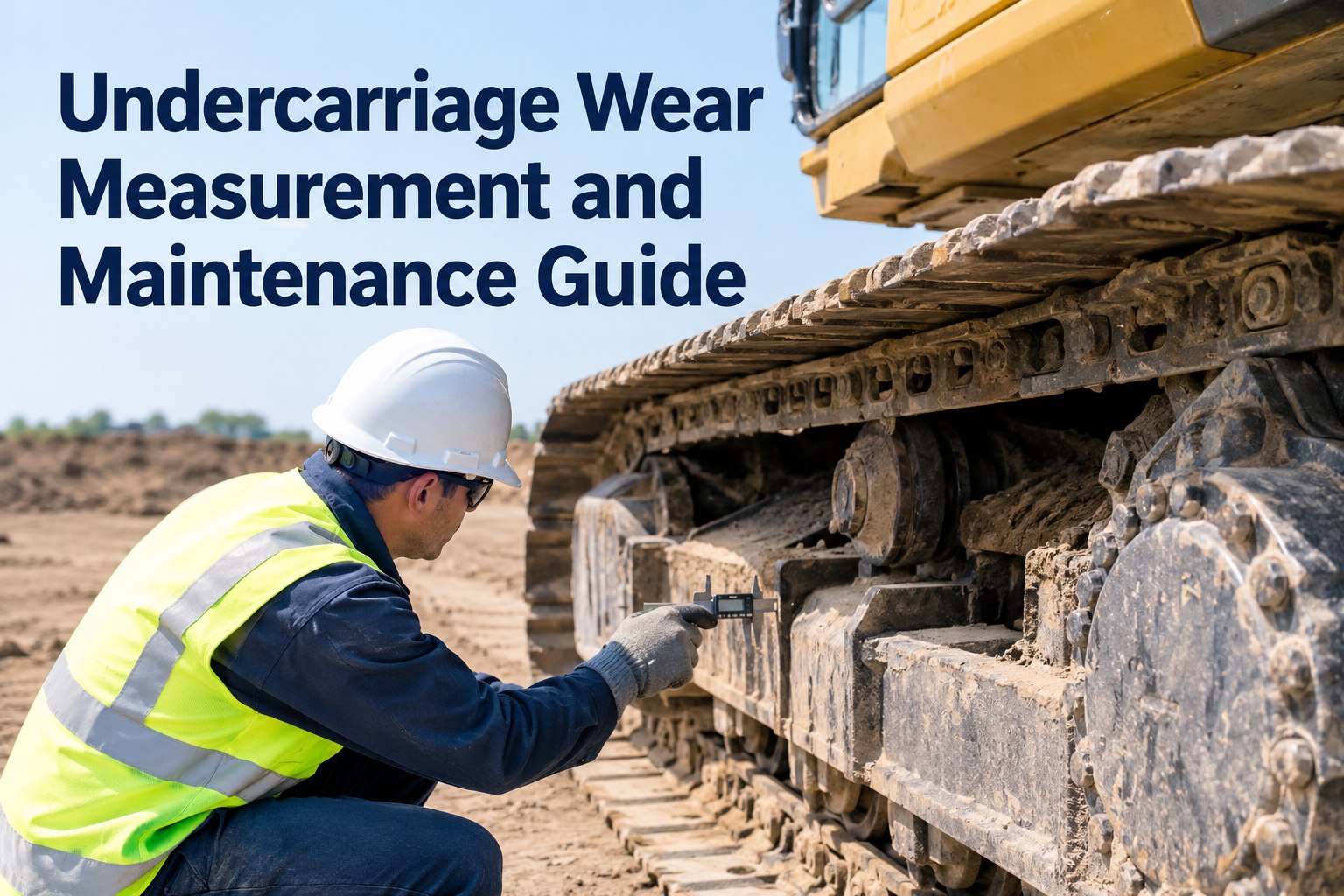
Roller inspection means measuring tread diameter at the most worn point with a caliper or gauge, against the chart. Check for seizing and seal leaks — a seized roller drags the chain, wears flat spots, and accelerates wear on everything it touches. One failed roller shortens the life of the whole system.
Sprocket — tooth profile
Sprocket wear measurement uses a gauge laid against the tooth, compared to the OEM profile. As it wears, the tooth shifts from a rounded shape to a sharp, hooked point that makes the chain skip. Never run a new chain on a worn sprocket — it destroys the new chain in short order.
Shoes & tension — grouser height
Measure grouser height for remaining traction life, and check track tension — the single most controllable wear factor. Lay a straightedge over the grouser tips from sprocket to idler and read the sag; too tight or too loose accelerates wear across the whole system.
Detailed measurement should happen every 250 to 500 hours (sooner in severe duty), always with the wear chart on hand, alongside a daily visual for debris, tension and seal leaks. Clean off packed dirt before measuring — it skews readings, and on its own cuts machine power by around 10% and raises wear by roughly 30%. Start free and capture all five measurements per machine on a phone
Wear trending for undercarriage maintenancewhy the wear rate matters more than today's measurement
Here's the second thing operators get wrong: they measure once, read "58% worn," and move on. But a single measurement tells you little for planning. 58% reached in 2,000 hours is very different from 58% in 6,000 — one is wearing three times faster. What you need is the rate.
Trending turns measurements into forecasts. Two or three readings over time give you a wear rate, and the rate lets you project the date each component will hit its threshold — so you order parts, book the shop, and replace on your schedule instead of reacting to a failure. That projection is the entire payoff of measuring; a lone number can't provide it.
Trending also exposes invisible problems. A sudden jump in a wear rate flags a developing issue — a seized roller, a tension problem, an abrasive new worksite — long before it shows as damage, and lets you compare a component against its class. None of that is visible in a one-time reading. Book a demo to see wear rate and projected replacement dates per component
$3k or $40kthe wear cascade that measurement is designed to stop
Why does any of this justify the effort? Because undercarriage components wear as an integrated system, and when one part passes its limit unnoticed, it accelerates the destruction of everything it touches. Measurement exists to break that chain reaction at the cheapest possible point. Here's how a skipped bushing turn becomes a full rebuild.
- 1Bushing passes 50%, turn window missedMeasured in time, the bushing turns for a modest cost and the chain gets a second life. Missed, the window is gone.
- 2Chain pitch stretchesWorn bushings let the pins move, so each link lengthens. The chain no longer matches the sprocket pitch.
- 3Chain climbs the sprocket teethThe stretched chain rides up and hooks the teeth, destroying a sprocket that was fine — and now a new chain won't run on it either.
- 4Full rebuildWhat could have been a planned turn or a single component becomes chain, sprockets and more — a five-figure emergency instead of a four-figure plan.
That's the whole economic case in one sequence: a $3,000 planned replacement and a $40,000 emergency rebuild are often the same machine, separated only by whether someone measured the bushing before the turn window closed — the cascades a measurement would have stopped. Start free and catch the turn window before the cascade starts
From an earthmoving equipment superintendent
We used to "measure" undercarriage by eye — a mechanic would look at the sprockets, say "yeah, that's got life in it," and we'd move on. Then we lost two chains and a set of sprockets on a dozer in one quarter because the bushings had blown past the turn point and nobody had a number to prove it.
Now every machine gets its five measurements logged at service, converted to real wear percentage off the chart, and trended. The trend is the part that changed everything — I can see a chain's going to hit limit in about 300 hours and order it, instead of finding out when it skips a sprocket on a Friday. We turn bushings on time now, our sprockets last, and I haven't written a surprise rebuild cheque since. The eyeball was costing us a fortune we couldn't even see.
The takeaway
Undercarriage wear is not a fraction of the part's size — it's (new − measured) ÷ (new − wear limit), read against the chart. A roller from 4″ to 3″ can be scrap, not "25%."
Measure five systems separately — chain pitch, bushings, rollers/idlers, sprocket, grouser/tension — because they wear at different rates, and trend the rate, because one number can't forecast anything.
Measurement exists to stop the wear cascade — a missed bushing turn becomes chain, then sprocket, then a five-figure rebuild. The same job, measured in time, is a fraction of the cost.
The undercarriage carries more of a tracked machine's lifetime cost than anything else, and almost all of it comes down to two disciplines of undercarriage wear measurement: measuring each component correctly against its wear chart, and trending the rate so replacement is planned rather than reactive. Get the math right, capture all five systems, watch the rate, and turn the bushing before its window closes — and the most expensive system on the machine becomes the most predictable. That's the difference between a $3,000 line in next quarter's budget and a $40,000 hole in this one. Book a demo to track equipment wear and maintenance with HVI
Frequently asked questions
How do you calculate undercarriage wear percentage?
Wear percentage is calculated against the component's usable wear range from the manufacturer's wear chart, not as a fraction of the part's overall size. The formula is: wear % = (new spec − measured value) ÷ (new spec − wear-limit spec) × 100. The denominator is the allowable wear range — the distance between the new dimension and the end-of-life limit — which is usually much smaller than the part itself. If a roller is 4 inches new and its chart lists 3.2 inches as end of life, the usable range is only 0.8 inches, so a roller at 3 inches has worn a full inch — past 100%, scrap, even though it's only 25% smaller than new. This is why measuring undercarriage wear always requires the specific wear-limit chart for that component; eyeballing wear as a fraction of size leads operators to discard good parts or run components past their limit.
What is track pitch elongation and why does it matter?
Track pitch is the distance between pins in the track chain, and pitch elongation is how much that distance has grown as pins and bushings wear internally. It's widely considered the single most important undercarriage measurement because it reveals internal chain wear you can't see from outside. As pins and bushings wear, each link effectively lengthens, and the accumulated stretch eventually stops the chain seating on the sprocket. The most accurate field method is to measure across a four-pin span rather than a single link, then calculate [(measured pitch − new pitch) ÷ new pitch] × 100. It matters because it drives the bushing-turn decision — when to rotate the bushings to a fresh surface to extend chain life — and because a chain that stretches too far climbs and hooks the sprocket teeth, destroying a good sprocket and preventing any new chain from running on it.
How often should you measure undercarriage wear?
There are two layers. A quick visual check should happen daily or at shift start, covering debris removal, track tension, obvious damage, loose shoe bolts, and any wetness around roller and idler seals. A detailed measurement inspection, where each component is measured against its wear chart, is commonly done every 250 to 500 operating hours, with the shorter interval in severe-duty conditions like abrasive or rocky ground. Consistency matters more than the exact interval, because the value comes from trending. A single measurement only tells you where a component is today, not how fast it's wearing or when it'll reach its limit. Measuring at regular intervals and logging against the machine builds a wear-rate trend that forecasts each component's replacement date and surfaces problems early, since a sudden acceleration flags a developing issue before it becomes visible damage.
Why is the undercarriage so expensive to maintain?
Because it's a large collection of wear components in direct, constant contact with abrasive ground — links, pins, bushings, shoes, rollers, idlers and sprockets — and per Caterpillar the undercarriage is 20 to 50% of a tracked machine's lifetime maintenance cost, more than any other system. Two factors drive it. The components are sacrificial by design, wearing so the machine's structure doesn't, which makes ongoing replacement unavoidable. And — the controllable part — they wear as an interconnected system where one neglected part accelerates the wear of everything it touches: a bushing left past its turn point stretches the chain, the stretched chain hooks and destroys the sprocket, and the worn sprocket destroys any new chain fitted to it. A single missed measurement can cascade into a rebuild costing many times what timely intervention would have. Operators who measure, trend, and replace on data typically get 30 to 50% more life from every component.
Can you replace just one worn undercarriage component?
Sometimes, but it must account for the interconnected system or a single new part can cause damage. The clearest rule: never run a new chain on a worn sprocket, because the worn tooth profile no longer matches the new chain's pitch and rapidly destroys it — so sprockets and chains are often evaluated for matched replacement at the bushing-turn point. Rollers are another case: installing new rollers alongside heavily worn ones on the same side creates uneven height, so the new ones sit lower and get overloaded; better practice is to group similarly worn rollers or replace in sets. Bushings are the component most often addressed individually and non-destructively, since they can be turned at around 50% wear to present a fresh surface. The principle is to manage the undercarriage as a system, each component measured and trended separately, so replacements are planned to coincide sensibly rather than reacting to one failure at a time.
Turn the most expensive system on the machine into the most predictable
HVI captures every undercarriage measurement against the machine, converts it to true wear percentage off the component's chart, and trends each of the five systems toward its limit — so you get projected replacement dates, automatic bushing-turn alerts, photo evidence on every reading, and a full wear history per asset. Stop guessing, stop scrapping good parts, and stop paying for cascades a measurement would have caught. Live on your fleet in under two weeks.
No hardware · Wear-chart conversion & trend analytics · Photo evidence per reading