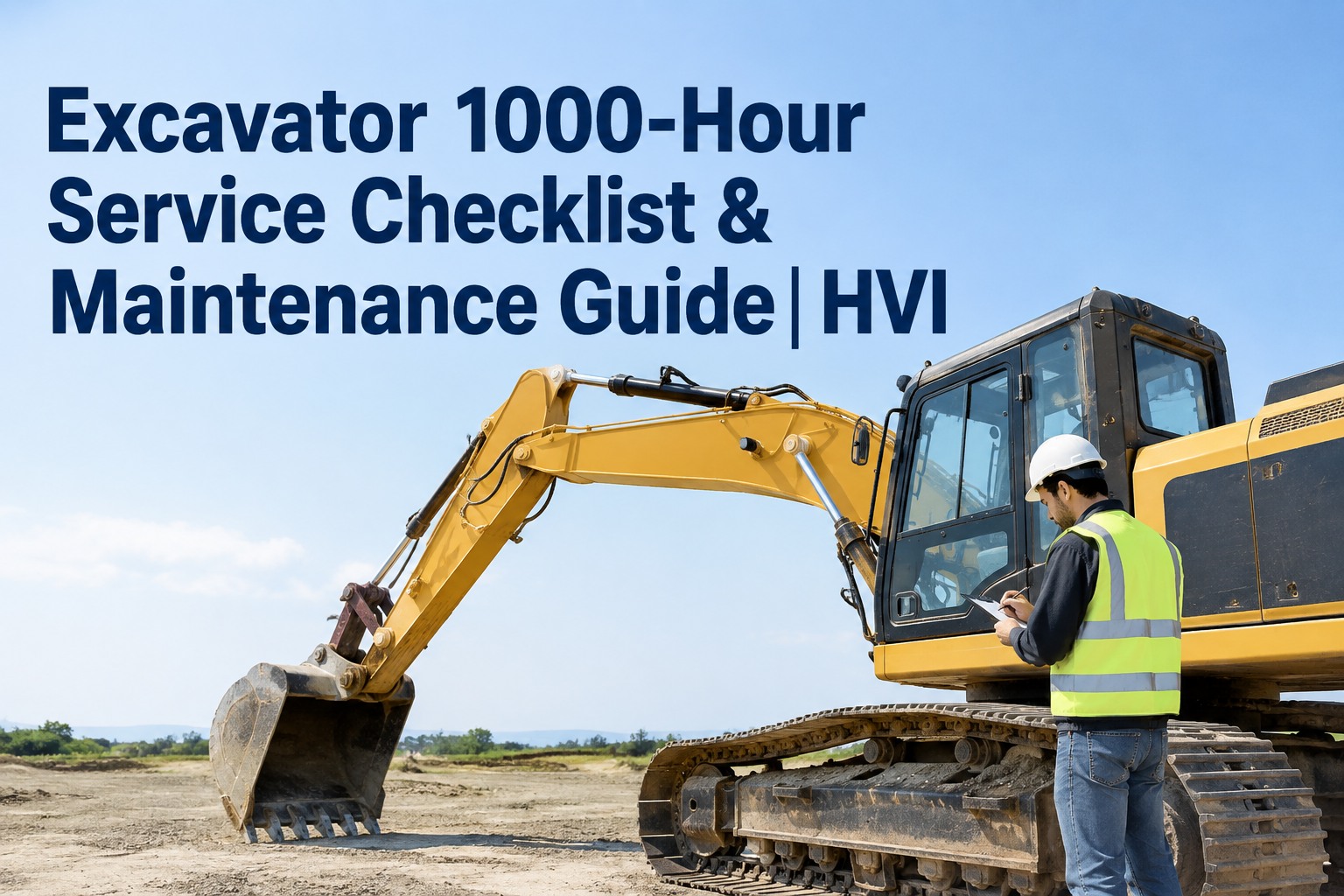
The hour meter rolls past 1,000 and the technician pulls the machine in not really sure what's actually due — last time it was whatever the previous guy remembered, and the paper log has a gap where March should be. A real excavator 1000-hour service checklist isn't a generic list pulled from memory; it's whatever the manufacturer's own schedule says is due at that interval, on that model, in that application. Book a Demo
Why the OEM Schedule Controls Your Excavator 1000-Hour Service Checklist1,000 hours means something different on every make and model
A 20-ton excavator running in a quarry and a 20-ton excavator doing utility work in soft ground hit 1,000 hours under completely different stress loads. The manufacturer's service schedule accounts for that — a generic checklist pulled off the internet doesn't.
Treat this guide as a framework, not a substitute for the OEM manual
Exact service requirements at 1,000 hours vary by manufacturer, model, application, and operating environment — a machine running in extreme heat, dust, or heavy cycling may have shortened intervals or additional checks that a standard schedule wouldn't list. The tasks below cover the areas most excavator manufacturers address at a major service interval, but the machine's own OEM service schedule should always determine exactly which tasks are due, and in what order, at 1,000 hours specifically.
What doesn't vary by manufacturer is the value of catching problems here rather than later — hydraulic failures alone are commonly cited as accounting for around 45% of major excavator breakdowns industry-wide, and a large share of those trace back to contaminated fluid that a scheduled service is specifically designed to catch. Book a Demo
The Systems Every Excavator 1000-Hour Service Checklist Should Touchsix areas, cross-checked against your OEM manual for the specifics
A 1,000-hour service goes well past a routine oil-and-filter change. These are the six areas that show up on most manufacturers' major-service schedules at this interval, in one form or another.
Fluids, filters & sampling
Engine and hydraulic oil condition, filter replacement, and a fluid sample pulled and sent for analysis before the fresh fluid goes in — not after.
Cooling, belts & hoses
Radiator and cooler core condition, coolant quality, belt tension and wear, and every hose checked for chafe points and weeping fittings.
Hydraulic components
Cylinder condition, pump and valve performance, pressure checks against spec, and a close look at any component already flagged in prior inspections.
Swing system & bearing
Swing bearing play and lubrication, swing motor and gearbox condition, and bolt torque on the bearing mounting — a component that's expensive to catch late.
Travel motors, final drives & undercarriage
Final drive oil and seal condition, travel motor performance, track tension, and wear on rollers, idlers, and sprockets across the undercarriage.
Electrical & stored fault codes
Battery and charging system condition, wiring and connector integrity, and a diagnostic scan to pull any stored fault codes the operator never saw on the display.
Attachment pins, bushings, and linkage wear, along with every grease point on the lubrication chart, round out the list — small items that add up to real downtime if skipped for a second consecutive service. Sign Up Free
Why One Fluid Sample Never Tells the Whole Storya single reading is a data point — a series of them is a trend
A fluid sample pulled at 1,000 hours tells you the condition of the oil that day. It's the same sample pulled at 250, 500, 750, and 1,000 hours — read together — that actually shows whether wear metal levels are climbing gradually, spiking suddenly, or holding steady. A single inspection can miss exactly the kind of slow drift that historical data catches early.
That rising line is what a component like a swing bearing or a hydraulic pump looks like in the months before it fails — visible in the data well before it's audible in the machine. Hour-meter data and telematics are what make it realistic to schedule that next sample before a task becomes overdue, instead of hoping someone remembers. Book a Demo
Turning 1,000 Hours Into a Condition-Based Checkpointthe service interval becomes smarter once it has history behind it
On its own, a 1,000-hour service is a fixed checkpoint. Combined with historical inspection results, past repairs, fluid-analysis trends, and stored fault codes, it becomes something closer to condition-based maintenance — a service that's informed by what this specific machine has actually been doing, not just how many hours are on the clock.
It's worth being direct about what that shift can and can't promise: measurable improvements in downtime, cost, or component life from this kind of data-driven approach depend heavily on the asset type, the baseline maintenance practices already in place, the quality and consistency of the data being collected, and how well the programme is actually implemented day to day. A fleet with clean historical records and consistent sampling will get more out of this than one starting from scattered paper logs — and that gap closes gradually, not overnight. See how hydraulic contamination trends typically show up before they turn into a failure.
From a maintenance manager who stopped trusting the paper log
We had four excavators on what was supposedly the same 1,000-hour schedule, and every one of them had a different half-finished paper trail. One machine had three oil samples in two years; another had none.
Now every machine's service history, fault codes, and sample results live in one place tied to its actual hour meter. When a swing bearing on one unit started trending the wrong way, we caught it at the next scheduled service instead of finding out mid-project.
Ray's fleet didn't need a different schedule — it needed a record that survived from one service to the next. Book a Demo
Frequently asked questions
What's typically included in an excavator 1000-hour service checklist?
Most manufacturers' major-service schedules at this interval cover engine and hydraulic fluid and filter changes, fluid sampling for lab analysis, cooling system inspection, belt and hose condition, hydraulic component checks, swing bearing and swing system inspection, travel motor and final drive service, undercarriage wear assessment, attachment and linkage wear, full lubrication, and a diagnostic scan for stored electrical fault codes. The exact combination and depth of tasks depends on the specific manufacturer, model, and application, so the OEM service manual should be the final word on what's actually due.
Why does the manufacturer's schedule matter more than a generic checklist?
Service requirements at any given hour interval vary by manufacturer, model, application, and operating environment. A machine running in extreme heat, high dust, or heavy-cycle applications may need shortened intervals or additional checks compared to the same model running in milder conditions. A generic checklist can serve as a useful reference for the general areas to cover, but it cannot substitute for the specific tasks, torque values, and part numbers in that machine's own OEM service schedule.
Why is fluid sampling more useful over time than as a single test?
A single fluid sample shows the condition of the oil at that moment, but it can't distinguish a normal reading from one that's part of a gradual upward trend. Comparing results across multiple scheduled samples reveals whether wear metal levels, viscosity, or contamination are climbing steadily, which is often the earliest available warning of developing component wear, well before the issue would be detectable through a routine visual inspection alone.
How does telematics data help with 1000-hour service planning?
Telematics provides accurate, real-time operating hours and stored fault code data, which allows service planning to be triggered proactively as a machine approaches its next interval rather than reactively once the interval has already passed. It also captures operating conditions and fault history that add useful context when reviewing whether a machine's actual usage pattern justifies adjusting from the standard OEM interval, in consultation with the manufacturer's guidance.
Does condition-based maintenance guarantee lower costs or less downtime?
No. Combining historical inspection, fluid-analysis, and fault-code data into a condition-based approach can meaningfully improve visibility into developing problems, but measurable results in cost or downtime reduction depend on factors including the asset type, the fleet's existing baseline maintenance practices, the quality and consistency of the data being collected, and how well the programme is implemented in practice. Results will vary between fleets rather than following a fixed formula.
A Complete Excavator 1000-Hour Service Checklist, Backed by Real Machine History
HVI ties inspection templates, fluid-analysis records, telematics-sourced hours and fault codes, and work-order history to each machine's permanent record — so the next scheduled service starts with data, not guesswork. Live in under two weeks.
No credit card · Telematics integration included · Per-asset history ready on day one