The compliance officer hands you a citation packet after a walkaround of your site, and the number at the bottom makes your stomach drop — but here's what most contractors don't realize about OSHA penalties 2026: the figures circulating online are often wrong because sources published estimated inflation increases that never happened. The actual maximum for a serious violation in 2026 is $16,550, and for willful or repeated violations it's $165,514 — the same as 2025, because the Bureau of Labor Statistics didn't publish October 2025 CPI data during the federal funding lapse, so no inflation adjustment occurred. If you're running a mixed fleet with operators climbing on equipment, working around crushers, or maintaining heavy plant, understanding what a construction violation actually costs — and how to prove you did the right things before an inspector arrives — is the difference between a manageable fine and a six-figure problem that follows your company for years. The contractors who sleep well at night aren't the ones hoping OSHA never shows up; they're the ones who can pull up timestamped inspection records in seconds when the compliance officer asks for proof.
What a Construction Violation Actually Costs Your Operation
One serious violation: $16,550. Willful or repeated: $165,514. Failure to abate: $16,550 per day. And that's before the citation history hits your insurance, bonding capacity and contract eligibility.
OSHA Penalty Amounts 2026: What You're Actually Facing
These are the verified maximum penalties per violation as of 2026. No inflation adjustment was applied because BLS did not release October 2025 CPI data during the federal funding lapse, so 2025 amounts carry forward unchanged.
Maximum penalty for a serious violation — one where death or serious physical harm could result. Missing guardrails, unguarded equipment, no fall protection.
Same maximum as serious. Direct relationship to safety and health but unlikely to cause death or serious harm — missing records, inadequate signage.
Ten times the serious penalty. Willful means intentional disregard or plain indifference. Repeated means you were cited for the same or similar violation within the past five years.
If you don't fix a cited hazard by the abatement deadline, OSHA can assess $16,550 for each day the violation continues past the abatement date.
Why One Inspection Can Produce Six-Figure Exposure
OSHA penalties are assessed per violation, not per inspection. A single walkaround of your site can generate multiple citations, and each one carries its own maximum penalty. Here's how the math works on a real jobsite scenario.
Worked Example: 40-Ton Excavator Maintenance Bay Inspection
A compliance officer walks your maintenance shop and finds the following during a 90-minute inspection:
That's before legal fees, abatement costs, or the failure-to-abate clock if you miss the correction deadline. And the citation history stays on your company's record for five years, affecting insurance renewals, bonding capacity and prequalification for government contracts.
How OSHA Calculates Your Final Penalty Amount
The maximum penalty is the starting point. OSHA applies reduction factors based on employer size, good faith and violation history. But reductions are discretionary — and they disappear fast if you can't prove you have a safety program in place.
Size Reduction
Up to 70% reduction for employers with 1-10 workers, scaling down to 10% for 101-250 workers. Employers with 251+ workers get no size reduction. The 2026 enforcement guidance expanded small-employer reductions, but you must have fewer than 251 employees company-wide to qualify.
Good Faith Reduction
Up to 25% reduction if you have a written safety and health program, documented training, and evidence of self-inspections and hazard correction. This is where timestamped inspection records, photo-backed defect reports and closed work orders make the difference. No documentation, no reduction.
History Reduction
10% reduction if you have no serious, willful, repeat or failure-to-abate citations in the past five years. One prior citation wipes this out. This is why contractors who centralize their inspection and maintenance records protect their clean history — they catch and fix hazards before OSHA sees them.
Gravity-Based Penalty Adjustment
OSHA also adjusts the penalty based on the gravity of the violation — severity (likelihood of death or serious harm) and probability (likelihood an injury will occur). High-gravity violations get the full maximum. Low-gravity violations can be reduced by up to 50%. But gravity adjustments are applied after size, good faith and history reductions, so the final number still stings.
What a Citation Costs Beyond the Fine
The penalty check you write to OSHA is the smallest part of the total cost. The citation history follows your company for years and hits you in places most contractors don't expect until it's too late.
Insurance Premium Increases
General liability and workers' comp carriers pull OSHA citation history during underwriting. A serious or willful citation can trigger 15-30% premium increases at renewal, and some carriers will non-renew you entirely. You're paying for that citation for three to five years.
Bonding Capacity Reduction
Surety companies review OSHA records when setting bonding limits. A willful or repeat violation can cut your bonding capacity in half or price you out of bonded work entirely. If you bid public projects, this kills your pipeline.
Government Contract Disqualification
Federal and state prequalification forms ask for OSHA citation history. Willful or repeat violations can disqualify you from bidding for one to three years. Private owners increasingly check OSHA records too, especially on industrial and energy projects.
Legal Fees and Abatement Costs
Contesting a citation means attorney fees, expert witnesses and management time — often $10,000 to $50,000 even if you win. Abatement itself (engineering controls, equipment retrofits, program development) can dwarf the penalty. And if you miss the abatement deadline, the $16,550-per-day clock starts.
Stop Hoping OSHA Doesn't Show Up. Start Proving You Did the Work.
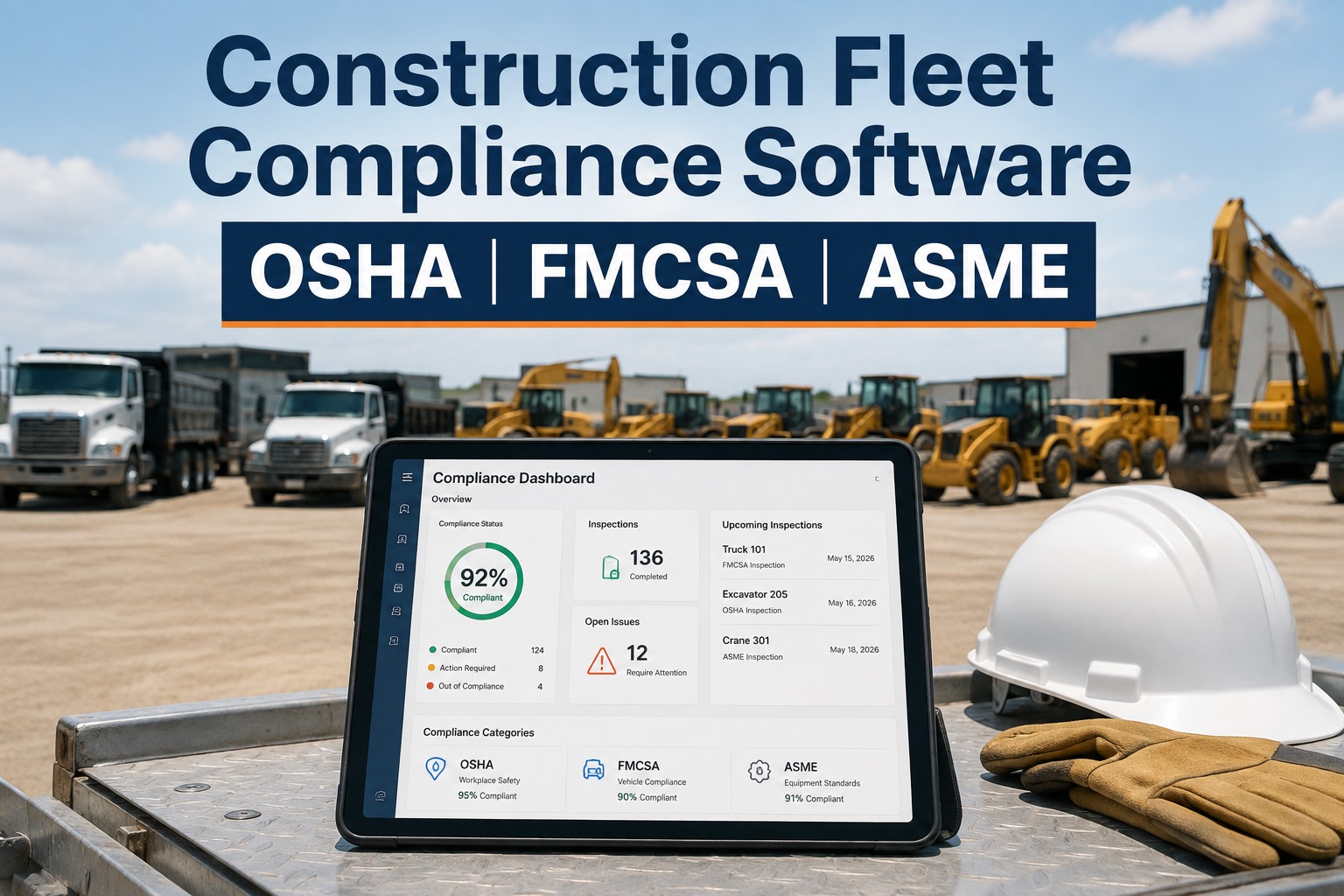
HVI gives you timestamped, photo-backed inspection records and closed work orders you can pull up in seconds during an audit — the exact documentation that earns good-faith reductions and protects your citation history.
Turn Inspection Records Into Penalty Protection
The contractors who avoid citations — or earn the biggest reductions when they do get cited — are the ones who can prove they have a working safety and maintenance program. HVI makes that proof automatic.
Digital Inspections with Photo Capture
Operators complete daily equipment checks on any phone or tablet, capturing photos of defects and hazards in real time. Every inspection is timestamped, geotagged and stored in the cloud. When OSHA asks for your self-inspection records, you pull them up in seconds instead of digging through binders.
Instant Defect-to-Work-Order Conversion
When an inspection flags a hazard — missing guard, damaged ladder, hydraulic leak — HVI converts it to a work order immediately and tracks it to closure. You have a complete audit trail showing you identified the hazard and fixed it, which is the core of a good-faith defense.
Preventive Maintenance Scheduling
Schedule PMs by date, mileage or engine hours with automatic due and overdue alerts. HVI tracks every service, inspection and repair across your entire fleet — trucks, trailers, excavators, loaders, cranes — so nothing falls through the cracks and you can start logging PMs free to build your compliance record.
Audit-Ready Compliance Reporting
Generate compliance reports showing inspection completion rates, hazard correction times and PM compliance by asset, site or date range. When a compliance officer, insurance auditor or prequalification reviewer asks for proof of your safety program, you hand them a report instead of a shoebox.
What You Need to Remember About OSHA Penalties 2026
The verified 2026 maximum penalties are $16,550 for serious and other-than-serious violations, $165,514 for willful or repeated violations, and $16,550 per day for failure to abate. No inflation adjustment was applied because BLS did not publish October 2025 CPI data during the federal funding lapse.
Penalties are assessed per violation, not per inspection. A single site visit can generate multiple citations, and each one carries its own maximum penalty. A 90-minute walkaround can produce six-figure exposure.
Penalty reductions for size, good faith and history are discretionary. You earn the good-faith reduction by proving you have a written safety program, documented training and evidence of self-inspections and hazard correction. No documentation, no reduction.
The citation history follows your company for five years. It affects insurance premiums, bonding capacity and eligibility for government contracts. The fine is the smallest part of the total cost.
The contractors who avoid citations — or minimize the damage when they do get cited — are the ones who can prove they did the work. Timestamped inspection records, photo-backed defect reports and closed work orders are your defense. If you're still running paper checklists and text-message photos, see how HVI works on your own equipment before the next inspection.
"I track two numbers every month: inspection completion rate and average time to close a defect. If either one slips, I know we're exposed. Last year OSHA walked one of our sites and asked for six months of daily equipment checks. I pulled them up on my phone in about 30 seconds — timestamps, photos, operator names, everything. The compliance officer looked at the records, looked at me, and said 'You're one of the few contractors who actually has this stuff.' We got the good-faith reduction and the citation was cut in half. That's the difference between a $16,000 problem and an $8,000 problem."
OSHA Penalties 2026: Your Questions Answered
What is the maximum OSHA penalty for a serious violation in 2026?
How much is a willful or repeated OSHA violation in 2026?
Can OSHA penalties be reduced, and how?
What happens if I don't fix a cited hazard by the abatement deadline?
How long does an OSHA citation stay on my company's record?
See HVI Running on Your Own Fleet — Book a 30-Minute Demo
We'll walk you through digital inspections, work order management and audit-ready reporting using your actual equipment and workflows. No generic sales pitch — just a working system you can test on your own units.
Free to start — Works on any phone — No card needed