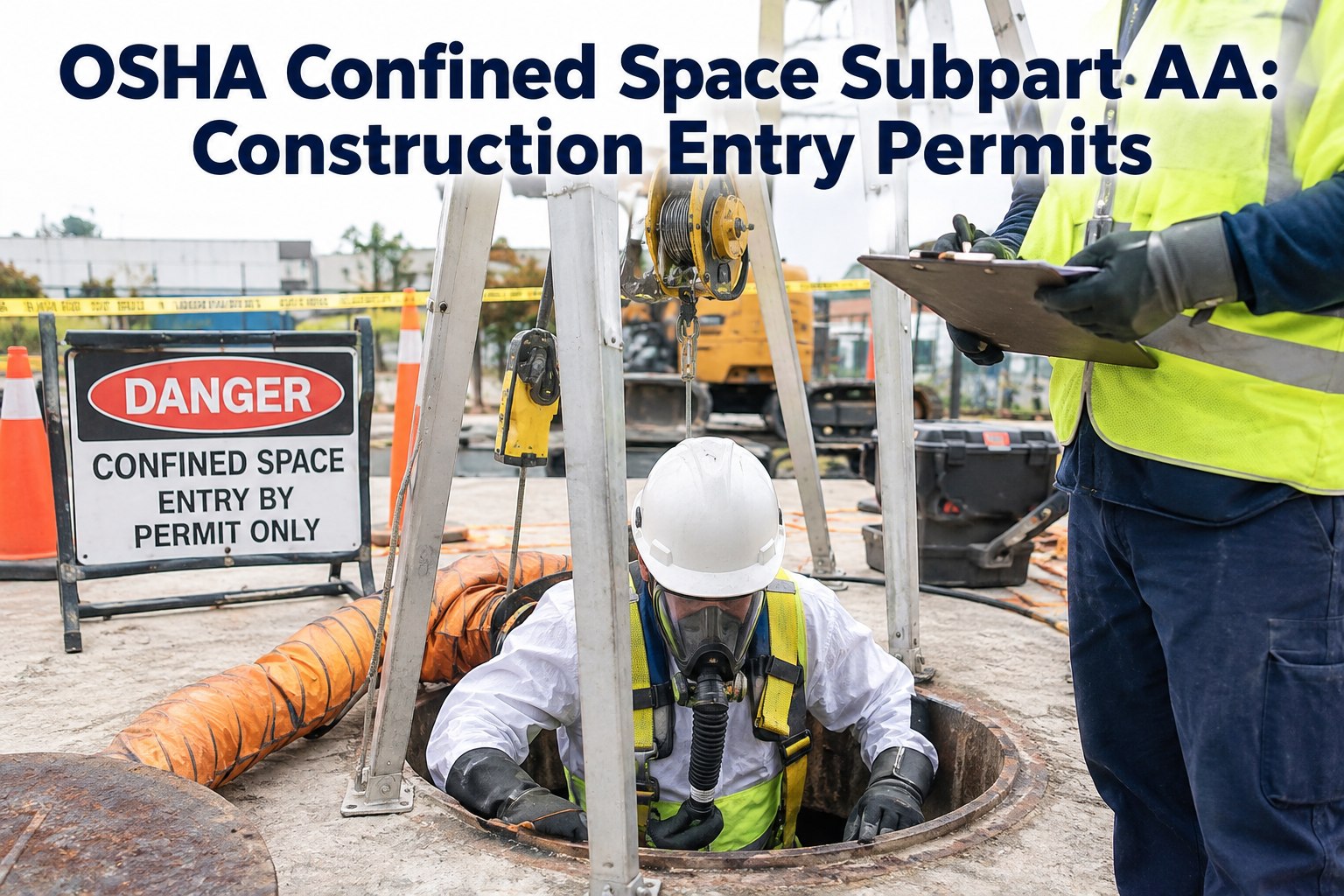
Your crew is standing at the edge of a 3-metre excavation, the shoring is in, the ladder is down, and the foreman is about to climb in to check a seepage point — but nobody has run a four-gas monitor through it this morning. That is exactly where OSHA confined space construction rules under Subpart AA bite: deep excavations, manholes, vaults, tanks and storm drains all qualify as confined spaces the moment an atmospheric or engulfment hazard could exist, and most contractors run more permit-required entries than they realise. If the permit, the testing log, the attendant and the rescue plan are not documented before the first boot goes in, you are exposed — to citations, to stop-work orders, and to something far worse. This guide walks through classification, atmospheric testing, attendant duties, entry supervisor authorisation and rescue planning in plain jobsite language, and shows how contractors are now tracking it all digitally — you can see the full entry-permit workflow in a 30-minute demo before your next dig.
OSHA 1926 Subpart AA — Field Guide
Is that excavation a permit-required confined space right now?
If it is large enough to enter, has limited entry and exit, and could hold a hazardous atmosphere or engulfment risk, the answer is yes — and the permit, testing and rescue plan are due before entry, not after the incident.
Classification First
Permit-required vs non-permit confined space: how to classify it on your site
Every confined space decision starts with three gate questions. Get them wrong and everything downstream — testing, attendant, rescue — is built on nothing.
Is it a confined space at all?
Large enough to enter and work, limited entry and exit, not designed for continuous occupancy. Manholes, valve vaults, storm drains, tanks, silos, pits — and yes, deep excavations where access is restricted — all pass this gate.
Does it carry a hazard?
A hazardous atmosphere (or the potential for one), engulfment material, an internal shape that could trap or wedge a worker, or any other serious safety hazard. One yes makes it permit-required.
Can the hazard be eliminated?
If you can isolate and ventilate so the only hazard is removed and stays removed, it may be reclassified as non-permit — with documentation. If not, you run a full permit entry every single time.
The excavation trap: Subpart AA pulls trenches and excavations into scope when atmospheric hazards exist — near landfills, old fuel lines, sewers, decomposing fill, or where engine exhaust pools. A 4-foot utility trench beside a running compressor has put workers down before. When in doubt, test it and treat it as permit-required.
Test Before You Trust
Atmospheric testing sequence for confined space entry
Order matters. Test in the wrong sequence and your meter can lie to you — a flammable-gas reading taken before oxygen is meaningless if O2 is too low for the sensor to burn.
Oxygen first — 19.5% to 23.5%
Below 19.5% is oxygen-deficient; above 23.5% turns ordinary materials into fuel. Displacement gases like CO2 and methane push O2 down without any smell or warning.
Flammables second — under 10% of LEL
Methane from soil, fuel vapour from old lines, solvent residue in tanks. Anything at or above 10% of the lower explosive limit stops the entry until it is ventilated and retested.
Toxics third — H2S and CO
Hydrogen sulfide kills your sense of smell at high levels, so "it smells fine" proves nothing. Carbon monoxide from nearby engines and pumps drifts into low spaces and stays there.
Test top, middle, bottom — then keep testing
Gases stratify: methane rises, H2S and CO2 sink. Probe every level before entry and run continuous monitoring while anyone is inside — conditions change as work disturbs sludge and soil.
Every reading belongs on the permit with a time stamp, the monitor's serial number and the tester's name. Contractors who walk through digital testing logs in a live demo usually spot two or three gaps in their current paper permits within the first ten minutes.
The Equipment Side
Gas monitor calibration and bump testing: where programs quietly lapse
A monitor that has not been bump tested is not a safety device — it is a decoration on someone's belt. This is the obligation that slips first on busy jobs.
Bump test — before each day's use
A 30-second shot of known gas that proves the sensors and alarms respond. It does not adjust anything; it answers one question: does this unit alarm when it should? If it fails, it goes to calibration, not into the manhole.
Calibration — per manufacturer schedule
Typically monthly, and always after a failed bump test, a drop, or exposure to a sensor-poisoning atmosphere. Calibration resets the readings against certified gas and must be logged with date, gas lot and technician.
| Equipment obligation | Frequency | Record you must be able to show | What lapses look like |
|---|---|---|---|
| Bump test, four-gas monitor | Before each day's use | Pass/fail log tied to the unit's serial number | Monitor used for weeks with no test record |
| Full calibration | Manufacturer schedule, usually monthly | Calibration certificate with gas lot and date | One shared monitor, no idea when last calibrated |
| Rescue tripod, winch and harness inspection | Before each use plus periodic | Inspection checklist with competent person's sign-off | Harness with a cut webbing strap still in the kit |
| Ventilation blower and duct check | Before each entry | Pre-use check on the entry permit itself | Blower arrives on site with a torn duct |
HVI treats each gas monitor, tripod and blower as a tracked asset with its own calibration and inspection schedule, firing 90, 60 and 30-day expiry alerts so a lapsed calibration surfaces in your inbox weeks before it surfaces in an OSHA interview. You can start tracking your monitors free with the serial numbers you already have.
People On The Permit
Attendant, entry supervisor and authorised entrant: who does what
Three named roles, three signatures, zero overlap. Subpart AA is explicit that these duties cannot be diluted — and the attendant rule is the one contractors break most.
Eyes on the space, nothing else
Stays outside, maintains contact, counts entrants, monitors conditions and orders evacuation. The attendant cannot be shared with other duties — not flagging traffic, not running the pump, not fetching fittings. The moment they turn away, your entry is out of compliance.
Authorises, verifies, terminates
Confirms testing is done, controls are in place, rescue is arranged and the permit is complete — then signs it. They also terminate the entry and cancel the permit when conditions change or the work finishes. No signature, no entry.
Trained before the first descent
Knows the hazards, the symptoms of exposure, the communication method and the exit plan. Training must be documented per worker — name, date, content, trainer — and refreshed when duties or spaces change. A toolbox talk from two years ago does not count.
Keeping training records per worker in one system means the entry supervisor can verify qualification on a phone at the space, instead of phoning the office to dig through a filing cabinet.
The Plan That Saves Lives
Confined space rescue plan: why "call 911" is not a plan
About 60% of confined-space fatalities are would-be rescuers — coworkers who went in after the first victim with no equipment and no plan. OSHA knows this, which is why a phone number on the permit does not satisfy the rescue requirement.
A compliant rescue plan has
- Non-entry retrieval first: harness, lifeline, tripod and winch rigged before entry so the attendant can pull a worker out without going in
- A named rescue service — on-site team or off-site service — that has confirmed availability, knows your spaces and can reach the site in a realistic time
- Rescue equipment inspected and staged at the space, not locked in a container across the site
- Practice: at least one simulated rescue from the actual space type, documented, before you rely on it
What gets contractors cited
- "Call 911" written on the permit with no verification the local service does confined-space rescue at all
- A tripod and winch on the truck but no harness sized for the entrant going down
- Attendant expected to perform entry rescue with no training and no backup
- No drill records — the plan exists on paper and has never been tested against the real space
A worked example: a utility crew doing valve work in a 4-metre vault prices a standby rescue team at a few hundred dollars for the day. The alternative — an entrant overcome by H2S, an attendant going in after him, a stop-work order and a willful citation — runs into six figures before you count the two funerals. Rescue planning is the cheapest line item on the permit.
How HVI Helps
Run every confined space entry from one phone screen
HVI is built for fleet-heavy and site-heavy operations, so your monitors, permits, people and rescue gear live in the same CMMS as your trucks and plant.
Entry permits in under 30 minutes
Configurable permit templates with testing fields, role signatures and photo capture. Crews complete them on any phone at the space; the signed permit is timestamped and stored the moment the supervisor approves.
Calibration alerts at 90, 60, 30 days
Gas monitors, tripods, blowers and harnesses tracked as assets with their own schedules. Expiry alerts land before the lapse, and an overdue unit is visible to every supervisor in the system.
Training records per worker
Entrant, attendant and supervisor qualifications stored against each person with renewal dates. Verify a crew's status at the space in seconds instead of calling the office.
Audit-ready retrieval
When OSHA, a client auditor or an insurer asks for last quarter's entries, you pull permits, testing logs, calibration certificates and drill records in one search — no binders, no group-chat photos.
Most contractors book a demo with one real space in mind and see their own permit rebuilt live on the call.
Your next entry permit could be signed, tested and filed before lunch
See HVI running a full confined space entry — permit, atmospheric log, calibration check and rescue record — on your own spaces in a 30-minute walkthrough.
Key Takeaways
OSHA confined space construction compliance, in one look
Subpart AA is not complicated, but it is unforgiving of shortcuts. Classify every space honestly — deep excavations included. Test oxygen, flammables and toxics in that order, at every level, and keep monitoring while people are inside. Bump test the monitor daily and calibrate it on schedule, because the equipment obligation is the one that lapses first. Keep the attendant on the space and nothing else, get the entry supervisor's signature before descent, and build a rescue plan that starts with non-entry retrieval — not a phone number. Finally, document all of it so you can prove it a year later. Contractors running digital permits and equipment schedules free in HVI stop chasing paper and start catching lapses before an inspector does.
My standing rule is simple: no bump test, no entry, and I don't care how far behind schedule we are. Two winters ago a monitor we'd been using all week failed its bump on a Tuesday morning — turned out a sensor had been dead for days. That was the week I put every meter and tripod on a tracked schedule with expiry alerts. I check one dashboard now instead of trusting whatever tag is hanging off the case.
Derek Malloy — Safety Manager, civil utilities and pipeline contractor
Questions From The Field
Confined space entry permit FAQs
Does a deep excavation really count as a confined space under Subpart AA?
What order do you test the atmosphere in a confined space?
How often does a gas monitor need calibration and bump testing?
Can the attendant do other jobs while watching the space?
Is calling 911 enough for a confined space rescue plan?
Make your next permit entry the one an auditor can't fault
Permits, atmospheric logs, monitor calibrations, training records and rescue drills — all timestamped, photo-backed and retrievable in seconds from any phone.
Free to start - Works on any phone - No card needed