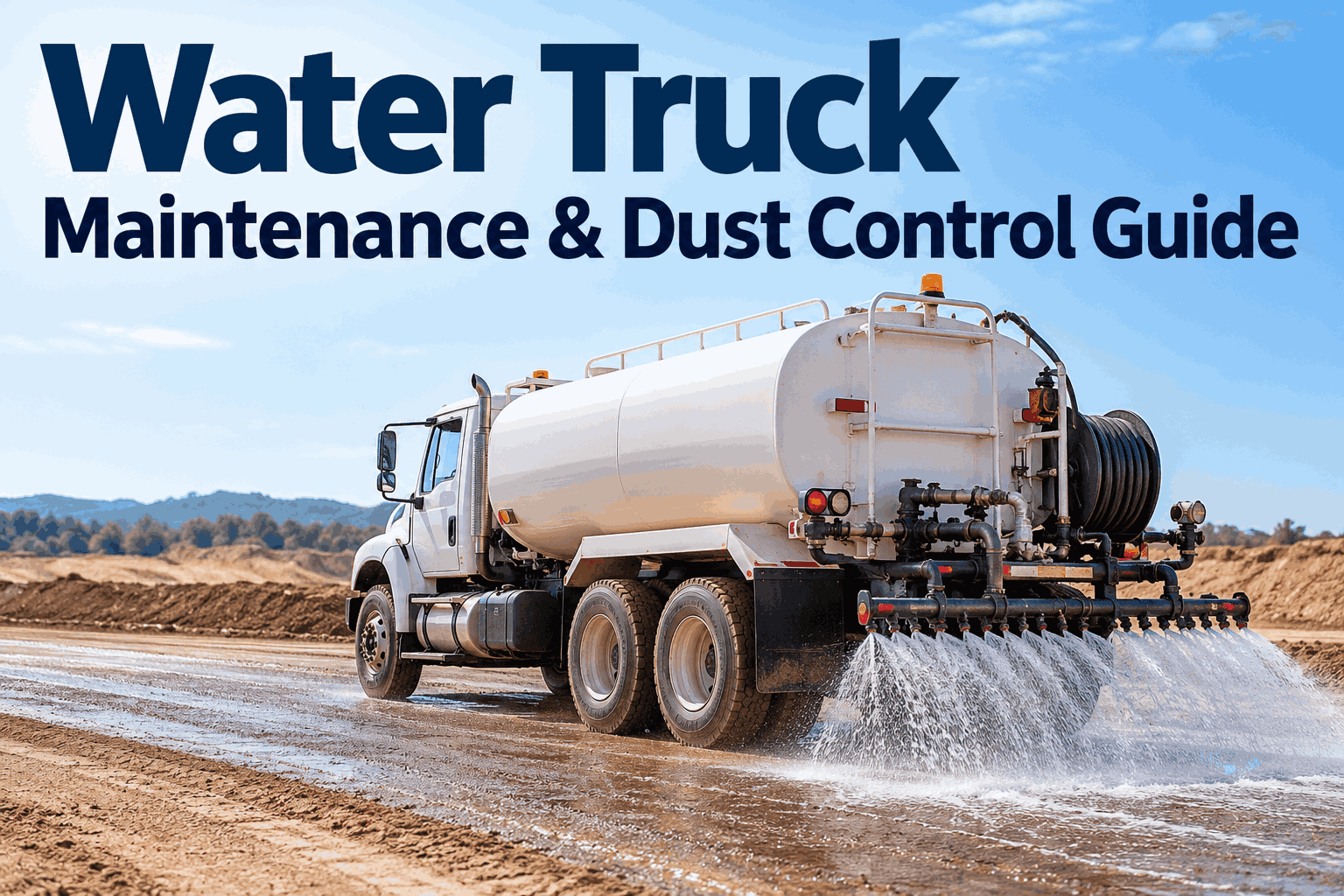
Water truck maintenance is really two jobs in one: keeping a heavy truck running, and keeping the water system that does the actual work — pump, spray bar, tank and hoses — ready every shift. When a water truck goes down, dust control stops, and on many sites that means the whole job stops. Book a demo to keep every water truck jobsite-ready.
A Truck Plus a Water System to Maintain
Water truck maintenance covers the chassis and the whole water system on top of it — pump, spray bar, tank, hoses and valves. Miss the water side and the truck runs fine but can't do its one job: keeping the dust down.
Here's a water truck maintenance program that keeps trucks ready for dust control — the water-system components that fail, what a down truck actually costs a jobsite, the preventive-maintenance schedule that prevents it, the inspection routine that catches problems early, and how to track it all so no truck slips.
It's a truck plus a water systemwhy a standard truck check isn't enough
A water truck passes a normal DOT-style inspection and still fails at its job if the water system isn't maintained. The engine, brakes and tires are only half the machine — the pump, spray bar, tank and plumbing are what actually deliver dust control, and they wear on their own schedule, in their own ways.
The truck can be roadworthy and still useless for the job. A seized pump, clogged spray heads or a cracked hose don't show up on a chassis inspection, but any one of them means no dust suppression. Water truck maintenance has to cover the water system as seriously as the drivetrain, because that's the part the site is actually paying for.
The water-system components that failwhat breaks, and why it stops the job
Most water truck downtime traces to four systems — the ones a generic truck check skips entirely. Knowing how each fails is the foundation of a water truck maintenance program that actually keeps trucks spraying.
Water pump
Runs dry, loses prime or wears its impeller and seals. A failing pump means weak or no spray — the most common water-truck breakdown.
Spray bar & heads
Nozzles clog with sediment or corrode, so coverage goes patchy and uneven. Clogged heads waste water and leave dust behind.
Tank & baffles
Baffles crack and let water surge, hurting stability; tanks corrode or grow sediment that migrates into the pump and heads.
Hoses & valves
Hoses chafe and split under pressure; valves stick or leak. A blown hose drops pressure instantly and can soak the cab or wiring.
None of these appears on a standard chassis inspection, which is exactly why water trucks need a purpose-built check. Capturing these water-system items — with photos of a clogged head or a chafed hose — is what a good water tanker inspection checklist is built to do. Book a demo to build a water-truck inspection
What a down water truck costs the jobdust control isn't optional — it's often a permit condition
On most earthmoving and haul-road sites, dust control isn't a nicety — it's a condition of the permit and a safety requirement for visibility. When the water truck stops, the dust doesn't, and the consequences stack up fast.
That's why water truck maintenance pays back so directly: the cost of a planned pump service is trivial next to a stopped site or a dust-related stop-work order. Preventing the failure is far cheaper than reacting to it, which is the whole case for preventive maintenance scheduling on these trucks. Book a demo to prevent water-truck downtime
The water truck PM schedulewhat to service, and how often
A water truck preventive-maintenance schedule layers the water system on top of the usual chassis PM. Each layer runs on its own interval — some checks are every shift, others weekly or seasonal — and skipping the water-side layers is where dust-control trucks quietly fall apart.
The interval that matters most is the daily water check, because it's the one under time pressure at shift start — and the one that catches a clogging head or a weeping seal before it becomes a mid-shift failure. The deeper services are easy to lose track of when a truck's hours vary week to week, so meter- or hour-based scheduling is what keeps the pump service from quietly sliding past due. A water truck that runs double shifts through a dry spell hits its pump interval far sooner than the calendar suggests, which is exactly the kind of drift an hours-based schedule catches. Start free and set each interval per truck.
Where water trucks get neglectedthe four gaps that put a truck on the shoulder
Water trucks are often the last asset a fleet formalizes — treated as simple until one strands a crew. These four gaps are where the neglect shows, and each is avoidable with a water-specific program.
The pattern is treating a water truck like a plain truck when it's really specialized equipment — the water system needs the same seriousness a fleet already gives its excavators or haul trucks. Closing the gaps means a water-specific inspection, real service intervals, and records that show the program is running, so the truck earns the same confidence as every other asset on the site rather than being the one everyone quietly worries about. Book a demo to close the water-truck gaps
Track it so no truck slipswhere the program meets the software
A water truck maintenance program only works if it's tracked — the daily check done and logged, the pump service triggered on time, the defect turned into a repair. When that lives in one system instead of a clipboard, the truck stays ready and the records are there when you need them.
Water-specific DVIR
Pump, spray, tank and hoses built into the daily inspection, with photos of any defect.
PM triggered on time
Pump and system services scheduled by hours or date, with alerts before they're overdue.
Defects to work orders
A clogged head or weeping seal becomes a work order and stays open until it's fixed.
That's the difference between a water truck that's ready every morning and one you hope holds up: a tracked program where nothing depends on memory. It runs on the same digital inspection and DVIR platform that keeps the rest of the fleet moving. Start free and track every water truck in one place.
From an equipment manager
We treated our water trucks as an afterthought for years — they got a fuel-and-tire glance and that was it. Then one seized its pump on a dry August afternoon and the whole grading crew sat for half a day while we chased a replacement, and the inspector was already asking about our dust plan. That day cost more than a year of proper pump service. We put the water trucks on the same program as everything else: a real daily check that includes spray pattern and pump prime, a pump service on hours, spray heads cleaned weekly. Since then we haven't lost a shift to a water truck, and when the air-quality inspector shows up I can pull the service history in seconds. For a piece of equipment everyone underrates, that's been one of our best returns.
How HVI keeps water trucks jobsite-readyinspect the water system, schedule the PM, track every truck
Water truck maintenance works when the water system is inspected daily, the PM runs on schedule, and every truck is tracked in one place. HVI's fleet inspection, DVIR and preventive maintenance do exactly that for a dust-control fleet.
Inspect the water system
A daily DVIR built for water trucks — pump, spray, tank, hoses.
Schedule the PM
Pump and system services triggered by hours or date, with alerts.
Track every truck
Defects, repairs and service history in one place, per truck.
See how a water-truck program comes together — from a water truck comparison guide to a live inspection and PM schedule — inside HVI. Walk through your own dust-control fleet in a quick demo
Water truck maintenance: quick answers
What does water truck maintenance involve?
Water truck maintenance covers two things at once: the truck chassis (engine, brakes, tires, drivetrain) and the water system that does the dust-control work (pump, spray bar and heads, tank and baffles, hoses and valves). A complete program includes a daily pre-trip and water-system check, weekly cleaning of spray heads and filters, hour- or date-based pump and chassis servicing, and seasonal tank and baffle inspection plus winterization. The water system is the part a standard truck inspection misses, so it needs its own dedicated checks.
What are the most common water truck problems?
The most common failures are in the water system rather than the chassis. Water pumps lose prime or wear their seals and impellers, cutting spray pressure. Spray heads clog with sediment or corrode, leaving patchy dust coverage. Tank baffles crack and let water surge, and tanks build sediment that migrates into the pump. Hoses chafe and split under pressure, and valves stick or leak. Because none of these show on a normal truck inspection, they're easy to miss until the truck can't keep the dust down mid-shift.
How often should a water truck be serviced?
On a layered schedule. A daily pre-trip should check the pump prime, spray pattern, hoses and tank level along with the usual chassis items. Weekly, clear the spray heads and clean the intake filters. Monthly or on an hours-based interval, service the pump seals and impeller and run the chassis PM with a full water-system pressure check. Seasonally, inspect the tank and baffles, flush sediment, and winterize the system against freezing. Hour- or meter-based scheduling keeps the deeper services from slipping as the truck's usage varies.
Why is water truck maintenance so important for dust control?
Because on most sites dust control is a permit condition and a safety requirement, not an optional extra. When a water truck goes down, dust suppression stops — which can breach an air-quality permit, trigger a stop-work order, cut visibility on haul roads, and idle crews and equipment until the truck is fixed. The cost of a stopped site or a compliance penalty dwarfs the cost of the planned pump service that would have prevented it, which is why keeping the water system maintained pays back directly.
How does HVI help with water truck maintenance?
HVI gives each water truck a purpose-built digital inspection and DVIR that covers the pump, spray bar, tank and hoses — not just the chassis — with photos of any defect. Its preventive-maintenance scheduling triggers pump and water-system services by hours or date, with alerts before they're overdue, and turns any defect into a work order that stays open until it's fixed. Every truck's inspection and service history lives in one place, so the fleet stays jobsite-ready and the records are there when an air-quality inspector asks.
Never lose a shift to a water truck again
HVI turns water truck maintenance into a program that runs itself — a water-specific daily DVIR, pump and system PM triggered on time, and every defect tracked to closure — so the truck is spraying when the site needs it and your dust-control records are always audit-ready.
No credit card · Built for construction & dust-control fleets
- Daily: pump prime, spray pattern, hoses
- Weekly: clear spray heads & filters
- Hours-based: pump service & chassis PM
- Seasonal: tank, baffles & winterize
- Track every check & service per truck