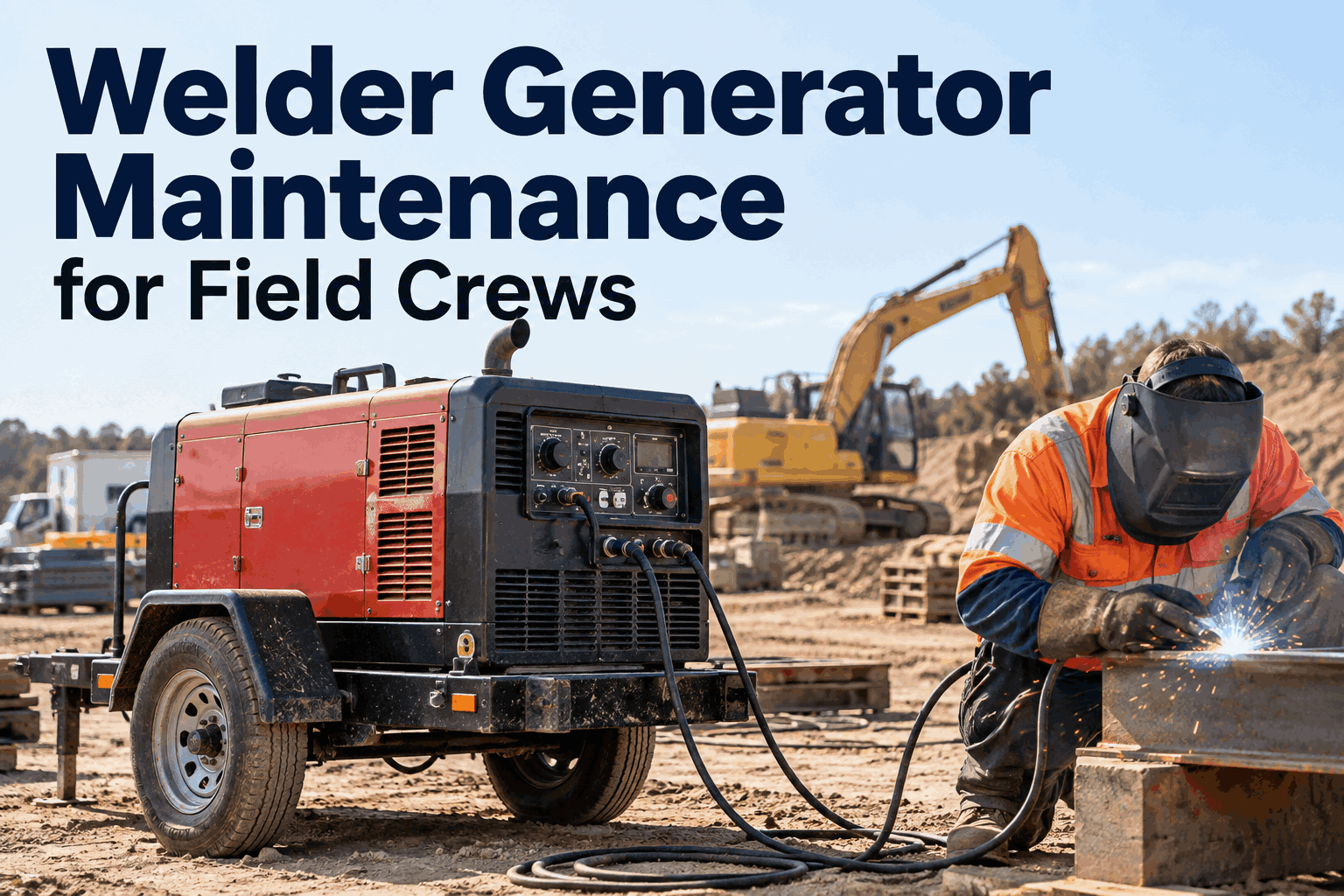
Welder generator maintenance is really about keeping two machines alive in one frame — a hard-working engine and the welding output it drives — usually miles from the nearest shop. When a field welder quits, the crew quits with it, and there's no spare on the truck. Book a demo to keep every field welder generator running.
Two Machines in One Frame
A welder generator is an engine and a welding power source sharing one chassis. Maintain only the engine and the weld output drifts; maintain only the welder and the engine strands the crew. Both sides need a program.
Here's a welder generator maintenance program built for field crews — why it's two machines to look after, the six systems that need checking, why field conditions wear them faster, the hour-based service schedule that prevents breakdowns, and how to track it all when the equipment is scattered across jobsites.
It runs the engine and makes the weldwhy one-sided maintenance always fails
Crews tend to maintain a welder generator like a generator — oil, fuel, filters — and assume the welding side takes care of itself. It doesn't. Worn brushes, dirty slip rings and damaged leads degrade weld quality and output long before the engine shows any trouble, and a bad weld on a structural job is its own kind of failure.
A running engine doesn't mean a working welder. The engine and the welding power source wear on different clocks and fail in different ways, so welder generator maintenance has to cover both — engine service to keep it starting and running, and welding-system checks to keep the arc clean and the output on spec. Neglect either and the crew loses the tool they came to use.
The six systems to keep checkedengine and welding side, together
A complete welder generator maintenance program covers six systems — four the engine shares with any diesel, and two unique to the welding side. Each fails in its own way, and each belongs on the check.
Engine
Oil and filter, valve health, starting and running under load. The core of reliability — skip it and nothing else matters.
Fuel
Filters, water separator and injectors. Dirty fuel on a dusty site is the fastest way to a hard-starting, low-power machine.
Cooling
Coolant level, radiator and airflow. Welders run at sustained high load, so an overheating engine is a constant field risk.
Electrical / output
Battery, connections and generator output. Loose or corroded connections rob welding power and cause erratic output.
Welding system
Leads, clamps, brushes and slip rings. Worn brushes and damaged leads are the top cause of poor arc and off-spec welds.
General / structural
Enclosure, mounts, guards and controls. Vibration on rough transport loosens everything — a quick walk-around catches it.
The two that get skipped most are the welding side — brushes and leads — because the machine still "runs" without them being right. Catching a worn brush or a nicked lead early keeps welds on spec and prevents a callback on finished work, which is exactly what a purpose-built field inspection and DVIR is for. Book a demo to build a welder-generator check
Field conditions wear them fasterwhy jobsite welders need a tighter program
A welder generator in a clean shop and one on a jobsite are not the same maintenance problem. Field units run at high load for long stretches, breathe dust and grit, take a beating in transport, and are serviced by whoever's on site — which is why they need a tighter, tracked program than their duty cycle suggests.
Because the wear runs ahead of a calendar, field welder generators are best serviced on engine hours, not dates — a unit on a long weld-heavy job hits its service point far sooner than the month implies. Hours-based scheduling is the difference between catching a filter before it starves the engine and finding out at 2pm on a deadline. Start free and schedule by engine hours, not the calendar.
The hour-based service schedulewhat to do, and at how many engine hours
Welder generator maintenance runs on engine hours, layered from a quick daily check up to a full annual service. Each milestone adds to the last, and the daily check is the one that catches field damage before it becomes downtime.
The daily walk-around is the highest-value habit because it's free and it catches the field damage — a chafed lead, a weeping seal, a loose mount — that turns into a mid-shift failure if it's missed. Hours-based scheduling keeps the deeper services honest as usage swings, the same discipline behind any sound preventive maintenance program. Book a demo to set service by engine hours
Where field welders get neglectedthe four gaps that strand a crew
Welder generators are easy to under-maintain precisely because they keep running — until they don't. These four gaps are where field units slip, and each is avoidable with a tracked program.
The pattern is treating a welder generator as a simple generator when it's a precision tool with an engine attached. Closing the gaps means checking both sides, tracking engine hours, and keeping records that follow the unit between jobsites — the foundation of a program you can rely on far from the shop. Book a demo to close the field-welder gaps
Track it across every jobsitewhere the program meets the software
The hardest part of field welder maintenance isn't the wrench work — it's knowing what's been done to a machine that's been on three jobs this month. When the check, the hours and the service history live in one system that travels with the unit, the program holds together wherever the equipment goes.
Both-sides DVIR
A guided field check covering engine and welding systems, with photos of a worn brush or nicked lead.
PM by engine hours
Services triggered on the unit's actual hours, with alerts before they're overdue, wherever it's parked.
History that travels
Every check and repair tied to the unit, so the record follows it from job to job.
That's the difference between a welder generator that's ready on every job and one the crew crosses their fingers over: a tracked program where the machine's history is a lookup, not a guess. It runs alongside the rest of your equipment programs — the same approach that keeps a water truck maintenance program on track. Start free and track every welder generator in one place.
From a field maintenance manager
Our welders were the one asset nobody owned. They'd get an oil change when someone remembered and that was the whole program — nobody ever touched the brushes or checked a lead until the arc went bad. We had a crew lose most of a day on a pipeline job because a welder's slip rings were caked and the output was all over the place, and the machine had "just been serviced." Once we put the welders on the same hours-based program as our other iron — a real daily walk-around that includes the welding side, brushes and leads on the 50-hour check, service by engine hours — the surprise failures stopped. The best part is I can pull any unit's history no matter which job it's on. For equipment that used to be an afterthought, it's saved us a lot of lost days.
How HVI keeps field welders runningcheck both sides, service by hours, track everywhere
Welder generator maintenance works when both sides are checked, services run on engine hours, and every unit is tracked wherever it goes. HVI's preventive maintenance and fleet inspection / DVIR do exactly that for a field fleet.
Check both sides
A field DVIR covering engine and welding systems, done by whoever's on site.
Service by hours
PM triggered on each unit's engine hours, with alerts before it's due.
Track everywhere
Checks, hours and repairs tied to the unit as it moves between jobs.
See how a field welder program runs on the same preventive maintenance scheduling that keeps the rest of the fleet moving. Walk through your own welder generators in a quick demo
Welder generator maintenance: quick answers
What does welder generator maintenance involve?
Welder generator maintenance covers two machines in one: the engine and the welding power source. On the engine side that means oil and filters, fuel system, cooling, air intake and the electrical/output system; on the welding side it means leads and clamps, brushes and slip rings, and output quality. A complete program layers a daily pre-use walk-around, a filter-and-welding-side check around every 50 hours, an oil and full service at the manufacturer's interval (often 100–200 hours), and an annual deep service. Both sides matter — a running engine doesn't guarantee a good weld.
How often should a welder generator be serviced?
On engine hours rather than the calendar, because field units run at very different rates. A daily pre-use check covers levels, fuel, leads and leaks. Around every 50 hours, check air and fuel filters and service the welding side — brushes, slip rings and leads. At the manufacturer's interval, commonly 100–200 hours, change the oil and filter and service the cooling and output systems. Annually, do a deep service including valve adjustment, injector service and a generator overhaul. Always follow the specific hours in your machine's manual; these milestones are the shape of the program, not a replacement for it.
Why does the welding side get neglected?
Because the machine still runs and still welds — just not well — when the welding side is worn. Crews maintain the engine because a dead engine is obvious, but worn brushes, dirty slip rings and damaged leads degrade the arc and output gradually, so the decline is easy to miss until a weld fails inspection or the output goes erratic. That's why a good welder generator program explicitly includes the welding system on the check, rather than assuming it looks after itself.
What are the most common welder generator problems in the field?
Field failures cluster around a few causes: clogged air and fuel filters from dust, overheating from sustained high-load welding, worn brushes and dirty slip rings degrading output, damaged or chafed leads from rough transport, and loose electrical connections from vibration. Most trace back to field conditions — high load, dust, and rough movement between sites — wearing the machine faster than its hours alone suggest, which is why jobsite welders need a tighter, tracked program than shop units.
How does HVI help with welder generator maintenance?
HVI gives each welder generator a guided field inspection and DVIR that covers both the engine and the welding side — with photos of a worn brush or damaged lead — and a preventive-maintenance schedule driven by the unit's actual engine hours, with alerts before a service is due. Every check, hour reading and repair is tied to the unit, so the history travels with the machine as it moves between jobsites. That turns field welder maintenance from a guess into a tracked program the crew can rely on far from the shop.
Keep every field welder ready to strike an arc
HVI turns welder generator maintenance into a program that runs itself — a both-sides field DVIR, PM driven by engine hours, and a service history that follows each unit between jobs — so the crew never loses a shift to a welder that runs but won't work.
No credit card · Built for construction & field-service fleets
- Daily: levels, fuel, leads, leaks
- ~50 hrs: filters, brushes, slip rings
- 100–200 hrs: oil & full service
- Annual: valves, injectors, load test
- Track hours & history per unit