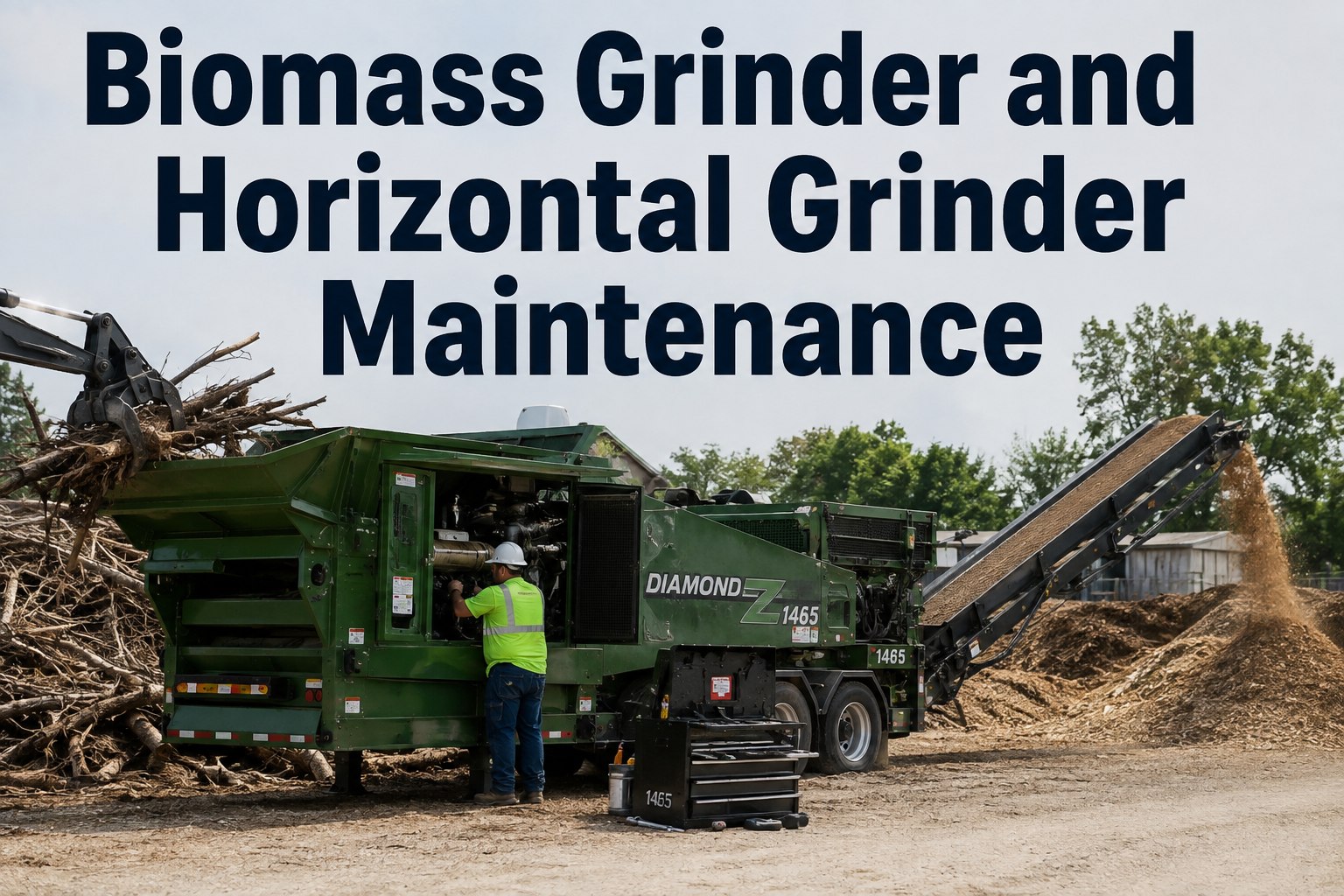
Horizontal grinder maintenance is the discipline of keeping hammers, screens, bearings and metal detection ahead of a rotor that will destroy anything it was not designed to eat — including, eventually, itself. If you run biomass grinders, tub grinders or horizontal grinders on wood waste, slash or land-clearing work, you already know the week that starts with one piece of tramp metal in the feed and ends with a cracked rotor, a bent shaft and a machine sitting dead while the pile grows. The difference between a grinder that earns and one that bleeds is rarely the machine — it is whether wear parts get rotated and replaced on hours, whether the metal detector actually gets tested, and whether anyone wrote down the bearing temperature before it became a fire. This page breaks down the maintenance points that decide grinder uptime and shows how crews track them without paper; you can also see it running on your own units in a 30-minute demo.
The rotor does not forgive. Your maintenance log has to.
Whole trees in, chips out — and in between, the most destructive duty cycle in forestry equipment. These are the checkpoints that keep a biomass grinder producing instead of waiting on a rotor rebuild.
- Hammer and tooth wear tracked against engine hours, with rotation due before throughput drops
- Metal detection and magnet function verified daily — the one test that prevents the catastrophic week
- Screen condition, rotor vibration and bearing temperature logged on every shift, photo-backed
- Fire suppression and fines clean-down checkpoints built into the same inspection, not a separate clipboard
Grinder downtime math every fleet manager should know
A mid-size horizontal grinder on contract grinding can bill well into five figures a week. When it goes down, the cost is not the repair invoice — it is everything around it. Four numbers worth pinning to the shop wall:
None of these are exotic failures. They are the routine ways grinders hurt you when inspection is a memory instead of a record. If you want to pressure-test these numbers against your own fleet, book a demo and walk through your actual downtime history.
How hammer wear cascades into fuel burn, screen damage and rotor imbalance
On a grinder, nothing wears in isolation. Each component you let slide loads the next one. This is the sequence your inspections need to interrupt:
Hammers and teeth round off
Cutting edges wear into blunt faces. The rotor stops slicing and starts beating material apart, which is where the fuel penalty and the heat begin. Rotation on a fixed engine-hour interval spreads wear evenly across the set.
Screens take the abuse
Blunt hammers recirculate material instead of sizing it, hammering the screen from both sides. Worn or holed screens then pass oversize product your customer rejects — and change rotor loading enough to matter.
Rotor balance drifts
Uneven hammer wear or a single broken tooth unbalances a rotor spinning at production speed. Vibration is your early warning — if anyone is writing it down. Left alone, it eats bearings.
Bearings fail under load and heat
Grinder bearings already live under extreme shock load. Add imbalance and dust-packed grease and you get the failure that ends seasons. Temperature and noise checks on every shift catch this weeks early.
The fix is boring and it works: hammer rotation and replacement on engine hours, screen inspection on shift, vibration and temperature logged daily. HVI ties each of these to a configurable checklist so the interval is enforced by the app, not by whoever remembers. Many crews start logging hammer hours free and build the rest of the program from there.
Tramp metal: the failure that takes a grinder out for a week
Every other item on this page degrades you gradually. Tramp metal does it in one bite. A fence post, a logging chain, an excavator tooth in the feed — and you are pricing rotor repairs instead of grinding. Your defence is layered, and every layer needs function verification, not assumption:
Metal detection head
The detector over the feed conveyor is your first line. It only works if sensitivity is set for your material and it is actually tested. A daily test-piece pass, logged with the result, is the difference between a system and a decoration.
Magnets on the discharge
Cross-belt and pulley magnets catch what the detector misses and what breaks loose inside. They need cleaning and a strength check on schedule — a magnet caked in its own catch stops catching.
Feed discipline
The cheapest layer. Operators who know what the rotor cannot eat, and a pile inspection habit before material goes on the belt. Your inspection form should ask the question so the habit survives staff turnover.
Post-event inspection
After any suspected metal event, a documented rotor, anvil and screen check before restart. This is where a $400 fix gets separated from a $40,000 one — and where a timestamped record protects you with the machine's owner or insurer.
In HVI, the metal-detector test is a mandatory line on the pre-shift inspection — the operator cannot close the form without a pass/fail and a photo. If that discipline is what your program is missing, see the inspection flow in a live demo.
Built for the dust, the hours and the audit
Four capabilities that map directly to the way grinders actually fail — and to what you need to prove when a client, insurer or safety officer asks.
Configurable inspection templates
Your grinder checklist, your wording: hammers, screens, detector test, magnets, bearings, discharge conveyor, fire suppression. Photo and defect capture on any phone, defect-to-work-order in one tap. No more paper forms dissolving in a dusty cab.
Wear component tracking
Hammer sets, screens and teeth tracked against engine hours with rotation and replacement history per unit. You see wear cost per ton produced instead of discovering it at the fuel pump.
Engine-hour PM scheduling
Grinders live by hours, not miles. Preventive maintenance triggers on engine hours with due and overdue alerts, so bearing greasing, belt tension and engine service happen on time even when the machine moves between sites.
Parts, inventory and fire checkpoints
Hammer sets and screens on the shelf, counted, across multiple yards — no more overnight freight on a part you thought you had. Fire suppression and clean-down checks live inside the same daily inspection, timestamped and audit-ready.
A grinder inspection checklist that actually gets done
Twenty minutes at the start of a shift is cheaper than one hour of unplanned downtime. Here is how the work splits across a day — the structure HVI enforces with separate forms per checkpoint:
| Checkpoint | What you check | Why it pays |
|---|---|---|
| Pre-shift, cold machine | Hammer and tooth condition, screen holes and tension, detector test-piece pass, magnet condition, fire suppression gauge, fines build-up around bearings and engine bay | Catches wear and a dead detector before the first ton; the clean-down check is your fire prevention |
| During operation | Rotor vibration change, bearing temperature and noise, discharge conveyor tracking and belt condition, engine temps in dust-loaded air, product size off the screen | Vibration and heat trends are the earliest warnings you will ever get — if they are logged, not felt |
| End of shift | Engine hours recorded, clean-down done, defects photographed and raised as work orders, fuel and any metal events noted | Feeds the PM schedule, gives the night or next crew a clean handover, builds the audit trail |
| Weekly / by hours | Hammer rotation due, screen rotation or replacement, belt tension and splice condition, bearing greasing, radiator and cooler blow-out, full magnet clean | The interval work that keeps the daily checks short — skip it and the daily list gets longer |
The engine and cooling row deserves respect: a grinder engine breathes dust-saturated air all day, and a plugged cooler turns a normal afternoon into an overheat shutdown. Blow-out intervals belong on the same engine-hour schedule as everything else. Crews that walk through this checklist structure in a demo usually recognise their own machine within the first screen.
See your own grinder checklist running in HVI
Bring one machine and one bad week from last season. In 30 minutes we will show you the inspection, the wear tracking and the work order that week would have produced.
What one caught bearing is worth: a two-grinder operation
Run the numbers on a small contract grinding outfit — two horizontal grinders, working five-day weeks through a dry season:
Without logged checks
Bearing heat noticed by ear on a Friday. By Monday the shaft is scored. Teardown, parts freight, a rebalanced rotor: 8 days down on one unit. At a conservative $6,000 a day in lost production and standing crew cost, that is roughly $48,000 — plus a strained customer and a pile that missed its contract date.
With HVI logging
Bearing temperature trend flagged on a Tuesday inspection, work order raised from the same screen, planned swap on Saturday using a bearing already on the shelf. Cost: one part, one planned Saturday, zero lost production days. The inspection that caught it took four minutes on a phone.
That is the whole business case in miniature: the app does not prevent wear, it converts surprises into scheduled work. Across a season, the operations that sign up and log every shift are simply the ones whose grinders are running when the contract calls.
Horizontal grinder maintenance, boiled down
- Hammers drive everything. Wear them past the limit and you pay in fuel, screens, balance and bearings. Rotate on engine hours, not on feel.
- Tramp metal is the catastrophic risk. A tested detector, maintained magnets and feed discipline are the only defence — and the test has to be logged to be real.
- Vibration and heat are free early warnings. Logged daily, they turn a week-long rotor or bearing failure into a planned Saturday swap.
- Dust is a fire load. Fines clean-down and fire suppression checks belong inside the same inspection as everything mechanical, every shift.
- Records are the product. When a client, insurer or safety officer asks how the machine was maintained, timestamped photo-backed inspections answer in seconds.
If your current system is a binder in the cab and a group chat full of photos, the move is easier than you think — most crews are running their first digital grinder inspection the same day they book a walkthrough with the HVI team.
My rule is simple: nobody starts my grinders until the detector test is logged. We lost a rotor to a piece of rail iron in 2019 — nine days, and I still think about it. Now I check the app at 6am and I can see the test pass, the hammer hours and the bearing temps for both machines before my coffee is done. The number I watch is cost per ton on wear parts. When that creeps, I know somebody is stretching hammer life, and we have a conversation before the fuel bill does it for me.
— Dale Merritt, Maintenance Manager, contract grinding and land-clearing operation
Grinder maintenance questions, answered straight
How often should you rotate or replace grinder hammers?
It depends on material, but the trigger should be engine hours and measured wear, not appearance from the cab. Most operations rotate on a fixed hour interval — often somewhere between 40 and 100 hours — and replace when the cutting edge is past the manufacturer's wear limit. HVI tracks hours per hammer set and alerts you when rotation is due, so the interval survives busy weeks and crew changes.
What is the best way to prevent tramp metal damage in a horizontal grinder?
Layer it: a metal detector on the feed conveyor with a documented daily test-piece pass, magnets on the discharge that get cleaned and checked on schedule, and feed discipline at the pile. No single layer catches everything. The test log matters as much as the hardware — an untested detector is an assumption, and assumptions are what crack rotors.
How do I know if my grinder rotor is out of balance?
Vibration is the early warning: a change in how the machine feels and sounds at operating speed, often after uneven hammer wear, a broken tooth or a metal event. Operators should log vibration on every shift so a trend is visible before bearings start paying for it. After any suspected metal strike, inspect and document before restart — that record also protects you with the machine's owner or insurer.
Can maintenance software actually work on a dusty remote grinding site?
Yes — that is exactly the environment HVI is built for. Inspections run on any phone or tablet, photos attach from the cab, and records sync when you have signal. There is no paper to dissolve in the dust and no binder riding around in the toolbox. You can create a free account and run your first grinder inspection today, or book a demo to see it configured for your machines first.
What records do I need to prove grinder maintenance for a client or safety audit?
Timestamped daily inspections with photos, PM history tied to engine hours, work orders showing defects were actioned, and verification records for safety systems like the metal detector and fire suppression. In HVI all of that lives on one unit record, so an audit answer is a search, not a week of digging through binders and text messages.
Keep the rotor earning, not waiting
Put hammer hours, detector tests, bearing checks and fire checkpoints on one platform your whole crew can run from a phone. See it on your own grinders before you spend a dollar.
Free to start — Works on any phone — No card needed