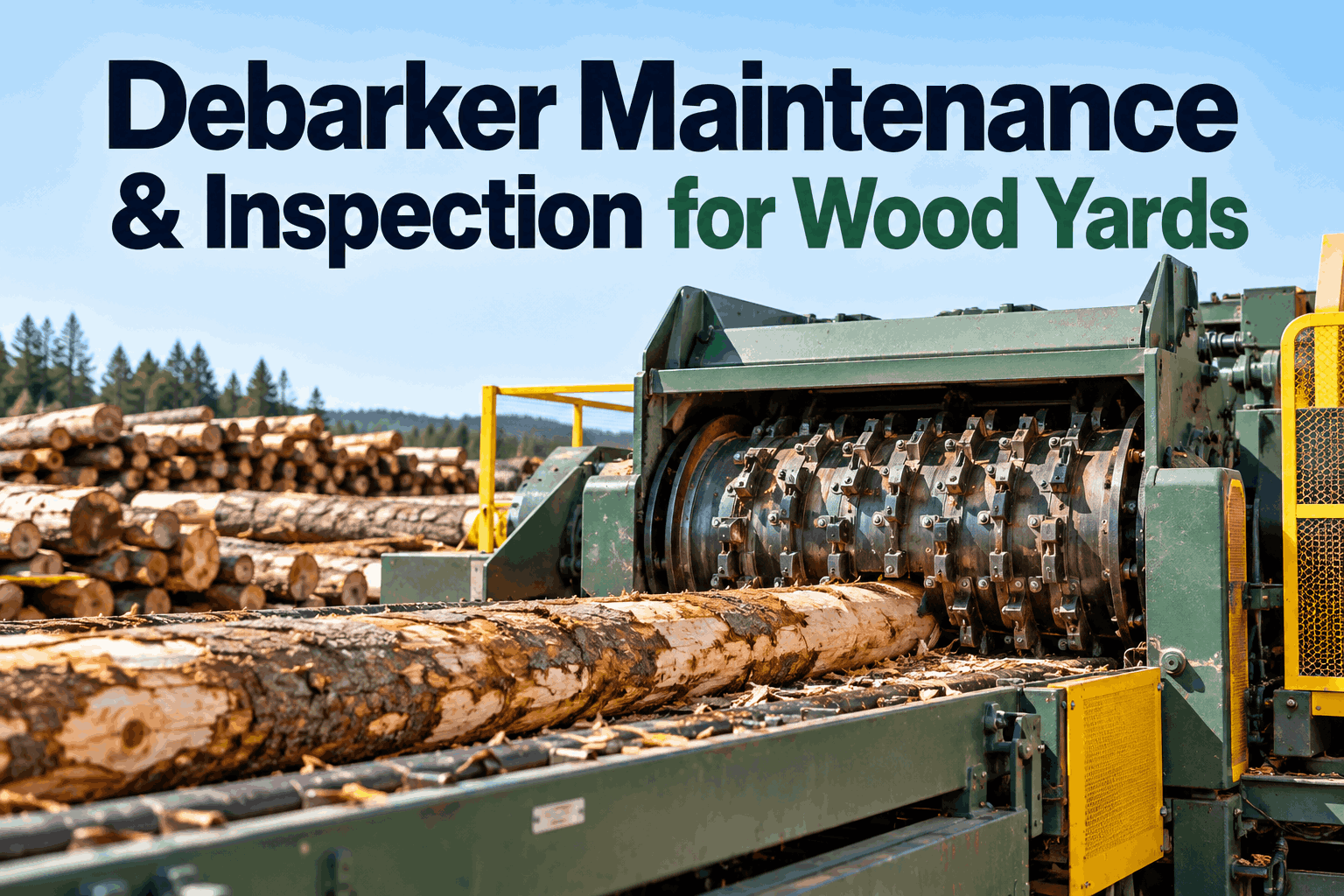
Debarker maintenance is really about one thing you can't see from the control pulpit: the tool circle. The ring of knife arms has to hold an even bite on every log that comes through, and the moment a few tips wear down or an arm loses spring pressure, bark starts riding through to the chipper and your fiber quality drops before anyone calls it a breakdown. Book a demo to see debarker wear tracked arm by arm. Below is how a wood yard keeps that circle tight.
Debarker Maintenance Starts With a Tight Tool Circle
Worn tips, tired arm springs and loose bearings open the circle a few millimetres at a time. You don't hear it — you see it in bark carryover and reject rates. Track each wear point before the circle gives.
- Ring carries the arms
- Arms spring in on the log
- Tips hold the tool circle
Debarkers live a hard life — grit, frozen bark, rock-studded butts and non-stop rotation. Wear doesn't arrive as a single failure; it creeps across the rotor, rings, bearings, drives and feed works until the machine quietly stops cleaning properly. A real debarker maintenance program catches each of those wear paths on a schedule instead of waiting for the bark to tell you.
5wear paths every debarker inspection has to cover
Think of the machine as five wear systems, not one. Each wears at its own rate and shows its own early sign — and each needs a different check on a different interval. Miss one and it becomes the one that stops the line.
The cutting edge of the whole machine. Tips round off fastest; arm springs lose tension. When pressure drops, bark survives the pass.
Check tips ~8h · arms ~40hCarries every arm and sets the tool circle. Uneven pressure around the ring means some arms bite and others skim.
Full visual ~40hCarry the whole rotating mass. Heat, noise and vibration are the early tells — a failed debarker bearing can take the ring with it.
Temp & vibration each roundGears, belts and feed rolls move the log through. Backlash, belt glaze and worn feed spikes let logs slip or stall mid-pass.
Feed gears daily · service ~40hPacked bark jams arm movement and buries grease points. Lube per the chart; keep the ring and bark cleaner clear.
Clear & lube every shiftCovering all five is what separates a debarker maintenance program from a grease-and-go routine. Book a demo to see all five wear paths on one inspection.
Worn tips open the tool circleand the first thing that tells you is the bark, not a gauge
A fresh tip holds a tight, even circle on the log. As tips round off and arm springs weaken, the circle opens unevenly — and the machine keeps running, just not cleaning. Here's the progression a good debarker inspection catches before the reject pile does.
The point of tracking tip and arm condition is to act at WORN, not at GONE. A quick logged check each shift turns a surprise shutdown into a planned tip change. Book a demo to see tip wear trended to a change-out point.
The debarker inspection cadencefour clocks running at once, from every shift to twice a year
Not everything on a debarker wears at the same speed, so a single weekly walkaround misses things. The practical approach runs four cadences side by side — each catching the items that wear at that rate.
Knife tips for wear and torque, debris packed around the ring, grease points, abnormal noise or vibration.
Knife arms and springs, full ring and tool-circle check, feed gears and rolls, belts and drive condition.
Bearing condition, gear backlash, feed-spike height, lubrication-chart audit, wear-part inventory check.
Full machine service — rotor balance, ring, drive train and bearings gone through end to end.
HVI holds all four cadences against the asset so nothing slides between them. Sign up free and put the debarker on a tracked schedule.
What the machine is telling youfive early signs that beat waiting for a breakdown
A debarker rarely fails without warning — the warnings just live in different places. Train the crew to log these, and most problems get caught at the inspection, not the chipper.
Clean logs start showing patches — the tool circle is opening. Check tips and arm pressure first.
Logs hesitating through the ring point to worn feed spikes, glazed belts or gear backlash.
A change in the running sound is often a bearing or an unbalanced rotor — log it the shift it starts.
A warm housing is a bearing asking for attention before it seizes and takes the ring with it.
Debris building around the ring stiffens arm movement and hides grease points — it compounds every other wear path.
How a wood yard runs debarker maintenance in HVIinspection to work order to a record that builds itself
The value isn't a prettier checklist — it's that a flagged tip or a hot bearing doesn't live in someone's head. It becomes a work order, a part on order and a line in the machine's history, automatically.
One digital debarker inspection on the phone — tips, arms, ring, bearings, feed — same every shift, every operator.
A worn tip or soft arm becomes a work order with the part and priority attached — no sticky note, no lost finding.
Every tip change, bearing swap and PM lands on the asset — a complete record for cost, warranty and planning.
This is separate from the roadside side of the operation — for the processor heads and delimbers out in the block, see delimber and processor inspection and maintenance, and for the haul side, logging truck and trailer maintenance. Book a demo to see the full inspection-to-history flow on your debarker.
From a wood yard maintenance manager
For years our debarker was a run-it-till-it-smears machine. We'd notice bark on the chips, pull it down, find half the tips rounded off and two arm springs shot. By then we'd been feeding dirty logs to the chipper for a shift or more.
Now the tips get a logged look every shift and the arms every week. The win wasn't fewer tip changes — it's that we change them on a Tuesday we planned, not at 2am when the reject bin's full. The bearings get caught on temperature now, too, well before they let go.
JM James M.Maintenance Manager · Sawmill wood yard
Debarker maintenance FAQs
What does debarker maintenance actually cover?
It covers five wear systems: knife tips and arms, the debarker ring and its tool circle, bearings, the drive and feed works, and debris and lubrication. Each wears at its own rate and needs its own check interval, from an 8-hour tip look to a twice-yearly full service. A good program tracks all five against the asset, not just the obvious ones.
How often should a debarker be inspected?
Run several cadences at once. Check knife tips, debris and grease points every shift (around 8 hours); inspect arms, the ring, feed gears and belts weekly (around 40 hours); do bearings, backlash and feed-spike height on scheduled PM; and bring in a full machine service roughly twice a year. Always follow the manufacturer's intervals and lubrication chart for your specific machine.
Why is bark getting through my debarker?
Usually the tool circle has opened up. Rounded-off knife tips or arm springs that have lost tension stop holding an even bite, so bark patches survive the pass. Check tip wear and arm pressure first, then look at feed speed and whether debris is stiffening arm movement. Catching it at this stage prevents a reject-rate spike downstream.
What are the most common debarker wear parts?
Knife tips go first and fastest, followed by arm springs, feed spikes or inserts, and drive belts. Bearings and ring components last longer but are the costliest when they fail. Tracking tip and arm condition on a schedule lets you stock the fast-movers and change them on a plan rather than scrambling for parts during a shutdown.
How does HVI help with debarker maintenance?
HVI standardizes the debarker inspection so every operator checks the same points, turns any defect into a work order with the part attached, schedules preventive maintenance by hours or date, and keeps a complete service history on the asset. HVI supports the inspection and maintenance workflow; it doesn't replace the manufacturer's service requirements for your machine.
Run Debarker Maintenance on a Schedule, Not a Smear
Make debarker maintenance a standardized inspection, catch tips and bearings early, and keep a full service history on every machine in the yard — so bark stays off the chips and the line stays up.