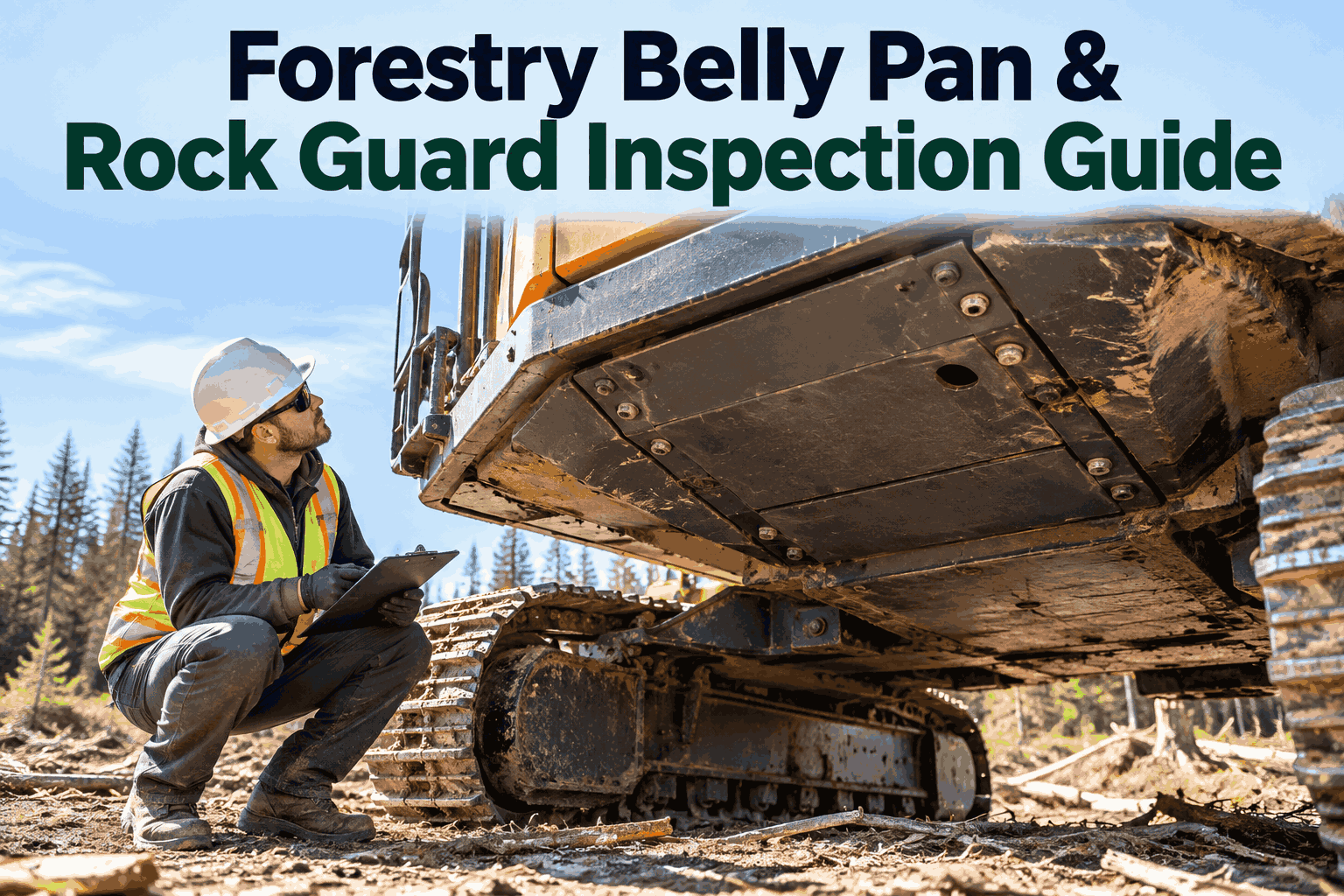
The belly pan and the rock guards are the only parts on a forestry machine whose entire job is to get beaten up so nothing behind them does. A stump that would have punched a hole in the oil pan hits a steel plate instead; a flying limb that would have sheared a hydraulic line bounces off a guard. The catch is that armor only works if it's actually there and still sound — and a belly pan inspection is how you catch the bent plate, the backed-out bolt and the guard somebody left off after a service, before the next strike finds the component it was protecting. Here's how to inspect them and track what you find — start a free trial to log it in HVI.
The armor only works if it's there.
Belly pans and rock guards take the hits so your engine, tank and hydraulics don't. HVI turns every guard inspection into tracked defects, work orders and a repair record — so a bent plate or a missing guard gets fixed before it costs you a component.
Guards are easy to overlook precisely because they're doing their job — a dented belly pan still looks like a belly pan, so it gets walked past. But forestry is about the harshest environment a machine can work in: stumps, rocks, slash and buried debris hammering the underside and the cylinders all shift. A guard that's cracked, loose or gone is a component strike waiting to happen, and the repair bill jumps from a bolt and a weld to an engine, a transmission or a severed hydraulic line. The whole point of a guard inspection is to keep that gap closed.
What the guards actually protectevery guard maps to an expensive part behind it
The fastest way to take guard inspection seriously is to see what each one is standing in front of. On a forestry machine, the cheap steel is always guarding something you really don't want to replace.
Shields the oil pan, transmission, fuel tank and hydraulic lines from ground strikes.
Fails → punctured pan or tank, oil loss, a seized engine in the field.
Protect cylinder rods and seals from impact that bends rods and starts leaks.
Fails → scored rod, blown seal, a cylinder rebuild and downtime.
Keep slash and rocks off hydraulic hoses and hard lines running along the frame.
Fails → severed hose, hot-oil spray, fire risk in dry slash.
Stop limbs from smashing glass, lights and the cab front in tight timber.
Fails → broken glass, blind night shifts, operator injury risk.
Seen this way, a guard inspection isn't housekeeping — it's protecting the most expensive parts on the machine with the cheapest. It's a natural part of any forestry equipment inspection routine, right alongside the full machine walkaround a demo will show you. The same discipline runs across a forestry excavator or roadbuilding machine.
Four ways a guard quietly stops protectingthe belly pan damage and guard faults that hide in plain sight
A guard rarely fails loudly. It stops doing its job in one of four quiet ways — and all four look fine from the cab, which is why they need a real look underneath.
Bent, cracked or torn
A pan pushed up against the component it's meant to protect, a cracked weld, or a torn edge no longer spreads an impact — it channels it straight through.
Loose or backed-out hardware
Constant vibration walks bolts loose. A pan hanging on half its fasteners flexes, rattles and eventually drops a corner into the undercarriage.
Missing entirely
The worst one: a guard pulled for a service and never reinstalled, or lost on the trail. The component now runs fully exposed and nobody noticed.
Packed with debris
A belly pan full of oily chaff and bark traps heat against the drivetrain and becomes a fire load. Clean-out and clear drain holes are part of the check.
Three of these four — loose hardware, a missing guard, packed debris — leave no mark an operator sees from the seat, so they only get caught when someone deliberately looks and records what they find. That's the difference between a guard program and a guard you remember to check. Start free and make the underside check a logged step →
From found to fixed — the defect-tracking loophow a guard fault becomes a closed work order, not a sticky note
Finding a cracked belly pan is only useful if the finding goes somewhere. This is the loop that turns a guard inspection into a repair that actually happens — and a record that proves it did.
Without the loop, a guard fault lives on a paper sheet or in someone's memory and quietly disappears. With defect tracking and work orders tied to the inspection, every fault is accounted for from the moment it's found to the moment it's fixed. Book a demo to see the defect-to-work-order flow →
Guard defects, tracked in HVIbelly pan damage, loose hardware and missing guards — per machine
Here's the payoff: every guard fault with a photo, a severity and a work order, on the machine's record — so forestry equipment defect tracking becomes a list you clear instead of problems you rediscover.
Every defect stays on the machine's history with its photo and fix, so you can prove a guard was sound after a service and see which machines keep losing hardware. That record feeds the reporting and analytics across your forestry equipment fleet. Book a demo to see guard defects tracked per machine →
Belly pan & rock guard inspection checklistthe underside walk that saves a component strike
Here's a baseline guard inspection routine, grouped the way HVI loads it — each item logged against the machine, with a photo on anything flagged.
- No dents pressing on components
- No cracks at welds or mount points
- Debris cleaned out, drain holes clear
- No oil pooling (hidden leak sign)
- All guards present (none left off)
- Bolts & fasteners tight, none missing
- Cylinder & hose guards undamaged
- Brush & light guards intact
- Photo attached to each flagged fault
- Severity set for repair priority
- Defects raised as work orders
- Fix recorded, machine signed off
On paper the underside check gets a tick and the missing guard never surfaces; in HVI a fault needs a photo, becomes a work order, and stays open until it's fixed. It runs alongside the rest of your forestry maintenance — which a quick demo walks through end to end. Start free and load your guard checklist →
From a forestry equipment manager
We dusted a transmission because a belly pan came back from a service with four bolts instead of eight. It flexed, dropped a corner, caught a stump, and that was that — nobody could say when the bolts went missing because nobody had looked underneath in weeks.
Now the underside check is its own step with a photo, and a missing guard or loose hardware is a work order before the machine leaves the yard. It's the least glamorous inspection we do and probably the one that's saved us the most money.
Belly pan inspection — FAQs
What is a belly pan inspection?
It's a check of the steel plate under a machine that shields the engine, transmission, tank and hydraulic lines from ground strikes. The inspection looks for dents pressing on components, cracks, loose or missing bolts, and trapped debris — all faults that leave the belly pan unable to protect what's behind it.
How often should forestry guards be inspected?
Guards and belly pans should be checked as part of the regular equipment inspection — typically daily or each shift in heavy forestry work, and always after a known hard strike or any service that required removing a guard. The underside is easy to skip, so making it a required, logged step is what keeps it honest.
Does a dented belly pan need replacing?
Not always — a guard's job is to take damage, so some denting is normal. The test is whether it can still protect: a dent pressing against a component, a crack, or distortion that's opened a gap means it needs repair or replacement. Minor surface dents that still hold their shape and clearance can stay in service.
Why does debris in the belly pan matter?
A belly pan packed with oily sawdust, bark and chaff traps heat against the engine and drivetrain and becomes a serious fire load in dry conditions. Clearing the pan and keeping drain holes open is part of a proper guard inspection, not just a cleanliness nicety.
How does HVI help with guard and defect tracking?
HVI makes the guard inspection a logged step with a photo, turns any fault — bent pan, loose hardware, missing guard, packed debris — into a tracked defect with a severity, raises it to a work order, and keeps the repair on the machine's permanent record. Nothing found underneath gets lost between the yard and the shop.
Keep the armor on and accounted for
HVI makes belly pan inspection a logged step — every bent plate, loose bolt and missing guard captured with a photo, raised as a work order, and closed on the machine's record. So the cheap steel is always there doing its job, and the expensive parts behind it stay safe. Live on your fleet in under two weeks.
No credit card · Works offline in the bush · Defect records from day one