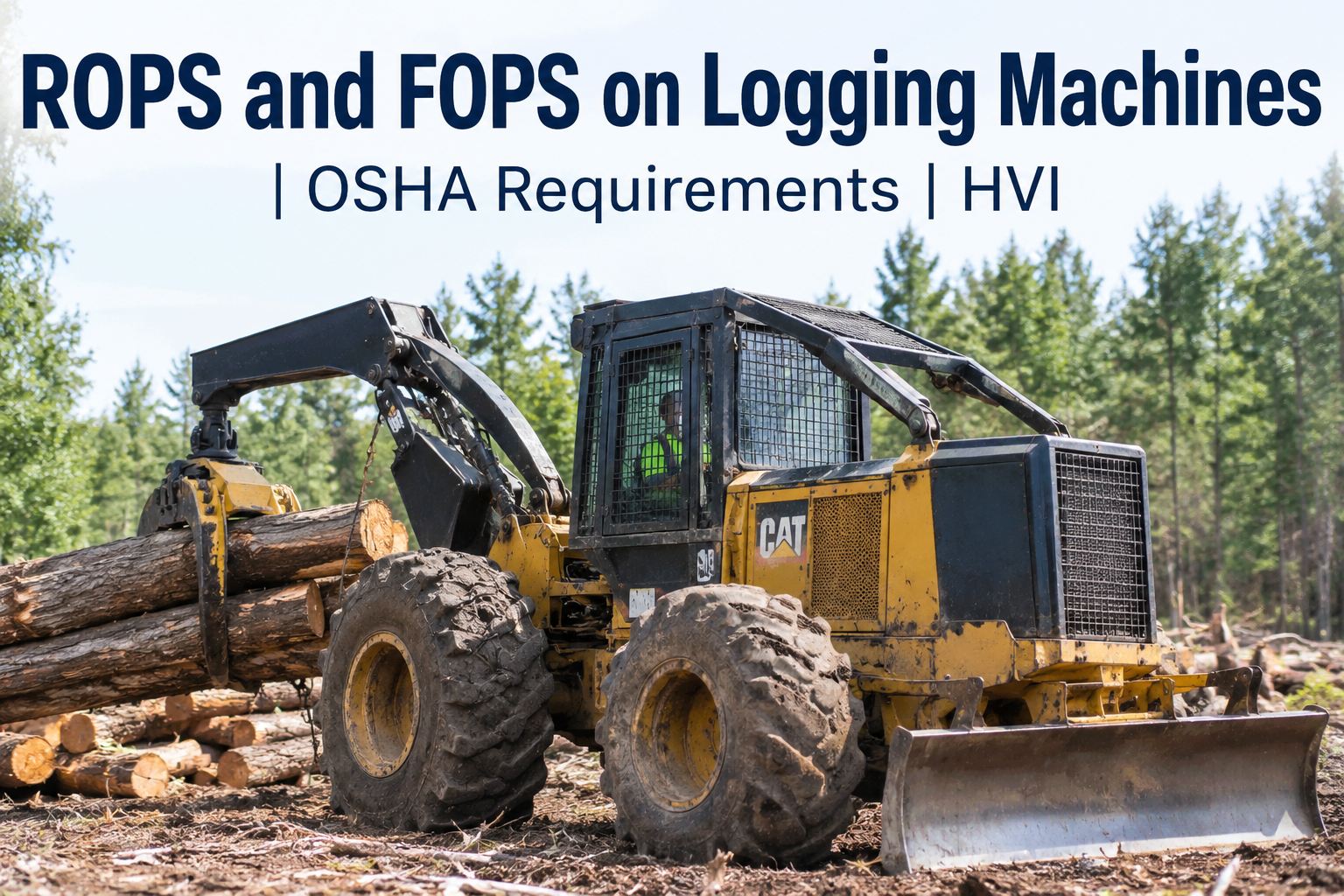
A bent cab guard on a skidder or a cracked FOPS canopy on a feller buncher is the kind of defect that gets spotted at 5 a.m. in the cold and then forgotten by 7 a.m. when the crew is behind. On logging machines placed into service after 9 February 1995, that damaged structure is not a "run it until we get back to the shop" item — it is a removal-from-service item. ROPS and FOPS on logging machines exist for one reason: keeping the operator alive when the machine rolls, a limb drops, or a log swings wide. The rules around which machines are covered, what happens when a structure is removed, and how you prove compliance are where most operations slip up, and where a quick walkthrough of your inspection setup can save you a citation and a life.
If a ROPS or FOPS comes off, it goes back on — or the machine stops
Logging machines placed into service after 9 February 1995 need certified protective structures. Removed, damaged, or uncertified cabs mean you are running outside compliance and inside the danger zone.
Which logging machines need ROPS and FOPS?
If your machine was placed into initial service after 9 February 1995, it falls under the logging-machine protective-structure rules. That covers a broad slice of the typical forestry fleet — not just the obvious ones.
Logging tractors
Rubber-tired and tracked tractors used for pulling and skidding falls under both ROPS and FOPS, since rollover and falling-object exposures are both present on the line.
Skidders
Cable and grapple skidders are the backbone of the operation and the most common machines cited for missing, modified, or damaged cab guards.
Swing yarders
Yarder cabs see heavy falling-object risk from cable loads and rigging. FOPS integrity is critical, and operator stations must be fully enclosed.
Log stackers & loaders
Stackers and loaders handling suspended loads over the cab require certified FOPS. A cracked or homemade guard is not compliant.
Mechanical felling devices
Tree shears, feller bunchers, and harvesters are explicitly covered. The cutting head creates concentrated falling-object and rollback hazards.
360° rotation exception
Machines capable of 360-degree rotation around their own axis are excepted from the fixed-ROPS mounting requirement, since the operator station is designed to rotate away from the hazard.
The date that matters is initial service, not purchase date or the model year on the data plate. A machine manufactured in 1992 but not placed into service until 1996 is covered. A machine built in 1998 but sitting unused since 2001 is still covered when you bring it back into service. If you are running a mixed fleet of older and newer machines, the only safe approach is to treat every machine as covered unless you have documented proof it was in service before the February 1995 cutoff. You can map your fleet's service dates against the OSHA requirement in a quick setup session.
ROPS and FOPS replacement: removed means replaced
The single most misunderstood part of the rule is not which machines are covered — it is what happens when a structure comes off. The answer is simple and non-negotiable.
Structure removed
A cab guard, FOPS canopy, or ROPS frame is unbolted for an engine swap, major repair, paint job, or clearance modification.
Employer obligation
The employer must replace the FOPS or ROPS. You cannot run the machine without it, and you cannot substitute a non-certified structure.
Certified replacement
The replacement must meet the same performance standard as the original. For machines built after 1 August 1996, that means SAE J1040 for ROPS and the deflection-limiting volume per SAE J397.
The failure mode here is real. A shop pulls a FOPS canopy off a feller buncher to do a hydraulic repair, the repair takes three days longer than planned, and the machine goes back out "just for a shift" without the canopy reinstalled. That is a willful violation. It is also the moment when a falling limb turns a routine day into a fatality. The replacement obligation exists because the structure is the last line of defense, and removing it without reinstallation voids the machine's compliance status entirely.
The same logic applies to damage. A ROPS frame that has been bent in a rollover, a FOPS canopy with a crack across a weld, or a cab guard with missing bolts is no longer certified. A damaged structure cannot be "repaired" by bending it back or adding a patch plate. The manufacturer's certification is based on the structure surviving a defined impact in its original condition. Once that geometry is altered, the certification is gone. Start logging protective-structure defects free with photo capture so nothing gets lost between the woods and the shop.
SAE J1040, SAE J397, and the 1 August 1996 cab enclosure rule
Two dates and two standards drive the engineering requirements. Knowing which applies to your machine tells you exactly what documentation you need to produce during an inspection or audit.
| Machine service date | ROPS standard | FOPS / DLV standard | Cab enclosure |
|---|---|---|---|
| After 9 Feb 1995, before 1 Aug 1996 | ROPS required (prior SAE criteria) | FOPS required | Not mandatory under the 1996 rule |
| After 1 Aug 1996 | SAE J1040 | SAE J397 (deflection-limiting volume) | Full cab enclosure required |
| 360° rotation machines | Excepted from fixed ROPS | Still require operator protection | Per manufacturer design |
| Pre-9 Feb 1995 (in service) | Exempt from the 1995 mandate | Exempt from the 1995 mandate | Follow manufacturer and site rules |
SAE J1040 is the performance standard for rollover protective structures on construction, industrial, and forestry machines. It defines the energy the structure must absorb in a rollover without the deflection-limiting volume — the operator's survival space — being breached. SAE J397 defines the deflection-limiting volume itself, the imaginary box around the seated operator that no part of the cab or structure is allowed to intrude into during an impact test.
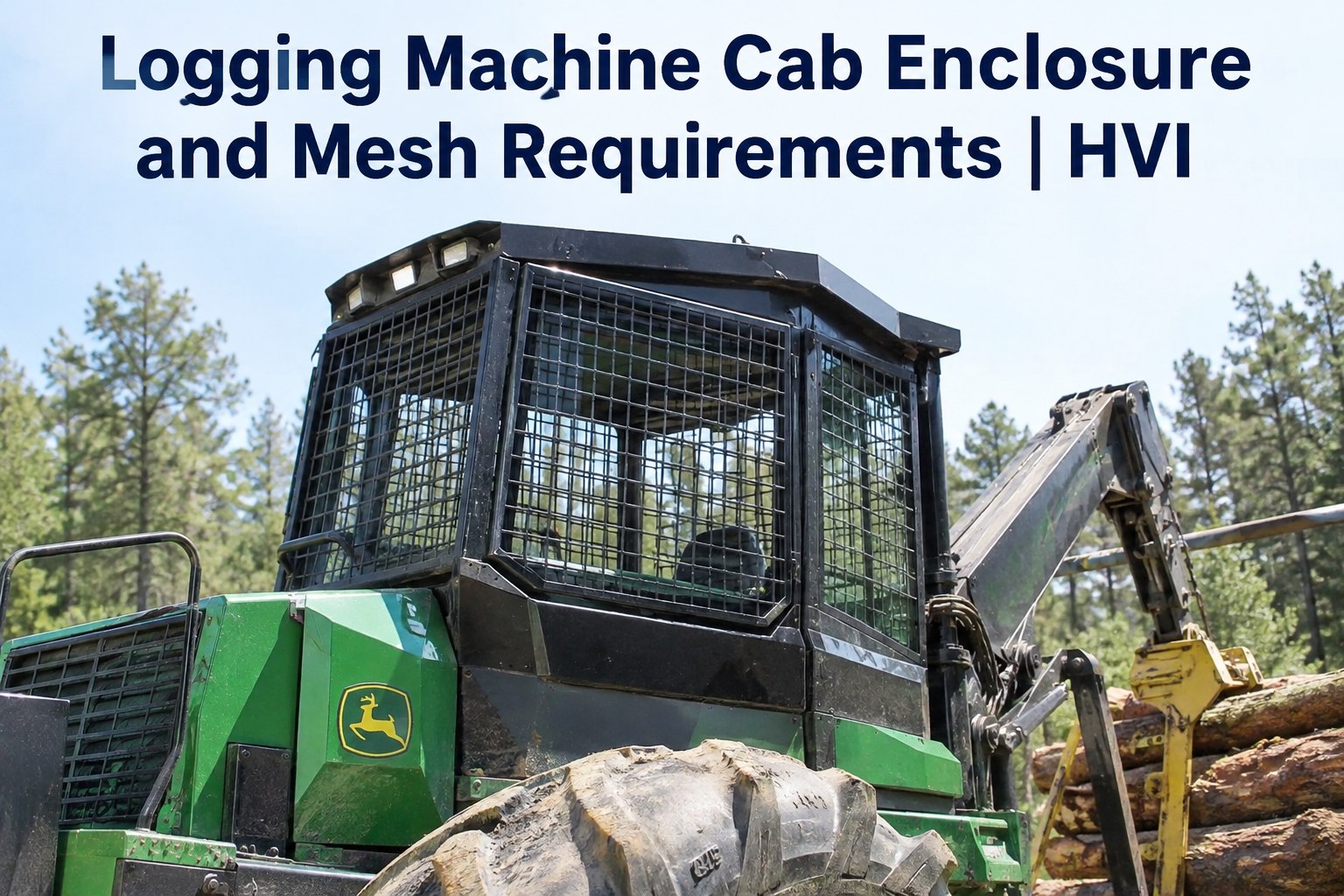
The cab enclosure requirement for machines manufactured after 1 August 1996 means more than just a frame. It means a fully enclosed operator station with doors, glazing, and a structure designed to keep objects out and the operator in. This is where many older machines fail when they are rebuilt or re-cabbed — the replacement cab looks enclosed but has no certification to SAE J1040 or J397. If you cannot produce the certification label or documentation, the machine is non-compliant regardless of how strong the cab looks. You can set up a proof-of-compliance workflow for your cab structures without changing how your crew works.
Protective structure inspection: what to check and what to record
A daily walkaround that says "cab looks good" is not an inspection. OSHA and your insurance auditor want to see specific checks, documented with photos, on a schedule that matches the risk.
Mounting bolts and torque
Every bolt connecting the ROPS or FOPS to the machine frame must be present, properly torqued, and free of stretch or corrosion. A single missing mounting bolt can void the certification.
Welds and parent metal
Inspect all structural welds for cracks, porosity, or signs of re-welding. Any field repair weld on a certified structure invalidates the certification unless re-tested.
Deflection-limiting volume
Confirm nothing has been added inside the cab — controls, monitors, radios — that intrudes into the DLV. Aftermarket mounts are a common and silent compliance failure.
Certification label
The ROPS/FOPS label must be legible and attached to the structure. If it is missing, painted over, or illegible, you need replacement documentation from the manufacturer.
Cab enclosure integrity
For post-August 1996 machines, check door latches, window integrity, and that the enclosure is complete. A door that will not latch is an open defect.
Damage and removal lockout
Any visible bend, crack, or structural damage triggers a safety defect lockout. The machine does not return to service until the structure is replaced or recertified.
The gap between "we inspect that" and "we can prove we inspected that" is where citations live. Paper DVIRs get lost in the truck, wet in the rain, or filled out in the lunchroom at the end of the shift. A digital inspection with timestamped photo capture means every cab guard check is a record you can pull up in seconds — during an OSHA visit, an insurance audit, or a client safety review. See how the photo-backed inspection template works on a real machine before you roll it out.
Don't let a missing cab guard photo cost you the contract
Book a 30-minute demo and see HVI's protective-structure inspection workflow on your own fleet.
How HVI keeps your ROPS and FOPS compliance audit-ready
HVI is built for the gap between what the rule requires and what actually happens in the woods. Protective-structure checks live inside your daily inspection template, defects become work orders automatically, and every record is timestamped and photo-backed.
Cab guard checks with photo capture
Every pre-start inspection includes ROPS and FOPS condition checks. Operators attach a photo of the cab guard and certification label directly from their phone — no separate paperwork, no text-message photos that vanish.
Safety defect lockout on damage
When an operator flags a cracked FOPS or a bent ROPS frame, HVI locks the machine out of service automatically. The defect becomes a work order, and the asset stays down until the repair is closed and signed off.
Audit-ready compliance records
Pull every protective-structure inspection for any machine, any date range, in seconds. Timestamped, photo-backed, and exportable for OSHA, client safety audits, and insurance reviews — no binder, no scramble.
Defect-to-work-order automation
A flagged cab guard defect flows straight into your work order system with the photo, the asset, the operator, and the timestamp attached. The shop sees it before the machine is back at the yard.
For a 20-machine logging fleet running two shifts, that means roughly 40 cab guard inspections a day flowing into a single record. Over a month, that is 1,200 timestamped, photo-backed compliance records — the kind of evidence that turns a four-hour audit scramble into a two-minute export. If you want to start building that record on your own machines, the setup takes less time than one shift changeover.
What a missed cab guard defect actually costs you
The price of a non-compliant protective structure is never just the citation. It is the downtime, the lost contract, the insurance fight, and — in the case nobody wants to talk about — the operator who does not go home.
Consider a realistic scenario: a 15-machine logging operation where a feller buncher's FOPS canopy was removed for a hydraulic repair six weeks ago and never reinstalled. The machine has been running two shifts a day. That is 60 shifts of exposure — 60 shifts where a falling limb or a dropped tree section had no barrier between it and the operator. If OSHA walks onto that site, or if an incident occurs, the question is not whether the citation is coming. It is how many shifts they count. And the answer is all of them. Walk through the lockout workflow that prevents exactly this before the next shift goes out.
ROPS and FOPS on logging machines: what you need to remember
Date drives coverage
Machines placed into initial service after 9 February 1995 need ROPS and FOPS. Track the service date, not the model year.
Removed means replaced
If a protective structure comes off for any reason, it must be replaced with a certified equivalent — no exceptions, no "temporary" runs.
Standards are specific
Post-August 1996 machines must meet SAE J1040 for ROPS and SAE J397 for the deflection-limiting volume, with full cab enclosure.
Documentation is compliance
If you cannot produce the inspection record, the photo, and the certification, the machine is effectively non-compliant in an auditor's eyes.
Always confirm current requirements directly with OSHA, as interpretations and enforcement guidance can shift. The standards above reflect the core framework, but your specific operation may carry site-specific or state-level obligations on top of the federal baseline. Review your inspection template with the HVI team to make sure it matches what your auditor expects to see.
"We had a skidder come back from a rebuild with the FOPS canopy sitting in the bed of the service truck. Nobody flagged it for three days because the paper DVIR just said 'cab OK.' The day we switched to photo capture on every cab guard check was the day that stopped being possible."
Common questions about ROPS and FOPS on logging machines
Do all logging machines need ROPS and FOPS?
What happens if a ROPS or FOPS is removed from a machine?
What standards apply to ROPS and FOPS on forestry equipment?
Can a damaged ROPS frame be repaired and reused?
How should protective structure inspections be documented?
See HVI running on your own fleet — book a 30-minute demo
Photo-backed cab guard checks, automatic defect lockout, and audit-ready compliance records in one platform.
Free to start — Works on any phone — No card needed