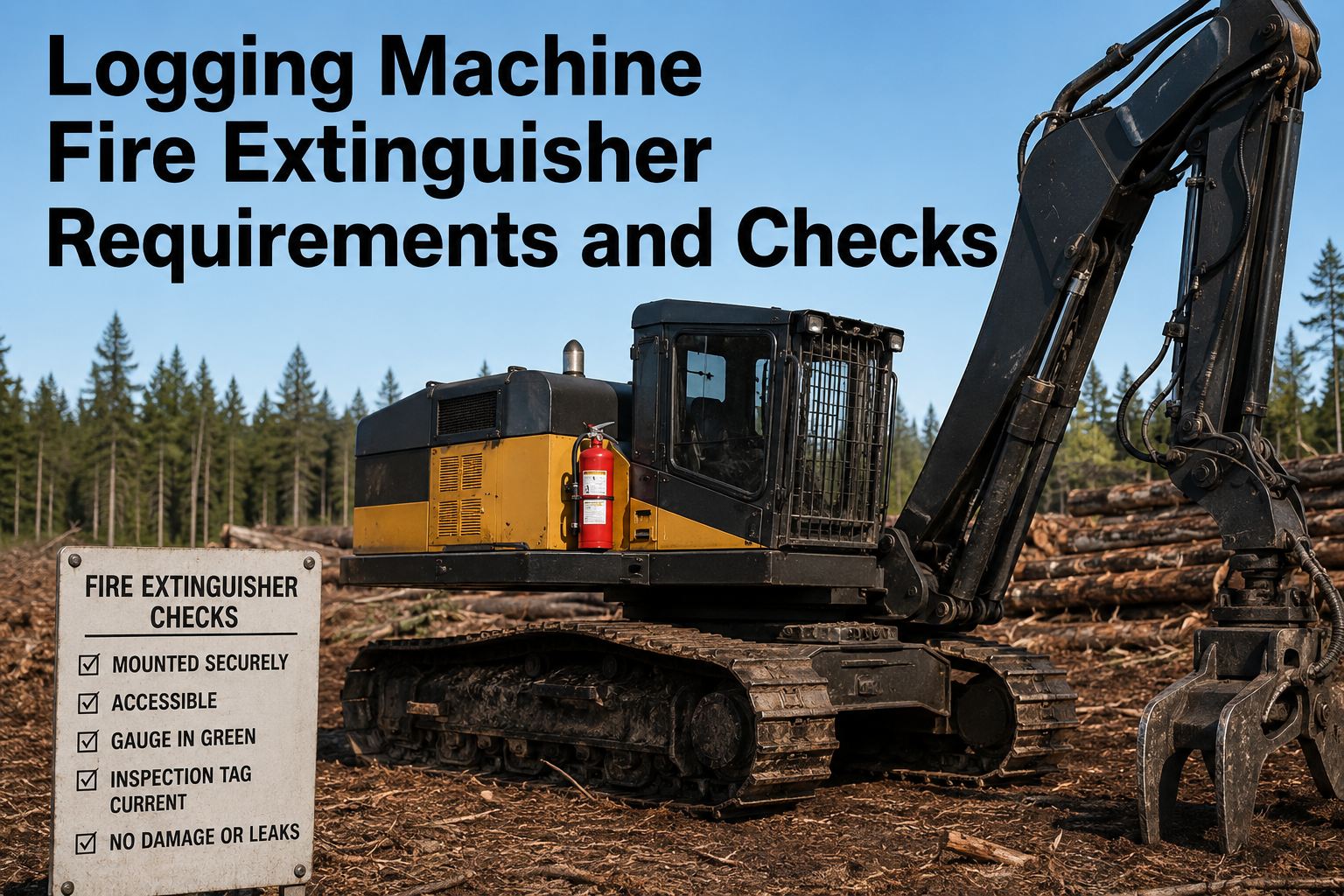
A dry needle pile under a harvester belly, a thin film of hydraulic oil on a hot exhaust shield, and a crew that is twenty kilometres from the nearest gravel road — that is the real ignition scenario on a logging site, and it is exactly why the logging fire extinguisher requirement is not a box-tick. Portable extinguishers on logging machines are both a legal obligation and your first line of defence against an equipment flare-up that can become a bushfire in minutes. The general fire-protection provisions require the employer to provide and maintain a portable extinguisher on each machine and vehicle, and that maintenance duty — charge, accessibility, mounting, and current inspection status — turns a one-time fitment into a recurring inspection item you can walk through on your own units with a quick demo.
FORESTRY FIRE SAFETY
Is every extinguisher on your fleet charged, mounted, and in date — right now?
If the answer takes more than ten seconds to find, you are already carrying the fire risk you think you are controlling. A single missed charge check on one processor head can turn a twenty-dollar maintenance item into a site evacuation and a regulator visit.
THE COST OF A MISSED CHECK
What a failed extinguisher check actually costs a logging crew
The extinguisher itself is cheap. The downtime, the compliance hit, and the wildfire exposure that follow a failed check are not. Here is what the numbers look like when a unit is found empty or out of date at the wrong moment.
REQUIREMENT TO RECORD
Fire extinguisher compliance logging: what the provision asks of you
The general fire-protection provisions do not just say "carry an extinguisher." They say provide, maintain, and be able to prove it. That proof is where most contractors slip — not because the extinguisher is missing, but because the record is missing, stale, or sitting in a glovebox.
| Obligation | What it means on a logging machine | What an auditor will ask to see |
|---|---|---|
| Provide | A portable extinguisher of the correct rating fitted to each machine, vehicle, and support truck on the site | Unit present, correct type for fuel load, physically mounted — not loose on the floor mat |
| Maintain | Charge in the green, seal intact, nozzle clear, bracket secure, no corrosion on the shell | Pressure gauge reading, tamper seal, mounting bracket condition — checked on a recurring cycle, not annually |
| Inspect | A documented walk-around check at the interval your fire plan sets — typically monthly, plus a pre-start visual during fire-restriction periods | A dated, signed inspection record tied to the asset ID, not a generic site checklist |
| Prove | On request, produce the full inspection history for any machine going back months — not just the current tag | Timestamped, photo-backed records retrievable in seconds, not a search through a filing cabinet |
If your current proof is a paper tag on a wire and a clipboard in the foreman's truck, book a walk-through and see how that proof lives on your phone instead.
THE IGNITION SCENARIO
Where machine fires start on logging equipment
An extinguisher is the last line before a flame becomes a wildfire. Understanding where the fire starts tells you what the pre-start inspection really needs to catch — because the extinguisher is for the fire you did not prevent, not the one you could have.
Debris and chaff around hot surfaces
Dry needles, bark fines, and pitch build up around exhaust manifolds, turbo housings, and DPF shields. A hot shutdown on a dry day is enough to light it. The inspection is not just the extinguisher — it is the blow-down and clean-out that stops the ignition source forming.
Hydraulic and oil residue
A weeping fitting on a harvester head leaves a fine oil mist across a hot guard. Under load, that mist flashes. Catching a leaking hose during a pre-start walk-around — and logging it as a defect that becomes a work order — is fire prevention that no extinguisher can replace.
Electrical shorts and battery faults
Vibration chafes a loom, a terminal corrodes, a battery box collects carbon track. An electrical fault smoulders long before it flames. A pre-start inspection that captures "smell of burning" as a photo-backed defect stops the machine going out that shift.
PRE-START CHECKLIST
Extinguisher inspection logging: the four-point pre-start check
This is the check that should happen before the machine moves, every shift, during fire season. It takes under a minute. The version below is the one that belongs on a phone, not a clipboard — each item is a tap, a photo if it fails, and an automatic flag if the unit is past its service date.
Charge — gauge in the green
Pressure gauge must read within the green band. A needle in the red or below means the unit has lost charge and must be serviced or replaced before the machine operates. Log it as a defect; it becomes a work order automatically.
Accessibility — reachable from the ground
The extinguisher must be reachable from ground level without tools, and not buried behind gear, chains, or fuel containers. If a crew member has to climb or unpack to reach it, it will not be reached in time.
Mounting — bracket locked, no rattle
The bracket must hold the unit firmly. A loose mount lets the extinguisher fall and discharge or damage the valve. Check the strap, the quick-release pin, and that the unit has not vibrated out of the cradle over rough ground.
Inspection status — tag current, seal intact
The monthly inspection tag must be punched and signed, the tamper seal unbroken, and the service date within the allowed cycle. An expired tag is a failed audit waiting to happen, and the kind of thing a digital checklist flags before the operator even opens the door.
If you want that four-point check to live on every operator's phone and auto-flag anything past its date, start logging inspections free and set it up against your own asset list.
ONBOARD SUPPRESSION
Modern harvesters with fixed suppression systems
Many modern harvesters, forwarders, and processors are fitted with onboard fire-suppression systems — a fixed tank, distribution lines, and nozzles around the engine bay and hydraulic compartment. These systems are a major upgrade over a handheld extinguisher, but they bring their own inspection requirement that is easy to miss because they sit out of sight.
The suppression system inspection covers cylinder pressure, nozzle blockage, line integrity, and the manual pull cable. It is a separate check from the portable extinguisher, and it needs its own line on the inspection sheet — not a single "fire equipment OK" tick that papers over both.
See HVI running on your own fleet — book a 30-minute demo
Watch a fire-suppression pre-start check, a defect-to-work-order flow, and an expiry-tracked extinguisher report on your own machines. No slide deck, no generic tour — just your workflow on our platform.
SEASONAL RISK
Fire risk harvest season: when the checks tighten
During declared fire-restriction periods, the bar moves. A monthly visual is no longer enough — most sites require a documented pre-start extinguisher check every shift, plus a clean-down of debris around hot surfaces at each fuel stop. The seasonal dimension is why the inspection needs to be a living record, not a calendar reminder.
Off-season — wet ground, green fuel load
- Monthly documented extinguisher inspection
- Quarterly fixed-suppression service check
- Annual full service and pressure test by a competent person
- Pre-start visual as part of standard DVIR
Dry ground, declared fire-restriction period
- Daily pre-start extinguisher check, logged and timestamped
- Daily debris clean-down around exhaust and turbo
- Suppression-system pull-cable and nozzle check each shift
- Onboard water knapsack or slip-on unit on all support vehicles
Extreme fire weather — harvest may be halted
- Full fire-equipment audit before any machine moves
- Spotter on site with comms during all operations
- Extinguisher and suppression status proven for every asset before dispatch
- Records produced on demand for the warden or regulator
When the restriction period hits, you want your records already in order. Book a demo and see how HVI tracks seasonal readiness across a mixed fleet from one dashboard.
WORKED EXAMPLE
The cost of one missed extinguisher charge check
A 12-machine logging crew running in a fire-restriction period. One processor's extinguisher is found empty during a regulator spot-check — the gauge has dropped into the red and the last monthly tag is two weeks overdue. The machine is stood down, the crew waits, and the record gap becomes a compliance issue.
The maths is brutal because the ratio is brutal. A digital pre-start check that flags a low gauge the day it happens — and a demo of HVI's defect-to-work-order flow shows exactly how — pays for itself the first time it catches one of these.
HOW HVI HELPS
Fire suppression as a pre-start checkpoint, not a paper tag
HVI turns the fire extinguisher and suppression-system check from a clipboard item into a timestamped, photo-backed record on every machine — and tracks expiry per asset so nothing goes past its service date quietly.
Photo-captured suppression check
Fire suppression is named as a pre-start checkpoint in the inspection template. The operator snaps the gauge, confirms the pull cable, and a failed item creates a defect with a photo attached — no text-message photos to the foreman, no lost evidence.
Extinguisher expiry tracking per machine
Each extinguisher's service date and next-due date is tracked against the asset ID. HVI flags units approaching expiry before they lapse, so a recharge is scheduled as preventive maintenance — not discovered during an audit or, worse, during a fire.
Audit-ready records in seconds
When a regulator, a client, or an insurer asks for proof, you pull the full fire-equipment inspection history for any machine — date, time, operator, photo, outcome — in seconds. No binder, no filing cabinet, no scramble.
Defect to work order, automatically
A failed extinguisher or suppression check does not sit in a chat thread. It becomes a work order linked to the asset, assigned to the shop, and tracked through to close — so the recharge actually happens and the record closes itself.
KEY TAKEAWAYS
Logging fire safety: what to do next
Confirm the requirement with OSHA
The general fire-protection provisions require portable extinguishers on each machine and vehicle, maintained and inspected. Confirm the exact rating, placement, and inspection interval that applies to your operation, and treat it as a floor, not a ceiling.
Make it a recurring check, not an annual one
Charge, accessibility, mounting, and inspection status change week to week on a logging machine. A monthly documented check plus a pre-start visual during fire season is the minimum cadence that actually catches problems.
Track both portable and fixed systems
If your machines have onboard suppression, that is a second inspection line with its own service interval. Do not let a single "fire equipment OK" tick cover both — they fail differently and get serviced differently.
Move the record off paper
A paper tag on a wire proves the unit was checked once. A digital record with a timestamp, a photo, and an asset ID proves it every time it is asked for. That is the difference between passing an audit and failing one.
"I used to sign a tag on the wall and hope nobody asked for the history. Now I want the photo of the gauge, the date it was checked, and the operator's name on my phone before that machine leaves the pad. A missed extinguisher charge is a $28 problem that becomes a $7,000 problem the second a warden walks on site."
— Darryl Hines, Site Supervisor, mixed harvesting contractor (14 machines, Pacific Northwest)
FIRE EXTINGUISHER FAQ
Common questions about fire extinguisher requirements on logging machines
Is a fire extinguisher required on every logging machine and vehicle?
How often should a fire extinguisher be inspected on a logging machine?
What is the four-point extinguisher check operators should do before start-up?
Do onboard fire-suppression systems on harvesters need a separate inspection?
How should extinguisher inspection records be kept for an audit?
Stop proving your fire safety with paper tags — book a demo
See HVI run a fire-suppression pre-start check, track an extinguisher expiry, and produce an audit-ready record on your own machines in 30 minutes.
Free to start — Works on any phone — No card needed