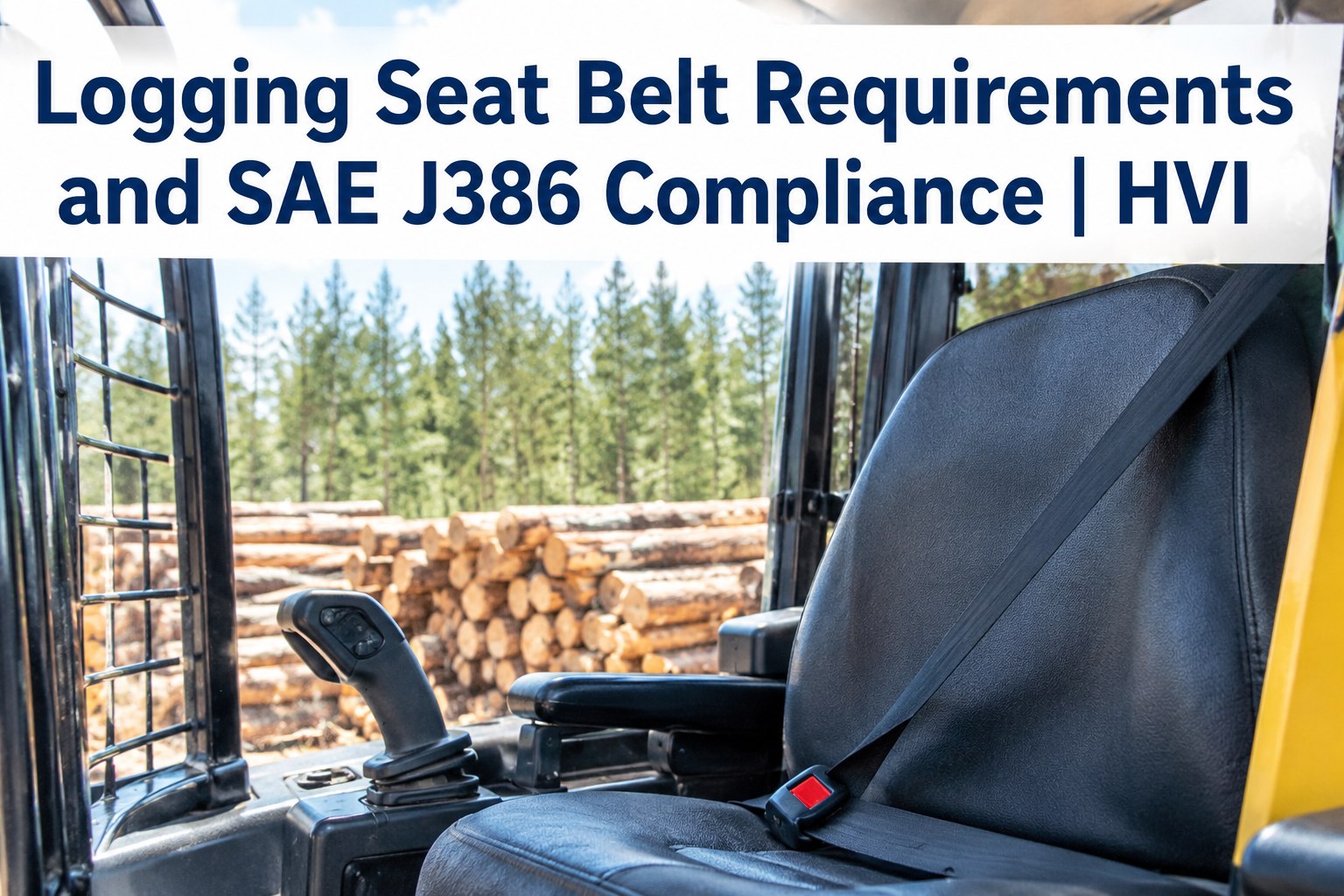
You already know the skidder needs a belt. What most logging crews miss is that the logging seat belt requirement is not one rule but four separate obligations, and any one of them can fail on its own. A belt can be worn, meet the spec, be present at manufacture and still fail the inspection because the retractor is sluggish or the anchor plate is rusted through. If you want to walk through it on your own units, the checklist below breaks down where each obligation tends to break down in practice.
Four Obligations, One Anchor Point: Do Not Let a Belt Fail the Audit
A worn webbing, a missing belt, a non-compliant spec or a driver who forgot to clip in — each one is a separate violation under logging standards. See exactly how HVI maps each one to a timestamped, photo-backed inspection record.
Why Logging Seat Belt Requirements Are Treated as Four Distinct Rules
The logging standard treats the operator restraint as a survival system, not a formality. A machine with a protective structure (ROPS or FOPS) is engineered so that in a rollover or falling-object event, the operator stays inside the protective envelope. That only works if the operator is held tightly in the seat. The belt transfers the operator's mass to the machine's frame, which is what stops the cab from crushing the operator. Remove the belt, leave it loose, or let the webbing degrade, and the protective structure cannot do its job.
Most shops treat the belt as a pass/fail checkbox at annual inspection. The standard breaks it into four parts precisely because each can fail independently. A belt can be SAE J386 compliant and still be unfastened. A belt can be fastened and still be cut. A belt can be in good condition and still have been removed from a machine that left the factory with one, which itself is a violation even if a replacement is sitting on the seat. Below is what each obligation actually costs you when it fails.
SAE J386 Seat Belt Standard and the Removal Prohibition
The specification obligation says each machine seat belt must meet SAE J386, the standard for operator restraint systems on off-road work machines. SAE J386 covers webbing tensile strength, retractor locking performance, buckle release force, anchor strength and the full-system dynamic test the belt has to survive. The practical issue is that not every aftermarket belt sold for "off-highway" use meets J386. A generic three-point belt from an auto parts counter will bolt up, fit the anchor and look right, but if it was not certified to J386 the machine is not compliant.
The removal prohibition is the one that catches shops off-guard. If a machine was equipped with a seat belt at manufacture, that belt must not be removed. If it has been removed — because it was cut, frayed, taken out for cab upholstery work, or just thrown away by a previous owner — the obligation is to replace it. A belt lying on the seat is not compliance. The belt has to be installed, anchored and serviceable. When you are sourcing replacements, keep the J386 marking or the supplier's certificate on file so a compliance officer or an insurance auditor can see it on demand. If you want a record structure that handles that, walk through it on your own units and see how the spec and the photo evidence live together.
SAE J386 Specification
Each belt must meet the SAE J386 standard for operator restraint systems on off-road work machines — covering webbing strength, retractor lock, buckle force and dynamic performance. Generic belts that bolt up but lack J386 certification are not compliant.
Removal Prohibition
A belt that was installed at manufacture must not be removed. If it has been removed — for any reason, by anyone — the obligation is to replace it with a compliant unit, properly anchored. A belt sitting on the seat is not compliance.
The Wearing Requirement and the Serviceable-Condition Rule
The wearing obligation is the one your operators control on the ground: each employee must securely and tightly fasten the seat belt so they are restrained within the machine cab. "Securely and tightly" is the operative language. A belt clipped behind the seat, draped over the operator's lap or clicked in but hanging loose does not restrain the operator in a rollover, and it does not satisfy the rule. The belt has to be routed, latched and snugged so the operator's torso and pelvis are held against the seat.
The maintenance obligation is what turns the belt from a driver habit into a shop item. Each belt must be kept in serviceable condition. That makes belt and anchor condition a scheduled inspection item, not an assumption. Webbing frayed at the D-ring, stitching separating at the tongue, a buckle that does not latch with a positive click, a retractor that does not lock under a sharp tug, an anchor bolt backed out or a mounting plate corroded through — any of these put the belt out of service. The anchor is the part that gets missed most often because it is hidden under the seat trim, and a cab that gets pressure-washed regularly will rust the anchor long before the webbing looks bad. You can start logging inspections free and turn this into a captured record instead of a walk-by glance.
Wearing Checklist
- Belt routed across lap and shoulder, not behind seat
- Tongue fully latched in buckle with positive click
- Webbing snugged tight against body, no slack
- Operator trained to clip in before machine moves
- Supervisor verifies belt use during site walks
Condition Checklist
- No cuts, fraying or melted spots on webbing
- Stitching intact at tongue and D-ring
- Buckle latches and releases cleanly
- Retractor locks under sharp tug
- Anchor bolt torqued, plate not corroded
Compliance Checklist
- Belt marked or certified to SAE J386
- No belt removed from a machine equipped at manufacture
- Replacement belt sourced with J386 documentation
- Inspection logged with date, unit and technician
- Photo evidence of belt condition on file
From Seat Belt Inspection to a Defensible Audit Record
The difference between a belt that passes and a belt you can prove passed is the record. When an auditor, an insurer or a client safety officer asks for evidence, a binder that says "belt OK" with a tick mark does not hold up. They want to see which unit, which belt, who checked it, when, what they found and what happened next. The table below maps each of the four obligations to the record you need to produce on demand, which is exactly the structure HVI enforces. If you want to see the mapping running on your own fleet, walk through it on your own units with the HVI team.
| Obligation | What the rule requires | Record you must produce | How HVI captures it |
|---|---|---|---|
| Wearing | Operator securely and tightly fastens belt | Operator sign-off on pre-start check | Required field in pre-start template with photo |
| Specification | Belt meets SAE J386 | J386 marking or supplier certificate on file | Spec field and document attachment on asset record |
| Prohibition on removal | No belt removed from a machine equipped at manufacture | Evidence belt is present, installed and anchored | Photo of installed belt with timestamp and GPS |
| Serviceable condition | Belt and anchor kept in serviceable condition | Inspection log with defect notes and resolution | Defect capture auto-creates work order for replacement |
Turn Belt Inspections Into Audit-Ready Records
Stop trusting a tick mark. Capture a photo, a timestamp and a technician signature on every belt, every shift.
How HVI Maps Each Belt Obligation to a Captured Record
HVI is built for mixed fleets running trucks, trailers and off-road plant under one roof, which means the same inspection app the driver uses on the highway truck is the one the operator uses on the skidder in the cut block. The seat belt checks live inside the pre-start and PM templates, so the belt is inspected at the same cadence as the rest of the machine — not once a year on a clipboard. Here is how each capability lines up with the four obligations.
Photo-Backed Pre-Start Checks
Belt condition, anchor plate and buckle are captured as a required photo field in the pre-start template. The image is timestamped, geotagged and locked to the asset record so it cannot be backdated or moved between units. The wearing sign-off is a required yes/no the operator cannot skip past.
Defect-to-Work-Order Auto-Creation
When a belt fails — frayed webbing, corroded anchor, missing unit — the defect flag auto-generates a work order against that asset and routes it to the shop. The PM schedule holds the machine due for a belt replacement, so a failed belt does not sit on a forgotten clipboard for three weeks.
Spec and Certificate Storage
The SAE J386 marking or supplier certificate lives on the asset record as an attached document, so when the auditor asks "prove this belt meets the spec," the answer is one tap away. Replacement belts are sourced against the stored spec, killing the problem of a counter-bought belt that bolts up but is not certified.
PM Scheduling by Engine Hours
Off-road machines do not accrue mileage, so HVI schedules belt inspections by engine hours, date or both. A 500-hour belt and anchor check runs alongside oil and filter service, so the belt is inspected at a cadence that matches how the machine is actually used in the block.
ROPS, FOPS and Why the Belt Is the Load-Bearing Link
The reason the standard treats the belt as non-negotiable is that it is the load-bearing link between the operator and the protective structure. A ROPS (Roll-Over Protective Structure) or FOPS (Falling Object Protective Structure) is engineered to a defined energy level — the cab will deform in a rollover, but it will not collapse past the operator's clearance zone, provided the operator's body is held in the seat. If the operator is unrestrained, their body leaves the seat, strikes the cab interior or is ejected, and the protective structure cannot protect them. The belt is what keeps the operator inside the envelope the structure was designed to maintain.
That is why a loose belt, a cut belt or a removed belt is not a minor paperwork issue. It is the single point that determines whether a several-thousand-dollar protective structure does its job. A logging machine operating on a side slope, in a cut block with overhead hazards, is relying on that system every minute. When the belt fails, the entire protection system fails with it. If you want to see how HVI surfaces belt defects as a priority safety item rather than a general maintenance note, walk through it on your own units and watch a flagged belt route straight to the shop.
Operator Restrained
Belt transfers operator mass to seat and frame.
Cab Structure Holds
ROPS/FOPS deforms but maintains clearance envelope.
Operator Survives
Operator stays inside protective zone, not ejected.
Logging Seat Belt Requirement: The Practical Summary
The logging seat belt requirement is not one rule but four, and your inspection process has to catch all four independently. The wearing obligation is operator-driven: belt on, routed, latched and tight, every time the machine moves. The specification obligation is procurement-driven: every belt on every off-road machine must meet SAE J386, and you need the documentation to prove it. The removal prohibition is history-driven: if a machine left the factory with a belt, a belt must be there, installed and anchored, regardless of who removed it or why. The maintenance obligation is shop-driven: belt and anchor condition is a scheduled inspection item, not an annual glance.
Treat the belt as the load-bearing link in the rollover survival system, because that is what it is. A protective structure without a restrained operator is just a metal cage. Move the belt off the clipboard and into a captured, timestamped, photo-backed record — then an audit is a five-minute export instead of a three-day scramble. You can walk through it on your own units with the HVI team, or you can start logging inspections free today and see the difference on your next shift. Confirm all specific requirements with OSHA and your local regulator, as obligations can vary by jurisdiction and machine type.
"I used to sign off belts once a year on a clipboard. Then we had a skidder roll on a side slope — operator walked away because the belt held, but the anchor plate was rusted halfway through. After that, belt and anchor became a photo field on every pre-start. Took the guesswork out of it entirely."
Seat Belt Compliance Questions, Answered
Does every off-road logging machine need a seat belt that meets SAE J386?
Can a seat belt be removed from a logging machine if it was equipped at manufacture?
How often should seat belts and anchor points be inspected on forestry machines?
What counts as a failed seat belt in a forestry inspection?
How does HVI capture seat belt inspections for logging fleets?
See HVI Running on Your Own Fleet
Book a 30-minute demo and watch a belt inspection become an audit-ready, photo-backed record in real time.
Free to start — Works on any phone — No card needed