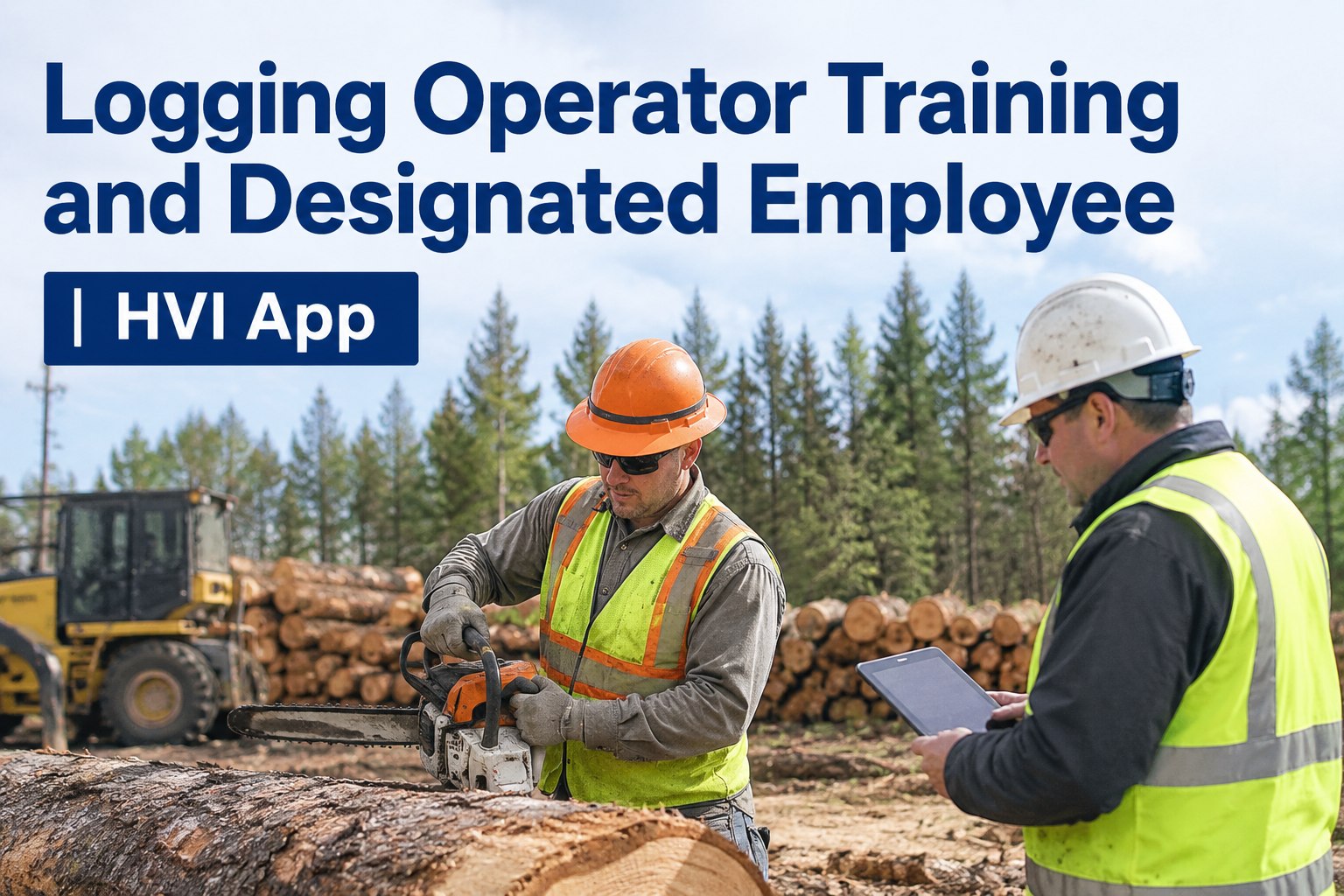
When a skidder rolls off a stump and a compliance officer asks who cleared the operator to run it, the silence that follows is usually longer than the investigation itself. Logging operator training and designated employee records are the first thing an inspector asks for after an incident, and the last thing most contractors can produce on the spot. Most crews train their people in practice — the weakness is almost never the training itself, it is the paper trail proving who was designated, on which machine, and when that designation was verified. If you want to see how that paper trail looks when it is actually audit-ready, book a 30-minute walkthrough of HVI on your own fleet.
1910.266 COMPLIANCE
If the designation is not recorded, it did not happen.
Federal logging operations standards require that machines be started and operated only by designated employees — an employer decision that must be documented, not informal. Skidder operators must be specifically trained, and every vehicle operator must hold a valid licence for the class of equipment they run.
THE COST OF INFORMAL DESIGNATION
Four numbers that explain why verbal training fails audits
Logging operations carry some of the highest incident rates in heavy industry. The gap between a trained crew and a documented crew is where liability lives.
Logging consistently ranks among the most dangerous occupations, with a fatal injury rate roughly 14 times the all-industry average across North America.
When an operator is injured and the employer cannot produce a training or designation record, insurance and client defences weaken immediately.
Inspectors generally expect proof of designation and competency within 48 hours of a request — paper binders buried in a truck cab do not survive that timeline.
Digital, per-operator training files tied to machine assignment mean every record is retrievable in seconds, not after a weekend of searching.
REQUIREMENT TO RECORD
How 1910.266 logging training requirements map to documentation
The standard is not vague about what the employer must do — it specifies who, what, and when. The table below maps each obligation to the record an inspector will actually ask to see.
| Standard obligation | What it means on the jobsite | The record that proves it |
|---|---|---|
| Designated employee only | Machines must be started and operated only by employees the employer has specifically designated as qualified for that equipment. | Written designation list tying each named employee to specific machines by serial or unit number, dated and signed. |
| Skidder operator training | Skidder operators must be trained in the safe operation of the machine, including winching, cable, and choker handling relevant to the rigging in use. | Machine-specific training record covering topics, trainer name, date completed, and competency verification method. |
| Valid operator licence | Every vehicle operator must hold a valid licence for the class of vehicle they operate on public roads and the site. | Licence copy on file with expiry date tracked and an alert before renewal is due, not after. |
| Training before initial assignment | Employees must be trained in safe job performance and hazard recognition before they are assigned to any logging work, not after. | Pre-assignment training certificate or record dated prior to the employee's first shift on the operation. |
| Training when new hazards arise | When new equipment, new processes, or new site conditions introduce hazards, additional training must be provided before exposure. | Supplemental training record dated at or before the introduction of the new equipment, process, or condition. |
If your current system cannot produce all five of those records in under five minutes, the gap is not in your training — it is in your documentation. You can walk through the HVI records module on your own machines to see exactly how a compliant file is structured.
EVIDENCE CHECKLIST
What a competent logging operator training file must contain
An inspector is not looking for a training certificate on its own. They are looking for a chain of evidence that ties a named person to a specific machine, on a specific date, with verified competency. Here is what that file must hold.
Identity and scope
- Full legal name and employee identifier
- Date of hire and date of initial assignment
- Specific machines designated to operate (by unit number)
- Machines explicitly excluded from designation
Training content
- Safe job performance instruction for assigned tasks
- Hazard recognition specific to the site and equipment
- Skidder-specific modules where applicable
- Machine-specific operating procedures and limitations
Competency verification
- Name and qualification of the trainer or evaluator
- Method used — practical demonstration, written, or both
- Date competency was verified, not just training attended
- Operator signature acknowledging the designation
Licence and currency
- Valid licence for each vehicle class operated
- Licence expiry date recorded and tracked
- Renewal alert set before expiry, not after
- Record of any restrictions or conditions on the licence
Ongoing and supplemental
- Refresher training dates and content
- Records triggered by new equipment introduction
- Records triggered by new site hazards or conditions
- Incident-based retraining where applicable
Retrieval and audit
- Records stored digitally, not only in a cab binder
- Searchable by operator name or machine unit number
- Timestamped with date of entry and last update
- Exportable as a complete file for an inspector on request
JOBSITE REALITY
A real-world example: the day a designation was challenged
Consider a 12-machine harvesting operation running three skidders, two feller-bunchers, a processor, and a fleet of six highway trucks hauling to the mill. A skidder operator clips a stump, the cable snaps, and a choker flies into the cab door. The operator is shaken but uninjured. Within 24 hours, three separate parties ask the same question: was this person trained and designated to run that skidder?
The binder is in the foreman's truck
The foreman is two cuts away and will not be back to the landing until dark. The training binder is in his cab. When the safety coordinator asks for the operator's designation record, the answer is "he's been running that machine for three years, everyone knows that." The coordinator writes down "unable to verify training on site." That note follows the operation into the insurance review, the client safety audit, and the OSHA file. Three weeks later, the contractor is still pulling records together to prove what was true on the day of the incident — that the operator was trained, designated, and competent. The problem was never the training. It was the retrieval.
The file is on a phone in 20 seconds
The site supervisor opens HVI on a phone, searches the operator's name, and the complete training file appears: the dated designation for that specific skidder by unit number, the skidder operator training record with the trainer's name and competency verification date, the hazard recognition training completed before initial assignment, and the operator's valid licence with expiry tracked. The file is timestamped, photo-backed where relevant, and exportable as a PDF that can be emailed to the coordinator on the spot. The question "was this person designated" is answered before the cable is even re-spooled. That is the difference between a record and a defence.
If you want to see how that retrieval actually works on a phone in the yard, book a live demo and we will run it on your machine list.
Stop proving competence with paper and memory.
See how HVI ties every operator's training, licence, and machine designation into one audit-ready file you can pull from a phone in the yard.
HOW HVI HELPS
Logging operator training records that survive an audit
HVI is built for fleet-heavy operations that need to prove who was trained, on what machine, and when — without searching a binder. Four capabilities map directly to the 1910.266 documentation gap.
Per-person training and qualification files
Every operator has a digital file holding their training records, competency verification, designation list, and licence — all in one place, searchable by name, not buried in a binder. Expiry alerts fire before a licence or refresher lapses, not after.
Outcome: No more "he's been running it for years" — you have the dated proof.
Machine assignment tied to designated operators
Each machine in your fleet is linked to the specific employees designated to operate it. When an inspector asks who is cleared to run unit 304, the answer is a list — not a guess. Assignment changes are timestamped and logged.
Outcome: Designation is an employer decision that is recorded, not informal.
Expiry and refresher alerts
Set alerts for licence expiry, refresher training due dates, and competency re-verification intervals. Alerts land before the deadline, giving you time to schedule the training without the operator going out of currency.
Outcome: Operators never run a machine on an expired licence or lapsed training record.
Audit-ready retrieval in seconds
When an inspector, client, or insurance auditor asks for proof, you pull the operator's complete file on a phone or tablet — training, designation, licence, competency verification, all timestamped. Export as PDF on the spot. No foreman's truck required.
Outcome: A 48-hour audit window becomes a 20-second answer.
If you want to start logging operator training records free and see the structure on your own crew, HVI is live in minutes — no server, no IT setup.
BEFORE AND AFTER HVI
The shift from paper designation to digital proof
Most logging contractors already train their people. The shift is not from untrained to trained — it is from unverifiable to provable. Here is what changes when designation and training records move into HVI.
Paper binder in the foreman's truck
- Training records exist but are not retrievable on site
- Designation is verbal and based on seniority or habit
- Licence expiry is tracked on a whiteboard, if at all
- Competency verification date is rarely recorded
- New-hazard training is not consistently documented
- Audit response takes hours or days, not seconds
Digital file on every phone and tablet
- Every record searchable by operator or machine instantly
- Designation is a written, dated, signed employer decision
- Licence expiry tracked with alerts before the deadline
- Competency verification recorded with trainer name and method
- Supplemental training triggered and logged for new hazards
- Audit response is a 20-second export from a phone
ROLLING OUT IN HVI
How to move your logging training program into HVI
Moving off paper does not mean retraining anyone. It means digitising the records that already exist and building a structure that holds every future record. Here is the workflow.
Load your operator list
Import every employee who operates a machine or vehicle — name, role, hire date, and current licence class. This becomes the backbone of your per-person training files.
Build the machine registry
Enter each machine and vehicle by unit number — skidders, feller-bunchers, processors, processors, forwarders, highway trucks. Each asset becomes a node you can tie designated operators to.
Attach existing training records
Upload or enter the training records you already have — dates, topics, trainer names, competency verification. If it is on paper, photograph it and attach it to the operator's file.
Set designation and expiry alerts
For each operator, record which machines they are designated to run. Set licence expiry and refresher training alerts so they fire before the deadline, giving you time to schedule renewal.
Test an audit retrieval
Pick an operator at random and pull their complete file on a phone. If it takes longer than 30 seconds, adjust the structure. Once it is under 30 seconds, you are audit-ready. Book a demo and we will run this test on your crew.
KEY TAKEAWAYS
What logging operator training compliance actually requires
Designation must be recorded. Machines may be started and operated only by designated employees, and that designation is an employer decision that must be documented — not informal.
Skidder operators must be specifically trained. The standard calls out skidder operator training by name, and the record must cover machine-specific operation, not generic orientation.
Licences must be valid and tracked. Every vehicle operator must hold a valid licence for the class they operate, and expiry must be tracked before the deadline — not caught after a roadside stop.
Training must cover hazards and be updated. Training is required before initial assignment and whenever new hazards arise — new equipment, new processes, new site conditions all trigger a record.
Records are what prove the designation. If you cannot retrieve the file in seconds, the training did not happen as far as an inspector is concerned. Digital, timestamped, photo-backed records are the defence.
Always confirm current requirements with OSHA. Standards and interpretations change. Verify the current 1910.266 requirements and any state or provincial equivalents that apply to your operation.
The hardest part of an incident is not the investigation. It is the hour after, when you are standing in the yard trying to remember which binder has the training record for the kid who was on the skidder. I stopped trusting paper the day I found out our designation list was two years out of date and nobody had noticed. Now I can pull any operator's file on my phone before the coffee is poured. That is the only reason I sleep.
Dale Mercer
Site Supervisor, mixed forestry and hauling contractor — Pacific Northwest
FREQUENTLY ASKED
Logging operator training and designated employee questions
What does designated employee mean in logging operations?
A designated employee is a person the employer has specifically selected and authorised to start or operate a particular machine. The designation is an employer decision that must be recorded — not an informal practice based on seniority or who happens to be available. The record should tie the employee by name to specific machines by unit number, with the date of designation and the trainer or evaluator who verified competency. Without that written record, the designation is difficult to prove after an incident.
Is skidder operator training specifically required?
Yes. The logging operations standard specifically identifies skidder operator training as a requirement, separate from general machine operation. Skidder operators must be trained in the safe operation of the machine, including winching, cable, and choker handling relevant to the rigging in use. The training record should be machine-specific, not a generic equipment orientation, and should name the trainer, the date, and the method used to verify competency.
Do logging vehicle operators need a valid licence?
Yes. Every vehicle operator must hold a valid licence for the class of vehicle they operate, whether on public roads hauling to the mill or on site. The licence must be verified, copied to file, and tracked for expiry. If a licence lapses, the operator must not run that vehicle class until it is renewed. A compliant system flags expiry before the deadline, not after a roadside inspection finds it. You can see how HVI tracks licence expiry by booking a walkthrough.
When must training be provided under 1910.266?
Training must be provided before initial assignment to any logging work, covering safe job performance and hazard recognition specific to the assigned tasks and site. Additional training is required whenever new hazards are introduced — new equipment, new processes, or new site conditions. Refresher training should be scheduled at appropriate intervals, and any incident or near-miss may trigger retraining. Every training event must be recorded with date, content, and trainer.
How should logging training records be stored?
Training records should be stored digitally in a system that is searchable by operator name and machine unit number, timestamped, and exportable as a complete file on request. Paper binders in a foreman's truck are not sufficient because they cannot be retrieved reliably during an audit or investigation. Records should include the operator's designation list, machine-specific training, competency verification, licence copy with expiry, and any supplemental training triggered by new hazards.
PROVE EVERY DESIGNATION
See HVI running on your own fleet — book a 30-minute demo
Walk through how operator training, designation, and licence records look in HVI, using your own machine list and crew names. See the audit retrieval live, then decide.
Free to start — Works on any phone — No card needed