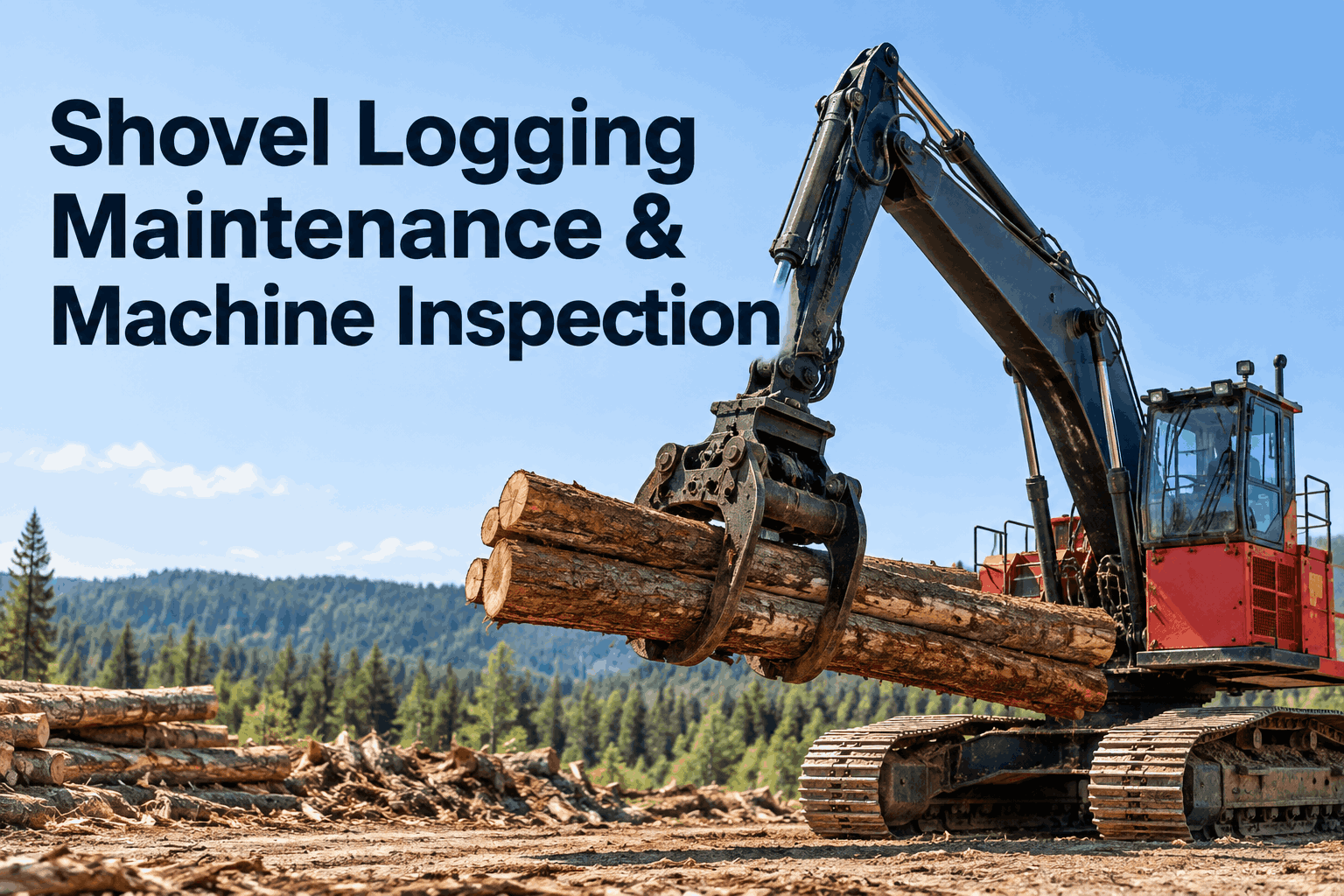
A shovel logger does one brutal thing all day: plant the tracks, swing a grapple full of timber downhill, release, and swing back — thousands of times, often across a side-slope. That swing-and-grade duty cycle punishes the swing bearing, boom and undercarriage far harder than ordinary excavator work. Shovel logging maintenance is what keeps the machine in the cut. Book a demo to see inspections run by machine-hours.
The swing-and-slope cycle wears four systems fast
A shovel logger lives in a stress loop ordinary excavators never see. Know the four systems it punishes — and catch the wear before it parks the machine.
Shovel logging gets the wood to the landing without a forwarder — the machine simply hands it downhill, arc by arc. That efficiency comes at a cost: the swing bearing takes continuous load, the boom cycles under side-stress, and the undercarriage works on grade with uneven track loading. Treat a shovel logger like a general excavator and it wears out early. Treat the duty cycle as the real inspection driver and it stays in the cut.
Shovel logging isn't normal excavator duty
Same base machine, a completely different workload. The gap between a digging excavator and a shovel logger is why a generic PM plan leaves wear uncaught.
- Swing in bursts between digging
- Works mostly on level ground
- Boom loaded straight-on
- Travels to reposition
- Near-constant heavy swing cycles
- Works across side-slopes on grade
- Boom side-loaded under full grapple
- Walks on tracks, repositions less
That's more swing hours, more side-load and more grade stress on the exact components that are slowest and most expensive to fix. The fix isn't more horsepower — it's catching the wear on the duty cycle's schedule. Book a demo to see inspections tied to the duty cycle.
What to inspect, and what wears first
Each of the four stress systems fails its own way under shovel-logging load. For the deep dives, we have dedicated guides on the swing bearing, the knuckle boom and the undercarriage; this is the machine-level view that ties them together.
Boom & stick
Continuous side-loaded cycling fatigues pins, bushings, cylinders and weld seams. Cracks start small and grow fast under swing stress.
Swing system
The bearing, drive and gearbox take the heaviest load on a shovel logger. Worn teeth or dry bearings turn into a very expensive teardown.
Undercarriage
Working on grade loads one side harder, so rollers, idlers and track chains wear unevenly. The downhill side almost always goes first.
Grapple
Grab-swing-release all day fatigues tines, the rotator and hoses. A worn rotator or weeping hose slows every single cycle.
None of this needs a shop visit to spot — it needs a consistent walkaround that records what it finds, so the next check compares against the last. Start free and build a shovel-logger inspection.
An inspection rhythm built for the duty cycle
Shovel loggers run hard hours, so the checks ride on machine-hours, not the calendar. Each tier has a job; nothing slips through a busy block. Confirm exact intervals against your OEM manual.
Leaks, hoses, track tension, grapple, swing grease — before the first swing.
Chain stretch, swing backlash, pin play — logged against the machine.
Swing gearbox oil, filters, undercarriage checks at set machine-hours.
Swing or boom work scheduled into weather downtime, not a failure.
The whole point is to move the expensive jobs from "breakdown mid-block" to "planned into a rain day." That's the difference a program makes. Book a demo to see an hours-based schedule.
A parked shovel logger stops the whole show
On many operations the shovel logger is the machine that moves the wood — when it's down, the block stops. That's why catching wear early pays back so fast.
Swing teardown
A failed swing bearing or drive is one of the longest, costliest repairs on the machine — days down, not hours.
Stalled block
No shovel means wood doesn't reach the landing — the whole crew waits on one machine.
Slope safety
Worn tracks or a sloppy swing on grade isn't just downtime — it's a stability risk on the side-slope.
Each of these traces back to wear that was visible on a walkaround weeks earlier — if someone was recording it. Book a demo to see wear caught before the machine goes down.
An equipment manager on hours, not guesswork
Our shovel was down three days for a swing drive nobody saw coming, and the whole block sat idle waiting on it. Now the swing backlash and grease get checked on machine-hours and logged, so I can see it creeping and book the work into a wet day. We haven't lost a block to a surprise swing failure since. On a machine that does nothing but swing all day, that check is the cheapest insurance we buy.
Run the machine program on HVI
Field inspection checklists
Digital inspections put the shovel-logger walkaround in the operator's hand, signed and dated.
PM scheduled by machine-hours
Preventive maintenance ties swing, boom and undercarriage service to run-time.
Wear logged per system
Maintenance records track swing backlash, chain stretch and pin play over time.
Downtime & cost reporting
Reporting shows cost per hour and which machine is trending toward trouble.
One record per machine, built on the walkaround the operator already does — so the program runs itself and the swing teardowns stop surprising you. Start free and put your shovels on a program.
Shovel logging maintenance questions
Q1What makes shovel logging hard on a machine?
The duty cycle. A shovel logger swings heavy grapple loads almost continuously, often across side-slopes, so the swing bearing, boom and undercarriage see far more load and side-stress than a digging excavator. That concentrated wear is why shovel loggers need a maintenance plan built around swinging, not digging.
Q2What should a daily shovel logger inspection cover?
Leaks and hose condition, track tension, grapple and rotator, and swing-system grease — a quick walkaround before the first swing. The goal is catching the obvious before it becomes a failure; measured wear checks (chain stretch, swing backlash) come weekly or at a set machine-hour interval.
Q3Why does the swing system wear faster on a shovel logger?
Because swinging is the main job, not an occasional move between digs. The bearing, drive and gearbox carry near-constant heavy load all shift, so they accumulate wear far faster than on a general excavator — and a failed swing is one of the longest, most expensive repairs on the machine.
Q4How often should shovel logger service be done?
Tie service to machine-hours rather than the calendar, since these machines run hard hours. Daily walkarounds, weekly measured wear checks, and hours-based gearbox, filter and undercarriage service. Always confirm exact intervals against the OEM manual for your machine and operating conditions.
Q5How does HVI help with shovel logging maintenance?
HVI runs the field walkaround as a digital inspection, schedules swing, boom and undercarriage service by machine-hours, and logs wear per system over time — so the duty cycle drives the maintenance and major failures get planned, not discovered. It's an inspection and maintenance layer, not an OEM service manual.
Put your shovel loggers on a wear program
Run the walkaround as a digital inspection, schedule swing, boom and undercarriage service by machine-hours, and catch the wear before it parks the machine mid-block. Live in weeks, not quarters.
No credit card · Inspections by machine-hours · Built for forestry fleets