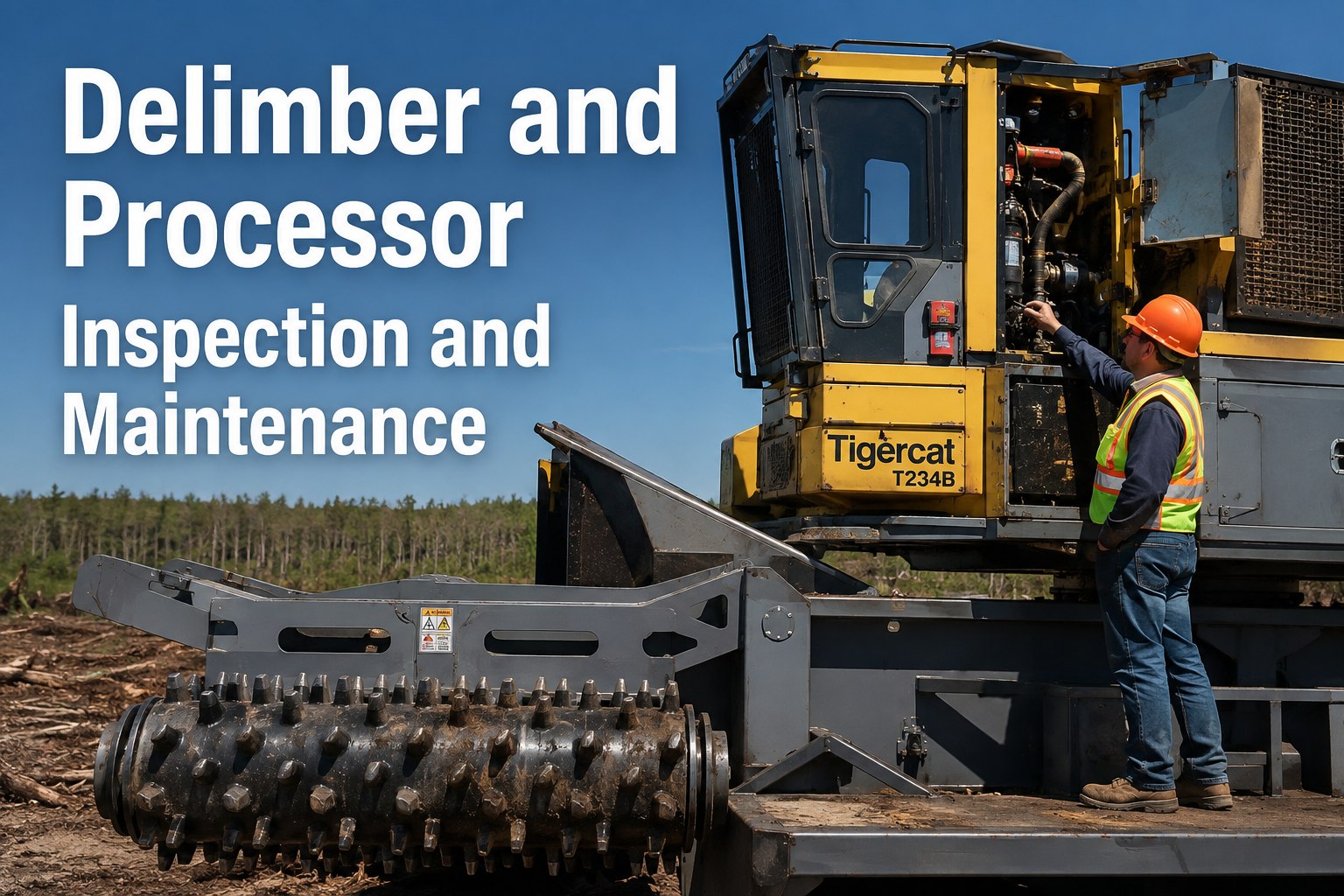
Your delimber is still running, but the loads are getting lighter and nobody can say exactly when it started. That is the reality of delimber inspection and processor head service on roadside processing jobs: knives, feed rollers, saw bars and measuring wheels wear down a fraction every shift, so throughput fades gradually instead of failing loudly. By the time the operator mentions it, you have already lost weeks of production and burned through parts nobody tracked. This page breaks down the seven wear zones that quietly eat your output, what a practical PM schedule looks like for stroke delimbers and processing heads, and how to turn a vague "it feels slow" complaint into a scheduled, costed repair. If you want to see this running on your own units, you can book a 30-minute walkthrough with your actual machine list and we will map it live.
Is your delimber slow, or is it just worn?
Delimbing knives, feed systems, saw units and measuring wheels degrade steadily, not suddenly. Production drops a few percent a month, operators compensate by forcing stems through, and the wear bill lands all at once. Here is how to measure it before it measures you.
The numbers behind a "tired" processor
None of these failures trigger an alarm. They show up as shorter loads, more stem damage, extra fuel burn and a parts invoice that keeps creeping up. Put a number on each and the case for scheduled wear-part changes writes itself.
Lost per unplanned knife or feed roller swap
A roadside change with the wrong parts on hand costs half a shift. A planned swap at the landing takes under an hour.
Daily value of a downed processor on a tight contract
When the processor stops, the feller buncher and the trucks behind it stop earning too. The machine rate is only part of the loss.
Of saw bar and chain spend is avoidable with tension and oil checks
Running a bar dry or a chain loose for one shift can scrap both. A two-minute daily check catches it.
Measuring errors traced to wheel wear, not calibration
Short wood penalties and log-length disputes often come from a worn measuring wheel nobody inspected, not a bad computer.
The seven wear zones to inspect on every delimber and processor
A solid delimber inspection covers the same seven zones every time, whether you run a stroke delimber, a pull-through or a harvester-style processing head. The difference between a good PM program and a expensive one is how often each zone gets measured, not just glanced at.
Delimbing knives
Edge wear and chips increase stem damage, leave branch stubs and force the operator to slow the feed to compensate. Check edge radius, cracks at the mounting bolts and uneven wear between upper and lower knives. A knife that needs replacing at 80% worn will destroy stems at 100%.
Feed system — rollers, chains and drives
Worn feed roller spikes slip on smooth-barked species and polish the stem instead of gripping it. On chain-feed units, check stretch, sprocket hooking and drive motor case drain flow. Feed slip shows up as inconsistent log lengths before it shows up as a breakdown.
Saw unit — bar, chain, tension and oil
The processor bar and chain live in the dirtiest spot on the machine. Check bar groove wear, rail burring, chain tension at operating temperature and actual bar oil delivery at the pad, not just tank level. A pinched oil line reads as a "worn out" bar every time.
Measuring system and calibration
Processing head calibration drifts as measuring wheels wear and encoder mounts loosen. Verify length against a tape on a known stem weekly, and check wheel diameter against the value stored in the system. Short wood from a worn wheel costs you at the scale house, not in the bush.
Stroke boom and frame structure
On stroke delimbers, the boom and slide cycle thousands of times a day. Inspect slide pads, boom pins, bushing play and the frame around the delimbing station for hairline cracks. High-cycle fatigue cracks grow quietly and fail expensively — catch them at the dye-penetrant stage, not the weld-rebuild stage.
Hydraulic circuits under continuous demand
Delimber hydraulics rarely rest: knife clamps, feed pressure, saw motors and the stroke circuit all pull flow constantly. Track operating temperature, cycle times and filter condition. A stroke that takes half a second longer than last month is telling you a pump or valve is wearing.
Wear-part consumption tracking
This is the zone most fleets skip. Log every knife, roller, bar, chain and measuring wheel change against engine hours. After two or three cycles you know exactly how long each part lasts on your wood, and "it feels slow" becomes "the knives are at 1,400 hours, change is due at 1,600."
A preventive maintenance schedule that matches how these machines actually wear
Calendar-based PM fails on processing equipment because wear tracks engine hours and stem volume, not dates. This schedule is built around hour-meter intervals, with the saw bar rebuild tied to the engine overhaul cycle where it belongs.
| Interval | Task | What it prevents |
|---|---|---|
| Daily / pre-shift | Knife edge check, saw chain tension, bar oil flow test, measuring wheel spin check, hydraulic leak walk-around | Stem damage, thrown chains, dry bars, short wood |
| 250 hours | Feed roller spike measurement, knife bolt torque, saw bar groove gauge, filter condition log | Feed slip, knife movement, premature bar wear |
| 500 hours | Stroke boom slide pad and pin play check, measuring system calibration against a taped stem, hydraulic temperature baseline | Boom slop, length drift, overheating under load |
| 1,000 hours | Knife set rotation or replacement per wear log, drive motor case drain flow test, structural crack inspection at high-stress welds | Throughput fade, motor failure, fatigue cracks |
| At engine overhaul | Full saw bar rebuild, feed system overhaul, cylinder repack, measuring wheel and encoder replacement | The big mid-season failure that stops the whole roadside crew |
Engine-hour intervals only work if someone reads the meter. HVI pulls hours from your telematics feed or a quick operator entry, then fires due and overdue alerts automatically — you can see the hour-based PM engine in a demo with your own intervals loaded.
What one untracked knife set costs over a season
Here is a simple, realistic example you can rerun with your own numbers. A contractor running one stroke delimber on a roadside job, producing roughly 20 loads a week.
Without wear tracking
- Knives run 400 hours past their effective life
- Feed speed drops ~10% to protect stem quality
- 2 loads a week lost over a 20-week season = 40 loads
- One emergency knife + roller swap roadside: 4 hours downtime
- Stem damage claims and rework at the mill
With hour-based wear tracking
- Knife change scheduled at 1,600 engine hours, done at the landing in 45 minutes
- Feed speed holds all season — 40 loads recovered
- Parts pre-ordered from the consumption log, no emergency freight
- Zero roadside swaps, zero stem-damage disputes
- Cost per machine report shows the true wear-part spend
At $150–$250 of margin per load, that is $6,000–$10,000 a season from one wear item on one machine. Multiply it across knives, bars, chains, rollers and wheels, then across a fleet, and the payback on tracking is measured in weeks. Fleets that start logging wear parts free in HVI usually have their first consumption baseline inside a month.
Built for machines that wear instead of break
HVI is a cloud and mobile CMMS for fleet-heavy operations — trucks, trailers and off-road plant like delimbers, processors and bunchers, all in one platform.
Machine-specific templates
A stroke delimber checklist is not a highway truck DVIR. Build a template per machine type — knives, feed, saw, measuring, structure, hydraulics — with photo capture on every defect, on any phone or tablet at the landing.
Engine-hour PM with wear tracking
Schedule by hours, not dates. Log every knife, bar, chain and roller change against the meter, and HVI turns it into a consumption baseline — including the saw bar rebuild at engine overhaul. Due and overdue alerts go to the right person automatically.
Parts and inventory with auto-deduction
When a work order closes with two knives and a bar chain, stock deducts itself. Reorder points flag before you run out, so the next change is a planned swap, not a freight emergency to a remote site.
Cost per machine reporting
See wear-part spend, labour and downtime per unit per season. When a processor's cost curve climbs, you know whether to rebuild, rotate or replace — with numbers a client or an owner accepts.
Defects found on inspection convert to work orders in one tap, with the photo attached. No paper binders in the pickup, no text-message photos that vanish. If you want to test it on one delimber first, sign up free and build your first template today.
See your own wear-part costs in 30 minutes
Bring your machine list and your rough PM intervals. We will load one delimber or processor live and show you the hour-based schedule, the wear log and the cost report.
The two systems that punish skipped checks hardest
If you only have time to tighten two parts of your program, make it these. The saw unit and the hydraulic circuits fail faster, cost more and take the longest to recover from when ignored.
Do
- Test bar oil delivery at the pad every morning — a pinched line scraps a bar in one shift
- Check chain tension at operating temperature, not cold
- Log hydraulic cycle times monthly; a slowing stroke is early pump wear
- Change hydraulic filters on condition and hours, and record both
- Keep one full saw bar and chain set in parts inventory per machine
Don't
- Run a bar until the rails burr — groove wear then eats every new chain you fit
- Top up bar oil and assume it is reaching the chain
- Ignore a rising hydraulic temperature because the machine still cycles
- Let operators adjust feed pressure to "feel" — it hides worn rollers and overloads motors
- Wait for the measuring system to drift before checking wheel diameter
Every one of these checks fits on a two-minute digital inspection. When a technician flags low bar oil flow with a photo, the work order exists before the machine cools down — book a demo and watch a defect become a work order in real time.
Delimber and processor maintenance, in five lines
- Delimbers wear, they rarely break. Throughput fade is a maintenance signal, not an operator problem — measure knives, feed and measuring wheels on hours.
- The saw unit is your highest-cost consumable zone. Bar, chain, tension and oil checks daily; a full saw bar rebuild at engine overhaul.
- Stroke booms and frames fatigue on cycles, not age. Pin play, slide pads and crack inspections belong in every 500-hour PM.
- Wear-part consumption tracking pays for itself in weeks. One knife set changed on schedule instead of late can recover thousands of dollars a season in loads.
- Delimber inspection data only matters if it triggers work. Digital checklists with photo defects feeding straight into work orders close the loop that paper never could.
You do not need a new machine to get the lost production back. You need to know when each wear part hit its limit — and a system that tells you before the operator does. Many maintenance managers walk through their own fleet setup in a short demo before rolling it to the crew.
"For years my delimber guys would say the machine felt tired and I had nothing to argue with. Now I track knife hours, bar changes and feed rollers per unit, and the number I watch is loads per engine hour. When it dips two weeks in a row, I order parts before the operator even mentions it. Last season we did every knife swap at the landing on a planned morning — not one roadside change."
Dale Merrick — Maintenance Manager, contract logging and roadside processing operation
Delimber and processor maintenance FAQs
How often should delimbing knives be inspected and replaced?
What causes a processor to cut short or long wood?
How do I schedule PM on a stroke delimber that works irregular hours?
What should a daily processor head inspection include?
Can I track wear parts like bars, chains and knives in HVI?
Stop guessing when your wear parts are done
Put your delimbers and processors on hour-based PM, track every knife, bar and roller, and see cost per machine in one dashboard. Start free, or let us show you on your own equipment first.
Free to start — Works on any phone — No card needed