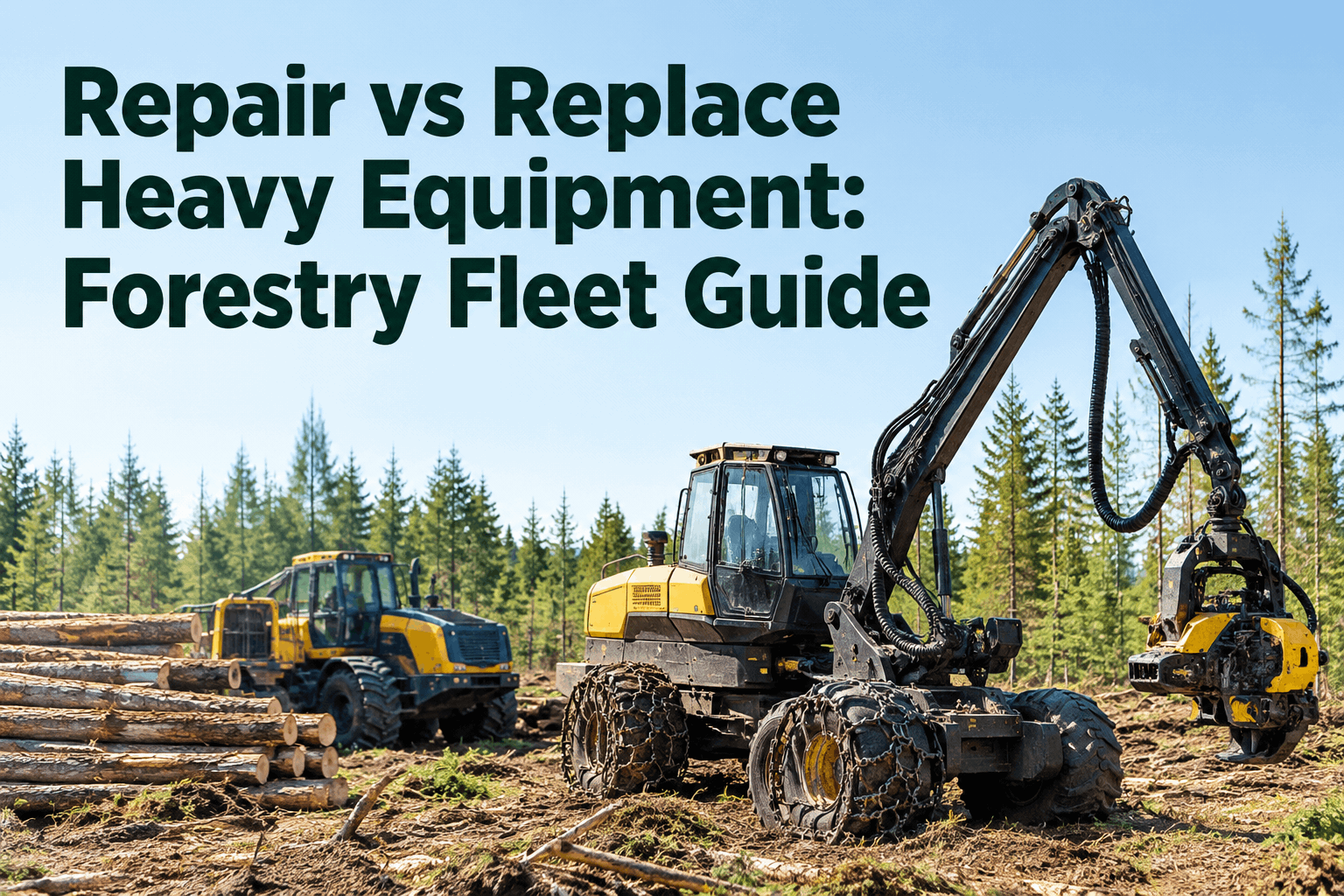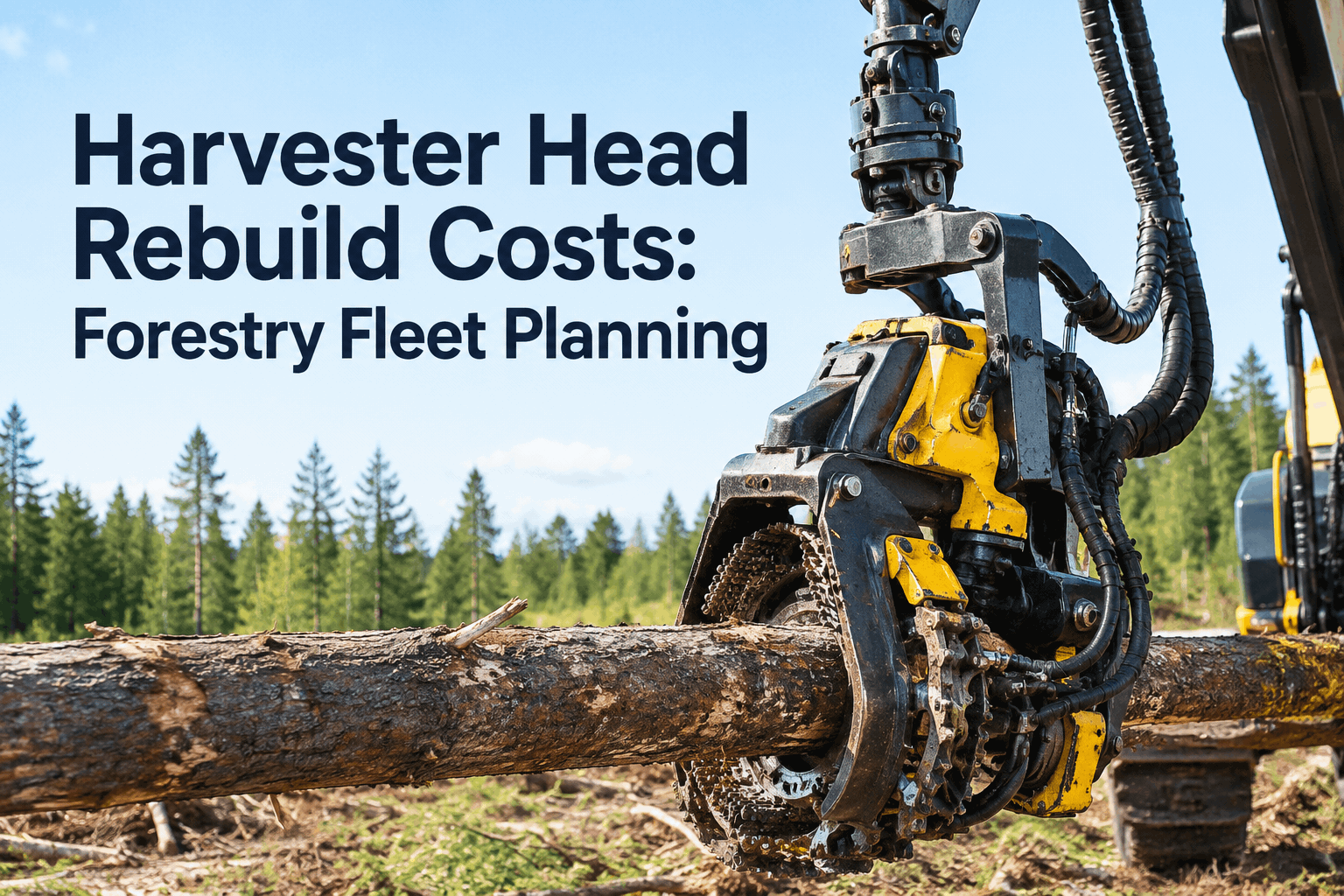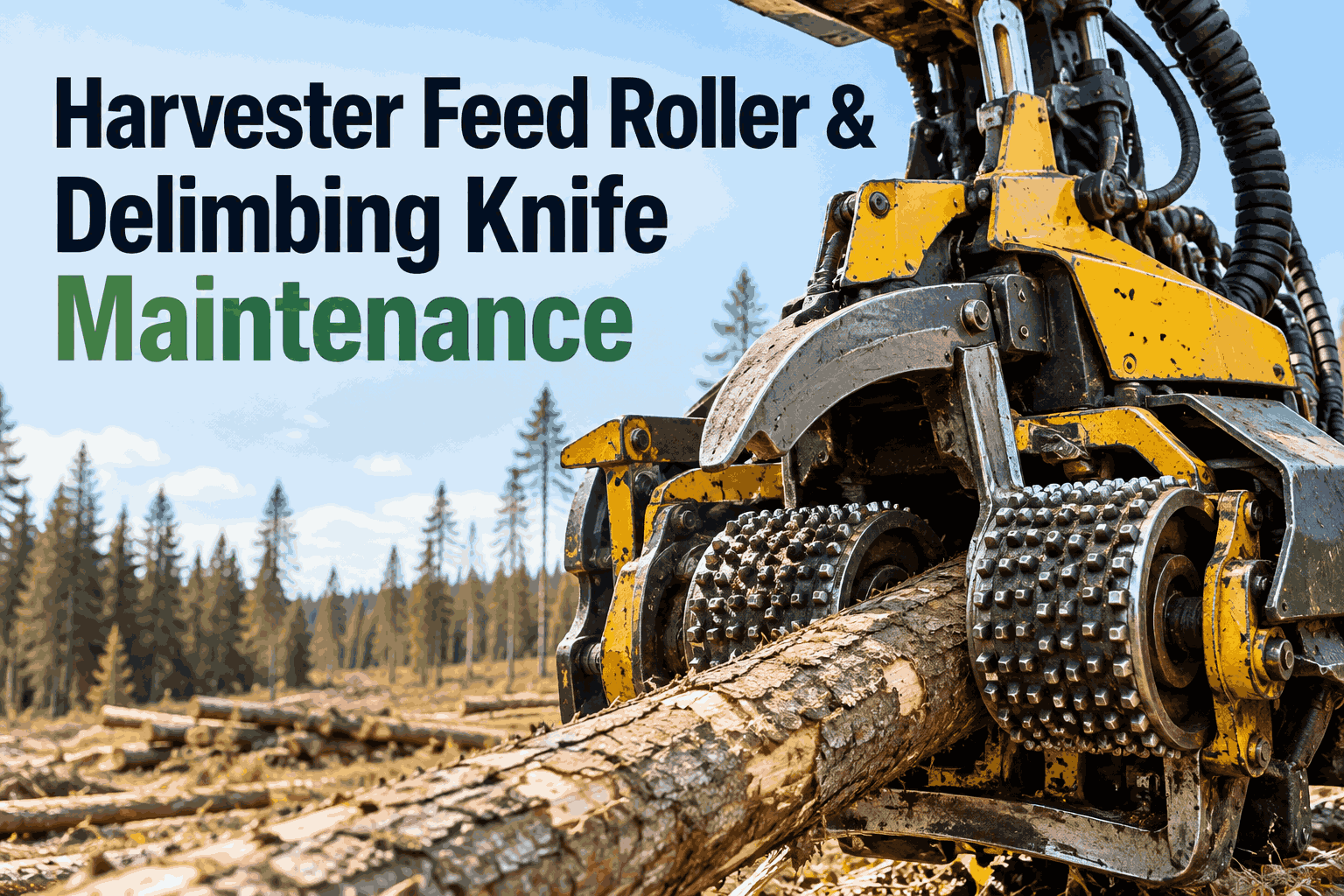
A harvester head grips, feeds and delimbs thousands of stems a day through grit, sap and frozen bark. The feed rollers and delimbing knives take the brunt — and when they go dull the damage isn't just the part, it's every log measured wrong and bucked short. Harvester feed roller maintenance is what keeps the head earning. Book a demo to see wear tracked by head-hours.
The head's wear parts decide what every log is worth
Feed rollers that slip and knives that drag don't just break — they measure wrong, delimb poorly and quietly cost you value on every stem. Here's the head, part by part.
The head is where fibre becomes product. Feed rollers pull the stem through and read its diameter; delimbing knives shear the branches and hold the stem straight; the measuring wheel counts length; the saw bucks it. Let the rollers or knives wear and that whole chain drifts out of true — which is why a wear program on the head pays back faster than almost anything else in a forestry fleet.
Worn parts don't just break — they lose you value
A dull knife or a glazed roller rarely stops the machine. It does something worse: it keeps working while quietly degrading every stem. Follow the chain from a worn feed roller to a short-bucked log.
Worn grip teeth lose traction on the stem
Slip throws off diameter and length reads
Cut to the wrong length for its grade
Downgraded to a cheaper assortment
Repeat that across a shift and the lost value dwarfs the price of a roller set. The head that measures true is the head that pays — which starts with catching wear before it reaches the wood. Book a demo to see wear flagged before it hits measurement.
The four wear points to watch on every head
Each wear part fails in its own way and shows its own warning signs. This is the feed-roller and knife view; for keeping the head measuring accurately, see our harvester head calibration guide.
Feed rollers
Grip teeth or spikes round off against bark and grit, so the roller slips instead of pulling. Feed force climbs, measurement wanders.
Delimbing knives
Edges dull and chip, so branches tear rather than shear. The head works harder, fibre quality drops and the stem can get gouged.
Measuring wheel
The wheel's teeth or surface wear and it stops tracking cleanly on the stem, so recorded length drifts from true length.
Pins, bushings & hoses
The pivots that carry roller and knife arms wear and go sloppy; hoses chafe. Slop here throws off everything the arms do.
Most of these are visible on a walkaround if someone knows what to look for — and recordable, so the next inspection compares against the last. Book a demo to see a head wear checklist in the field.
Fresh, watch, or rebuild — know where each part sits
Wear isn't on/off. Each part moves through stages, and the win is acting in the "watch" window — before performance drops, while a rebuild is still cheaper than the value you're losing.
Tracked over head-hours, each bar tells you what's coming due — so a rebuild is scheduled into a planned down-day, not forced by a failure mid-block. Book a demo to see wear trended by part.
Rebuild the part, or replace it?
Feed rollers and knives can often be rebuilt — re-toothed, re-faced, re-sharpened — for a fraction of new. The call turns on how far the wear has gone and what the base component is worth.
- Wear is on the working surface only
- Roller body / knife base is sound
- Caught in the "watch" window
- Lowest cost per service hour
- Cracks, deep pitting or bent body
- Rebuilt too many times already
- Run to failure, past the window
- Safety-critical damage present
The difference between a cheap rebuild and a full replacement is almost always how early you caught it — which is the whole case for tracking wear instead of waiting for slip. Book a demo to see rebuilds logged against each part.
A head maintenance rhythm by the hour
A harvester head runs on head-hours, not calendar days. Tie the checks to run-time and nothing slips through a busy block. Intervals vary by head, species and conditions — confirm against your OEM manual.
Roller grip, knife edges, visible hoses and pins; lube per schedule.
Measure roller and knife wear, log it against the part, compare to last.
Re-check length/diameter accuracy and clamp pressure at set head-hours.
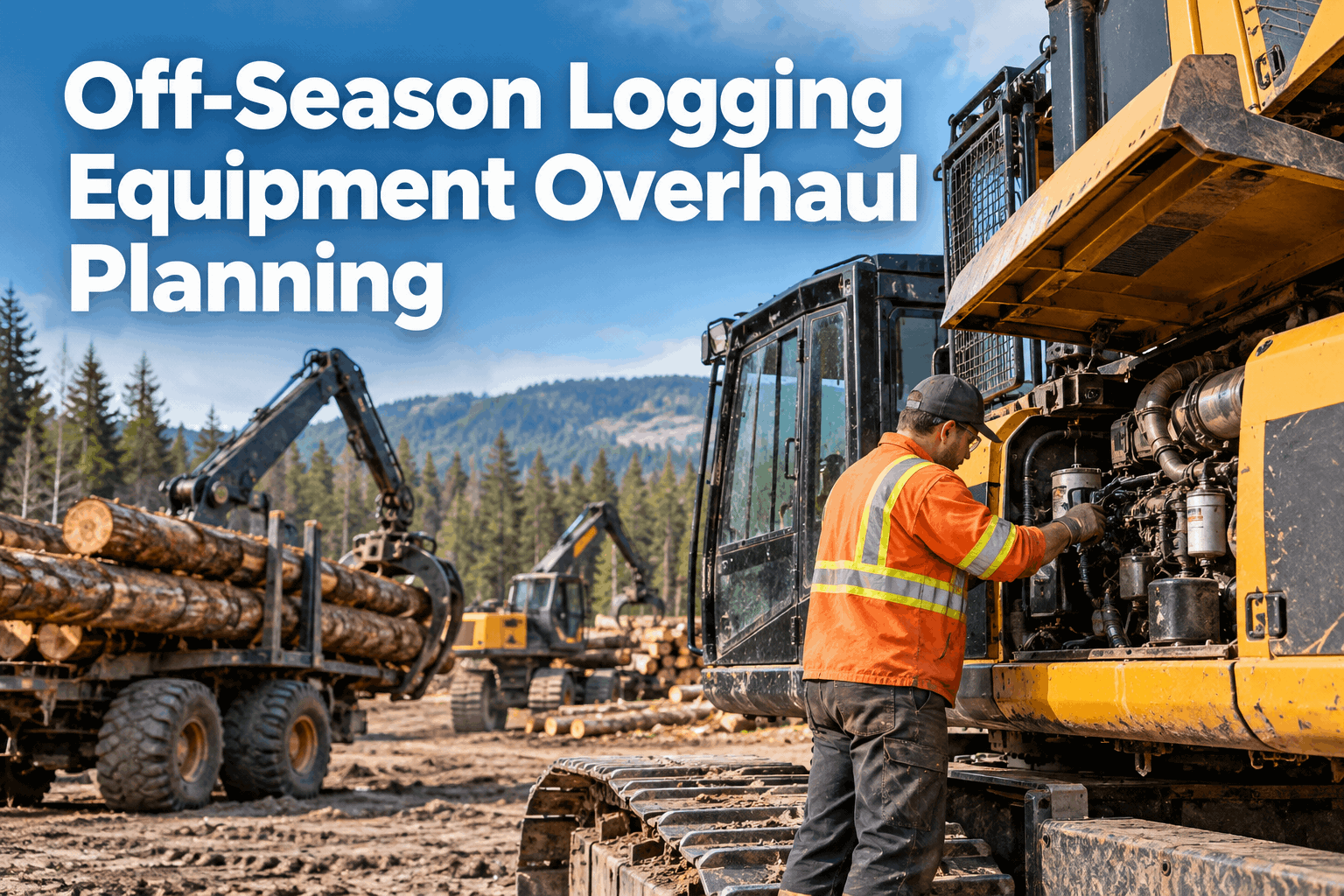
Rollers, knives and pins rebuilt in a planned down-day, not a breakdown.
The point isn't more maintenance — it's maintenance that lands on run-time, so the expensive failures turn into cheap, scheduled ones. This pairs with whole-machine upkeep in our delimber and processor maintenance guide.
A forestry maintenance manager on catching it early
We used to run rollers until the operator complained about slip — by then the knives were shot too and we'd lost a week of good bucking to downgrades nobody traced back to the head. Now the checks are tied to head-hours and logged against each part, so I can see a roller set trending toward rebuild and book it into a rain day. The rebuilds are cheaper, and the wood comes out on grade. Catching it early is the whole game.
Run the head program on preventive maintenance
PM scheduling by head-hours
Preventive maintenance ties roller and knife checks to run-time, not the calendar.
Wear logged per part
Maintenance records track each roller, knife and wheel so you see the trend.
Field inspection checklists
Digital inspections put a head walkaround in the operator's hand, signed and dated.
Rebuild & cost history
Reporting shows cost per head-hour and when a part's rebuilds no longer pay.
One record per head, built on the walkaround you already do — so the program runs itself and the surprises stop. Start free and put your heads on a wear program.
Harvester head maintenance questions
Q1How often should harvester feed rollers be inspected?
Visually every day as part of the walkaround, with a measured wear check weekly or at a set head-hour interval. Tie it to run-time, not calendar days — a head working hard wears far faster. Confirm exact intervals against your OEM manual for the species and conditions you cut.
Q2What happens when feed rollers wear out?
Grip teeth round off and the roller slips on the stem, so feed force rises and diameter and length measurement drift. That leads to mis-bucked logs cut to the wrong length for their grade — losing value on wood that's otherwise good. Catching slip early protects both the part and the product.
Q3Can delimbing knives be sharpened instead of replaced?
Usually yes, while the wear is on the edge and the knife base is sound — re-sharpening or re-facing restores a clean shear for a fraction of new. Replace once there's cracking, deep pitting, a bent body, or the knife has been reground past its service limit.
Q4When should a harvester head be rebuilt vs. replaced?
Rebuild when wear is on the working surfaces and the underlying bodies, pins and bushings are sound — the cheapest path per service hour. Move to replacement when there's structural damage, repeated rebuilds no longer hold, or a part was run past its window into failure.
Q5How does HVI help with harvester head maintenance?
HVI schedules feed-roller and knife checks by head-hours, logs wear against each part, runs the field walkaround as a digital inspection, and tracks rebuild cost over time — so wear is caught in the "watch" window and rebuilds are planned. It's a maintenance and inspection layer, not an OEM service manual or calibration tool.
Put your harvester heads on a wear program
Schedule feed-roller and knife checks by head-hours, log wear against every part, and catch the rebuild in the watch window — before slip reaches the wood. Live in weeks, not quarters.
No credit card · Wear tracked by head-hours · Built for forestry fleets