You watch the top of an 80-foot western hemlock sway against a sudden ridge gust just as the saw bar punches through the holding wood, threatening a catastrophic barber chair. In manual timber harvesting, manual felling safety is not an exercise in hope; it is an uncompromising geometric discipline of precise face notches, intact holding hinges, and pre-cleared escape paths. Preventing fatal tree kickbacks and crushing incidents requires systematic hazard assessments, disciplined cutting sequences, and verifiable digital safety documentation before the saw enters wood. Book a demo to see how HVI digitizes forestry tailboard hazard assessments and crew felling safety audits
Manual Felling Safety: The Anatomy of Controlled Tree Drops
Felling control relies entirely on the hinge wood acting as a mechanical steering axle. Switch below to see how calculated notch-and-hinge cuts compare to informal bypass cuts on steep timber slopes.
A sawyer cuts completely through the hinge wood during the backcut on a forward-leaning tree. The trunk splits vertically from the stump upward (barber chairing), hurtling the powerhead backward and pinning the faller against unmanaged slash.
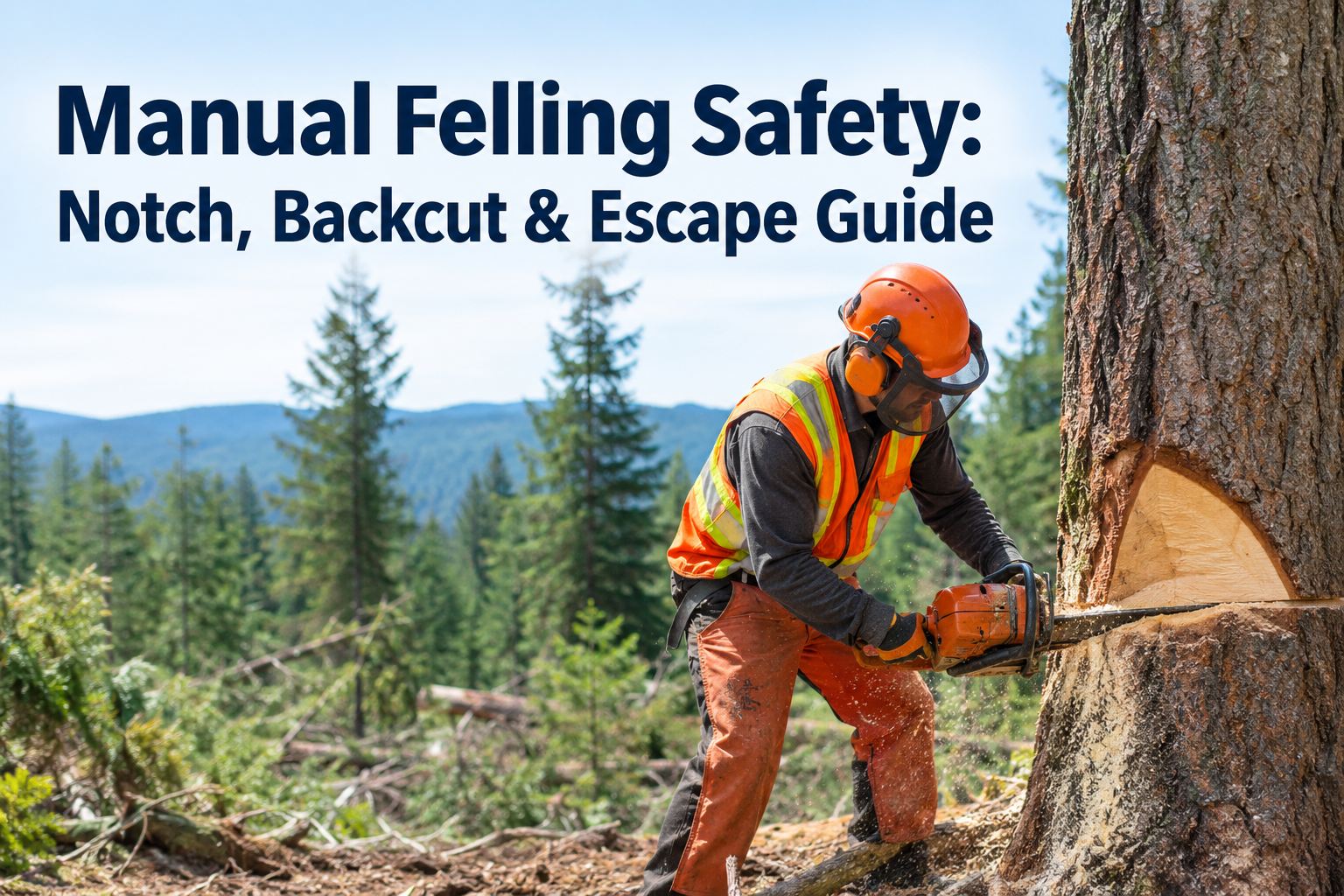
The faller cuts an accurate open-face notch, maintains an intact hinge across 80% of the stump diameter, and leaves 1 to 2 inches of holding wood. As the tree hinges over, the cutter retreats along a cleared 45-degree angle escape path before the butt touches the ground.
Manual timber felling remains one of the most hazardous production activities in the global heavy-industrial sector. Felled trees weigh between 10,000 and 80,000 pounds, fall under gravity acceleration, and generate violent reverberations that snap surrounding limbs and snagged snags. When a manual faller steps up to a trunk with a 32-inch bar, survival depends entirely on understanding the physics of the notch, preserving hinge integrity, and clearing an unobstructed retreat route.
The 3 Structural Components of a Controlled Felling Cutnotch geometry, hinge width, and backcut alignment required under OSHA 1910.266(h)
Under federal logging regulations, trees must be felled using three distinct, coordinated cuts. Omitting any cut, overcutting the hinge, or cutting without an undercut is a direct regulatory violation and an immediate life-safety hazard.
Face Notch (Directional Guide)
The undercut removes a wedge of wood facing the planned direction of fall. It establishes the trajectory and provides a clear opening so the tree can pitch forward without closing early.
- Depth: Must penetrate 20% to 25% of the tree's diameter at breast height (DBH).
- Angle: Minimum 70 degrees for open-face notches to allow the tree to reach the ground before the notch closes.
- Clean Junction: The horizontal and sloping cuts must meet precisely with zero bypass (Dutchman kerf).
The Hinge (The Steering Wheel)
The hinge is the continuous strip of uncut wood left between the backcut and the apex of the notch. It controls the fall direction and prevents the stem from twisting, sliding off the stump, or kicking backward.
- Thickness: Maintained at roughly 10% of the tree diameter (e.g., 2 inches of hinge on a 20-inch stem).
- Length: Must span at least 80% of the tree's diameter across the stump.
- Integrity: Must never be cut through; severing the hinge releases all mechanical steering control.
The Backcut (Release Cut)
The backcut is executed from the opposite side of the tree toward the notch apex. It severs the supporting wood fibers, shifting the tree's center of gravity onto the holding hinge.
- Level: Executed level and horizontal, positioned 1 to 2 inches higher than the hinge line (stump step).
- Wedges: Fallers must insert felling wedges behind the guide bar early to prevent tree sit-backs and guide the fall.
- Bore Cutting: Recommended for forward-leaning timber to prevent sudden barber-chair trunk ruptures.
Do not leave timber falling practices to informal crew habits. Schedule an operational walkthrough to see how HVI configures digital tailboard checklists and felling safety audits
The 45-Degree Escape Route: Surviving the Stump Zoneclearing secondary egress paths and executing the retreat before the tree hits the deck
Under OSHA 29 CFR 1910.266(h)(2)(i), the faller must establish and clear an escape route before cutting starts. Over 75% of logging fatalities occur within 10 feet of the stump, caused by butt rebound, trunk kicking, or falling overhead widowmakers as the tree separates.
Plan at a 45-Degree Angle to the Rear
Never retreat directly behind the tree (180 degrees) where butt kickback and root recoil occur. Establish an escape route diagonally back at a 45-degree angle from the line opposite the intended fall direction.
Clear a 20-Foot Path Free of Tripping Hazards
Swamp out underbrush, briars, snow, and loose limbs for at least 20 feet away from the base of the trunk. Ensure clear, firm footing that allows a rapid, upright retreat without tripping while holding the saw.
Select Secondary Protection Shelter
Identify a substantial standing tree or terrain rise along the escape path that can shield the faller from flying limbs, whipping cables, or ricocheting debris as the stem crashes down.
Engage Chain Brake and Execute Immediate Retreat
The instant the tree commits to the hinge and begins falling, immediately engage the saw chain brake, cut throttle, and walk briskly along the escape path while keeping your eyes on the tree canopy.
Pre-felling site walkarounds must confirm sawyers have swamp out their escape corridors. Sign up for HVI to digitize pre-cut timber faller safety checklists
Paper Logbooks vs. Connected Forestry Safety Managementhow digital oversight eliminates blind spots and protects timber operations during OSHA audits
Managing contract timber fallers across steep, remote acreage makes physical paper logbooks ineffective. Paper inspection forms get ruined by rain, hazard assessments go unrecorded, and expired sawyer certifications expose logging operators to massive OSHA liabilities.
Paper Binders & Verbal Agreements
- Faller chain brake, throttle lockout, and chain catcher checks go undocumented.
- No photo verification of PPE compliance (cut-resistant chaps, hard hats, eye screens).
- Wind, slope, and widowmaker hazard assessments left to informal, unrecorded conversations.
- Significant administrative burden assembling training proof when OSHA inspectors arrive on the landing.
HVI Digital Safety Platform
- Mobile pre-shift checklists mandate photo proof of chainsaw functional tests and PPE.
- One-click work order creation routes dull chains, cracked handles, or oiler leaks to shop mechanics.
- Digital tailboards log GPS coordinates, slope hazards, and faller sign-offs before saw work starts.
- Signed PDF inspection records provide tamper-proof compliance evidence for safety regulators.
Operations implementing structured digital safety inspections experience up to a 25% reduction in annual maintenance costs and rapid 3-month payback periods. Book a demo to see how HVI eliminates forestry safety blind spots
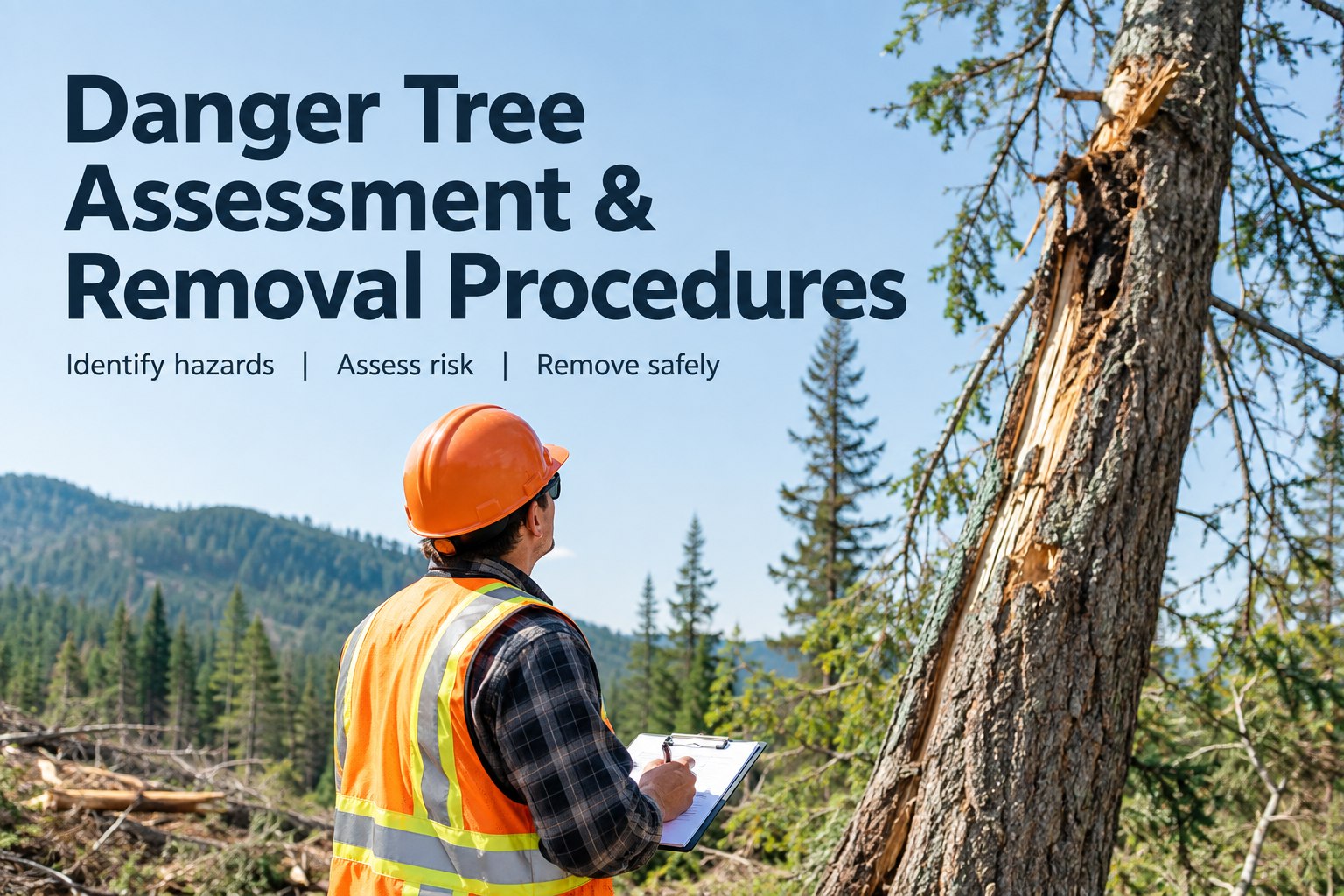
The 5-Point Pre-Felling Hazard Assessment (OHLEC)standardized visual screening protocol before the chainsaw touches bark
Before making any cut, every manual faller must conduct the industry-standard OHLEC assessment. Rushing into the notch without assessing canopy binds, terrain lean, and dead overhead limbs accounts for a majority of fatal timber strike incidents.
| OHLEC Checkpoint | Assessment Focus | High-Risk Indicators | Mandatory Mitigation |
|---|---|---|---|
| Overhead Hazards | Crown, snags, widowmakers | Dead broken tops, hung-up branches, wasp nests | Do Not Fall; Use Iron |
| Hazards Surrounding | Adjacent trees, terrain traps | Bystanders within 2 tree lengths, powerlines, rock bluffs | Clear Exclusion Zone |
| Lean of the Tree | Natural lean & heavy limbs | Back-lean against wind; severe side-lean toward draws | Use Double Wedges |
| Escape Route | Retreat path condition | Heavy slash, deep snow drifts, steep drop-offs | Swamp 45° Path Clean |
| Cut Plan & Hinge | Internal wood integrity | Center conk rot, hollow trunk base, ring shake | Widen Hinge / Bore Cut |
From a contract logging supervisor who rebuilt felling safety
We were hand-falling old-growth Douglas fir on a steep Pacific Northwest unit where blowdown timber was crisscrossed like matchsticks. One of our contract fallers rushed his backcut on a heavy forward leaner without boring the center or checking for an overhead widowmaker. The stem barber-chaired three feet up the trunk, kicking the saw handle into his ribs and narrowly missing his head.
That close-call forced us to overhaul our operations. We instituted HVI's digital tailboard checklists and pre-cut hazard evaluations on rugged field tablets that very week. Now, every faller runs through the OHLEC routine, logs their escape route clearance, and checks chain brakes before starting their saw. Having verified safety routines on every tract keeps our sawyers safe and our safety records clean.
Frequently asked questions
What is a barber chair and how can timber fallers prevent it?
A barber chair is a fatal felling accident where a tree with heavy forward lean splits vertically up the trunk above the backcut before the severance cut is finished. As the front half falls, the rear half kicks straight back at head height. Fallers prevent barber chairs by using the bore-cutting technique: boring through the center of the tree behind the hinge and cutting backward to leave a holding strap at the rear, which is then severed from the outside.
Why is the open-face notch preferred over a conventional notch in manual felling?
An open-face notch features a wide 70-to-90-degree opening that allows the tree to hinge all the way to the ground before the notch closes. Conventional notches have only a 45-degree opening, which closes when the tree is only halfway down. When a notch closes early, the hinge breaks while the tree is still high in the air, causing the butt to kick off the stump unpredictably.
What are the OSHA requirements for escape routes during manual felling?
Under OSHA 29 CFR 1910.266(h)(2)(i), the employer must ensure that before falling begins, an escape path is planned and cleared. The path must be cleared of brush and tripping hazards, leading diagonally away and to the rear of the intended fall direction at roughly a 45-degree angle. The faller must immediately move away from the stump as soon as the tree begins to fall.
What role do felling wedges play in manual timber felling?
High-impact plastic or aluminum felling wedges are essential mechanical tools. Inserted into the backcut kerf behind the guide bar, they prevent the tree from sitting back and pinching the chainsaw bar. Driving wedges with a falling axe lifts the center of gravity forward, forcing back-leaning or neutral trees over the holding hinge into the intended fall line.
How does HVI software streamline manual felling safety and OSHA compliance?
HVI provides an offline-ready mobile platform that lets logging supervisors conduct daily tailgate safety meetings, verify chainsaw maintenance (chain brakes, catch pins, guards), and record faller PPE verifications on remote timber acreage. The system syncs signed PDF documentation to the cloud automatically, providing an audit-ready compliance trail for OSHA 1910.266 reviews.
Conclusion: Systematic Felling Cuts Protect Workforce Livesreplacing guesswork with disciplined notch geometry, intact holding wood, and digital safety oversight
Full adherence to manual felling safety standards is the ultimate life-saving discipline in production timber harvesting. Gravity, wood fiber tension, and extreme tree mass offer no second chances when a sawyer bypasses a notch, undercuts a holding hinge, or neglects to clear an escape corridor.
By implementing HVI's digital safety checklists, pre-shift equipment inspections, and mobile tailboard management tools, forestry contractors eliminate communication gaps and establish audit-ready compliance across every logging side. Protect your timber fallers, maintain clean equipment records, and ensure your timber harvest operates safely and productively. Schedule an operational safety consultation today
Standardize Manual Felling Safety & Crew Compliance with HVI
Ensure every chainsaw inspection, tailboard hazard briefing, and faller credential is fully documented across your forestry operations. Deploy mobile checklists, eliminate paperwork delays, and maintain audit-ready safety logs across all harvest tracts.
No credit card required · Offline mobile capabilities · Comprehensive audit compliance