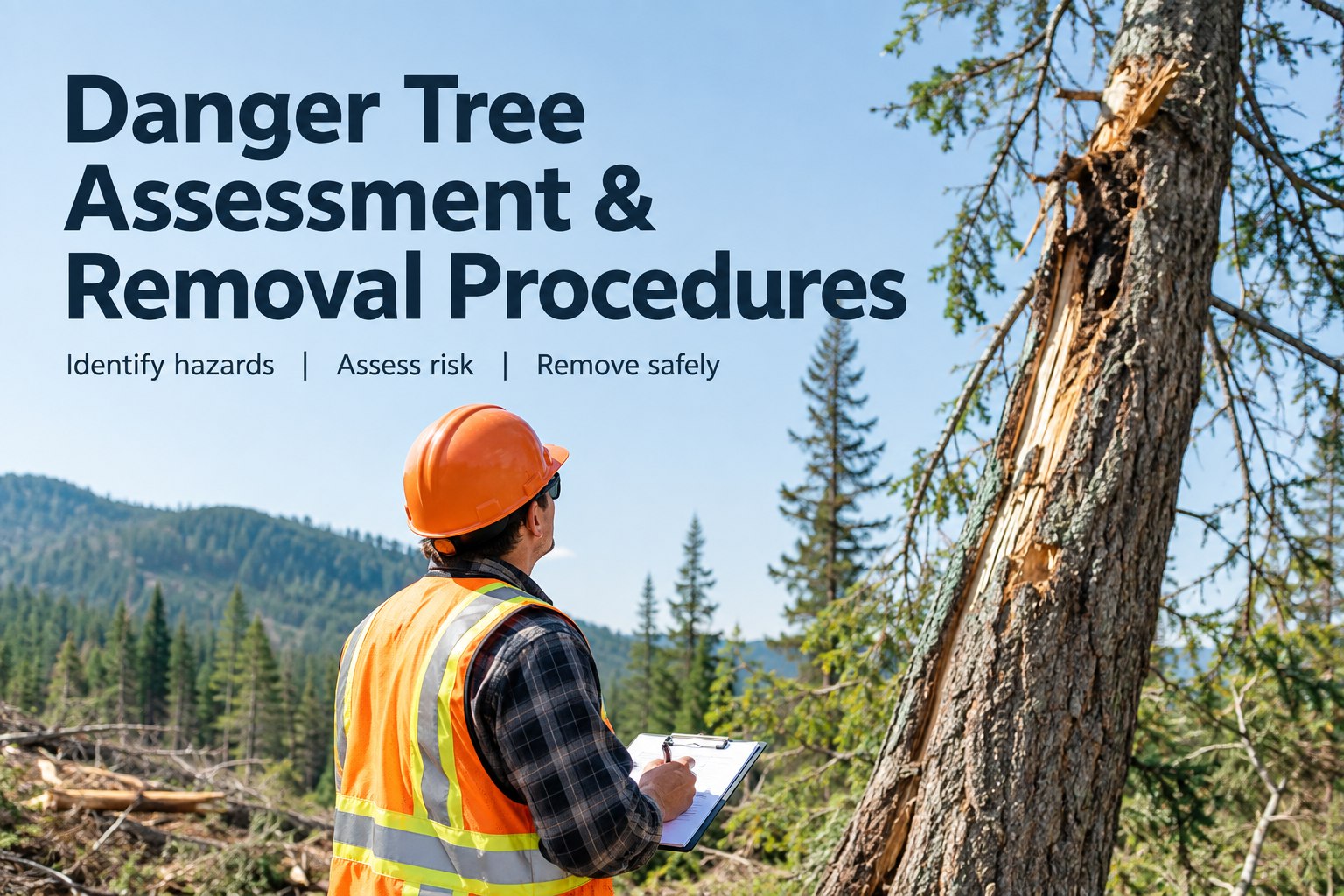
A lodged tree doesn't look like an emergency — it's just hanging there, tangled in the canopy, not moving. That stillness is exactly what makes it one of the deadliest conditions in logging. Danger tree assessment exists because a standing hazard rarely announces itself before it fails. Here's what OSHA actually defines as a danger tree, the four conditions that create one, and the exclusion-zone rule that applies the moment it isn't removed.
Is This Tree a Danger Tree?
Pick a condition. See whether it meets OSHA's danger tree definition, and what the standard requires before work starts nearby.
Deterioration or physical damage to the root system, trunk or stem is named directly in OSHA's definition — the tree must be felled, removed, or marked with a two-tree-length exclusion zone before nearby work begins.
A dead or broken top hung in the canopy can fall without warning, with no wind or contact needed to trigger it — one of the least predictable hazards a crew works under.
OSHA names lodged trees and snags explicitly. Never work in the presence of a lodged tree — it must be brought down mechanically before any other work continues nearby.
Direction and degree of lean is one of OSHA's named conditions — a lean toward the work area, retreat path, or another crew changes the felling plan entirely, not just the risk level.
What OSHA Actually Defines as a Danger Tree
OSHA's logging standard, 29 CFR 1910.266, defines a danger tree in Appendix C as a standing tree that presents a hazard to employees due to conditions including, but not limited to, deterioration or physical damage to the root system, trunk, stem or limbs, and the direction and lean of the tree. That definition matters because it's broader than "obviously dead" — a healthy-looking tree with root damage from nearby ground disturbance, or a live tree leaning the wrong direction relative to a retreat path, both qualify.
The operative requirement sits in 1910.266(h)(1)(vi): every danger tree, explicitly including lodged trees and snags, must be felled or removed using mechanical or other techniques that minimize employee exposure before work begins in the area. Danger tree assessment isn't a courtesy step before felling — it's the specific, named regulatory trigger that determines whether work in that area can legally proceed.
Four Conditions a Danger Tree Assessment Must Catch
Root & Trunk Damage
Decay, cavities, fire scarring, storm damage or root disturbance from nearby machine traffic all reduce a tree's structural integrity in ways that aren't always visible from a distance — a full walk-around at the base is part of a real assessment, not a glance from the skid trail.
Dead or Broken Tops — "Widowmakers"
A broken limb or top hung in the canopy can release with no warning, no wind trigger and no contact from the tree being felled — it's one of the few hazards on a logging site that can strike a crew member doing everything else correctly.
Lodged & Hung-Up Trees
A tree that hasn't reached the ground, caught against another tree mid-fall, carries enormous stored energy in an unpredictable release direction. OSHA's own logging eTool calls these conditions exactly what they are and instructs crews not to work in their presence at all.
Excessive or Unusual Lean
Forward, back or side lean changes hinge sizing, felling direction and retreat-path planning — a tree leaning toward the planned retreat route or an adjacent work area needs a different plan entirely, not just extra caution on the same plan.
Two Tree Lengths: The Rule When a Danger Tree Stays Standing
Removal isn't always immediate or possible the moment a danger tree is identified. OSHA's standard covers exactly that situation: if the danger tree isn't felled or removed right away, it must be marked, and no work may be conducted within two tree lengths of it. That's a specific, measurable distance — not "keep clear" or "use judgment," but a defined exclusion zone tied directly to the height of the hazard itself, which scales the buffer to the actual fall radius of that specific tree.
This is also where informal safety culture breaks down most often. A crew member who knows about a lodged tree and warns others verbally has done half the job — without a physical mark and a recorded exclusion zone, the next shift, a different crew, or someone working from the opposite direction has no way to know the hazard exists at all.
The Hazard Evaluation Before Every Felling Cut
Determines hinge sizing and whether the natural fall direction matches the planned one.
A cleared route away from the falling tree must be identified and communicated before the first cut, not planned on the way out.
Adjacent danger trees, terrain, and other crew or equipment positions within the potential impact zone.
Sized to safely guide the tree through its fall based on lean, species and diameter — not a default cut applied to every tree.
Every one of these is required under 1910.266(h)(2) before a felling cut begins, and every one depends on the danger tree assessment having actually happened first — a hazard evaluation built on an incomplete walk-around inherits that gap silently. Start a free trial to walk crews through this exact evaluation on a phone or tablet, before the first cut, not from memory.
Why This Isn't Theoretical
Occupational Safety and Health Review Commission case records include multiple documented logging fatalities where a lodged or leaning tree was known to a crew before the incident — in more than one case, a worker was aware of the hazard and warned others, then continued working within its fall radius anyway because no formal exclusion zone had been marked. Logging consistently ranks among the most dangerous occupations tracked by federal injury data, and danger trees specifically — not the tree being actively felled, but a second hazard standing nearby — are a recurring, well-documented cause. The regulation exists in direct response to exactly this failure pattern: a hazard that was seen, understood, and not formally isolated.
Documentation: What a Danger Tree Assessment Record Should Capture
A verbal warning disappears at shift change. A written or digital record doesn't. A complete danger tree assessment record should capture the condition observed, its specific location relative to the active work area, whether it was felled, removed, or marked with an exclusion zone, who performed the assessment, and when. That record is also what a safety manager needs after an incident, during an audit, or simply to confirm a hazard flagged three days ago on a different crew's shift was actually resolved — not just remembered by one person who happened to be there. Start a free trial to log danger tree assessments with location, condition and resolution status in the same system your crew already uses for daily safety checks.
What a Safety Manager Actually Watches For
We used to rely on radio calls — "heads up, there's a hung-up tree past the ridge." That worked until it didn't, because the next crew rotating through that section never heard the original call. Now every danger tree gets logged with its location the moment it's spotted, and nobody starts a felling cut nearby without checking that log first. It sounds simple, but it's the single change that ended our near-misses in that category.
The Takeaway
Danger tree assessment works when it's treated as a formal, documented step — not a glance and a verbal heads-up. OSHA's definition covers more than obviously dead trees: root damage, broken tops, lodged trees and excessive lean all qualify, and the standard is specific about what happens next, right down to a two-tree-length exclusion zone when a hazard isn't immediately removed. The crews that stay ahead of this aren't the ones with the most experienced eyes; they're the ones whose hazard record travels with the crew instead of living in one person's memory. Start your free trial and put every danger tree assessment on a record the whole crew can see.
Frequently Asked Questions
What does OSHA define as a danger tree?
Under 29 CFR 1910.266, Appendix C, a danger tree is a standing tree that presents a hazard to employees due to conditions including, but not limited to, deterioration or physical damage to the root system, trunk, stem or limbs, and the direction and lean of the tree. This definition explicitly includes lodged trees and snags, and covers healthy-looking trees with structural or lean-related hazards, not just obviously dead or damaged ones.
What must happen when a danger tree is identified?
Under 1910.266(h)(1)(vi), each danger tree must be felled or removed using mechanical or other techniques that minimize employee exposure before work begins in that area. If it isn't felled or removed immediately, it must be marked, and no work may be conducted within two tree lengths of it until it's addressed.
What is a "widowmaker" in logging safety?
A widowmaker is a dead or broken limb, or a broken tree top, that's hung up in the canopy above a work area. It can fall without warning, without wind, and without any contact from felling operations happening nearby, making it one of the least predictable hazards on a logging site and a named condition under OSHA's danger tree criteria.
What should be evaluated before every felling cut?
Under 1910.266(h)(2), a felling evaluation must determine forward, back and side lean and how they affect hinge sizing; establish a clear retreat path before the first cut; identify surrounding hazards including other danger trees and crew or equipment positions within the potential impact zone; and determine the proper felling method and hinge size for that specific tree. Each of these depends on an accurate danger tree assessment having already been completed for the surrounding area.
Why is a lodged or hung-up tree considered especially dangerous?
A lodged tree hasn't fallen completely to the ground and is instead caught or leaning against another tree, storing significant energy in an unpredictable release direction. OSHA's own logging safety guidance instructs crews not to work in the presence of a lodged tree at all — it must be brought down using mechanical means, such as a machine pushing or pulling it, before any other work continues nearby.
Put Every Danger Tree Assessment on Record
HVI's Safety Management tools log danger tree conditions, location, marking status and pre-felling hazard evaluations in the field, so hazards flagged on one shift are visible to every crew that works that area afterward.
No credit card · No hardware required · Live before your next harvest block