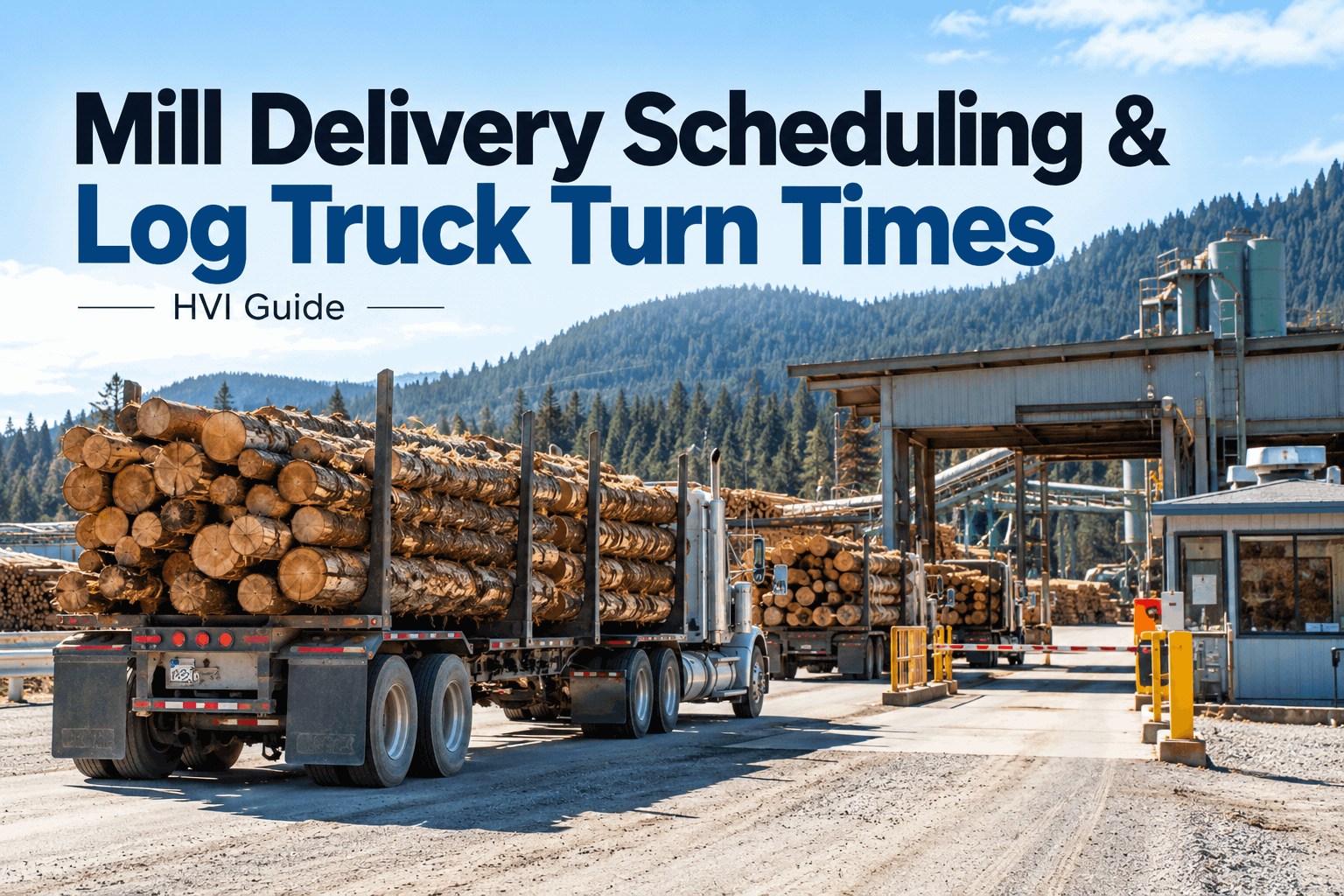
Mill delivery scheduling works best when dispatch plans reflect unloading capacity, road travel time, truck readiness and the variability of mill queues. For logging fleets, a missed delivery window can create idle time, disrupt the next haul and increase operating costs. This guide explains how to measure log truck turn times, build practical delivery windows and use maintenance records to protect the schedule.
Mill Delivery Scheduling That Keeps Log Trucks Moving
Align dispatch, mill unloading slots and fleet readiness—then find the delays that lengthen every haul cycle.
Why mill delivery schedules break down
A dispatch plan can look efficient on paper but fail when several trucks reach the gate together or unloading takes longer than expected.
Arrival bunching
Multiple loads reach the mill within the same short window, creating a queue even when daily capacity is sufficient.
Unloading constraints
Limited bays, equipment interruptions or mixed timber handling increase service time per truck.
Road variability
Forest road conditions, weather and loading delays make arrival predictions less reliable.
Vehicle downtime
Unexpected truck defects remove capacity from the dispatch plan and delay subsequent trips.
Measure the full log truck cycle—not just the mill queue
Record consistent timestamps for each stage. A longer cycle does not always mean the mill is the bottleneck.
Define whether your mill turn time includes scale, paperwork and yard travel. Use the same definition across trucks and sites.
Build delivery slots around actual unloading capacity
Start with observed service time, bay availability and operating hours. Then leave a practical buffer for equipment interruptions and uneven arrivals rather than filling every theoretical slot.
For example, one unloading position averaging 20 minutes per truck has a theoretical capacity of three trucks per hour. Actual workable capacity may be lower because of scale activity, yard movements, shift changes and interruptions.
When the mill controls appointments, confirm its rules before dispatching. When appointments are informal, agree on target arrival bands and escalation contacts with the receiving team.
Book a Demo to explore HVI fleet maintenance visibility →Five decisions that shorten avoidable truck waiting
Coordinate the load plan, receiving capacity and vehicle condition before the first truck leaves the landing.
Confirm receiving windows
Check mill hours, accepted timber types, unloading restrictions and appointment rules.
Stagger dispatch departures
Space expected arrivals using realistic travel times—not identical departure intervals.
Update ETAs when conditions change
Use dispatcher communication and available operational data to adjust the plan.
Record actual timestamps
Capture arrival, bay entry, exit and return times to separate queue time from road delays.
Review recurring exceptions
Investigate repeat bottlenecks by mill, shift, route, load type and truck.
Reduce maintenance surprises that disrupt log hauling
See how HVI can help your forestry team manage inspections, preventive maintenance and repair history alongside day-to-day dispatch planning.
A weekly mill delivery scorecard worth using
Compare planned arrivals against actual results, then investigate the causes rather than treating every delay as a dispatch failure.
| Metric | How to calculate | Management question |
|---|---|---|
| On-time arrival rate | Arrivals within agreed window ÷ total arrivals | Are departure plans realistic? |
| Average mill turn time | Total mill time ÷ completed deliveries | Which mills or shifts run slowly? |
| Average queue time | Total wait before bay entry ÷ deliveries | Are arrivals clustered? |
| Truck cycles per shift | Completed haul cycles ÷ truck shifts | Where is productive time lost? |
| Maintenance-related missed trips | Trips missed because truck was unavailable | Which defects threaten capacity? |
Here, queue time is the largest component. Test arrival spacing before assuming unloading equipment must be expanded.
Translate queue delays into a useful cost estimate
Long waits consume driver time and may reduce the number of loads a truck can complete. Keep fuel, labor and lost capacity assumptions separate so the estimate is defensible.
Example: 4 trucks each wait an avoidable 25 minutes on 5 working days. That equals approximately 8.3 truck-hours per week. At an illustrative $55 per truck-hour, the modeled weekly time cost is about $458.
This is not automatically cash savings: some costs are fixed, and time saved only becomes additional revenue if loading, receiving and driver availability support another trip.
Where HVI supports a more reliable haul schedule
Mill appointment booking and live queue dispatch are specialized logistics functions. HVI's role is to help keep the trucks behind the schedule inspectable, serviceable and accountable.
Mill / dispatch system
Delivery appointments, load allocation, live ETAs, gate check-in and unloading queues.
Manage with the mill's scheduling and dispatch processes.HVI fleet maintenance
- Vehicle and equipment records
- Digital inspection workflows
- Preventive maintenance planning
- Repair work orders and maintenance history
- Fleet maintenance cost visibility
Do not assume HVI provides native mill appointments, GPS ETA predictions or automatic mill queue integrations; confirm any integration requirements during a product demonstration.
A practical 30-day improvement plan
Baseline
Define timestamps and collect current mill turn times, missed slots and vehicle downtime.
Coordinate
Agree on receiving windows, dispatch contacts and rules for late or early arrivals.
Pilot
Stagger departures on one route and compare queue time against the baseline.
Refine
Review results, investigate outliers and update maintenance readiness checks.
Mill delivery scheduling FAQs
What is mill delivery scheduling for log hauling?
It is the coordination of logging truck arrivals with mill receiving hours, unloading capacity, load requirements and dispatch plans to reduce congestion and missed delivery windows.
How do you calculate log truck turnaround time?
Choose consistent start and end timestamps. Mill turn time commonly measures arrival to exit, while full haul-cycle time includes loading, travel, unloading, return travel and reset for the next load.
What causes long log truck queues at sawmills?
Common causes include trucks arriving together, limited unloading positions, slow scale or paperwork processes, equipment interruptions and changes to the receiving plan.
Which KPIs should a timber hauling fleet track?
Start with on-time arrival rate, mill turn time, queue time, completed haul cycles, missed trips and maintenance-related truck unavailability. Compare results by mill and route.
Does HVI provide mill delivery appointment scheduling?
HVI is positioned here as fleet inspection and maintenance management software, not as a dedicated mill reservation or live truck queue system. Ask for a demo to verify available reporting and integration options.
Make truck readiness one less scheduling uncertainty
Track inspections, preventive maintenance and repair activity so unexpected vehicle downtime is easier to manage.