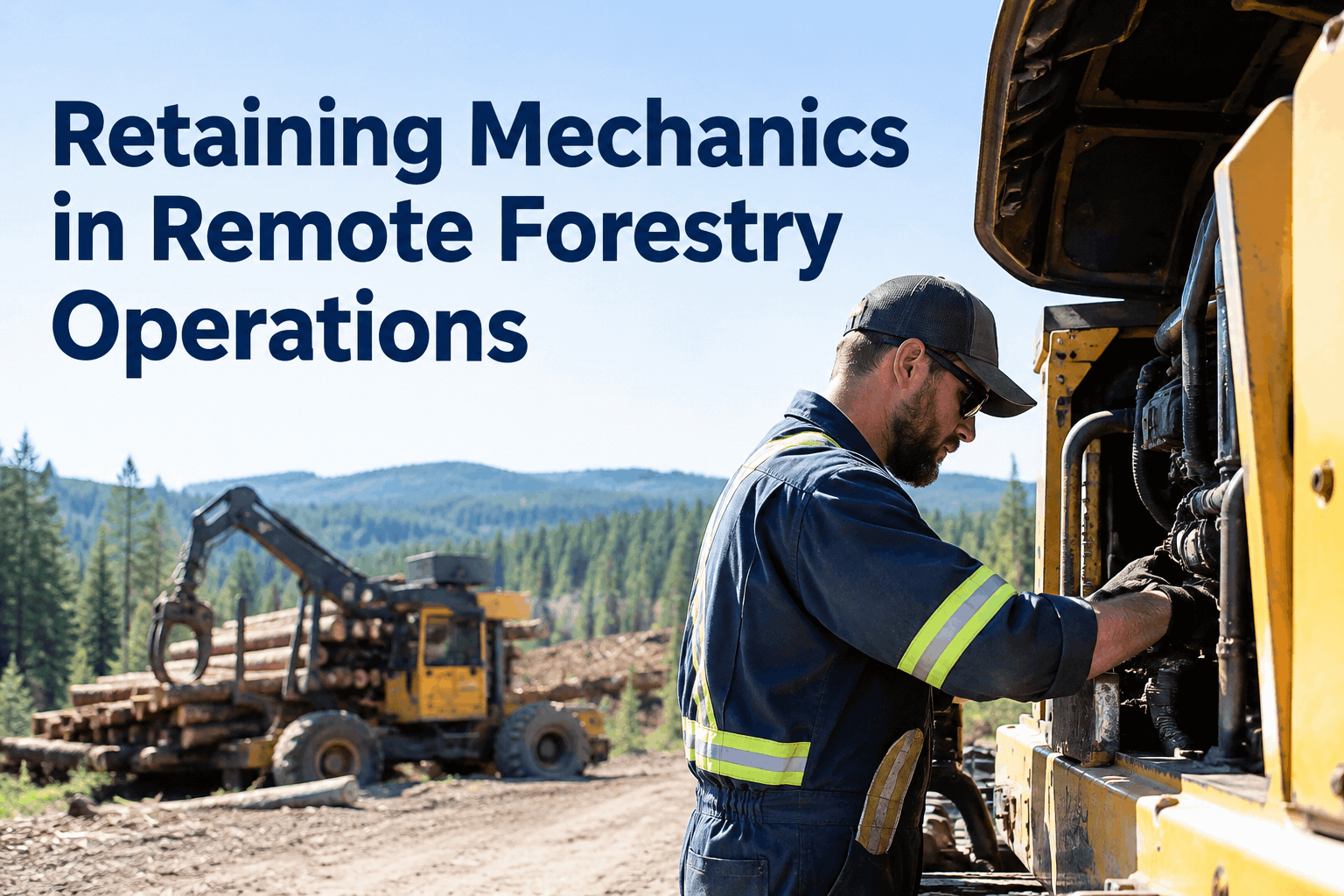
The hardest person to replace on a remote forestry operation isn't the operator — it's the mechanic who knows which skidder always loses that fitting and keeps the whole fleet running two hours from the nearest dealer. Lose them and you don't just lose a pair of hands; you lose the memory of the fleet. Retaining mechanics in remote forestry operations has quietly become one of the biggest levers a maintenance manager has, and most of what drives a good one to quit is fixable. Start free and take the admin load off your mechanics.
What actually drives good mechanics out of remote forestry operations — and the maintenance, parts and team-coordination changes that make them want to stay.
The shortage is real and it isn't getting easier. Across the diesel-technician workforce, a 2025 ATRI report found 65.5% of shops understaffed and 19.3% of positions sitting unfilled. Forestry layers its own difficulty on top — the work is remote, the hours are long, and a mechanic in the woods is often alone with the problem. But retention isn't mostly about pay. It's about whether the job is set up to let a good mechanic do good work, and that part is squarely in a maintenance manager's hands.
Why mechanics leave remote forestry operationsthe frustrations that push good people out — and what each one really is
Exit conversations in the woods rarely start with money. They start with a job that got harder than it needed to be. These are the four that come up most, and all four are a process problem, not a person problem.
Not one of these is about the mechanic being wrong for the job. They're all about the job being badly set up around a good mechanic. Book a demo to see how the setup changes.
What actually keeps remote forestry mechanicsturning each frustration into a reason to stay
Retaining mechanics in remote forestry operations comes down to flipping those four frustrations. You don't need a pay war — you need the day to feel manageable, respected and connected. Here's the before and after on each.
The right-hand column is what a well-run maintenance operation feels like from the mechanic's side. Explore how HVI's maintenance planning builds that day. Book a demo to see the mechanic's view.
A remote mechanic's day, two waysthe same shift with and without the system behind them
Retention lives in the texture of an ordinary day, not a policy document. Here's the same remote forestry shift run two ways — and it's easy to see which one a good mechanic re-signs for.
- Arrives to a surprise breakdown nobody saw coming
- Drives back to the yard — the right part isn't on the truck
- Fixes it, then re-keys the whole job onto a paper sheet at dusk
- No one at the office knows what today cost or caught
- Does it all again tomorrow, alone
- Opens the phone to a planned list — today's PM is already booked
- Parts for the job were staged on the truck the night before
- Logs the work with photos in two taps, on the spot
- The office sees it live — the save and the catch both count
- Tomorrow's already planned, and they're part of a team
The difference isn't the mechanic's skill — it's the system around them. See how field inspections and reporting replace the dusk paperwork, or book a demo to walk a mechanic's day in HVI. For the bigger maintenance picture, read our forestry CMMS guide for logging fleets.
Mechanic retention checklist for remote operationsthe practical moves a maintenance manager can make this quarter
You don't need a new budget to start. Work down this checklist — most of it is about how the work is organised around your mechanics, not what you pay them.
Most of this is organisation, not budget — and it's what good mechanics notice. Start free and set your workshop up this way.
What the mechanic shortage really costs a forestry fleetwhy keeping one beats finding one
The numbers behind the shortage make the case for retention on their own — every mechanic you keep is one you don't have to find, train and wait on in a market this tight.
Replacing a skilled remote mechanic means recruiting into a shortage, then carrying months of training before they know your fleet. Retaining mechanics in remote forestry operations is simply the cheaper, faster path — and it starts with the day you give them. Book a demo to see what a better-run day looks like.
A maintenance manager on keeping mechanicswhat actually moved the needle on retention
I used to think I was losing techs over money. Then my best one told me, on his way out, that it wasn't the pay — it was coming in every day to chaos and then doing an hour of paperwork alone in the dark. We changed how we planned and how they logged work before I lost another. The difference was night and day. A mechanic who can actually get ahead of the fleet, and whose work gets seen, is a mechanic who stays.
Retaining remote forestry mechanics FAQswhat maintenance managers ask most
Why is retaining mechanics in remote forestry operations so hard?
The work is isolated, the hours are long, and a mechanic in the woods often faces problems alone, far from parts and support. On top of a nationwide technician shortage, that mix burns people out — but most of the strain comes from how the work is organised, which a manager can change.
Is mechanic retention really about pay?
Less than most managers assume. Pay matters, but exit conversations more often point to constant firefighting, parts delays, paperwork and feeling unseen. Fixing those day-to-day frustrations usually moves retention more than a raise, and costs far less than replacing a skilled tech.
How does maintenance software help keep mechanics?
It removes the frustrations that drive them out — planned jobs instead of surprises, parts staged ahead, paperwork done on a phone in seconds, and work the office can see and recognise. It makes a remote mechanic's day manageable and their effort visible.
What can a maintenance manager change without a bigger budget?
Plenty. Move from breakdown-only to planned PM, stage parts before jobs, cut field paperwork, give the office live visibility of each mechanic's work, and set clear roles so no one carries the whole fleet. Most retention wins are about organisation, not spend.
Does tracking training help retention?
Yes. ATRI found shops that invest in training and development run notably lower vacancy rates. Keeping clear training and certification records gives newer techs a visible path forward, which is one of the stronger reasons people stay rather than move on.
Build the day that makes good mechanics stay
Planned maintenance, staged parts, two-tap logging and work the whole team can see. Set your remote operation up so your best mechanic has a reason to re-sign — and see it running on your own fleet first.
- Planned PM, fewer emergency call-outs
- Parts staged before the job
- Two-tap field logging, offline-capable
- Roles, workload and training in one place