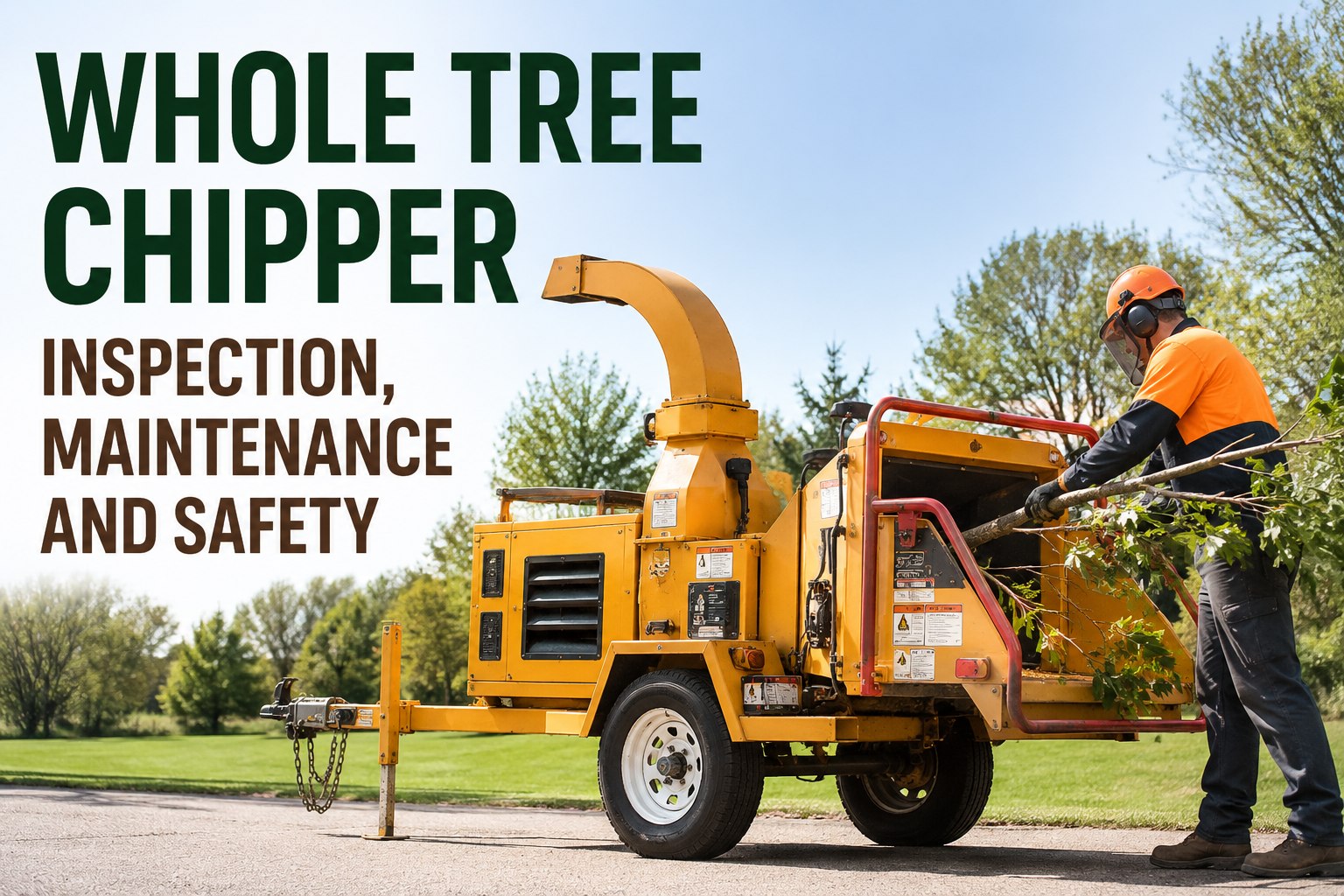
A whole tree chipper does not forgive. The drum in a big tow-behind or self-propelled unit carries enormous stored rotational energy, the infeed is designed to grab and pull, and the gap between a productive day and a life-changing injury is often a worn knife bolt, a sluggish reverse bar or a guard propped open with a stick. That is why a disciplined chipper inspection checklist matters more on this machine than almost anything else in your fleet: knife and anvil condition, infeed and emergency stop function, guarding and interlocks, drum balance, bearings and lockout discipline are not maintenance niceties, they are the difference between a crew that goes home and one that does not. This page walks through what to inspect, how often, what it costs when you skip it, and how to make the whole routine stick without paper binders. If you want to see the digital version running on your own units, you can book a 30-minute walkthrough and bring your toughest questions.
Is your chipper inspection routine actually testing the things that hurt people?
Most chipper checklists tick boxes on oil and tyres and skip the four systems that cause severe injuries and catastrophic downtime. Here is what a real inspection covers:
- Knife edge, fastening torque and anvil clearance measured, not eyeballed
- Emergency stop and feed reverse bars function-tested every shift
- Guards, access panels and interlocks verified closed and working
- Isolation and lockout steps recorded before any drum access
The real price of a loose chipper PM schedule
Four numbers worth pinning above the parts desk. Each one is money, downtime or risk that lands on your desk when chipper maintenance slips.
A gap that should be a credit-card thickness becomes a hammer mill. Chips turn to chunks, fuel burn climbs and knives dull in days instead of weeks.
Lost production, an idle crew and a grinder or truck waiting on chips. One failed drum bearing easily costs a week of that.
These devices fail silently. A bar that worked in March can be cable-stretched and useless by June, and you only find out the day you need it.
A single knife bolt at the wrong torque can liberate a knife at operating speed, wrecking the drum, housing and anvil in one event.
The six systems every whole tree chipper inspection must cover
A defensible chipper inspection checklist is built around the machine's energy and its infeed, not around a generic plant template. These are the six groups, in the order most shops work through them.
Knives & anvil
- Knife edge condition: chips, rolls, cracks, uneven wear
- Knife fastening: every bolt present, torqued to spec, marked
- Anvil clearance measured with gauge, not guesswork
- Chip quality checked as a live indicator of the cut gap
Why it matters: clearance affects chip quality, fuel consumption and knife life at the same time. Drift here costs you three ways before anyone notices.
Infeed & feed control
- Feed roller teeth, springs, bearings and hydraulic drive
- Feed stop / start / reverse control response
- Emergency stop bar and reverse bar: physically function-tested
- Infeed chute for cracks, wear plates and weld fatigue
Why it matters: the infeed is the part that draws material in and does not let go. Its safety devices must be proven every shift, never assumed.
Guarding & interlocks
- All guards and access panels present, closed and latched
- Interlock switches tested: drum must not run with a panel open
- No guards wired open, propped or bypassed for convenience
- Discharge chute deflector and rotation lock functional
Why it matters: chipper guarding compliance is where audits and incident investigations look first. A defeated interlock is indefensible.
Drum / disc balance
- Vibration checked at start-up and under load
- Knives changed in matched, weighed sets
- Drum inspected for cracks, loose pockets and build-up
- New vibration logged as a defect, not a shrug
Why it matters: chipper vibration is the earliest signal of imbalance, a cracked drum or a failing bearing. Caught early it is a knife job; ignored it is a drum job.
Bearings & driveline
- Bearing temperature by hand or gun after a work cycle
- Grease intervals by engine hours, not calendar guesswork
- Belts, clutch and PTO shaft guard condition
- Listen for rumble or squeal under load
Why it matters: chipper bearing maintenance is unforgiving because the loads are brutal. A $60 bearing becomes a $6,000 shaft and housing when it seizes at speed.
Shutdown & lockout
- Full stop, drum at rest, key out before any access
- Lockout / tagout applied and verified by the person entering
- Stored energy respected: a drum can freewheel for minutes
- Isolation steps recorded on the work order itself
Why it matters: most severe chipper injuries happen during clearing, unblocking and knife work, not during chipping. The discipline before access is the control.
A preventive maintenance rhythm that matches how chippers actually wear
Chippers wear by engine hours and material throughput, not by the calendar. A workable whole tree chipper maintenance schedule layers quick daily function tests under deeper hour-based services.
| Interval | What gets done | Who | What it prevents |
|---|---|---|---|
| Every shift | E-stop and reverse bar function test, guard and interlock check, walk-around for loose panels, leaks and damage | Operator | Infeed entanglement, defeated guarding, silent safety-device failure |
| Daily / 10 hrs | Knife edge inspection, anvil clearance check, grease bearings and pivots, chip quality review | Operator + lead | Poor chip spec, excess fuel burn, accelerated knife wear |
| Weekly / 50 hrs | Knife rotation or sharpening, bolt torque verification, feed roller and hydraulic inspection, belt tension | Technician | Thrown knives, drum damage, infeed stoppages |
| Monthly / 250 hrs | Drum crack and balance inspection, bearing temperature trend, discharge chute wear, full interlock test with meter | Technician | Catastrophic drum failure, bearing seizure, audit findings |
| Seasonal / 1,000 hrs | Full teardown inspection, anvil resurfacing or replacement, structural and weld survey, safety device recertification | Shop / dealer | Mid-season breakdowns, non-compliance, insurance exposure |
If you want this schedule running itself with due and overdue alerts by engine hours, you can start logging chipper PMs free and have the first unit live today.
What one missed bearing actually costs a chipping crew
Run the numbers on a single avoidable failure and the case for disciplined chipper bearing maintenance writes itself.
The skipped signal
A main drum bearing starts running warm. Nobody logs it because there is no easy place to log it. Grease interval was due 40 engine hours ago but the whiteboard says "next week".
The failure
The bearing seizes under load at operating speed. Shaft scored, housing damaged, knife hardware shock-loaded. The chipper is down hard and the grinder, trucks and crew wait on it.
The bill
Parts and machining around $4,500, freight on a shaft, five lost production days at $800+ per day, plus a crew standing idle. Total damage: roughly $9,000–$11,000 from one $60 bearing.
The $60 version
The daily check catches the heat, the PM alert fires at the hour interval, a work order carries the lockout steps, and the bearing is swapped in a planned two-hour window. That is the entire difference.
You can walk through this exact failure-to-work-order flow on a demo using one of your own units as the example.
See your chipper checklist running on a phone, not a clipboard
Bring one unit and one crew. In 30 minutes we will show you the inspection, the defect-to-work-order flow and the audit trail it creates.
Four ways HVI turns chipper safety from paperwork into proof
HVI is cloud + mobile inspection and maintenance work order software built for fleet-heavy operations, including the off-road plant that generic fleet tools ignore.
Configurable safety templates
Build your chipper inspection checklist with mandatory function tests for e-stops, reverse bars and interlocks. The inspection cannot be submitted with those steps skipped, so "assumed working" disappears from your fleet.
Photo capture on every defect
A cracked guard, a weeping bearing seal or a worn knife edge gets photographed on the spot and attached to a timestamped record. No more text-message photos that vanish into a group chat.
Work orders with isolation steps
Defects convert to work orders in one tap, and the work order carries the lockout and stored-energy steps before any drum access. The technician sees the isolation sequence on their phone, not on a wall chart back at the shop.
PM scheduling by engine hours
Knife rotation, bearing grease and drum inspections trigger on engine hours with due and overdue alerts, matched to how chippers actually wear. Every completed PM builds the audit-ready history insurers and clients ask for.
If you are comparing options, book a demo and see these four on a live unit before you commit to anything.
Chipper maintenance is chipper safety - treat them as one system
Test, don't assume
Emergency stops, reverse bars and interlocks fail silently. A whole tree chipper inspection that does not physically function-test them is decoration.
The cut gap is a triple cost
Anvil clearance drives chip quality, fuel burn and knife life together. Measure it on a schedule and log the number, not a tick.
Vibration is an early warning
New vibration means imbalance, a cracked drum or a dying bearing. Logged early it is a small job; ignored it is a five-figure one.
Isolation is the control
The worst injuries happen during clearing and knife work. Lockout steps belong on the work order itself, verified by the person doing the work.
The pattern underneath all four is the same: the checks only protect you if they are done, recorded and provable. That is exactly what a CMMS like HVI is for, and you can sign up free and digitise your first chipper checklist in an afternoon.
"My rule is simple: nobody opens a guard on my watch unless the lockout is logged first. Before we digitised, I was chasing paper tags and hoping the e-stop got tested. Now I can see the function test from every shift, with a photo, and the knife hours on each drum without ringing anyone. The number I watch is overdue safety checks - and these days it's zero."
Questions fleet and safety managers ask about chipper maintenance
How often should chipper knives be sharpened or replaced?
What is the correct anvil clearance on a whole tree chipper?
How do I test a chipper's emergency stop and feed reverse bar?
What causes excessive chipper vibration?
What records should I keep for chipper safety compliance?
Make your chipper the safest machine in the yard, not the riskiest
Digital inspections with mandatory safety tests, photo-backed defects, work orders with isolation steps and PM alerts by engine hours - on any phone, in any yard or woodlot.
Free to start · Works on any phone · No card needed