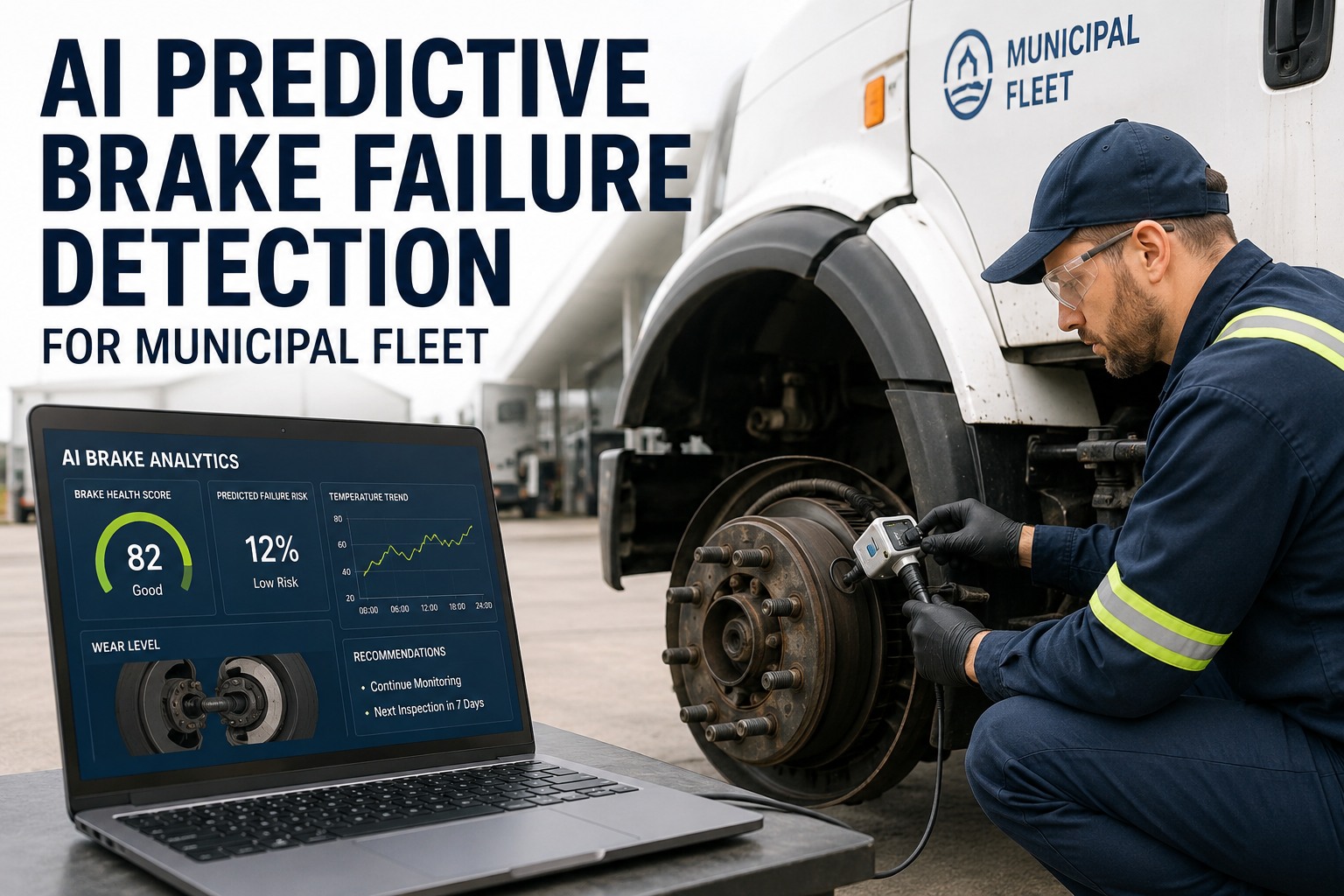
Every fleet manager has had that call: a truck down on the shoulder, brakes smoking, driver shaken, and a tow bill that eats the week's maintenance budget in one afternoon. AI brake failure detection changes that story — by reading pedal-force patterns, retard rates, and telematics data, modern models flag a failing brake system 14 to 28 days before it becomes a catastrophic event, with 85–95% accuracy. For municipal fleets running refuse trucks, buses, and utility vehicles through stop-and-go routes all day, that warning window is the difference between a planned pad swap on a Tuesday and a roadside shutdown with a full load. This page breaks down how AI brake wear detection actually works, what it costs you to ignore it, and how HVI's predictive brake module — built on Geotab telematics data — turns raw signals into scheduled work orders. If you want to see it running on your own units, book a 30-minute walkthrough with the HVI team and bring your toughest brake questions.
What if your trucks told you their brakes were failing — three weeks before they did?
HVI's predictive brake module reads pedal-force and deceleration data from your Geotab feed, scores every unit daily, and opens a work order the moment a brake system starts trending toward failure. No roadside surprises. No OOS citations. No guessing.
Why Brakes Are the #1 Out-of-Service Violation — and What That Costs You
FMCSA data consistently puts brake system violations at the top of every roadside inspection list. For a municipal fleet, one OOS order doesn't just cost a fine — it costs a missed route, a rescheduled crew, and a public complaint when the garbage doesn't get picked up.
Brake violations lead every CVSA International Roadcheck year after year — more than tires, lights, or cargo securement combined.
AI models trained on pedal-force and telematics data correctly flag failing brake systems before they reach the danger zone.
Tow, emergency labor, missed route penalties, and overtime for a single unplanned brake failure on a municipal route truck.
A scheduled pad-and-rotor swap takes a morning. An emergency roadside brake job takes the truck, the driver, and half your day.
From Pedal Pressure to Prediction: How AI Brake Wear Detection Reads Your Fleet
You don't need a data science degree to use this. The model watches three signal streams from every unit, every day, and learns what "normal" looks like for each truck — then flags the moment a unit starts drifting away from its own baseline.
Pedal-Force Delta
The model tracks how hard the driver has to push the pedal to achieve the same stop. Rising pedal force over days means pads are thinning, air is leaking, or a caliper is dragging — long before the driver feels it.
Retard Rate Decay
Geotab telematics captures deceleration rates on every braking event. When a truck that used to stop in 4.2 seconds now takes 4.8, the model sees the trend — even if the driver doesn't.
Telematics Context
Route type, load weight, ambient temperature, and stop frequency all feed the model. A refuse truck doing 900 stops a day wears brakes differently than a highway tractor — the AI knows the difference.
The Math: What One Predicted Brake Job Saves vs. One Roadside Failure
Here's a worked example from a typical 60-unit municipal fleet running refuse and utility trucks. One predicted brake job vs. one roadside failure — same truck, same pads, wildly different cost.
Roadside Failure (No AI)
- Driver calls in from Route 7, brakes gone at mile 14
- Heavy tow to shop: $450–$650
- Emergency labor rate + overtime: $380
- Missed route, rescheduled crew, complaint calls: $400+
- OOS citation risk + CSA score hit: unquantifiable
- Total: $1,200–$1,500+ and a truck down for 1–2 days
Predicted Repair (With HVI AI)
- HVI flags Unit 214 trending toward failure — 18 days out
- Work order auto-created, pads ordered from inventory
- Scheduled bay time, Tuesday morning: $220 labor
- Pads + hardware from stock: $140
- Truck back on route by lunch: zero downtime
- Total: $360 and zero service interruption
That's a 3–4x cost difference per event. Across a 60-truck municipal fleet averaging 8–12 brake events per year, AI prediction saves $7,000–$14,000 annually — before you count the avoided OOS citations, the CSA score protection, or the driver who didn't have to sit on a highway shoulder waiting for a tow. If you want to see how this math works on your own fleet's numbers, the HVI team can model it in a demo.
Why Municipal and Government Fleets Need AI Brake PM More Than Anyone
Municipal fleets face a unique brake-wear profile: stop-and-go routes, heavy loads, public accountability, and budget cycles that don't forgive surprise expenses. Here's what makes AI brake prediction a necessity, not a luxury, for government operations.
900+ Stops Per Day
A refuse truck on a residential route brakes more in one shift than a highway tractor brakes in a week. Traditional mileage-based PM intervals don't capture this — a truck can burn through pads in 8,000 miles on a dense route while the schedule says 25,000.
Public Accountability
When a city bus or garbage truck loses brakes on a residential street, it's not just a maintenance issue — it's a news story. AI prediction gives you the paper trail to show council, auditors, and the public that you caught it before it happened.
Budget Cycle Protection
Emergency repairs blow holes in annual maintenance budgets. Predictive brake PM converts surprise expenses into planned line items — you know in January what you'll spend on brakes through June, and you can defend that number.
Mixed Fleet Complexity
Municipal fleets run everything from Class 8 refuse trucks to transit buses to light-duty pickups. HVI's AI model learns each vehicle type's brake signature separately — no one-size-fits-all thresholds that miss the bus and over-flag the pickup.
See HVI's Predictive Brake Module Running on Your Own Fleet Data
Book a 30-minute demo and we'll connect to your Geotab feed, score your units, and show you which trucks are trending toward brake failure right now.
HVI's Predictive Brake Module: From AI Alert to Closed Work Order
HVI doesn't just flag a problem and leave you to figure out the rest. The predictive brake module is wired into the full CMMS — so an AI alert becomes a work order, a parts reservation, a scheduled bay, and a closed record, all in one platform.
Geotab Integration
HVI pulls pedal-force, deceleration, and route data directly from your Geotab devices. No new hardware, no extra sensors — the AI model runs on data you're already collecting. See the integration live in a demo.
Auto Work Order Creation
When the AI flags a unit, HVI opens a work order with the predicted failure window, the recommended parts, and the priority level. Your shop foreman sees it on the board — no email chains, no sticky notes.
Parts Reservation
The work order checks your parts inventory and reserves the pads, rotors, or hardware before the truck hits the bay. If stock is low, HVI flags the reorder — so the AI prediction doesn't die waiting for a part.
Compliance-Ready Records
Every AI alert, work order, and repair is timestamped and photo-backed. When a DOT auditor or city council asks how you manage brake safety, you pull the record in seconds — not dig through a filing cabinet. Start building your audit trail free.
How to Roll Out AI Brake Prediction in Your Fleet — Week by Week
You don't need to rip out your current process. HVI layers on top of what you already have, and most municipal fleets see their first AI brake alert within the first two weeks.
Connect Geotab + Import Fleet
Link your Geotab account to HVI, import your vehicle list, and assign units to shops. The AI model starts ingesting historical pedal and decel data immediately — most fleets have 90+ days of backfill ready to train on.
Baseline Learning Period
The model learns each unit's normal brake signature — pedal force, decel rate, route pattern. You'll see baseline scores appear on the dashboard. Units already trending toward failure get flagged first.
First Predictive Alerts + Work Orders
AI alerts start flowing into work orders. Your shop foreman reviews the flagged units, confirms the prediction with a physical inspection, and schedules the repair. Most fleets catch their first "save" in week 3 or 4.
Full Predictive PM Mode
Brake PM shifts from calendar-based to condition-based. HVI schedules brake jobs when the AI says they're needed — not when the odometer hits an arbitrary number. You start seeing the cost savings in the monthly report. Walk through the rollout plan for your fleet with an HVI specialist.
AI Brake Failure Detection: What to Remember
Brakes are the #1 OOS violation — and the most preventable. AI prediction gives you 14–28 days of warning, which is enough time to plan every repair.
The math is simple: a predicted brake job costs $360. A roadside failure costs $1,200–$1,500+. Across a fleet, that's thousands per year in avoidable spend.
You already have the data. If you run Geotab, the pedal-force and telematics signals are flowing. HVI's AI model just reads them and tells you what they mean.
Municipal fleets benefit most — stop-and-go routes, public accountability, and budget cycles make predictive brake PM a necessity, not a nice-to-have.
The fleets that adopt AI brake failure detection now will spend the next five years paying less for brake maintenance, passing more roadside inspections, and never explaining to a city council why a garbage truck lost its brakes on a school route. The technology is proven, the data is already flowing, and the ROI shows up in the first quarter. Sign up free and connect your first units today — or book a demo and see it on your own data first.
"I used to find out about brake problems when the driver called me from the side of the road. Now I find out three weeks early, in an email from HVI, with the parts already reserved. Last quarter we had zero roadside brake events across 47 units. Zero. I track that number every month and I don't plan on letting it move."
AI Brake Failure Detection: Frequently Asked Questions
How accurate is AI brake failure prediction?
Do I need to install new sensors or hardware?
How does this work with my existing PM schedule?
What types of vehicles does the AI brake model support?
How quickly will I see results after connecting HVI?
Stop Finding Out About Brake Failures From the Shoulder
HVI's AI brake module reads your Geotab data, predicts failures 14–28 days out, and turns every alert into a scheduled work order. See it on your own fleet — or start free and connect your first units today.
Free to start — Works with your existing Geotab devices — No new hardware needed