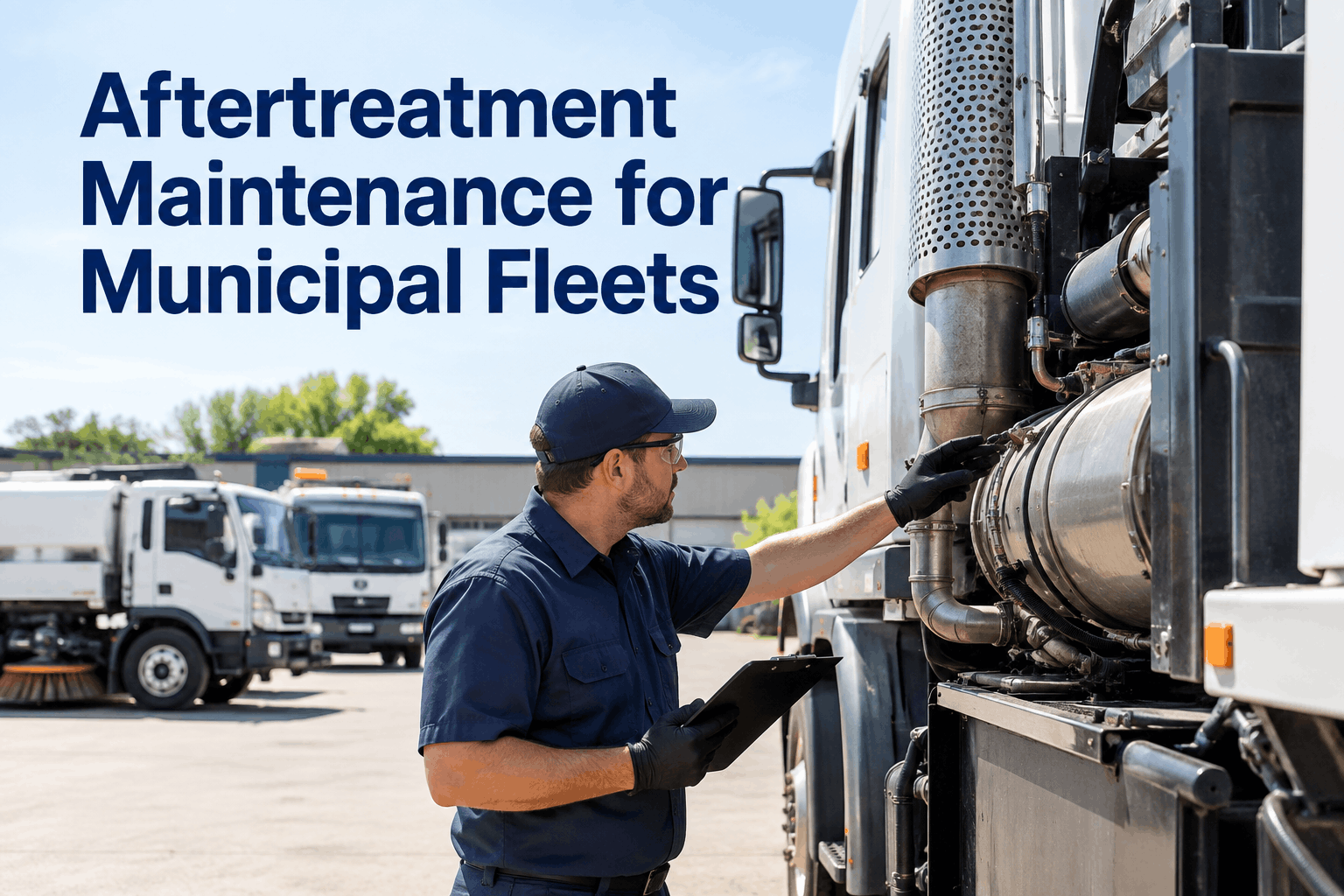
If your refuse trucks, sweepers, plows, or transit buses keep throwing DPF lights, sitting through forced regens, or landing in the shop for a four-figure aftertreatment service, the filter usually isn't the problem — your duty cycle is. Municipal diesels run slow, stop-start, high-idle routes, and that's exactly the pattern that stops a diesel particulate filter from cleaning itself. Aftertreatment maintenance here isn't a flat service interval; it's reading each vehicle's regen and fault history and acting per asset, before the cheap warning becomes the expensive repair. See regen and fault history trended per vehicle
Aftertreatment Costs Climb in Stages — and Municipal Duty Cycles Push You Up the Ladder
Catch the problem at the bottom and it's free. Let it climb, and it ends in a four-figure filter service.
The pattern behind almost every municipal aftertreatment headache is the same: the equipment is fine, but the way it's driven never lets the system clean itself. Below is why your duty cycle is the root cause, the soot-versus-ash trap that wastes thousands, how the whole aftertreatment system is connected, and how to manage it one vehicle at a time.
Why municipal duty cycles break aftertreatment
A DPF was engineered assuming a highway-style duty cycle — sustained speed and load that keep exhaust hot enough to burn soot continuously in the background. Municipal fleets run the opposite. Refuse trucks crawl a collection route, sweepers idle for hours, plows push at low speed, transit buses stop every block. The exhaust never stays hot long enough, so soot accumulates faster than passive regen can clear it — and the system spends its life fighting to catch up.
Refuse & sweepers
Constant low-speed crawling and long idle between stops — the classic pattern that never reaches passive-regen temperature.
Transit & plows
Stop-every-block routes and low-speed pushing keep exhaust temperatures down and force the system into active and parked regens.
High-idle service units
Utility trucks and units that idle 40%+ of engine hours are the fleet's DPF problem children — plan for service earlier than nameplate.
This is why a filter that's perfectly healthy on paper can fail early in municipal service: it's not a defect, it's a duty-cycle mismatch. Understanding that changes the whole approach — the fix isn't a better filter, it's better visibility into which units are fighting their duty cycle. For the full mechanics, see our DPF regeneration guide. Book a demo to see regen frequency against idle and low-speed hours.
The soot-versus-ash trap that wastes thousands
Here's the single most expensive misunderstanding in aftertreatment maintenance, and it hits municipal fleets hardest because they regen so often. Regeneration burns soot — but it leaves behind ash, the non-combustible residue from engine oil and fuel additives. No amount of regen removes ash. It accumulates over the filter's life and physically fills the cells until the filter is professionally cleaned.
Soot loading
Combustible carbon that a successful regen burns away. If pressure drops after a regen, it was soot — the system is working as designed.
Ash loading
Non-combustible residue that stays after soot burns. High pressure right after a good regen means ash — and forcing more regens only burns fuel and time.
The trap: a fleet treats every DPF warning as soot, forces regen after regen, and keeps a truck limping when what it needed was a shop visit thousands of miles ago. Knowing the difference — and tracking it per vehicle — is the line between a $150 fix and a chased-down $8,000 replacement. Start free and track regen outcomes per vehicle.
It's a system, not just a filter
Aftertreatment isn't only the DPF. It's a connected system, and a problem in one part blocks the others — which is why "just force another regen" so often fails. The most common surprise on a municipal fleet: the engine computer will refuse to run a regen at all if an active fault exists somewhere else in the system.
DPF
Traps soot; regenerates by heat. Ash-loads over time and eventually needs professional cleaning.
DEF / SCR
Cuts NOx with diesel exhaust fluid. Bad or empty DEF throws faults that block regen entirely — DPF and DEF problems feed each other.
DOC & sensors
The oxidation catalyst and EGT sensors generate and confirm regen heat. A weak DOC or bad sensor means regens start and never finish.
So the real first step when a regen won't complete isn't the DPF at all — it's the fault-code list. Clearing an SCR or sensor fault often restores normal regeneration without touching the filter, which is exactly why aftertreatment has to be managed as a connected system with full fault history, not a single part swapped in isolation. Book a demo to see fault codes logged against each regen event.
Managing aftertreatment at the asset level
The way out of the regen treadmill isn't a fleet-wide rule — it's per-vehicle management, because two trucks of the same model on different routes will have completely different aftertreatment needs. That takes three connected capabilities working together.
Service on the right trigger
Trigger DPF cleaning and aftertreatment checks on regen frequency, fault codes, engine hours, or condition — not one blanket mileage interval that's wrong for half the fleet.
HVI: Any-Trigger PMA template per duty cycle
Refuse, sweeper, transit, and highway units each get a service regime matched to their real aftertreatment demand — and mixed hybrid and EV units get their own.
HVI: Templates per PropulsionQualified techs on the work
Regen diagnostics and aftertreatment service need the right skills — qualification tracking makes sure the tech assigned to a DEF or SCR fault is actually certified for it.
HVI: Qualification TrackingTogether these turn aftertreatment from a reactive scramble — chasing lights and forcing regens — into a managed program where the vehicles most at risk are the ones that get seen first, serviced correctly, and kept off the $8,000 outcome. Start free and set aftertreatment triggers per vehicle class.
From a municipal maintenance manager
We were forcing regens on our refuse trucks constantly and still losing them to limp mode — the dealer kept regenning and it would hold a day, then relapse. It was never the filter; it was the route. Once we tracked regen frequency and fault codes per truck, the ash-loaded ones showed up plainly, we scheduled cleanings instead of chasing lights, and the four-figure surprise services basically stopped.
Frequently asked questions
Why do municipal diesel trucks have so many DPF regeneration problems?
Because their duty cycle fights the system. A diesel particulate filter cleans itself by passive regeneration, which needs sustained exhaust heat of around 1,100°F — something highway driving produces naturally. Municipal vehicles run slow, stop-start, short-trip, high-idle routes: refuse collection, street sweeping, plowing, transit. The exhaust never stays hot long enough, so soot accumulates faster than passive regen can clear it, forcing frequent active and parked regens. The filter isn't defective; it's a duty-cycle mismatch, which is why the fix is better per-vehicle visibility rather than a different filter.
What's the difference between soot loading and ash loading?
Soot is combustible carbon that regeneration burns away — what the regen system is designed to remove. Ash is the non-combustible residue left after soot burns, mostly from engine oil and fuel additives, and no amount of regeneration removes it. Ash accumulates over the filter's life until it's professionally cleaned, typically every 200,000 to 500,000 miles depending on duty cycle and oil quality. The practical tell: high differential pressure right after a successful regen means ash-loaded, not soot-loaded — and forcing more regens only wastes fuel and time.
Why won't a forced regeneration complete on some vehicles?
Most often because an active fault code elsewhere in the aftertreatment system is blocking it. The engine computer refuses to run a regen if it detects a condition that could damage the system — commonly an SCR or DEF fault, a failed EGT sensor, a weak oxidation catalyst, or a clogged dosing valve. It's the vehicle protecting itself. So the first step when a regen won't finish is scanning and clearing the fault codes, not pressing the button again. Aftertreatment is a connected system, and DPF and DEF problems frequently feed each other.
Should aftertreatment service run on a fixed mileage interval?
No — a flat interval is wrong for a mixed municipal fleet. Two trucks of the same model on different routes have completely different aftertreatment demands: a refuse truck crawling a route ash-loads and regens far more than a highway utility unit. The better approach triggers cleaning and inspection on signals that actually predict need — regen frequency, fault codes, engine hours, or condition — with a template matched to each vehicle's duty cycle. That way the units most at risk are seen first, and low-demand units aren't serviced on a blind calendar.
How does data help manage municipal aftertreatment maintenance?
By making the at-risk vehicles obvious before they fail. When each vehicle's regen events, fault history, and duty cycle are logged against the asset, the trucks fighting their route show up as high regen frequency, the ash-loaded ones stand out as high pressure after a good regen, and cleanings get scheduled instead of chased. It also connects the aftertreatment picture to the service schedule and to qualified technicians, so the right work happens on the right vehicle at the right time. That's the shift from reactive regen-chasing to a managed, asset-level program.
Manage aftertreatment one vehicle at a time — before the light becomes a repair
HVI connects duty cycle, regen events, and fault history to each vehicle's service schedule, triggers aftertreatment work on the right signal, matches a template to every duty cycle, and puts qualified techs on the diagnostics. So your municipal fleet stops chasing DPF lights and starts catching the problem at the cheap end of the ladder.
No credit card · Regen & fault history per vehicle · Duty-cycle service triggers