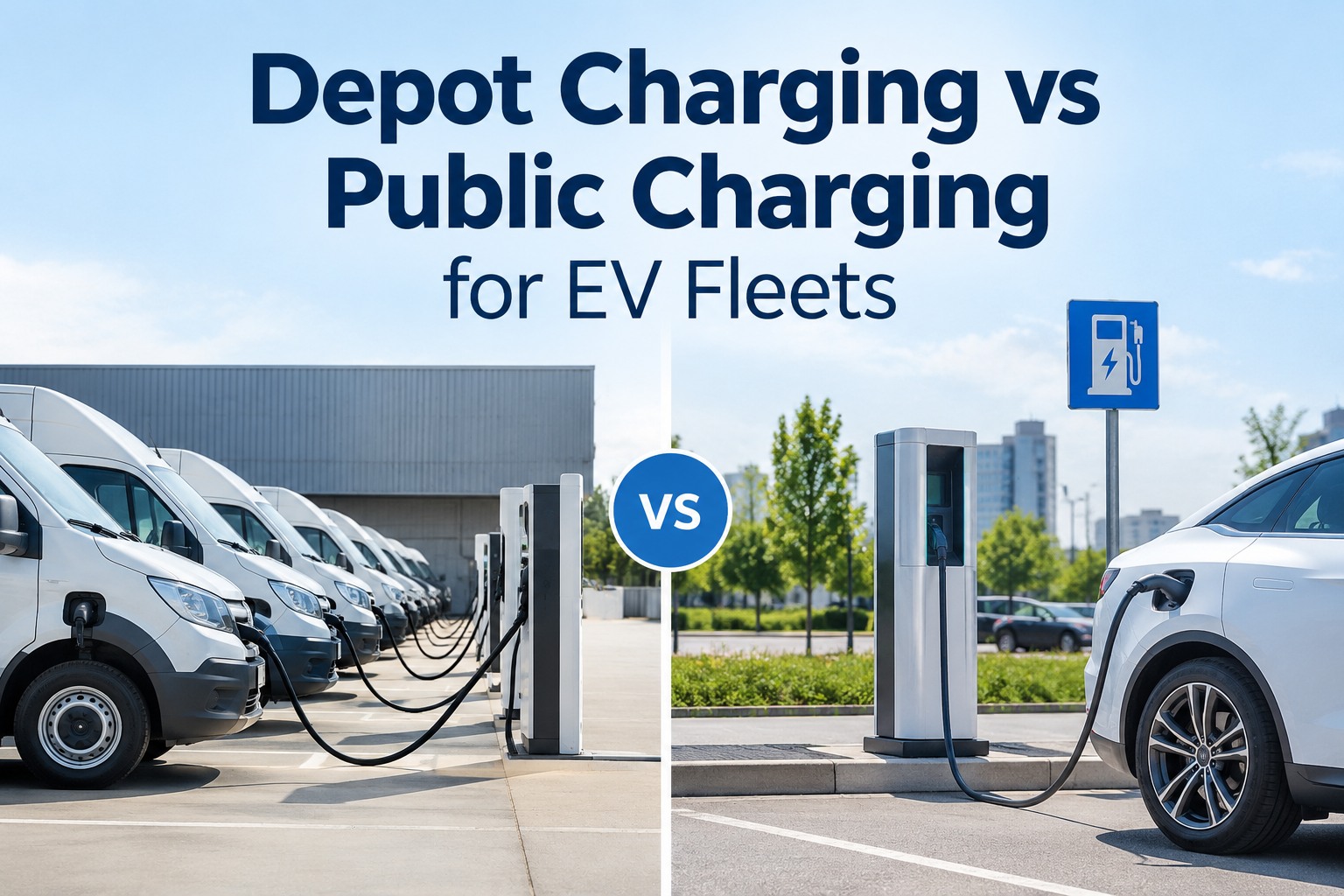
Your vans come home to the same yard every night, so depot charging looks like the obvious answer — until a route runs long and a driver hunts down a public fast charger at three times the price. Depot charging vs public charging isn't either/or for most fleets; it's a mix, and the money is won or lost in how you run and track it. Book a demo to see charging cost per vehicle.
Depot vs Public Charging: The Numbers That Actually Decide It
Both keep an EV fleet moving. But on the four things that hit your operation every single day, they behave very differently — and the gap compounds with every kilowatt-hour.
- Charge overnight, on your rates
- Full control & reliability
- Upfront infrastructure cost
- Zero infrastructure to build
- Fast top-ups on the road
- 2–3× the cost, less reliable
The headline is simple: depot charging is cheaper per mile, public charging is cheaper to start. But that one-liner hides the decision that actually matters for a working fleet — how the two compare on running cost, on the demand charges nobody warns you about, on whether the charger works when your driver pulls up, and on whether you can even see what each session costs. This guide breaks the comparison down across those four operational realities, then shows the mixed strategy most fleets land on.
Depot charging means charging fleet EVs at a facility you own or lease — typically overnight on Level 2 chargers, on your own utility rate. Public charging means using third-party networks, usually DC fast chargers, paying a per-kWh or per-session price set by the operator. Most fleets use depot charging as the backbone and public charging as a supplement for long or unpredictable routes.
Side by sidedepot charging vs public charging at a glance
Here's the full comparison a fleet manager weighing EV fleet charging options actually needs — not just price, but the operational factors that decide whether a strategy survives contact with a real duty cycle.
| Factor | Depot Charging | Public Charging |
|---|---|---|
| Cost per kWh | $0.10–$0.20 all-in | $0.35–$0.60 (DCFC) |
| Upfront cost | High (hardware + electrical) | None |
| Reliability | You control uptime | ~71% first-try success |
| Demand charges | Yes — manageable | Built into price |
| Scheduling | Overnight, predictable | Depends on availability |
| Best for | Return-to-base fleets | Long / irregular routes |
Swipe to compare →
No row here is a tie-breaker on its own. A return-to-base municipal fleet weights cost per kWh and control heavily; a fleet running unpredictable long-haul routes weights availability. The right answer is almost always a deliberate blend — which is exactly why tracking where each kWh was bought matters. Book a demo to see depot and public spend split per vehicle
2–3×the running-cost gap, and why it compounds
Public DC fast charging typically costs two to three times more per kilowatt-hour than well-managed depot charging — roughly $0.35–$0.60 per kWh on public networks versus $0.10–$0.20 all-in at the depot. For a vehicle covering serious annual mileage, that gap runs into thousands of dollars per unit, every year, and it compounds for every year the fleet stays on the road.
Walk it through with real numbers. A van burning roughly 12,000 kWh a year costs about $1,800 to charge at a $0.15 depot rate. The same energy on public fast charging at $0.50 costs $6,000 — a $4,200 difference on a single vehicle. Multiply across a 20-vehicle fleet and the annual delta is the kind of line item that funds the depot build several times over. That's why depot charging is where the economics of fleet electrification are won or lost. Public charging isn't the villain — it's a convenience premium you pay knowingly for flexibility, not by accident because nobody tracked where the energy came from. Start free and see cost-per-mile by charging source
The real answerhow most fleets actually run it
Almost no fleet is purely one or the other. The strategy that wins treats depot charging as the backbone and public charging as a deliberate, tracked exception. Here's the split that most return-to-base operations settle into.
The goal is to keep the cheap, controlled depot energy carrying the bulk of the load and use expensive public charging only where it earns its premium — keeping a vehicle in service instead of parked. Getting that ratio right, and holding it there, depends entirely on measuring it: if you can't see how much of your energy is quietly leaking onto public networks, you can't defend the ratio. Start free and monitor your depot-to-public charging ratio
From a municipal fleet manager mid-transition
We electrified 18 vans thinking the depot chargers were the whole story. First quarter, our energy cost was way over budget and I couldn't work out why — the depot rate was exactly what we'd modelled.
Turned out three routes were running long enough that drivers were topping up on public fast chargers most afternoons. Nobody was hiding it, it just wasn't on anyone's screen. Once we could see public sessions by vehicle, two things happened: we re-planned those three routes to finish at the depot, and we set a rule that public charging needs a reason. Energy cost came back in line in six weeks. The chargers were never the problem — not being able to see the split was.
People also ask
Is depot charging always cheaper than public charging?
Per kilowatt-hour, yes — depot charging is typically 2–3× cheaper. But that ignores upfront cost. Public charging has zero infrastructure to build, so for a very small fleet or a short-term pilot, paying the public premium can beat a capital project. The depot advantage grows with fleet size and mileage.
Can a fleet run on public charging alone?
It can, but it's rarely ideal. Public-only means paying premium rates on every kWh and depending on chargers you don't control, where roughly one attempt in three fails on the first try. It suits fleets without a fixed depot or those in a pilot phase, not high-utilization return-to-base operations.
What is a demand charge and does public charging have one?
A demand charge is a utility fee based on your peak power draw, not total energy used. Depot operators pay it directly and can manage it with load management. On public charging, the demand charge is already baked into the per-kWh price you're quoted — one reason that price is higher.
How do I track fleet charging costs across both?
Log every session — depot and public — against the vehicle, capture the cost, and roll it into cost-per-mile and cost-per-vehicle analytics. A fleet platform like HVI does this automatically, so the depot-to-public ratio and the true cost of each source are visible instead of buried in separate statements.
The takeaway
In depot charging vs public charging, depot wins on running cost and control (2–3× cheaper per kWh); public wins on zero upfront cost and on-route flexibility.
Watch the hidden costs: depot demand charges (controllable with load management) and public failed charges (~71% first-try success — not controllable).
The winning strategy is a tracked mix — depot as backbone, public as a deliberate exception — and it only pays off if you can measure the split.
For most return-to-base EV fleets the answer to depot charging vs public charging isn't a side to pick — it's a ratio to manage. Let cheap, controlled depot energy carry the load, use public charging only where it keeps a vehicle earning, and keep both on one screen so the premium is always a choice. That visibility is where a connected fleet platform turns an electrification budget from a guess into a managed number. Book a demo to bring depot and public charging cost into one view
Frequently asked questions
What is the difference between depot charging and public charging for EV fleets?
Depot charging means charging fleet EVs at a facility the operator owns or leases, usually overnight on Level 2 chargers and on the fleet's own commercial utility rate. Public charging means using third-party charging networks, typically DC fast chargers, and paying a per-kWh or per-session price set by the network operator. The core trade-off is cost versus convenience and capital: depot charging is far cheaper per kilowatt-hour (roughly $0.10–$0.20 all-in versus $0.35–$0.60 for public DC fast charging) and gives the fleet full control over reliability and scheduling, but requires upfront investment in chargers and electrical work. Public charging needs no infrastructure and offers fast top-ups anywhere on a route, but costs two to three times more per kWh and depends on chargers the fleet doesn't control. Most fleets don't choose one exclusively — they use depot charging as the backbone for the bulk of daily energy and public charging as a supplement for long or unpredictable routes.
How much cheaper is depot charging than public charging?
Depot charging is commonly two to three times cheaper per kilowatt-hour than public DC fast charging, and by some well-managed measures up to three and a half times cheaper. In concrete terms, a well-run depot delivers energy at roughly $0.10–$0.20 per kWh all-in, while public fast charging typically runs $0.35–$0.60 per kWh. The dollar impact scales fast: a vehicle using about 12,000 kWh a year costs around $1,800 to charge at a $0.15 depot rate but roughly $6,000 on public fast charging at $0.50 — a difference of about $4,200 per vehicle per year. Across a 20-vehicle fleet that gap can exceed $80,000 annually, which is often enough to justify the depot infrastructure investment several times over. The savings compound every year the fleet operates, which is why keeping the majority of charging at the depot is the central lever in EV fleet total cost of ownership.
Why is public EV charging less reliable for fleets?
Because a charger reporting itself as available doesn't mean a charge will actually start. Analysis of more than 100,000 charging sessions across thousands of public stations found that while networks report uptime of 98.7–99.9%, only about 71% of charging attempts succeed on the first try — meaning roughly one attempt in three fails even though the dashboard shows the unit as operational. Reliability also degrades as stations age: first-time success rates that average around 85% at new sites can drop below 70% by year three. For a consumer this is an annoyance, but for a fleet it's an operational risk — a failed public charge can strand a vehicle mid-route, cause a missed job, and cost driver time on a support call, none of which appears in the charger's advertised price. Depot charging removes this variable because the fleet controls and maintains its own chargers, which is a major reason high-utilization operations keep the bulk of charging in-house.
What are demand charges and how do they affect depot charging?
A demand charge is a utility fee based on the highest rate of power draw — typically the peak 15-minute window — during a billing period, separate from the charge for total energy consumed. For a fleet depot, the risk is that every vehicle plugs in at once when the shift returns, creating a simultaneous power spike that sets a high demand charge for the whole month, sometimes dominating the electricity bill. The solution is smart load management: staggering and throttling charging across the overnight window so total site draw never spikes, while still fully charging every vehicle by morning. This is the single most effective lever for controlling depot electricity cost, and it's only possible on infrastructure the fleet owns and controls. On public charging, demand charges still exist but are already built into the per-kWh price the network quotes, which is part of why public pricing is higher — the fleet simply pays it indirectly rather than managing it.
How can a fleet track and compare depot vs public charging costs?
The key is to log every charging session — whether it happened at the depot or on a public network — against the specific vehicle, capture the cost of that session, and roll everything into cost-per-mile and cost-per-vehicle analytics. Without this, depot and public spend often sit in separate systems or fuel-card statements, and the true depot-to-public ratio stays invisible, which is exactly how energy budgets quietly overrun when drivers top up on public chargers more than planned. A connected fleet platform such as HVI tracks charging sessions and charging cost alongside the rest of the vehicle's maintenance and operating record, so a fleet manager can see how much energy is coming from cheap depot power versus expensive public charging, spot vehicles or routes leaking onto public networks, and re-plan routes or set charging rules to hold the ratio. Measuring the split is what turns the depot-vs-public decision from a one-time capital debate into an ongoing, controllable operating cost.
See exactly what your EV fleet is spending — depot and public
HVI logs every charging session against the vehicle, captures the cost, and turns it into cost-per-mile, cost-per-vehicle, and depot-vs-public ratio analytics — so the public-charging premium is a number you manage, not a surprise you discover at quarter close. Track charging alongside inspections, maintenance and the full asset record, in one place.
No credit card · Works with your existing fleet · Charging cost visible from day one