Municipal boat fleet maintenance fails quietly — below the waterline, until a patrol boat won't start on a call or a rescue vessel overheats a mile out. Saltwater eats hardware, engine hours pile up invisibly, and safety gear expires in a locker nobody checks. A boat hides its problems the way a cruiser in the lot never can. The fix is the one that already works for the rest of your fleet: treat every hull as a tracked asset. Here's how — see it in a quick demo as you read.
The problems are below the waterline.
Police, fire-rescue and parks vessels don't show wear the way trucks do. Corrosion, engine hours and expired safety gear build up out of sight — so the agencies that keep boats ready are the ones tracking every hull as its own asset.
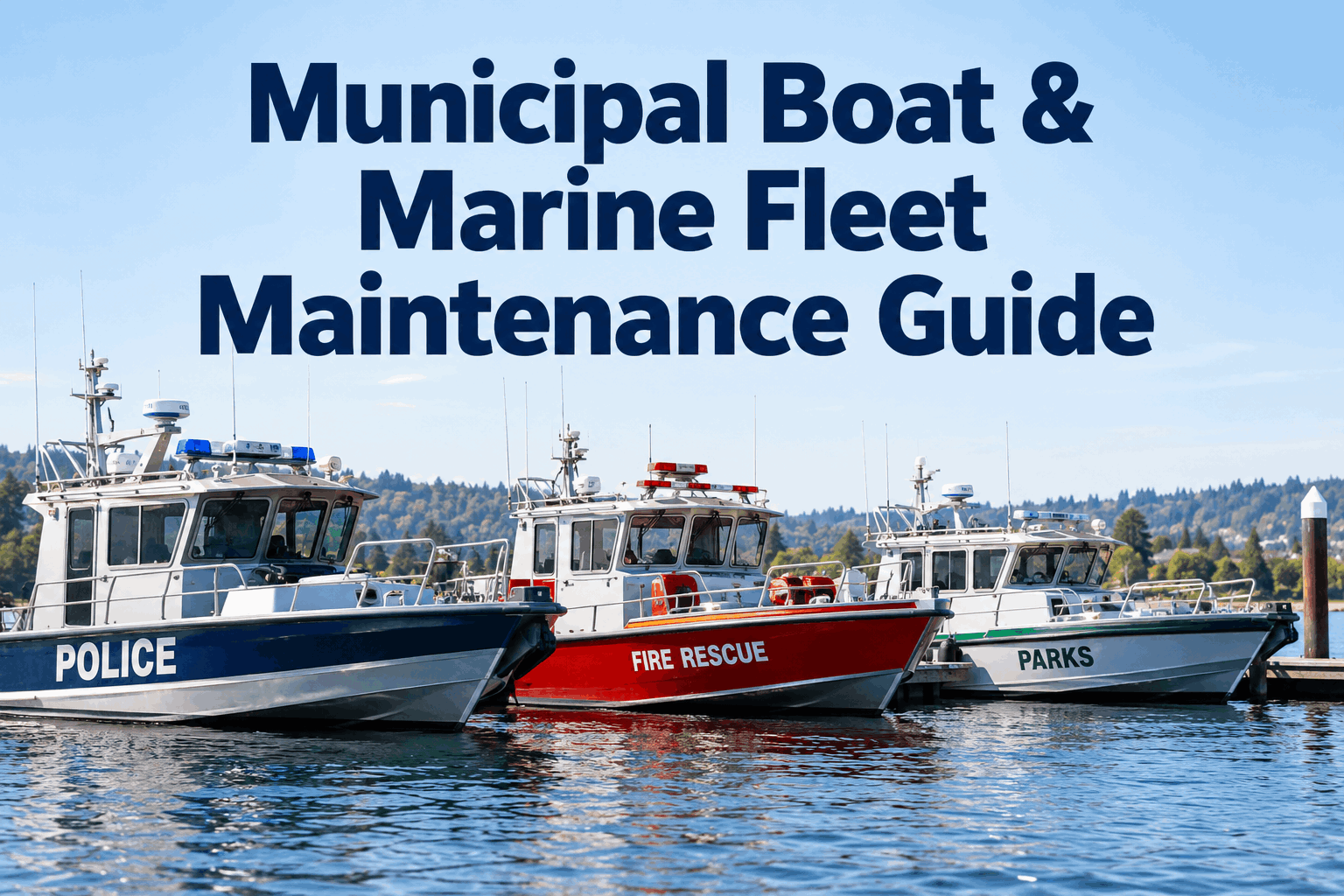
A municipal marine fleet is rarely one kind of boat. It's a police patrol boat that runs hard on weekends, a fire-rescue vessel that sits for weeks then launches for a mayday, and a parks department skiff that putters all summer. Different hulls, different engines, different duty cycles — and usually no single maintenance standard holding them together. That's the real gap. On the road side, these same agencies have inspection schedules, PM triggers and repair histories for every truck. On the water, the boats too often run on a mechanic's memory and a clipboard that lives in a dock box. This guide covers what a real municipal boat maintenance program looks like, and how to run one standard across every vessel you own.
What makes marine fleets harder than road fleetsfour realities that shape municipal boat fleet maintenance
Before any schedule, it helps to name why boats break the rules you built for trucks. These four realities are why marine assets need their own discipline, not a hand-me-down truck PM plan.
Corrosion never sleeps
Salt and brackish water attack metal every hour the hull sits in it. Sacrificial anodes, wiring and hardware degrade whether the boat runs or not — the opposite of a parked truck.
Engine hours, not miles
A boat has no odometer. Marine engines wear by operating hours, so a mileage-based mindset misses service entirely. Hours have to be logged and triggered deliberately.
Safety gear is the law
USCG carriage rules mean PFDs, fire extinguishers, visual distress signals, nav lights and a sound device must be aboard and serviceable — expiration dates and all. On a public-safety boat, it's non-negotiable.
Mixed vessel types
Outboards, sterndrives, inboards; patrol, rescue, utility. One agency's "boat fleet" is really several maintenance profiles that still need a single, consistent standard.
None of this is exotic — it's just different, and it rewards the same asset-level discipline you already apply to the rest of a government fleet. The agencies that stay ready are the ones that stopped treating boats as a side category.
One standard across every vessel typemarine patrol boat maintenance by mission, not guesswork
A single PM plan still has to flex to what each boat does. The trick is one standard — inspect, schedule by hours, track defects, keep a signed history — applied to three different vessel profiles. Here's how that lands for the boats most municipal fleets actually run.
High-use, often twin outboards, hard throttle cycles and quick launches.
- Engine-hour PM that keeps pace with heavy weekend use
- Steering, controls and electronics reliability
- Anodes and lower units checked often in salt water
Low hours, high stakes — sits for weeks, then must launch instantly.
- Readiness checks that catch sitting-still failures early
- Pump, battery and cooling tested, not assumed
- Calendar-based service to offset low engine hours
Seasonal, often single outboard, trailered and launched repeatedly.
- Season-open and season-close service bookends
- Trailer bearings and lights on the same program
- Fuel stabilization and winterization tracked
Same backbone, three profiles — which is exactly why a vessel-specific PM schedule in HVI beats one generic checklist stretched over boats that do completely different jobs. You can start a free record for one vessel and clone the standard across the rest.
The three things that sink a marine PM programboat preventive maintenance built on engine hours
Across every vessel type, the same three items cause most of the expensive, mission-killing failures — and all three are easy to miss precisely because they're invisible until they aren't. Always follow your engine OEM's manual for exact intervals, but the rhythm of boat preventive maintenance looks like this.
Fluids, battery, bilge, steering, and a safety-gear check — PFDs, extinguisher, signals, lights.
Inspect anodes, check lower-unit oil for water, look over fuel-water separator and lines.
Engine oil & filter, water-pump impeller, spark plugs, gear-lube change per OEM.
Deeper service — belts, thermostats, valve checks, fuel system per manufacturer.
Replace worn anodes, full corrosion survey, safety-equipment re-certification, trailer service.
Anodes & corrosion
Sacrificial anodes are the cheapest part on the boat and the most ignored. Let them waste past half and the metal they protect — drives, bolts, housings — starts paying the price.
Water-pump impeller
A rubber impeller is what keeps a marine engine from cooking itself. It's hour-and-age sensitive, and a failed one on the water means an overheated engine and a tow — or a stranded crew.
Safety-gear currency
Flares expire, extinguishers lose charge, PFDs wear out. On a public-safety vessel that's both a legal requirement and the gear a crew's life depends on — it has to be tracked, not assumed.
All three are hours- or date-driven, which is exactly why they belong in a preventive maintenance schedule that fires on its own, not in someone's head — you can see marine PM trigger by engine hours in a quick demo. A missed anode is cheap to fix and expensive to ignore.
One record per hull, from inspection to repairwhere marine fleet maintenance software earns its keep
Everything above only works if it lives somewhere permanent. The difference between a boat that's ready and one that surprises you is whether its history is a complete record or a stack of paper in a dock box. On HVI, each vessel is an asset — and the whole loop closes on that one record.
That's the whole value of running it through maintenance management instead of paper: a dock-side inspection that flags a wasting anode becomes a work order, the repair closes into a signed history, and the parts land in parts and inventory — all on that hull's record. See a vessel's full service record end to end.
From a municipal marine unit supervisor
Our patrol boats got attention because they run constantly. The fire-rescue boat was the scary one — it'd sit for a month and we'd just assume it was fine, then find a dead battery or a seized impeller the one morning we actually needed it. And nobody was tracking anodes at all; we were replacing lower units that corrosion ate because a two-dollar zinc got ignored.
Putting every hull on its own record with engine hours and a real PM schedule changed how the unit runs. The rescue boat gets a readiness check on a calendar now, not a prayer, and a flagged anode is a work order before it's a haul-out. For the first time the boats are managed like the rest of the city's fleet.
Police, fire and parks boats on one systema public safety boat fleet, finally in one place
The payoff of treating boats as assets shows up most when you zoom out to the whole marine fleet. Instead of each unit keeping its own paper, every vessel — whatever agency owns it — runs on the same backbone, visible on one screen.
Hours tracked per hull
Each vessel accrues its own engine hours, so PM fires on the boat that earned it — not a blanket date that misses the heavy users.
Defects visible dockside
A crew flags a soft anode or a dim nav light from a phone at the slip, and the shop sees it instantly — no clipboard in a dock box.
Audit-ready history
Every inspection, service and safety-gear check lives on the vessel, so readiness and spend are provable when a budget or audit question lands.
Real cost per vessel
See what each hull actually costs to keep — the data behind repair-or-replace calls and next year's marine budget.
It's the same connected approach these agencies already trust for trucks and heavy equipment — the boats just stop being the exception. Spin up records for your whole marine fleet free and build the history from today's launch forward.
Municipal boat fleet maintenance — FAQs
How should a municipal boat fleet schedule maintenance?
By engine hours for anything run regularly, with calendar-based service layered on for low-hour boats like rescue vessels that sit between calls. Follow each engine OEM's manual for exact intervals. A typical rhythm is a pre-launch check every use, anode and lower-unit checks around 50 hours, oil and impeller near 100 hours, deeper service around 300, and a full corrosion and safety survey annually. Tracking hours per hull is what keeps heavy users from slipping.
What's the most overlooked part of marine fleet maintenance?
Sacrificial anodes and the water-pump impeller. Anodes quietly waste away protecting expensive metal — drives, housings, hardware — and get ignored because they're cheap and underwater. A rubber impeller is what stops a marine engine overheating; it's hour- and age-sensitive and fails without warning. Both are small, both are easy to schedule, and both cause expensive, mission-killing damage when missed.
How do you manage different vessel types on one system?
You keep one standard — inspect, schedule, track defects, sign off a history — and flex the schedule to each profile. A high-use patrol boat runs on engine hours, a low-hour fire-rescue boat gets calendar-based readiness checks, and a seasonal parks boat gets open- and close-season service. In HVI every boat is its own asset, so each carries the right schedule while the whole fleet shares the same backbone.
Can HVI track boat safety-equipment compliance?
Yes — safety gear can be built into each vessel's inspection, so PFDs, fire extinguishers, visual distress signals, nav lights and sound devices are checked and their expiration dates tracked like any other item. It keeps a current, signed record of what's aboard and serviceable. HVI documents and schedules that compliance; it doesn't replace the Coast Guard's own carriage rules or an official vessel exam.
Is HVI marine diagnostic or navigation software?
No — and it's worth being clear. HVI doesn't run engine diagnostics, connect to a chartplotter, or act as the USCG inspecting authority. It's the maintenance system: digital inspections, engine-hour preventive maintenance, defect tracking, work orders and signed service records across your whole marine fleet. It makes sure the right service and safety checks happen on time and are recorded — the engine's own OEM tools and marine surveyors still handle diagnostics and certification.
Keep every boat ready for the call
One record per hull. Engine-hour PM that fires on the vessel that earned it. Corrosion, impellers and safety gear tracked instead of assumed. That's how a municipal marine fleet stops losing boats to a wasted anode or a seized impeller — and keeps police, fire and parks crews on the water when it counts.
One asset record per vessel · Engine-hour PM · Inspection → work order → history