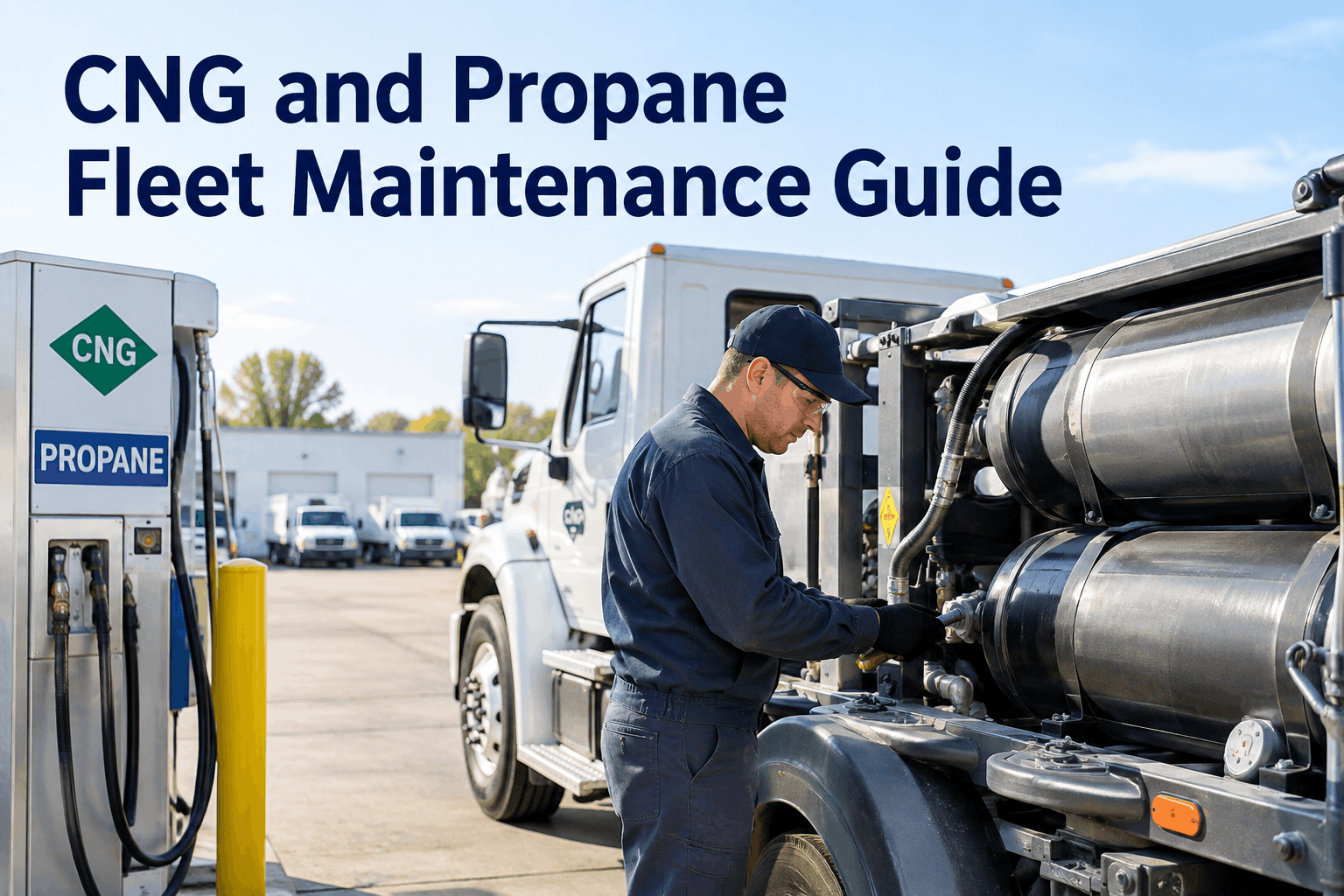
Running CNG or propane vehicles buys a government fleet cleaner air and lower fuel costs — but it adds a maintenance regime a diesel schedule never accounts for. These vehicles store fuel in high-pressure cylinders that must be inspected on a strict clock, serviced by a certified inspector, and — the part most fleets forget — physically retired on an expiry date, whether the vehicle is ready or not. CNG fleet maintenance isn't diesel maintenance with a different fuel; it's a distinct, date-driven, qualification-gated program that runs per vehicle. See cylinder and fuel-system PM tracked per vehicle
Your Fuel Tank Retires on a Fixed Date — Often Before the Truck Does
CNG and propane cylinders run a lifecycle a diesel tank never does: recurring inspections, then a hard expiry.
Every one of those dates lives on an individual cylinder and vehicle, not on a fleet-wide calendar — which is exactly why alternative-fuel fleets need per-asset tracking. Below is what makes this maintenance different, the inspection schedule in plain terms, the expiry deadline that ends a cylinder's life, and how to keep it all straight per vehicle.
What makes CNG and propane maintenance different
A diesel PM schedule covers oil, filters, brakes, and the usual wear items — and CNG and propane vehicles still need all of that. What they add is a whole high-pressure fuel system with its own rules, and three of those rules have no diesel equivalent at all.
High-pressure fuel system
Cylinders, high-pressure lines, regulators, pressure-relief devices, and shutoffs — components that need dedicated leak checks and inspection a diesel fuel system never requires.
Time-and-date-driven checks
Cylinder inspections trigger on the calendar and mileage, and the cylinder itself has an expiry date — deadlines that a mileage-only diesel schedule simply doesn't have.
A certified inspector required
Fuel-system inspection calls for a technician with recognised CNG certification — not any available tech. Qualification isn't a preference here; it's the standard.
Miss any one of these and the vehicle isn't just overdue — it may be unsafe or non-compliant to operate. That's the shift alternative fuel demands: maintenance planning that treats the fuel system as its own tracked programme, per vehicle, alongside the ordinary PM. Book a demo to see fuel-system tasks split out by propulsion type.
The cylinder inspection schedule
The core requirement, under FMVSS 304 and ANSI NGV2, is a periodic visual inspection of the high-pressure fuel system — and the interval depends on the vehicle's weight. Many states adopt these or stricter rules, and heavy commercial vehicles also fall under annual federal inspection, so the effective schedule looks like this.
Note two things that trip fleets up: the inspection covers the whole high-pressure system as industry best practice, not only the cylinders, and heavy vehicles that rack up miles fast can hit their interval far more often than once a year. Getting the interval right per vehicle — by weight, by mileage, by incident — is the difference between a compliant fleet and a grounded one. Try HVI Free — Set the Interval.
The deadline no inspection can extend
Here's the rule that catches fleets years down the line, because nothing on the vehicle warns you it's coming. A high-pressure fuel cylinder is manufactured with a finite designed life — commonly 15, 20, or 25 years, stamped on the cylinder. When that date arrives, the cylinder must be removed from service and replaced. No inspection, no matter how clean, extends it.
A CNG or propane cylinder is one of the only vehicle components with a legally designated end-of-life that can arrive before the vehicle's. Owners are told the expiry up front — and then, years later, tend to forget. A vehicle running past its cylinder expiry date is operating on a component it is no longer safe or legal to use.
This is precisely why the expiry date can't live in someone's memory or a forgotten spreadsheet cell — it has to be tracked against the specific cylinder and vehicle, with warning well ahead of the date so a replacement can be planned, not scrambled. It's a maintenance deadline and a budget line at the same time. Book a demo to flag cylinder expiry before it grounds a vehicle.
Managing it all at the vehicle level
Every requirement on this page — the interval inspections, the incident checks, the certification, the expiry — is specific to an individual vehicle and cylinder. That's why alternative-fuel maintenance needs three connected capabilities, and it's the same set that runs any well-managed mixed fleet.
A template per fuel type
CNG, propane, and diesel each get their own service regime with the right fuel-system tasks — so a gaseous-fuel vehicle is never serviced on a diesel checklist that ignores its cylinders.
HVI: Templates per PropulsionTriggers on date, mileage, or expiry
Cylinder inspections fire on the calendar and the odometer, and the hard expiry date raises its own alert — the time-sensitive triggers a mileage-only schedule can't produce.
HVI: Any-Trigger PMCertified techs on the work
Fuel-system inspection needs recognised CNG certification — qualification tracking makes sure the assigned technician actually holds it, and flags when a certification is due to lapse.
HVI: Qualification TrackingHeld together against each vehicle, these turn a genuinely complex requirement into a routine the system manages for you: the right tasks fire at the right time, the right person is assigned, and the expiry date is never a surprise. That's what makes an alternative-fuel fleet as manageable as a diesel one — and a lot safer to run. Start Free — Track Every Cylinder.
From a fleet maintenance manager running CNG
We moved a big chunk of our fleet to CNG for the emissions and fuel savings, and nearly got caught out the first year — a cylinder inspection came due and the only tech on shift wasn't certified for it. Then it hit me some of our early tanks would age out before the buses did. Once every cylinder's interval, certification, and expiry lived against the vehicle, the alerts came to me — and I could budget replacements years ahead instead of finding out the hard way.
Frequently asked questions
How often must CNG cylinders be inspected?
Under FMVSS 304 and ANSI NGV2, CNG fuel systems get a periodic visual inspection on an interval set by vehicle weight. Vehicles under 10,000 lb GVWR are inspected at least every 3 years or 36,000 miles, whichever comes first; vehicles at 10,000 lb and above at least every 12 months, aligned with annual commercial inspection. On top of that, any CNG vehicle must be inspected after a fire or accident regardless of interval. Many states adopt these or stricter rules, so the schedule has to be tracked per vehicle.
Do CNG and propane cylinders expire?
Yes, and it surprises many fleets. High-pressure gaseous-fuel cylinders are manufactured with a finite designed life — commonly 15, 20, or 25 years — stamped on the cylinder. When that expiry arrives, the cylinder must be removed from service and replaced; no inspection extends it, however good its condition. It's one of the only vehicle components with a designated end-of-life that can arrive before the vehicle's own. Since nothing on the vehicle warns you it's approaching, the expiry has to be tracked against the specific cylinder, with advance notice so a replacement is planned, not scrambled.
Can any technician inspect a CNG fuel system?
No. A CNG fuel-system inspection must be done by a technician with recognised certification — the CSA Group CNG Fuel System Inspector Certification is the standard, and CSA is recognised by OSHA and ANSI. The inspection covers the entire high-pressure fuel system, not just the cylinders, following methods such as CGA C-6.4, and takes specific training to do safely on a system holding up to 3,600 psi. That's why qualification tracking matters: the system confirms the assigned technician holds current certification before work is scheduled, and flags when one is about to lapse.
How is CNG or propane maintenance different from diesel?
Alternative-fuel vehicles still need all the usual diesel PM — oil, filters, brakes, tires — but add a high-pressure fuel system with its own requirements: dedicated leak checks and inspection of cylinders, lines, regulators, and pressure-relief devices; inspections triggered on date and mileage, not mileage alone; a hard cylinder expiry date; and a certified inspector for the fuel-system work. None have a diesel equivalent. So a gaseous-fuel vehicle can't run on a diesel PM template — it needs a propulsion-specific schedule that treats the fuel system as its own tracked programme.
How can a fleet keep track of all these requirements?
By tracking them against each vehicle and cylinder rather than a fleet-wide calendar, since every date is specific to one asset. That takes three things together: a service template per fuel type so CNG and propane vehicles get the right fuel-system tasks, PM triggers that fire on date, mileage, or expiry rather than mileage alone, and qualification tracking that confirms the technician is certified. With those connected against each vehicle, interval inspections, incident checks, certifications, and expiry dates all raise their own alerts — turning a complex safety requirement into a routine the system manages.
Run your CNG and propane fleet on a schedule built for it
HVI gives alternative-fuel vehicles their own service templates, triggers cylinder inspections on date, mileage, or expiry, and confirms the technician is certified before the work is booked. So every high-pressure fuel system is inspected on time, by the right person, and no cylinder ever runs past its expiry date unnoticed — managed per vehicle, the way alternative fuel demands.
No credit card · Cylinder inspection & expiry tracking per vehicle · Certified-tech assignment