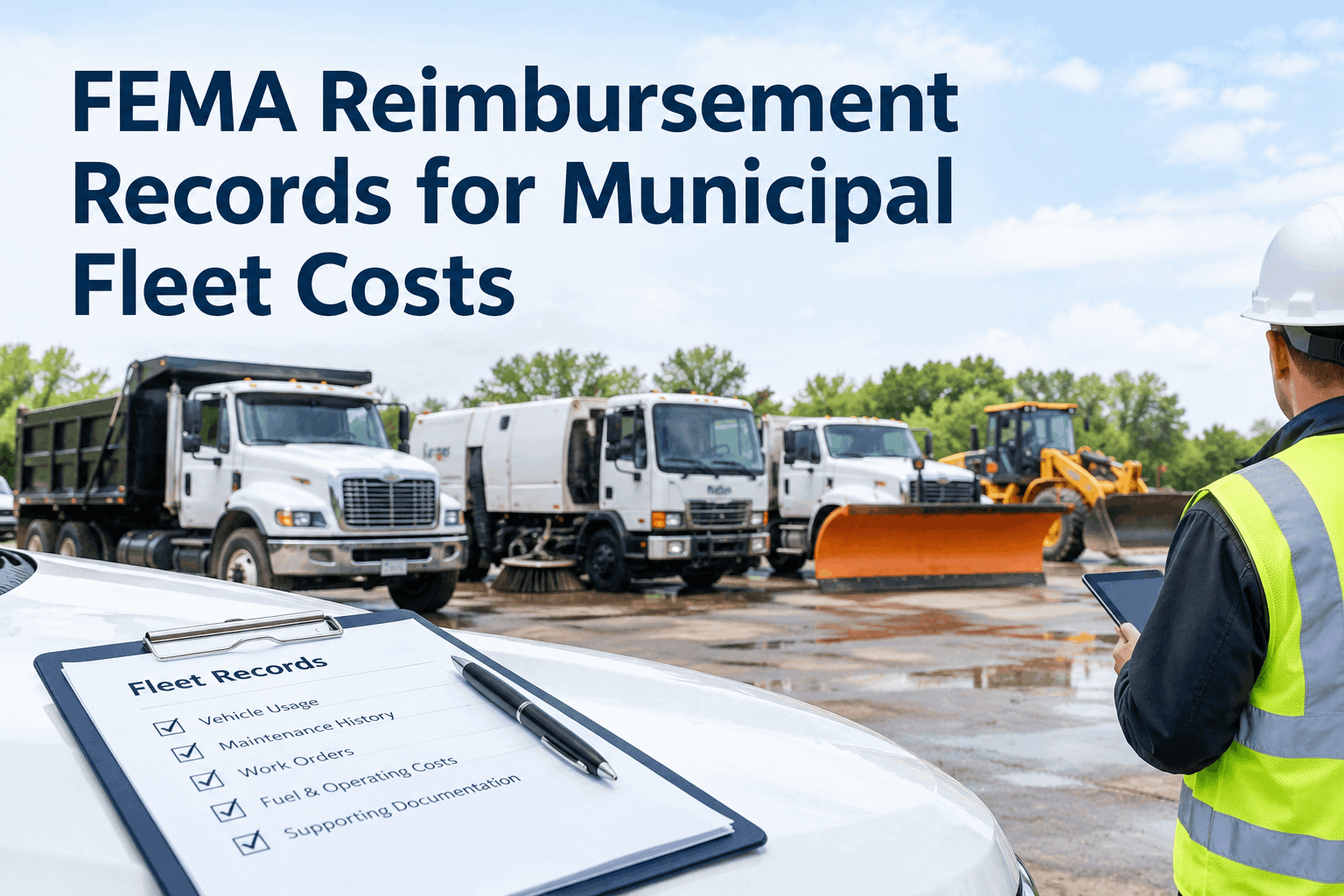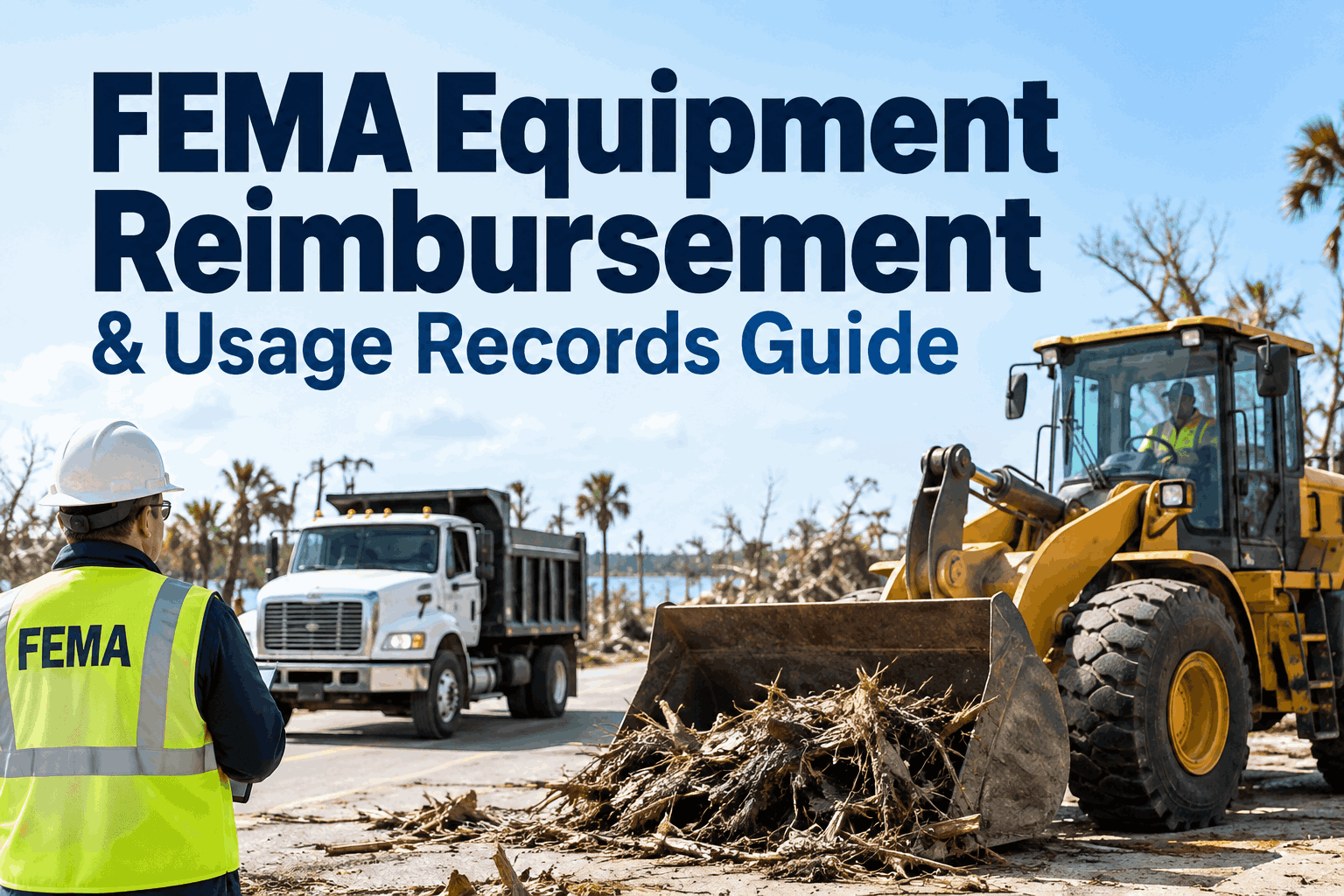
FEMA equipment reimbursement often comes down to one question long after the storm: can your agency prove which machine did the disaster work, where, who ran it, and for how long? When a grader clears debris for three days and the only record is a number on a clipboard, that gap costs real money. Building the record while crews are deployed beats reconstructing it weeks later. Book a demo to see emergency fleet usage captured in HVI.
FEMA Equipment Reimbursement Starts With the Record You Build in the Field
Connect the asset, operator, location, work performed and equipment hours as the work happens — so emergency fleet activity moves into reimbursement review with a record that holds up, not a story you have to piece back together.
For applicant-owned equipment, a complete FEMA record usually needs more than a total hour count. Depending on the project and documentation requirements, it may need to identify the equipment and attachments, its characteristics, the site, the equipment code or rate basis, the operator, and the dates and hours used. The hard part for most public works fleets is capturing all of that consistently while the emergency is still running hot.
What a FEMA Equipment Reimbursement Record Has to Explain
A useful disaster equipment record answers one plain operational question: what did this specific asset do during the event? A fleet number and a block of hours leave gaps a reviewer will notice. The entry gets stronger when it ties the machine to the operator, the work assignment, the date, the site and the actual time on task.
Entered days or weeks later, crews have to reconstruct which machine worked where, which operator ran it, and how the equipment time lines up with labor and activity records — after the people who know have moved on.
HVI gives that activity a home at the asset level instead of leaving it scattered across notebooks, spreadsheets and separate fleet files. Book a demo to see emergency equipment usage organized around each fleet asset.
A FEMA Reimbursement Record Is Only as Strong as Its Missing Fields
During a disaster, you may know a loader, dump truck or excavator worked long hours without having a complete record to back it. A fast completeness check surfaces what's missing before the response team disperses and the details get harder to verify.
The same discipline keeps labor and equipment records agreeing with each other. If an employee is logged operating a machine for disaster work, the related activity and equipment usage should read as one connected story across the supporting records — not three unrelated totals a reviewer has to reconcile.
That's the difference between a clean FEMA equipment reimbursement file and a week of chasing paperwork. Book a demo to see an equipment-by-equipment activity trail during emergency operations.
How FEMA Equipment Rates Fit Into the Usage Record
Usage records and reimbursement rates solve different parts of the problem. The field record establishes what ran and for how long. The applicable FEMA, state, tribal, territorial or local rate methodology determines how that eligible usage is valued under the Public Assistance rules.
This distinction matters when building FEMA reimbursement documentation. Adding costs separately without checking what the equipment rate already includes can create duplication. Always use the current FEMA policy guide to determine the allowable rate and cost treatment for a specific event and project.
A tracked usage record keeps that calculation honest from the start. Book a demo to see the equipment-hour record your cost review begins with.
Actual Use, Mobilization and Standby Are Not the Same Hours
Emergency deployments mix travel to the site, active work, interruptions, staging and standby. Those periods shouldn't collapse into one continuous block of reimbursable equipment time. FEMA applies specific rules to usage, mobilization and standby, so the field record needs enough detail for the applicant to classify time correctly in review.
FEMA policy treats actual operation as central to equipment-rate reimbursement, with specific exceptions for certain mobilization and intermittent standby situations. Apply the policy for your declared disaster rather than inventing a local shortcut that turns a whole shift into equipment hours.
What to Capture on Every Emergency Equipment Entry
You don't need a perfect form in the middle of a response — you need the same handful of fields captured every time, on every machine. When these travel together from the field, the reimbursement file nearly assembles itself later.
Unit number, type, make/model/size where it matters, plus any attachment in use — a bucket, broom or grapple can change the equipment code.
Name the person running the equipment so the usage ties back to force account labor and the day's activity without a guess.
Where the work happened — a zone, route, address or grid reference. "Where was it used?" is the field most often missing.
What the machine actually did — debris removal, pumping, road repair — so the usage connects to eligible disaster work.
Operating hours for the day, separated from standby and travel where the policy calls for it — not one undivided shift block.
The equipment code (FEMA rate) or the rate source when another schedule applies — captured once, verified in review.
Preserve inspections, meter readings and other fleet maintenance records alongside the asset's normal history, and you're not hunting across systems to prove a machine's identity and condition. For municipal and government fleet operations, that single home for asset records is what makes a response-time log reviewable. Sign up free and put this field checklist on every emergency asset.
From FEMA Equipment Usage Records to Supporting Documentation
Fleet data is one part of a Public Assistance file, but it's the operational foundation the rest rests on. The strongest workflow preserves the original field activity, checks it for completeness, applies the right equipment identification and rate basis, and keeps everything available for project and financial review.
Documentation
None of this decides FEMA eligibility — that's the applicant's and FEMA's determination. But it does mean disaster cost recovery starts from a clean equipment record instead of a reconstruction, which is usually the difference between a smooth review and a drawn-out one.
From a Public Works Fleet Supervisor Who Lived It
After the last flood event, our equipment claim stalled for weeks. We had the hours — what we didn't have was which loader worked which zone and who was on it. We spent days rebuilding that from memory and half-legible timesheets.
The fix wasn't a better form. It was capturing asset, operator, site and work right there in the field, on the machine, as it happened. Next event, the usage record was already built. Our recovery team spent their time reviewing, not reconstructing.
DR David R.Fleet Supervisor · County Public Works Department
FEMA Equipment Reimbursement FAQs
What information should FEMA equipment usage records contain?
It depends on the project and applicable FEMA requirements. For applicant-owned equipment, guidance can call for the equipment and attachments, year, make, model, size or capacity, location, equipment code when FEMA rates apply, rate source when other rates apply, operator, and dates and hours used. Follow the documentation requirements for your specific Public Assistance project.
What is FEMA force account equipment?
Force account equipment generally means equipment owned by the applicant and used to perform disaster-related work with its own resources. FEMA handles force account equipment, labor, purchased and rented equipment, and contracted work under applicable Public Assistance policies and documentation requirements.
Are FEMA equipment rates the same as operator labor costs?
No. FEMA's national equipment rates cover equipment ownership and operating cost components and do not include the operator's labor. Operator labor is documented separately under force account labor rules. Avoid separately claiming costs already built into the equipment rate where FEMA policy does not allow duplication.
Can all equipment standby time be claimed for FEMA reimbursement?
No. FEMA generally applies equipment rates to actual operation, with specific rules for mobilization and limited intermittent standby. Document what the equipment was actually doing and apply the FEMA policy for your disaster and project, rather than treating an entire deployment shift as reimbursable operating time.
How can HVI support FEMA reimbursement documentation?
HVI helps government fleets keep asset-level records — equipment usage, hours and supporting fleet history — so information is easy to retrieve during disaster cost review. HVI does not determine FEMA eligibility, choose the reimbursement rate, or replace FEMA, recipient or subrecipient documentation and grant-management requirements.
Make Emergency Equipment Usage Easier to Reconstruct — and Easier to Review
Keep equipment hours, operators, work context and asset records together while public works crews respond, so your disaster recovery team has a clear operational trail when FEMA equipment reimbursement documentation gets assembled.