Nobody at a housing authority signs up to run a fleet — then one day you've inherited a few vans, a service truck, a mower and a plow, with no fleet department and no system. Housing authority fleet maintenance is the quiet problem that only shows itself when the plow won't start the first snowy morning, or an auditor wants a record you never kept. A small mixed fleet doesn't need a shop — just one place to schedule, inspect and record. Book a demo to run a small public fleet from one screen.
Housing Authority Fleet Maintenance: One System for a Mixed Yard
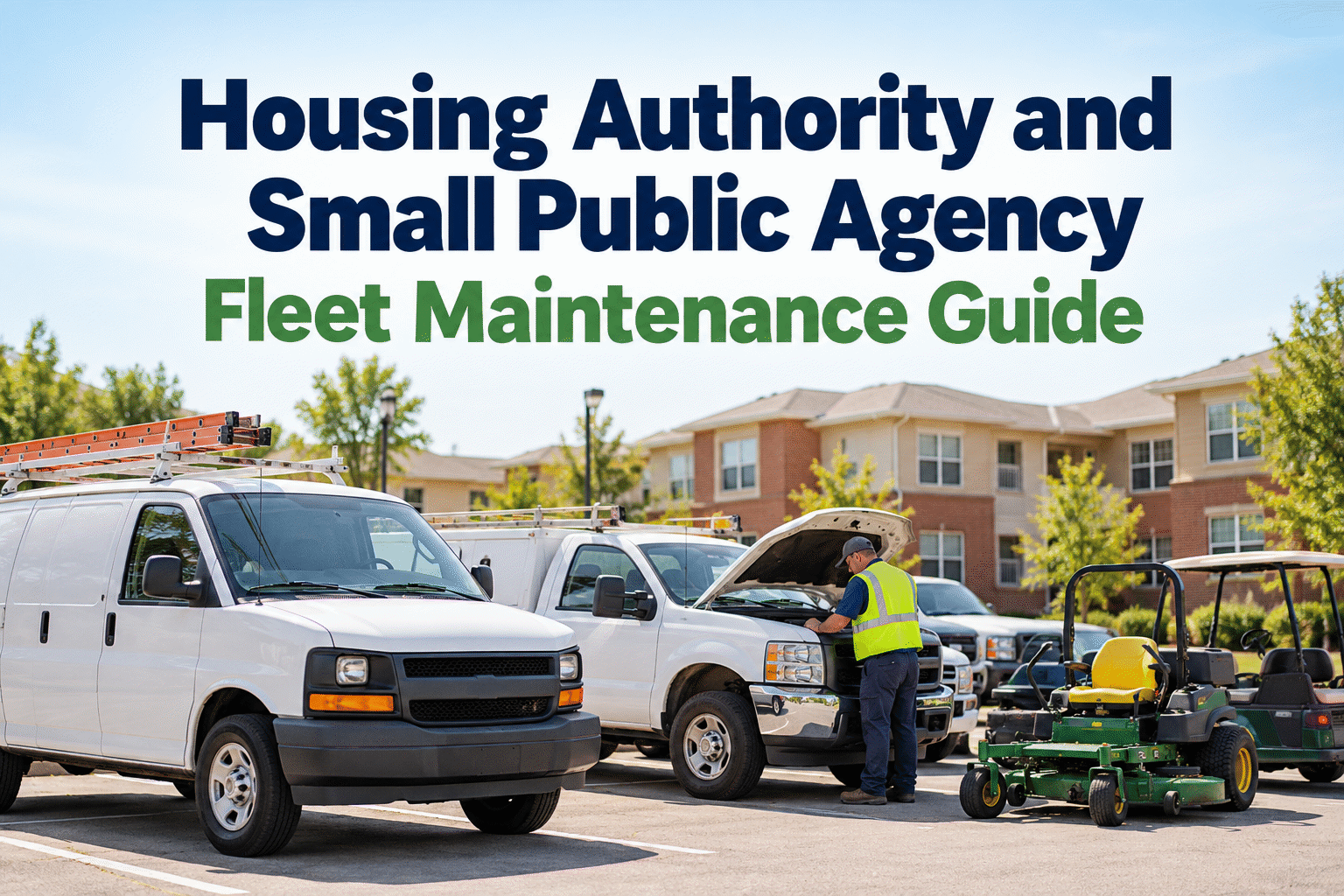
A van, a service truck, a mower and a plow don't wear the same way or get serviced the same way. Here's the yard you're actually managing — and how each piece gets scheduled.
The whole challenge of a small public fleet is in that picture: four machines, four completely different maintenance rhythms, and no one whose full-time job is to track them. This guide lays out the service intervals that actually matter, how to schedule each asset type, the operator walkaround that catches problems early, and the records that keep you audit-ready — all without hiring a fleet manager.
The intervals that mattera baseline service schedule for a small public fleet
You don't need a complex program to start. Public-housing maintenance guidance (HUD) lays out sensible minimum intervals — a floor to build on, adjusted up for heavy-use machines and down for light ones. Good housing authority fleet maintenance starts by putting these on a calendar instead of in someone's memory.
| Service | Baseline interval | Applies to |
|---|---|---|
| Lubrication | Quarterly | All motorized equipment |
| Filter changes | Quarterly | Engines — oil, air, fuel |
| Brake inspection | Semi-annually | Vans, trucks, carts |
| Tune-up | Annually | All engines |
| State inspection | Annually | On-road vehicles |
| Full safety check | At every service | Battery, coolant, tires, lights, brakes, fluids |
The last row is the one small fleets skip and regret: every time a machine is in for anything, run the broader check — battery, coolant, tires, lights, brakes, fluids. It's the cheapest breakdown insurance you have. HVI's preventive maintenance turns each of these into an automatic, repeating reminder per asset. Book a demo to load these intervals onto your fleet in minutes.
Miles, hours, or the calendarwhy one scheduling rule can't cover a mixed fleet
Here's the trap that makes small fleets feel impossible: your van's oil change is due by miles, but your mower's is due by engine hours, and your plow's is due by the season. Schedule them all the same way and half your fleet is either over- or under-serviced. Each asset type gets its own trigger.
Vans and light trucks follow odometer-based intervals — oil, filters and tires track the miles they run between sites.
Mowers, tractors and bobcats barely move but run for hours. Hour meters, not odometers, tell you when they're due.
A utility cart or standby unit may hit neither a mileage nor an hour threshold — so a fixed time interval keeps it from being forgotten.
Service plows and spreaders in late summer, mowers and chainsaws in late winter — before the season, not the morning you need them.
The seasonal one is where housing authorities get burned most — the snowblower that sat all summer and won't start the first cold morning. Scheduling by the right trigger for each machine is the single biggest upgrade a small fleet can make, and it costs nothing but setup. Sign up free and set a trigger for every asset type.
The crew is your inspection teammobile walkarounds, because you have no shop
A small agency doesn't have inspectors — it has the same maintenance workers who drive the vans and run the mowers. That's actually an advantage: the person using the machine is the first to notice a soft brake pedal or a weeping hose. A 60-second phone walkaround turns them into your early-warning system.
-
1
Quick walkaround on a phone
Operator opens the checklist for that vehicle or machine, taps through lights, tires, fluids, leaks — no paper form.
-
2
Flag a defect with a photo
A worn tire or a cracked hose gets snapped and noted on the spot, so the description isn't lost by the time it reaches the office.
-
3
It becomes a work order
The flagged item turns into a repair record — fixed in-house or sent to a contractor — instead of a sticky note that disappears.
-
4
The record stays with the asset
Inspection, defect and fix all attach to that machine's history, so nothing falls through the cracks between sites and staff.
The whole loop takes a minute at the start of a shift and catches the small problems before they strand a van or total a mower engine. HVI's mobile operator inspections and digital inspection forms make the walkaround something the crew will actually do. Book a demo to see a defect go from walkaround to work order.
One board for the whole fleetwhat mixed-fleet scheduling looks like in practice
When every machine lives in one system, the thing you could never hold in your head — what's due, on what, by when — becomes a single screen. Each asset on its own trigger, nothing forgotten.
Miles, engine hours, calendar or season — set the right one per asset in preventive maintenance, with reminders before each is due.
Your crew runs walkarounds and flags defects with photos through mobile reporting — no paper, no lost notes.
Work orders, costs and service history attach to each asset, so an audit or a council request is answered in seconds, not days.
Log contractor repairs alongside in-house work, so the full history is complete even when the fix was outsourced.
The service-record checklist
Whether a repair is done in-house or by a contractor, these are the fields that make a record stand up — drawn straight from public-housing recordkeeping guidance. Capture all of them and your maintenance history is audit-ready by default.
The site-coding field is quietly powerful — it shows which property is quietly eating the maintenance budget. All eight fields live on every HVI work order by default. Book a demo to see audit-ready records built from the walkaround up. This is a different scale of fleet than a city's — for larger public-works operations, see the municipal DPW fleet maintenance guide.
From a housing authority operations manager
We're not a fleet operation — we're a housing authority that happens to own a dozen vehicles and a shed full of grounds equipment. For years "maintenance" meant whoever noticed a problem mentioned it. Then we missed a state inspection and nearly lost a van for a week in peak season. Putting every machine on a schedule, with the crew doing phone checks, took an afternoon to set up. Now the plow gets serviced in September, not discovered broken in December.
Housing authority fleet maintenance — FAQs
How does a small public agency manage fleet maintenance without a fleet department?
Put every machine on a schedule by the right trigger (miles, engine hours, calendar or season), have the crew run quick phone walkarounds, and keep all service records in one system. A small mixed fleet doesn't need a shop or a dedicated manager — it needs one place to schedule, inspect and record.
What maintenance intervals should a housing authority fleet follow?
A sensible baseline (per HUD public-housing guidance): lubrication and filters quarterly, brake inspection semi-annually, tune-up and state inspection annually, and a full safety check — battery, coolant, tires, lights, brakes, fluids — every time a machine is serviced. Adjust up for heavy-use equipment and down for light.
Should grounds equipment be scheduled by hours or miles?
By engine hours. Mowers, tractors and similar equipment barely accumulate miles but run for hours, so an hour meter tells you when service is due far more accurately than an odometer. On-road vans and trucks go by miles; low-use carts by calendar; and seasonal gear by season.
What should a fleet maintenance record include?
Per public-housing recordkeeping guidance: a description of the work, estimated and actual materials and labor time, total cost, who performed it (staff or contractor), the site it's coded to, and supervisor completion approval — all linked to the specific asset. Those fields make the record audit-ready whether the work was in-house or outsourced.
How does HVI help a small public fleet?
HVI schedules each asset by miles, hours, calendar or season with automatic reminders, lets your crew inspect and flag defects from a phone, and keeps every work order and service record attached to the machine. It gives a small agency with no fleet department one simple system to stay on schedule and audit-ready.
Get your whole yard on schedule in an afternoon
HVI puts every van, truck, mower and plow on the right maintenance trigger, turns your crew's phones into the inspection team, and keeps every record audit-ready — so nothing gets discovered broken the morning you need it. Live in under two weeks.
No credit card · No hardware · Set up your fleet on day one