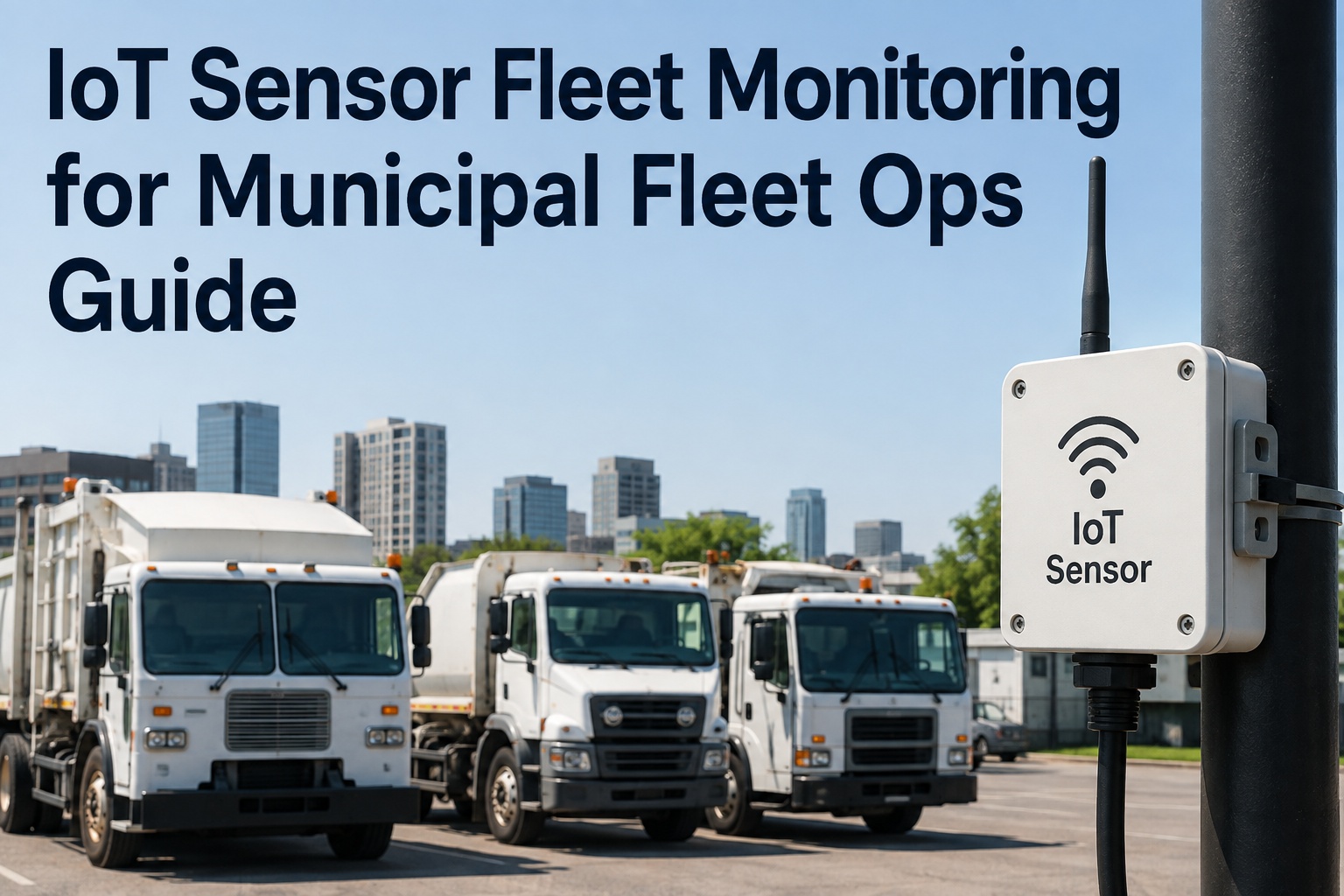
It is 5:40 on a Tuesday morning and your sanitation crew is standing in the yard because the side-loader's hydraulic pack overheated again — a fault that had been quietly building for three days while the truck ran routes. Nobody knew, because nobody was watching the coolant temperature between inspections. That is exactly the gap IoT fleet sensors close: small, always-on devices on the chassis, engine and hydraulics that watch battery voltage, tire pressure, fuel level and oil pressure around the clock, and flag trouble the moment a reading crosses a threshold instead of the moment a unit dies on route. For municipal and government fleets running mixed assets — refuse trucks, sweepers, plows, buses, pickups — this turns maintenance from reactive firefighting into planned work. This guide walks through which sensors matter, how threshold alerts become work orders automatically, and what the numbers look like on a real fleet. If you want to see the full sensor-to-work-order flow on your own units, you can book a 30-minute walkthrough of HVI's IoT integration and bring your toughest use case.
IoT Fleet Sensors • Municipal & Government Fleets
What if every truck in your yard reported its own faults before the shift started?
TPMS on every wheel, battery voltage, coolant temp, oil pressure and fuel level — streaming 24/7 over LoRaWAN or 4G into HVI, where a threshold breach opens a work order automatically. No driver report needed. No surprise breakdowns on route.
Why It Matters
The cost of finding out too late
Most municipal breakdowns are not sudden — the warning signs were there for days. These four numbers show what "finding out on route" actually costs a fleet like yours.
Sensor Coverage
Which IoT sensors belong on a municipal fleet?
Start with the five readings that predict the most roadside failures. Each one below maps to a real failure mode you already know — and to the work order it should trigger.
TPMS on every wheel position
Under-inflation kills casings and fuel economy; a slow leak on an inside dual is invisible on a walk-around. Set a low-pressure threshold and a rapid-leak rate alert, and a tire work order opens before the casing is ruined — protecting a $400+ retreadable carcass.
Battery voltage & cranking health
Batteries rarely die without warning — voltage sags for days first, especially on units with heavy auxiliary loads like plows and liftgates. A resting-voltage threshold catches the weak unit in the yard at 6 AM, not on a snow route at 6 PM.
Coolant temperature
A creeping overheat pattern — running 8–10 degrees hotter than baseline on the same route — usually means a failing fan clutch, a weeping water pump or a clogged radiator. Catch the trend and you schedule a $300 fix; miss it and you buy a head gasket.
Oil pressure
The one alert that should never wait. A sudden oil-pressure drop is a stop-engine-now event, and a slow decline points to bearing wear or a failing pump. Route this threshold straight to a high-priority work order with the unit flagged out of service.
Fuel level & consumption
Beyond "is there fuel," level data exposes after-hours draw that signals theft or unauthorized use, and consumption drift that flags injector or aftertreatment problems early. For a 60-unit municipal fleet, even a 3% fuel anomaly is real budget money.
Hydraulic pressure & temp
On refuse packers, sweepers and hook-lifts, hydraulics are the payload. Rising oil temperature under normal cycle counts means pump wear or a bypassing valve — the exact fault that strands a crew mid-route. Trend it, and the repair happens on your schedule.
How It Works
From sensor threshold to open work order in four steps
The hardware is only half the story. The value appears when a reading becomes action without anyone copying numbers into a spreadsheet. Here is the flow HVI runs.
Sensors stream readings
Devices on the chassis, engine and hydraulics report over LoRaWAN at the depot or 4G on the road — every few minutes, around the clock, whether the unit is working or parked.
HVI ingests the feed
Data lands in HVI via MQTT or API, mapped to the right asset automatically. Each unit carries its own thresholds — a sweeper's hydraulic limit is not a pickup's.
Threshold breach fires
A reading crosses its limit — say, battery resting voltage under 12.2V, or coolant 12° above baseline — and HVI evaluates severity: advisory, schedule-soon, or stop-use.
Work order opens, assigned
The work order is created with the sensor evidence attached, routed to the right shop, and the unit's PM schedule and parts needs update automatically. Your foreman sees it before the driver reports anything — because the driver never had to. You can watch this exact workflow in a live demo using your own asset list.
Worked Example
What one sensor alert is worth: a refuse-truck example
Take a 25-truck municipal sanitation fleet. One packer's TPMS flags a slow leak on an inside dual at 11 PM Tuesday. Here is the before-and-after math on that single alert.
Without IoT monitoring
- Leak goes unnoticed; tire runs flat under load Wednesday
- Casing destroyed — no retread value left
- Roadside service call plus a missed route day
- Crew overtime to cover Thursday's backlog
Typical hit: $1,900–$2,600 for one tire event
With HVI + TPMS thresholds
- Alert opens a tire work order Tuesday night
- Tech finds a nail, repairs it in the yard at 6 AM
- Casing saved, truck makes its full route
- Timestamped record proves the fix for audit
Actual cost: $45–$90 for a yard repair
One saved casing a month across a 25-truck fleet pays for the sensor hardware many times over — and that ignores the fuel savings from running correct pressures and the CSA-style roadside exposure you avoid. Fleets that start tracking these alerts in HVI free usually see the pattern within the first two weeks of data.
See your own thresholds firing as work orders
Bring your asset list and your worst recurring failure — we will show you the sensor feed, the threshold rules and the automatic work order, live on your fleet's profile.
Connectivity & Integration
LoRaWAN or 4G: how the data actually reaches your CMMS
Municipal yards are hard on connectivity — metal buildings, below-grade pits, remote depots. The good news: you do not need perfect coverage, you need the right mix.
| Factor | LoRaWAN (depot network) | 4G / LTE (cellular) |
|---|---|---|
| Best for | Yard-parked units, overnight battery and tire checks, fixed plant | Route vehicles, remote sites, real-time oil-pressure and overheat alerts |
| Range | One gateway can cover a full depot and surrounding blocks | Anywhere with cellular coverage, including rural routes |
| Power draw | Very low — battery-powered sensors run for years | Higher — usually wired to vehicle power |
| Ongoing cost | Minimal after the gateway is installed | Per-device data plan, typically a few dollars a month |
| Into HVI | Gateway forwards via MQTT/API to the asset record | Device pushes via MQTT/API direct to the asset record |
Most municipal fleets end up hybrid: LoRaWAN for the yard, 4G for anything that leaves it. HVI does not care which path the data takes — every reading lands on the same asset timeline next to your DVIRs, PM history and work orders. If your units already carry telematics, ask about a demo that maps your existing GPS feed into HVI alongside the new sensor data.
How HVI Helps
Turning IoT fleet sensor data into finished repairs
A dashboard full of blinking alerts is not maintenance. These four HVI capabilities are what convert raw sensor streams into uptime you can measure.
Threshold-to-work-order automation
You set the limits per asset class; HVI opens, prioritizes and assigns the work order with the sensor evidence attached. Outcome: faults are actioned in under a minute, and nothing depends on a driver remembering to report a gauge.
One asset timeline
Sensor events, digital DVIRs, PM history and repairs sit on a single record per unit. Outcome: when a truck overheats, your tech sees the coolant trend, the last fan-clutch job and the open work order in one screen — no group-chat archaeology.
PM scheduling by real condition
Combine sensor trends with date, mileage and engine-hour triggers so service happens when the unit actually needs it. Outcome: fewer missed intervals, fewer over-serviced units, and a defensible schedule when auditors or council ask why.
Audit-ready evidence, automatically
Every alert, work order and sign-off is timestamped and photo-backed. Outcome: proving a tire defect was found and fixed takes seconds, which matters for DOT, insurance and internal safety reviews. Many teams book a demo just to see the audit trail end to end.
Key Takeaways
IoT fleet sensors, in plain terms
If you remember nothing else from this guide, keep these five points.
Failures announce themselves early
Batteries sag, tires leak and coolant creeps for days before the breakdown. Sensors simply make that whisper audible.
Start with five readings
TPMS, battery voltage, coolant temp, oil pressure and fuel level cover the majority of predictable roadside failures on municipal units.
The alert is not the product
Value only appears when a threshold breach becomes an assigned work order automatically — that is the IoT CMMS integration that matters.
Connectivity is a solved problem
LoRaWAN covers the yard, 4G covers the road, and MQTT/API feeds both into one asset record in HVI.
The math is easy to prove
One saved tire casing or one avoided tow per month typically out-earns the entire sensor and software cost on a mid-size fleet.
The fleets getting the most from gov fleet IoT are not the ones with the most sensors — they are the ones whose alerts land inside a real maintenance workflow. If you want to test that on your own units, you can create a free HVI account and connect your first feed this week.
My gripe was never the breakdowns — it was finding out about them from an angry crew supervisor at 7 AM. Now I watch one number every morning: open sensor-triggered work orders. Last quarter it told me three trucks had batteries on the way out, and we changed all three in the yard on a Saturday. Nobody outside my shop even knew there was a problem. That is the whole game for me.
Daniel Reyes — Fleet Maintenance Manager, municipal public works fleet (120+ mixed units)
FAQ
IoT fleet sensor questions, answered
What sensors should a municipal fleet install first?
Start with TPMS on every wheel position and battery voltage monitoring — tires and batteries cause a large share of unplanned downtime and the hardware is the cheapest to fit. Add coolant temperature and oil pressure next, then fuel level if theft or consumption drift is a concern. Hydraulic pressure and temperature come first instead on packers, sweepers and hook-lifts where hydraulics are the payload.
How does a sensor alert become a work order automatically?
Each asset in HVI carries threshold rules per sensor — for example, resting battery voltage below 12.2V or coolant 12 degrees above baseline. When a reading crosses the line, HVI opens a work order with the sensor evidence attached, sets the priority by severity and assigns it to the right shop. You can see the threshold rules configured live in a demo with your own asset classes.
Do I need LoRaWAN, 4G, or both?
Most government fleets use both. LoRaWAN is ideal for depot coverage — one gateway, years of battery life, minimal running cost — while 4G suits route vehicles and remote sites that need real-time alerts anywhere. HVI ingests either feed via MQTT or API onto the same asset timeline, so the mix is invisible to your technicians.
Will IoT sensors replace driver inspections and DVIRs?
No — they complement them. Sensors watch what a walk-around cannot see, like an inside-dual slow leak or overnight voltage sag, while drivers still catch physical damage, lights and leaks. HVI keeps digital DVIRs and sensor events on one record, so a defect reported either way becomes a tracked work order with photo-backed, audit-ready history.
What does IoT fleet monitoring cost to get started?
TPMS and battery sensors typically run tens of dollars per wheel or unit, with a modest per-device data cost on 4G. The payback is fast: a single saved tire casing or avoided tow per month usually covers the hardware on a mid-size fleet. You can sign up free and connect your first sensor feed to validate the numbers on your own units before scaling.
Let your fleet report its own faults — before the shift starts
Connect TPMS, battery, coolant, oil-pressure and fuel sensors to HVI and watch threshold breaches open assigned work orders in under a minute. Book a 30-minute demo and we will map it to your actual units.
Free to start • Works on any phone or tablet • No card needed