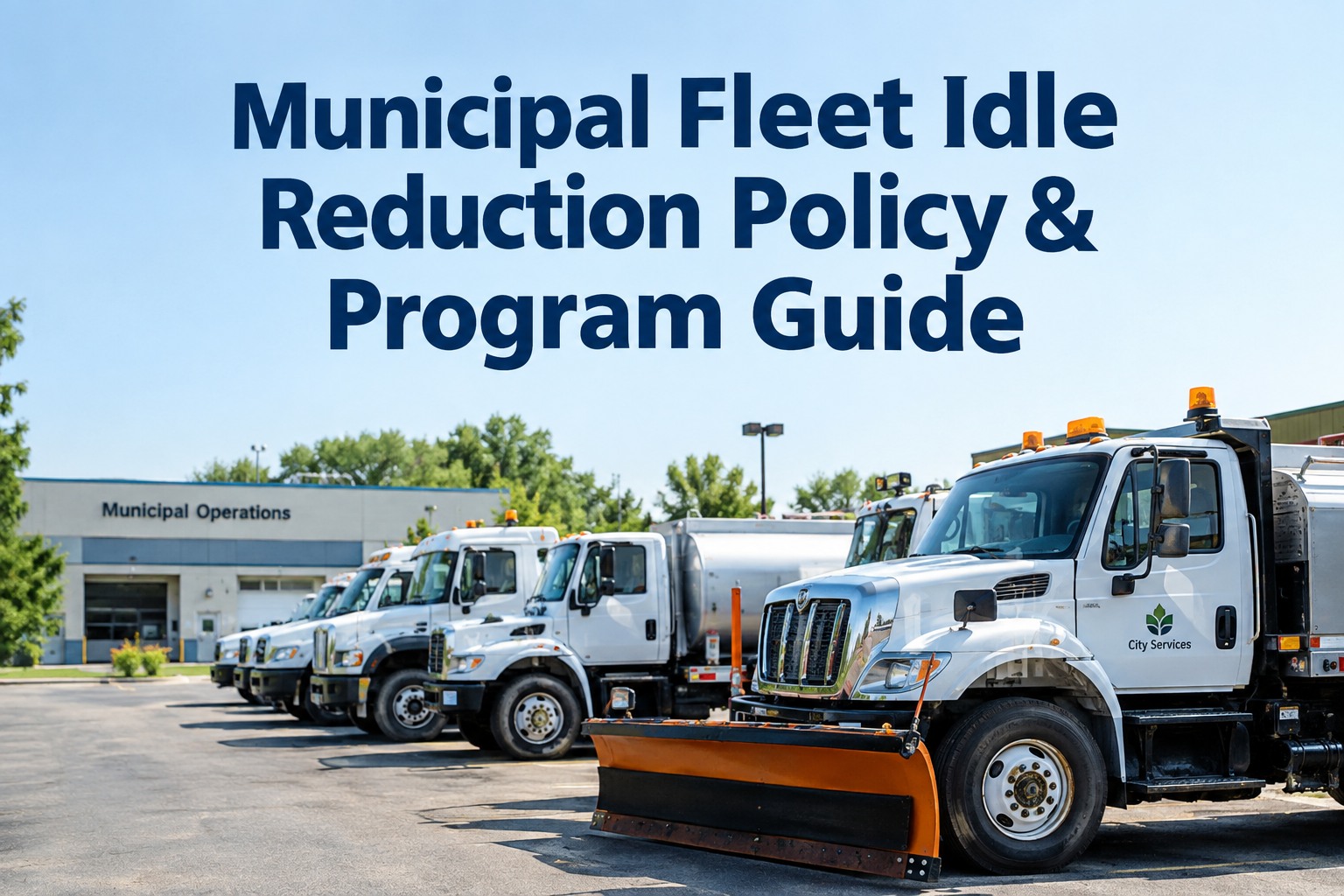
One Canadian municipal sustainability review estimated that 30 to 50% of a municipal service fleet's running time is spent idling during normal operations — not stuck in traffic, just left running. Municipal idle reduction fails when it stays a memo nobody enforces. Here's the exemption structure real municipal policies actually use, and the documentation that turns a policy into something an auditor or council member can verify actually happened.
Does This Idling Qualify as an Exemption?
Pick a scenario. See whether it typically qualifies under a municipal idle policy, and what documentation should back it up.
PTO-driven equipment is a standard exemption across nearly every municipal policy — the engine is doing required work, not just running. Log which attachment was engaged.
Nearly every municipal anti-idling policy explicitly prohibits idling an unattended, parked vehicle for climate comfort alone — this is one of the most commonly cited violation types.
Defrosting is a standard cold-weather exemption, but most policies cap it — idling must stop once the windshield is clear, not continue for the rest of the stop.
Air-brake pressure build-up is a mechanical necessity named explicitly in most municipal policies, distinct from comfort idling.
Why Municipal Fleets Idle More Than They Think
Municipal idle reduction usually starts from a wrong assumption — that idling is mostly traffic and weather. In practice, habit accounts for far more of it: a plow operator who leaves the truck running through an entire break because that's how the shift has always worked, a patrol unit idling for hours to keep radios and lights powered, a crew truck left running at a job site because restarting takes an extra ninety seconds nobody wants to spend. None of that shows up as a single dramatic event — it shows up as a fleet-wide percentage that keeps surprising the people who finally measure it. Multiply even a conservative idle rate across a fleet of a few hundred vehicles running eight-hour shifts, and the fuel and engine-hour cost adds up to a real budget line, not a rounding error buried inside a general fuel account. Book a demo to see engine-hour and idle-time data broken out per vehicle and department, instead of one blended fuel total nobody can trace back to a specific habit.
Municipal Idle Reduction: The Exemption Categories Every Policy Needs
Reviewing actual municipal anti-idling policies shows a consistent, narrow set of exemptions — not a vague "as needed" clause that becomes a loophole for everything.
PTO-Driven Equipment
Plows, lifts, pumps and other power take-off attachments genuinely need the engine running to function — a legitimate exemption, not a workaround.
Emergency & Safety Vehicles
Emergency response and vehicles running electrical equipment for traffic control or safety lighting are near-universally exempted.
Air Brake Pressure Build-Up
A mechanical requirement before a heavy vehicle can safely move — not a comfort or convenience idle.
Cold-Weather Defrost & Turbo Cooldown
Most policies allow a defined window — commonly 3 to 5 minutes — for windshield defrosting or turbocharger cooldown, not indefinite warm-up.
Pre-Ops Checklist Items
Where a pre-trip inspection genuinely requires the engine running to check a specific system, that portion is typically exempted.
K-9 & Specialty Climate Needs
Vehicles cooling an interior for a K-9 unit are commonly carved out explicitly, given the animal welfare stakes involved.
What's notably absent from every real policy reviewed: general comfort idling while parked and unattended. That's the default prohibition every exemption list exists against, and it's also the single most common violation type once a fleet actually starts measuring. Book a demo to see exemption categories built directly into a digital idle policy, flagged automatically instead of argued about after the fact.
A Policy Without Measurement Is Just a Memo
Nearly every municipal anti-idling policy reviewed includes a line about monitoring compliance through "regular inspections" or supervisor observation — and nearly none of them specify how that's actually supposed to happen at scale across dozens or hundreds of vehicles. A written policy circulated at onboarding and never revisited produces exactly one outcome: idling behavior reverts to whatever it was before the policy existed, because nothing is actually watching. Measurement doesn't have to mean surveillance culture — it means engine-hour and idle-time data attached to the vehicle, reviewed on a cadence, with exceptions expected to be explainable rather than ignored.
What "Audit-Ready" Actually Means for Municipal Idle Reduction
A council member, a public records request, or an internal auditor asking about a municipal idle reduction program isn't asking whether a policy exists — every fleet has a PDF somewhere. They're asking for proof it's being followed: signed acknowledgment from every employee who operates a covered vehicle, a retrievable log of idle events against defined exemptions, and evidence that flagged violations were actually followed up on, not just noted. Three records make that case: a signed policy acknowledgment on file for every operator, updated annually; a vehicle-level idle log with exemption status attached to each event; and a documented resolution trail for any flagged violation showing what corrective action happened and when.
What a Compliance Officer Actually Has to Defend Internally
Council asked a straightforward question during a budget review — how do we know the idle policy is actually working — and I genuinely didn't have a good answer beyond "drivers signed the form." Now every operator has a signed acknowledgment on file, and every flagged idle event either matches an exemption or gets a documented follow-up. The next time that question comes up, I can pull the actual record instead of describing our intentions.
The Takeaway
Municipal idle reduction succeeds when the policy is paired with three things most fleets skip: a narrow, documented exemption list instead of a vague catch-all, engine-hour and idle-time measurement that actually runs continuously, and a retrievable audit trail showing acknowledgment, exceptions and follow-up all actually happened. A policy alone changes very little — the fleets that see real reduction are the ones that can prove, on request, that the policy is more than a document. Sign up free and put your idle policy on a record instead of a memo.
Frequently Asked Questions
How much does idling actually cost a municipal fleet?
One municipal sustainability review estimated that 30 to 50% of a municipal service fleet's running time is spent idling during normal operations, not just traffic delays. That translates directly into fuel cost, engine wear and emissions that a policy is intended to reduce, and it's typically much higher than fleet managers assume until they start measuring engine-hour data directly.
What exemptions should a municipal idle reduction policy include?
Reviewing real municipal policies shows a consistent core set: PTO-driven equipment (plows, lifts, pumps), emergency and safety vehicles running electrical or lighting equipment, air brake pressure build-up, a time-limited window for cold-weather defrosting or turbo cooldown, pre-trip inspection items that genuinely require the engine running, and specialty needs such as K-9 unit climate control. General comfort idling while parked and unattended is explicitly excluded from every policy reviewed.
How should a municipality monitor compliance with an idle policy?
Most municipal policies commit to "regular inspections" or supervisor observation without specifying a scalable method, which is why many idle policies see little real-world effect. Effective monitoring pairs engine-hour and idle-time data at the vehicle level with a defined review cadence, so exceptions are expected to be explainable against a documented exemption rather than simply going unnoticed across dozens or hundreds of vehicles.
What documentation does an idle reduction program need to be audit-ready?
Three records typically matter most: a signed policy acknowledgment on file for every covered employee, renewed at least annually; a vehicle-level idle event log showing which events matched a defined exemption; and a documented resolution trail for flagged violations showing what corrective action was taken and when. Together these let a fleet answer a council question or public records request with retrievable evidence instead of a general description of intent.
Why do municipal idle reduction policies often fail to change behavior?
The most common failure pattern is treating the written policy as the finish line rather than the starting point — a document is circulated once, signed, and never measured or revisited. Without ongoing idle-time data and a real review cadence, behavior typically reverts to pre-policy habits within a short period, because nothing is actually tracking whether the policy is being followed.
Turn Your Idle Policy Into an Audit-Ready Record
HVI tracks vehicle-level idle events against defined exemptions, keeps signed policy acknowledgments on file, and retrieves the full compliance history in minutes — ready for a council question or a public records request, not reconstructed after one arrives.
No credit card · No hardware required · Live before your next council review