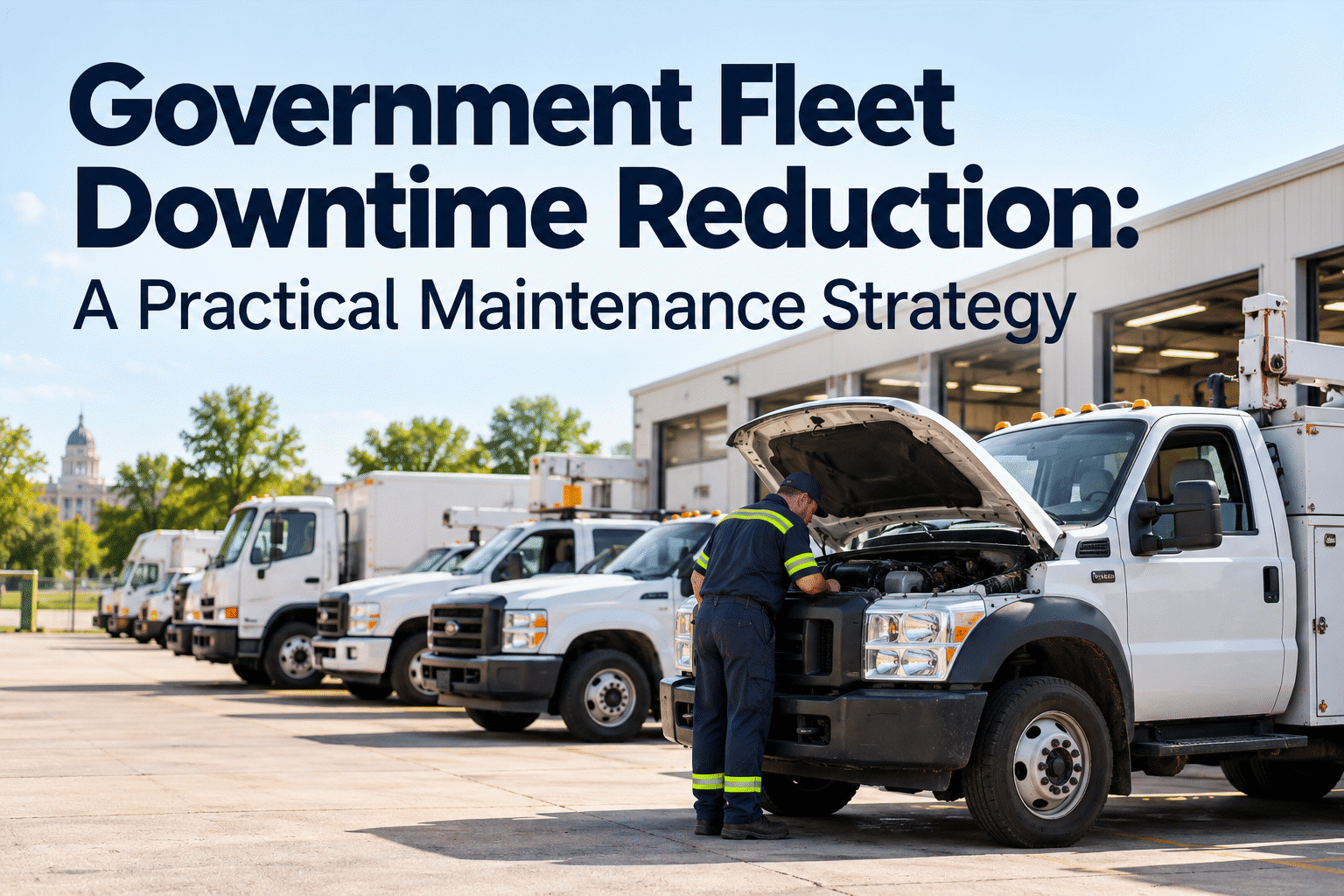
Government fleet downtime reduction starts with one question: which vehicles must be ready to keep public services running? A sidelined refuse truck, snowplow, utility repair vehicle or street sweeper affects more than the maintenance schedule. This practical guide shows municipal fleet teams how to find avoidable delays, prioritize critical assets, plan preventive maintenance and move defects through repairs faster—using clearer inspections, parts records and work-order history.
Keep the vehicles behind essential services ready.
Reduce unplanned downtime by connecting the field inspection, maintenance bay, parts shelf, and department dispatch decision—not by simply asking technicians to work faster.
Downtime is a public-service problem, not just a workshop metric.
A unit can be technically repairable but unavailable for days because the defect was reported late, a work order was unclear, a component was out of stock or a return-to-service decision was delayed. These gaps matter most when a department has limited backup vehicles.
Missed service windows
Collection routes, inspections and field repairs may need rescheduling.
Substitute equipment pressure
Backup units absorb extra duty, often increasing wear and maintenance demand.
Unplanned cost
Overtime, expedited parts, rentals and repeat repairs can add up.
Public works fleet performance guidance from the American Public Works Association includes preventive maintenance, fleet availability and downtime, technician time, and parts demand fill rate among useful measures. Track them together rather than treating uptime as one isolated number.
Follow the hours: where does a disabled vehicle actually wait?
A repair ticket tells you what was fixed. A downtime timeline reveals why the vehicle remained unavailable. Record timestamps consistently so the team can distinguish hands-on repair time from waiting time.
Operator finds a leak or warning light during an inspection.
Inspection checklistMaintenance confirms severity, safety and service priority.
Work order detailsVehicle sits while a required component or slot is unavailable.
Parts & inventory recordsTechnician completes the job and records the resolution.
Maintenance historyAuthorized staff confirm the vehicle is ready for assignment.
Availability reportingExample: 30 hours unavailable
In this illustrative case, only 6 hours are active repair. The bigger opportunity is reducing the 18 hours waiting for parts and the 6 hours in reporting, triage and release.
Put preventive maintenance around service demand.
Public fleets often mix daily-use units, seasonal equipment and low-mileage vehicles that still accumulate engine hours. Build PM intervals from manufacturer guidance, operating conditions, mileage, hours and applicable requirements—then coordinate service windows with department schedules.
PM
Four practical scheduling rules
Schedule refuse units outside route peaks and snow equipment before winter demand, where feasible.
Idle-heavy and stationary-duty vehicles may need more than mileage-based planning.
Review open defects and required parts before the vehicle enters the bay.
Assign an owner to missed PM and document the rescheduled date and operating decision.
HVI's preventive maintenance scheduling and equipment history can help organize these service requirements. Book a demo to review a public fleet PM workflow.
Move a defect from the field to a safe return-to-service decision.
Every handoff should answer three questions: what is wrong, who owns the next step, and what is needed to release the vehicle?
Capture
Driver or operator records the defect and supporting detail.
Digital inspectionPrioritize
Supervisor assesses safety, service impact and urgency.
Maintenance triagePrepare
Identify parts, technician, work scope and repair window.
Parts + work orderVerify
Document the repair and complete required safety checks.
Service historyNot every unavailable vehicle creates the same service risk.
Set a documented priority with department leaders. Consider the consequence of a missed assignment, backup capacity, seasonality and the nature of the defect—not just which department calls most often.
Priority 1
Emergency utility response unit with no substitute
Escalate repair planning immediatelyPriority 2
Refuse collection truck with a spare unit available
Coordinate repair and route coveragePriority 3
Specialty inspection unit with flexible scheduling
Plan downtime around next assignmentPriority 4
Pool vehicle with alternatives in service
Bundle work into planned maintenanceThis matrix prioritizes scheduling attention; it does not override safety requirements or statutory obligations. Link each priority to a work order and an agreed service date.
Make the next repair possible before the vehicle enters the bay.
Parts shortages can turn a straightforward job into multi-day downtime. Use work-order history to identify recurring demand and separate fast-moving consumables from critical, long-lead components.
Parts-readiness checks
- Confirm the exact part and asset compatibility before ordering.
- Review on-hand quantity and open demand against planned PM.
- Track backorders separately from active repair time.
- Keep critical spare decisions based on risk, not usage alone.
- Record issued parts against the relevant maintenance work order.
HVI Parts & Inventory records can support visibility into stocked items and parts used in maintenance. Start free to organize fleet parts records.
See how HVI can support a more reliable public fleet.
Bring your actual inspection, PM, parts and repair workflow to a product walkthrough. Focus on the gaps that keep service-critical vehicles unavailable.
Use a small scorecard that explains availability—not just reports it.
Start with a consistent definition of “available,” “planned downtime” and “unplanned downtime.” Report by department and asset class so a low-use pool car does not hide a shortage of frontline service trucks.
Fleet availability
Share of required service time that vehicles are ready for use.
Repair turnaround
Time from removal from service to authorized return.
PM completion
Scheduled services completed within the defined due window.
Parts-related delay
Unavailable hours attributable to missing or late parts.
How to read availability correctly
If a group of vehicles is required for 1,000 service hours and is available for 930, its availability is 93%. This is a teaching example, not an industry benchmark. Also review which critical vehicles were unavailable and why.
A practical 30-day government fleet downtime reduction plan
Start with one high-impact vehicle group—such as refuse trucks or utility service vehicles—before expanding across the municipality.
Establish the baseline
Define availability, review 30–90 days of repair records and list the five longest downtime cases.
Fix the handoffs
Standardize inspection defects, triage ownership, work-order status and return-to-service signoff.
Prepare recurring work
Review upcoming PM, long-lead parts, recurring failures and seasonal vehicle needs.
Review and expand
Compare delay reasons, turnaround and service readiness. Keep effective changes and assign next actions.
Connect the maintenance evidence behind each availability decision.
HVI can help organize the information public fleet teams need to act consistently. Operational priorities, staffing decisions, backup vehicle assignments and final safety approvals remain the municipality's responsibility.
Digital inspections
Document vehicle condition and report defects from field checks.
Preventive maintenance
Keep planned service activity visible across vehicles and equipment.
Maintenance work orders
Organize repair tasks, work details and completion records.
Parts & inventory
Maintain parts records to support repair preparation and usage review.
Maintenance reporting
Review recorded activity, repeat issues and operational improvement opportunities.
A good next step is to book an HVI demo focused on reducing municipal repair delays and compare the workflow with your existing process.
Government fleet downtime reduction FAQs
What is the most effective way to reduce government fleet downtime?
How should municipalities calculate fleet availability?
Can preventive maintenance eliminate all vehicle breakdowns?
Which spare parts should a public fleet keep on hand?
How does HVI support municipal fleet downtime reduction?
Build a clearer path from defect report to ready vehicle.
See how HVI's inspection, maintenance and inventory tools can support your public fleet's uptime priorities.