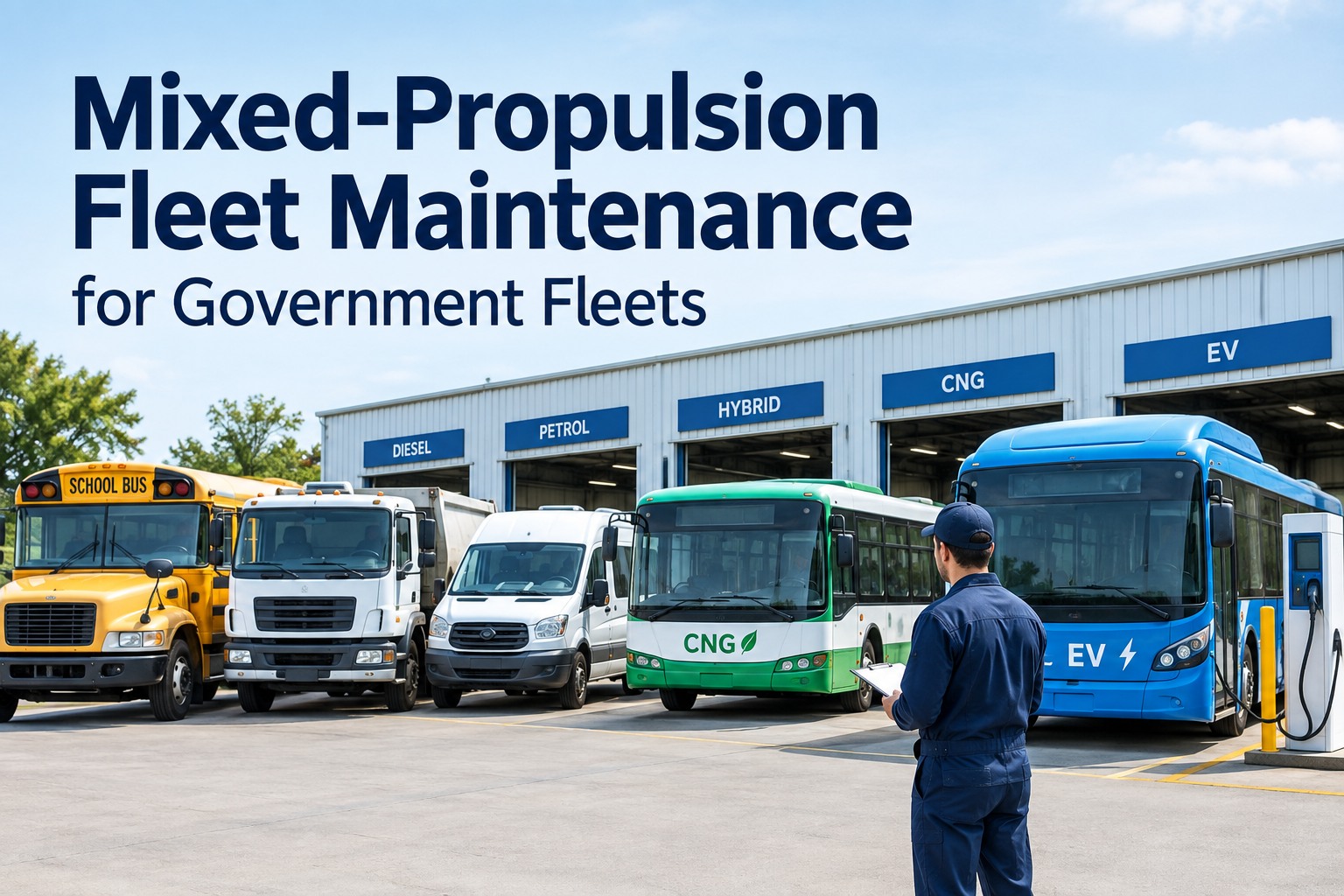
Electrification gets drawn as a switch — diesel out, electric in. For a government fleet shop, it's nothing like that. For years, the same garage and the same technicians have to maintain diesel, petrol, hybrid, CNG, and battery-electric vehicles at the same time — five completely different powertrains, five different tool sets, five different safety regimes, all on one floor. That transition phase, not the end state, is the real problem in mixed fuel fleet maintenance, and it's the part almost nobody plans for honestly. See every propulsion type maintained on one platform
Your Garage Didn't Get Simpler. It Got Five Times More Complicated.
Tap a powertrain. Each one needs its own PM trigger, tools, safety procedure, and parts — run them on one generic schedule and something critical goes unchecked.
This isn't a choice a city made — it's a mandate with a clock. With 33 states carrying ZEV policies and federal agencies facing a 2027 acquisition deadline, the mixed fleet is arriving whether the shop is ready or not. Here's what actually changes on the floor — PM schedules, technician safety, parts, and the building itself — and how one system keeps it from becoming five separate programs.
Why one PM schedule can't cover five powertrains
The instinct is to keep the maintenance schedule you already have and just add the new trucks to it. That's the fastest way to under-service the EVs and over-service the diesels — because each propulsion type is driven by a different clock and a different set of components entirely.
An EV has roughly 20 moving drivetrain parts against 2,000-plus in a diesel — so its maintenance is 30 to 50% lower, but it is not zero and it is not the same. That's exactly why PM has to fire on the right trigger for each type. Book a demo to see PM run on any trigger, per propulsion type.
The new safety reality: high voltage and gas on the same floor
This is the part that changes the shop, not just the schedule. A diesel tech and an EV tech are doing fundamentally different — and differently dangerous — work. Put the wrong person on a high-voltage job and it isn't a quality problem; it's a fatality risk. The transition adds safety controls a combustion-only shop never needed.
EV and hybrid systems carry lethal voltage. Work means proper HV isolation and lockout before a tech touches the pack — a documented procedure, every time.
Insulated gloves, tools rated for the voltage, and the PPE to match. A diesel shop's tool cart doesn't cover HV work — and using the wrong tool is how people get hurt.
The single most important control: only technicians certified for high-voltage work get assigned to it. That means tracking who's qualified for what — and enforcing it on the work order.
This is where a maintenance platform becomes a safety control, not just a scheduler. HVI's qualification tracking records which techs are certified for HV work and routes high-voltage jobs only to them — so certification isn't a binder on a shelf, it's enforced on the assignment. Start free and route HV work only to qualified techs.
Parts and the building both multiply
Two quieter costs surprise fleets mid-transition: the parts room and the shop itself. Both were built for combustion, and both have to stretch to cover five powertrains without simply doubling.
You still stock filters, belts, and DPF parts for the combustion fleet — and now add EV-specific components, CNG cylinder hardware, and hybrid parts. Inventory has to be tracked per propulsion so the right parts are on the shelf for each PM, without over-stocking a fleet you're phasing out.
CNG work requires proper ventilation and gas detection; HV work needs designated isolation areas and charging zones. A shop laid out for diesel doesn't automatically meet those — the building is part of the transition plan, not a given.
Neither of these is optional, and both are easy to under-budget because they don't arrive with the vehicles. Tracking parts and cost by propulsion type is what keeps the mixed fleet from quietly draining the maintenance budget. Book a demo to see parts and maintenance cost tracked per propulsion.
Train in sequence, plan for the long overlap
The last piece is people. You can't retrain the whole shop on high-voltage work overnight, and you don't need to — the transition is a multi-year overlap, so the training can be sequenced against how fast the EV share actually grows.
The fleets that handle this well don't treat it as a big-bang cutover — they run diesel and electric side by side for years and let the shop's capability grow with the fleet. The system underneath just has to keep every propulsion type, every schedule, and every qualification straight the whole way through. Book a demo to track technician qualifications across the transition.
The mixed-fleet shop readiness checklist
Before the propulsion mix outgrows your shop, this is what should be in place — the schedule, safety, parts, and people provisions that keep five powertrains from becoming five separate headaches. Use this mixed-fleet checklist online free, with a template and schedule per propulsion type from the start.
From a municipal fleet director running the overlap
People picture electrification as trading one fleet for another. What we actually have is five — we still run diesel and petrol, we brought in CNG a few years back, and now hybrids and battery-electrics are landing. My one shop maintains all of it, and for a while we were running the EVs on the same PM schedule as the diesels because that's what the system knew how to do.
The fix wasn't more staff — it was giving each propulsion type its own checklist and schedule, and making sure only the HV-certified guys touch the electric packs. Once the right checklist loaded for whatever was in the bay, and the work orders routed by who's qualified, the shop stopped feeling like five jobs and started feeling like one.
Frequently asked questions
Why is mixed-propulsion fleet maintenance harder than a single-fuel fleet?
Because one shop and one team now maintain diesel, petrol, hybrid, CNG, and electric vehicles at once — each with different PM triggers, tools, safety procedures, and parts. It's not just more vehicles; it's fundamentally different work happening side by side, including lethal high-voltage systems next to combustion and gas fuels. The transition phase, where all these run simultaneously for years, is the real operational challenge, not the electric end state.
Do electric and diesel vehicles need different PM schedules?
Yes. A diesel runs on mileage or engine-hour intervals with oil, filter, DPF, and fuel-system service. An electric vehicle has no oil, DPF, or transmission service — but battery state-of-health, high-voltage integrity, thermal management, and charging get their own intervals. Its maintenance is 30 to 50% lower but entirely different, so forcing an EV onto a diesel schedule either wastes effort or skips the checks that actually matter. Each propulsion needs its own template and trigger.
What safety changes does electrification bring to the shop?
High-voltage systems in EVs and hybrids carry lethal voltage, so work requires documented HV isolation and lockout, insulated PPE and voltage-rated tools, and — most importantly — only technicians certified for high-voltage work assigned to it. CNG adds ventilation and gas-detection requirements. A combustion-only shop never needed any of these, so the transition brings new safety controls, and enforcing which tech can do which job becomes a genuine safety measure, not just scheduling.
How do you manage parts inventory for a mixed-propulsion fleet?
By tracking parts per propulsion type. You still stock combustion consumables — filters, belts, DPF and fuel parts — while adding EV-specific components, CNG cylinder hardware, and hybrid parts. The goal is having the right parts on the shelf for each propulsion's PM without over-stocking a fleet you're phasing out. Tracking inventory and cost by propulsion type keeps the parts room from either running short on the new trucks or hoarding parts for the old ones.
Can one maintenance system handle all propulsion types?
It should — that's the point of managing a mixed fleet properly. The right system carries a configurable inspection and PM template per propulsion type, fires each schedule on its own trigger (miles, hours, calendar, or cycle), tracks technician qualifications and routes high-voltage work only to certified techs, and reports maintenance cost by propulsion. That turns five parallel maintenance programs into one operation, instead of diesel in the CMMS and everything else in spreadsheets.
Make the mixed fleet feel like one shop, not five
HVI carries a configurable template per propulsion type, runs PM on any trigger — miles, hours, calendar, or cycle — tracks technician qualifications and routes high-voltage work only to certified techs, and reports maintenance cost by propulsion. So the diesel, petrol, hybrid, CNG, and EV all live in one operation, and the years-long transition stays under control.
No credit card · Template per propulsion · Qualification-routed work orders